
Lately, it is hard to go a single day without hearing the term “Norwegian Method” among distance runners and endurance athletes.
Most discussions focus on its visible features—double-threshold days and lactate testing.
But here is the question that really matters: Does measuring lactate and doing two threshold sessions a day actually make your training Norwegian? Is there any genuine adaptation to be found simply by copying the training protocols of professional and elite athletes?
Those questions lie at the heart of Dr. Marius Bakken’s book, The Norwegian Method Applied—written by a former Olympian and practicing medical doctor (MD) who played a central role in the early development of this system.
In this series, starting today, we will not settle for surface-level summaries. Instead, we will meticulously examine the original text page by page, deeply exploring the reasoning, principles, and framework behind what Bakken questioned, why he arrived at those conclusions, and what he spent 30 years searching for.
For this inaugural installment, we examine the book’s cover, the foreword by Steve Magness, the table of contents, and Bakken’s Introduction. Just reading this sets the foundational theme posed by Bakken into striking relief.
- 1. Why Steve Magness Called It “A Game Changer”
- 2. Understanding the Structure: Inside the Table of Contents
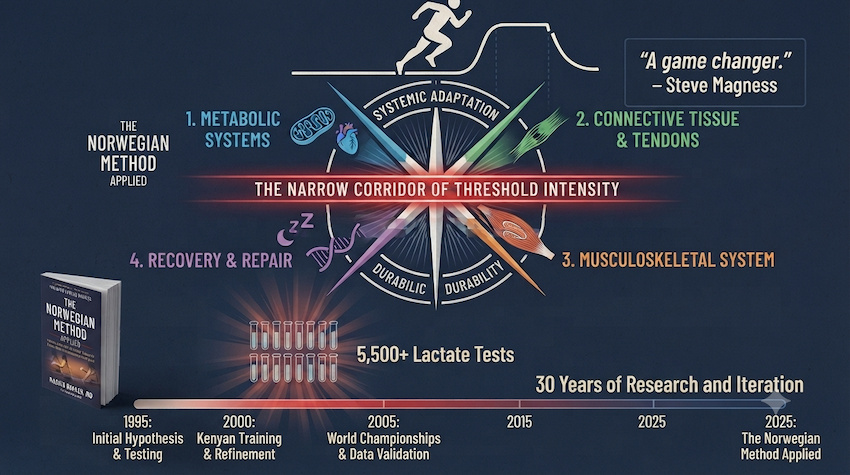
- 3. The “Narrow Corridor”: A Question Born in the Helsinki Warm-Up Room (2005)
- 4. The Ultimate Question Forged from Thousands of Lactate Tests
- 5. The Real Bottleneck: Why Load-Bearing Tissues, Not Lungs, Dictate Limits
- 6. Conclusion: Moving into the Core of Part 1
1. Why Steve Magness Called It “A Game Changer”
When you open the book, the very first words that leap out are from world-renowned exercise physiologist and coach Steve Magness:
“A game changer.” — Steve Magness
What makes this book a game changer is not that it introduced a secret workout, but that it changes how we think about and control training intensity.
The subtitle further elaborates:
Threshold Training and Intensity Control for Faster, More Durable Running at Every Level
What is emphasized here is not merely running faster. The true value of the book lies in the inclusion of the word Durable—becoming tougher and more resilient against breakdown.
Reading Magness’s Foreword, he recalls the shock of discovering Bakken’s website as a young man during the internet boom of the late 1990s. The running world at that time was an era where everyone simply copied the training systems of coaches such as Arthur Lydiard and Peter Coe.
The crucial message to take away from Magness’s words is that you must never replicate a training system purely by its outward form.
When Lydiard’s theories spread in the past, countless runners blindly followed the volume—believing that running 100 miles a week was the sole key to success—only to break down under the sheer weight of mileage. This is exactly the mistake that concerns Bakken—and the one Magness warns against: mindlessly adopting a protocol that says “just do two threshold workouts a day” leads only to severe overtraining and injury.
Rather than copying the shape of a workout, you must understand the context and structure through which Bakken built his approach. That is the essential mindset required when opening this book.
2. Understanding the Structure: Inside the Table of Contents
A glance at the Table of Contents reveals Bakken’s rigorous and systematic thinking. The book is structured into four main parts:
- PART 1: The Method
- Ch. 1: Threshold as the Hub and the Golden Zone
- Ch. 2: Finding Your Individual Threshold
- Ch. 3: Load and 6 Fundamental Principles
- Ch. 4: Durability and Muscle Tone
- PART 2: The Application
- Ch. 5–7: Practical Programs for Every Level
- Ch. 8: The Truth About Double Thresholds
- PART 3: Running for Life
- Ch. 9–11: Medical (MD) Perspectives on Injury Prevention, Recovery, and Signs of Overtraining
- PART 4: Going Deeper
- Ch. 12–17: History of Development Since 1995, Interpreting Lactate Profiles, Muscle Tone, Altitude & Heat Acclimatization, etc.
Looking at this structure, it is immediately clear how deeply Bakken guards against practice without theory.
The elements readers are most eager to explore—such as “Double Thresholds” (Ch. 8) and the practical training programs (Ch. 5–7)—do not appear until after the foundational principles established in Part 1. In addition, Part 3, “Running for Life,” addresses injury prevention, recovery, and overtraining from the perspective of an athlete who also has a medical background.
This structure itself reflects Bakken’s underlying message: training only has value when it can be sustained over time without being interrupted by injury or excessive fatigue.
Bakken’s core principle—that training that is repeatedly interrupted by injury or overtraining loses much of its value—is directly reflected in this structural blueprint.
3. The “Narrow Corridor”: A Question Born in the Helsinki Warm-Up Room (2005)
Entering the text of the Introduction, the narrative begins in the bleak, sterile warm-up room just moments before the 5000m final at the 2005 Helsinki World Championships.
Under fluorescent lights, amid a lingering scent of linoleum and dry sweat, Bakken looked around the room. He was the only European athlete present; the rest were elite African athletes from Kenya, Ethiopia, and Algeria.
Turning to his coach, Leif Olav Alnes, Bakken half-jokingly muttered, “I picked the wrong sport.” It was a moment where the stark reality of natural talent and environmental disparity hit home.
However, what separates Bakken is that he refused to attribute the secrets of world-class capability simply to innate talent or overwhelming training volume.
His focus was not on the superficial fact that they ran more or suffered harder. What he sought to observe was how these top-tier athletes managed to continuously deliver high loads to their bodies in a sustainable, non-breaking manner.
Bakken describes the zone where adaptation occurs most rapidly while avoiding injury or breakdown as “a narrow corridor.”
And with that, Bakken poses the universal question that every runner encounters sooner or later:
“How hard can you train without breaking down?”
Though Bakken recorded an impressive 5000m personal best of 13:06.39, he never viewed himself as a once-in-a-generation talent. That is precisely why he chose to pursue performance through measurement and control, rather than relying on sheer grit or arbitrary additions of volume.
4. The Ultimate Question Forged from Thousands of Lactate Tests
The quest Bakken began in 1995 was built upon an extensive dataset of over 5,500 individual lactate tests performed on his own body, his training partners, and local runners during extended stays in Kenya—supported by 30 years of hypothesis and verification.
Moving far beyond abstract speculation, the ultimate question Bakken derived from this relentless testing is inscribed on page 2 of the book:
“What is the highest intensity you can repeat, at the highest sustainable volume, week after week, for the lowest possible cost?”
This very concept forms the origin of Bakken’s inquiry, which would go on to profoundly shape modern endurance training philosophy.
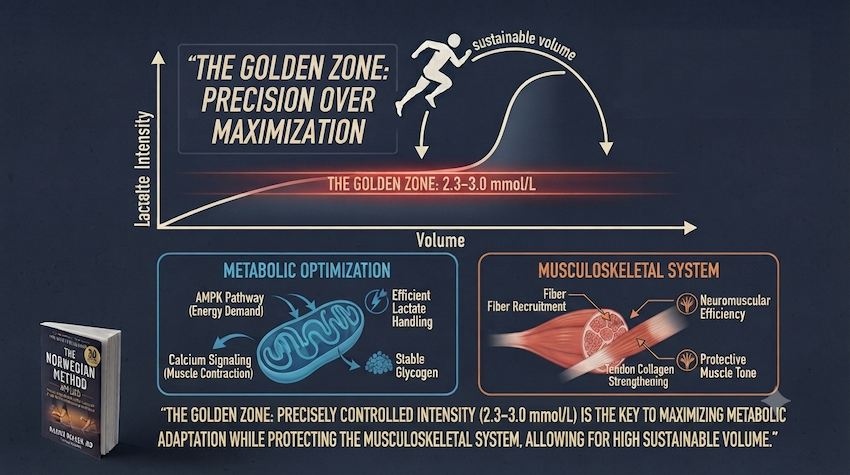
At this initial stage, Bakken is not yet defining strict lactate values or exact threshold numbers. The core message he seeks to convey is a training philosophy: find that precise intensity zone—one that is not high enough to break the body, yet high enough to provoke adaptation—and utilize it repeatedly.
Bakken repeatedly emphasizes the vital importance of discipline and control in training. Exercising the rigorous control required to hold oneself steadily within a designated intensity zone demands far more discipline than simply pushing past your limits.
The message Bakken continually imparts to readers is that the goal is not to “win the workout” by crushing yourself in a single session, but to accumulate high-quality stimulus continuously over months and years.
What Bakken warns against is not under-training, but the loss of intensity control that maximizes adaptation. By pushing too hard on easy days and over-exerting on heavy days, runners slip into an unproductive gray zone, accumulating fatigue that stalls performance. As the solution to this vicious cycle, Bakken presents precise intensity control.
5. The Real Bottleneck: Why Load-Bearing Tissues, Not Lungs, Dictate Limits
Before discussing threshold training itself, Bakken raises a more fundamental issue: what actually limits long-term development? In the final section of the Introduction (pp. 8–13), he addresses the physiological walls faced by athletes: “Different bodily systems adapt at different rates.”
According to Bakken, the bottleneck for growth among most runners is not the cardiorespiratory system (such as VO2 max) itself, but rather the adaptive limits of muscles, tendons, and other load-bearing tissues that absorb the impact of every single stride.
Metabolic systems like cardiorespiratory function and blood volume adapt relatively quickly to appropriate stimuli. In contrast, the structural reinforcement and remodeling of connective tissues and skeletal structures designed to absorb shock require vastly more time.
When training loads are scaled up rapidly to match improvements in cardiorespiratory fitness, structural tissues fail to keep pace, leading directly to injury. Bakken points out that this gap in adaptation speeds between systems is the root cause of breakdown.
This leads directly to the core principle Bakken forged from 30 years of inquiry:
“You don’t improve by training as hard as possible. You improve by training hard enough, often enough, for long enough.”
- Hard enough: Providing sufficient stimulus to drive adaptation.
- Often enough: Repeating sessions at a high frequency due to low structural damage.
- Long enough: Maintaining continuity uninterrupted for months and years free from injury or excessive fatigue.
Bakken concludes the introduction by urging readers not to treat the book as a one-time read to be shelved, but as a resource to be returned to as a reference according to their growth stage and current circumstances—whether facing plateaus, injuries, or long-term planning.
6. Conclusion: Moving into the Core of Part 1
In this installment, we have thoroughly unpacked the entire Introduction of The Norwegian Method Applied:
- The true essence of this training system is not copying workouts, but operating a precise intensity control system.
- By guarding the narrow corridor, you maximize adaptation at the lowest possible cost.
- Winning a workout matters far less than sustainable, high-frequency continuity—the true source of strength.
- Protecting load-bearing structures by respecting differences in system adaptation rates is an absolute prerequisite for long-term growth.
Infused with 30 years of dedication, thousands of measurements, and medical insight, Bakken’s philosophy transcends ordinary training hacks; it is a testament to profound observation of and respect for the human body.
With that foundation in place, we’re ready to move into the heart of Bakken’s framework.
In Part 2, we’ll begin unpacking his central concept: Threshold as the Hub and the Golden Zone, and examine why he considers threshold—not simply as a pace or lactate value—but as the organizing principle behind the entire system.
Note:
This article provides an independent interpretation and discussion of the training concepts presented in Marius Bakken’s The Norwegian Method Applied. It is intended to help readers better understand the ideas behind the Norwegian Method and is not a reproduction of the original text.
コメント