
In the previous installment, we laid the foundation of Marius Bakken’s framework, exploring the concepts of the threshold as a central hub and the operational boundaries of the Golden Zone. Yet, this introduces a fundamental question: Why did Bakken never advocate for running “faster”? Why did world-class athletes meticulously pursue the zone just shy of their absolute limits—repeating it thousands of times across rigorous testing—rather than constantly chasing the suffering of the redline?
The answer extends far beyond the superficial realm of fatigue management. It is rooted deeply in the physiological realities of muscles, lactate, mitochondria, and the precise boundary where the human body navigates the delicate equilibrium between adaptation and structural breakdown. Building upon the theoretical framework established in the first chapter, this installment explores the biochemical mechanisms that make this zone the engine of long-term adaptation, ultimately confronting the true limiting factor of endurance sport: the muscular system.
- 1. Double Threshold in Practice: The Operational Reality of the Golden Zone
- 2. Why Not 4.0 mmol/L?: Lactate Individualization and the Science of the Golden Zone
- 3. What Happens Inside the Body: Physiological and Biochemical Mechanisms Maximizing Adaptation
- 4. The Muscular System: The True Limiting Factor in Endurance Sport
- 5. From Theory to Practice: Summary of Chapter 1 and the Bridge to the Future
1. Double Threshold in Practice: The Operational Reality of the Golden Zone
The Practical Mechanics of Double Thresholds
For the seasoned runner, executing training within the Golden Zone represents a profound paradigm shift. In the broader running culture, the “Norwegian Method” is frequently equated simply with performing double threshold sessions. However, double threshold is not the foundation of Bakken’s system; it is a practical structure that allows athletes to repeatedly accumulate high-quality threshold work while remaining inside a controllable physiological zone.
The essence does not lie in the logistical hurdle of doing two workouts in a day, but in maximizing the total volume of stimulating workload while systematically avoiding excessive fatigue from a single session. By preventing profound fatigue in any single bout, the recovery timeline is compressed, ensuring the body is fully prepared to absorb another high-quality stimulus within a remarkably short turnaround.
Reviewing Bakken’s signature daily structure illuminates this calculated precision:
- Morning Session: 6 to 8 repetitions of 3 to 5-minute intervals.
- Afternoon Session: 30 repetitions of 1-minute intervals.
- Total Quality Volume: Divided into two manageable sessions, accumulating roughly 50 to 70 minutes of high-grade work.
Attempting to execute this total volume in a single, continuous session exacts an unsustainable physiological toll. Deep fatigue pushes the runner past the threshold boundary, extending the necessary recovery window from hours to days. By intelligently partitioning the load and maintaining a strict safety margin, the athlete bypasses destructive tissue trauma while amassing an overwhelming aggregate volume of adaptation.
The Absolute Principle: “The Center Holds”
The overarching architectural order of the training structure is deceptively simple, anchored by a singular mandate: The center holds, and everything else orbits around it.
Threshold training serves as the fixed, unyielding context. All auxiliary components—easy running, strength work, and fartlek—must be subservient to this core, ensuring the central stimulus is never compromised. The superficial thrill of daily heroics and exhausting maximal efforts vanishes from the training log, replaced by quiet, durable, and uncompromising long-term progression. This trade-off is the foundation for building long-term endurance capacity.
2. Why Not 4.0 mmol/L?: Lactate Individualization and the Science of the Golden Zone
The Limits of Textbook Standards and the Principle of Individualization
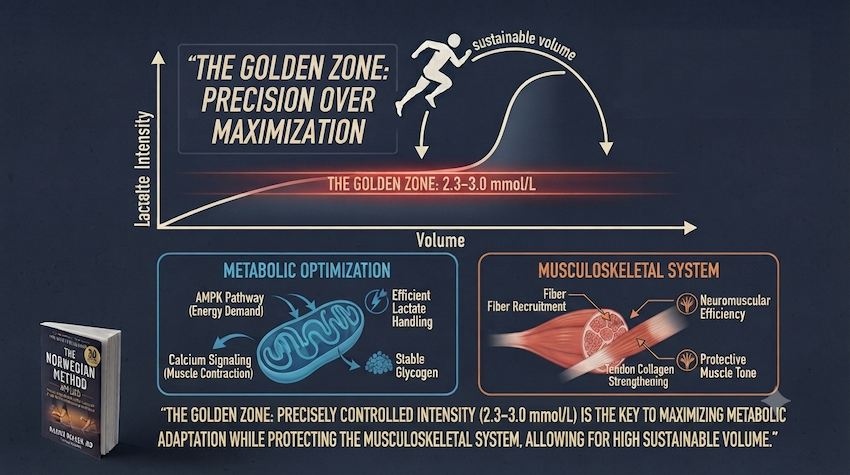
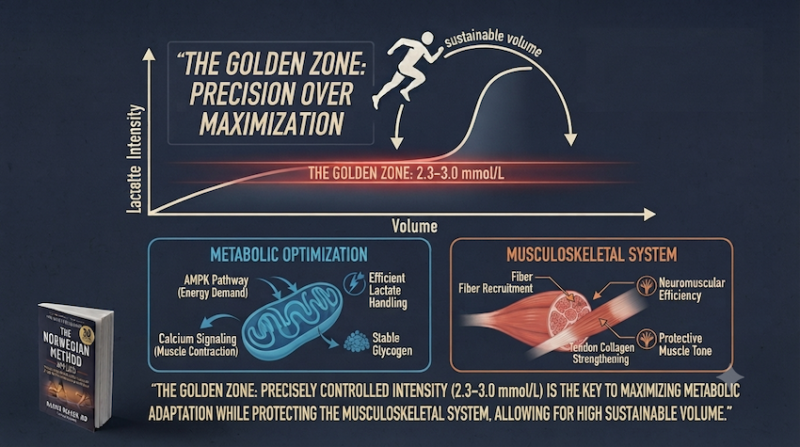
Why does the widely cited standard of 4.0 mmol/L fall short in high-performance execution? In well-trained runners, the Golden Zone typically resides significantly lower, often between 2.3 and 3.0 mmol/L. Because lactate dynamics vary drastically across individuals, the absolute number is irrelevant; the critical objective is identifying the precise personal zone that can be sustained repeatedly. This operating window sits safely below the generic “4.0 threshold” found in textbooks, serving as the foundational reason why high-frequency training remains viable.
While Mader’s research popularized the 4.0 mmol/L benchmark in the 1970s—providing a useful reference point for decades—it remains an oversimplification that ignores individual physiological architecture. Actual lactate thresholds fluctuate far more than most coaches acknowledge. One runner may threshold at 3.2 mmol/L, while another stabilizes at 4.5 mmol/L. Applying 4.0 universally is akin to prescribing a single, average shoe size to an entire population: superficially plausible, yet fundamentally flawed enough to induce systemic failure.
The core of Bakken’s 5,500 individual lactate tests was the relentless pursuit of this personalized zone. The goal was never to find the hardest pace an athlete could tolerate, but to find the highest intensity that could be repeated again and again without disrupting the entire training system. Specifically, this meant maintaining a conservative buffer of 0.3 to 0.6 mmol/L below the measured threshold point. Adopting a conservative intensity posture early in a training cycle helps many athletes establish a sustainable threshold intensity closer to the 3.0 mmol/L range. Many runners who test at 4.0 in a laboratory setting should intentionally execute sustained training below that output to observe how their true threshold shifts over time. The debate is not whether 4.0 is mathematically right or wrong; the failure lies in letting population averages obscure your own physiological optimum.
3. What Happens Inside the Body: Physiological and Biochemical Mechanisms Maximizing Adaptation
Bakken’s arrival at this conclusion was forged through an arduous personal battle against his own physiology. He possessed an engine; his VO2max was elite, and his raw speed was exceptional. Yet, a critical threshold arrived where his body could no longer absorb the training stress. The constraint was not cardiopulmonary. The haunting contradiction of wanting to run faster while the legs refused to comply gave birth to the core philosophy of this framework.
Why must training occupy this narrow corridor rather than easy running or maximal intervals? Easy running provides insufficient signal transduction, while training near VO2max incurs an unsustainable cost. Between these extremes lies a unique intersection where volume and intensity coexist. The body receives dual signals simultaneously: the enduring biochemical cascade of prolonged movement coupled with the acute energy demand of elevated output. The Golden Zone uniquely merges these stimuli through five simultaneous physiological mechanisms:
① Mitochondrial Biogenesis
Mitochondria are the cellular engines that dictate how efficiently oxygen is converted into energy. As their density and quality expand, an athlete can sustain faster paces before crossing into anaerobic reliance. The body constructs mitochondria through two distinct pathways:
- Pathway 1: Activated via calcium signaling during prolonged, continuous exertion.
- Pathway 2: Activated through the AMPK pathway, which detects rising cellular energy demand.
At threshold intensity, the AMPK pathway driven by energy demand and the calcium signaling pathway driven by muscle contraction operate concurrently, triggering a multifaceted remodeling of the mitochondrial network. Because both pathways are stimulated simultaneously over extended durations, Bakken leveraged a stress profile unattainable through either low or high-intensity training alone. An athlete does not choose between volume and intensity; instead, both elements synergize within a repeatable workload to compound total adaptive stimulus efficiently.
② Lactate Clearance and Utilization
Lactate is no longer viewed as a mere metabolic waste product; when the body is properly conditioned, it serves as a potent fuel source. As demonstrated by Sjödin’s research in the 1980s, threshold training shifts the lactate-velocity curve to the right:
- At an identical blood lactate concentration, the runner travels at a significantly faster velocity.
- At an identical running velocity, the body produces significantly less lactate.
This transformation is driven by enzymatic adaptations that elevate the system’s capacity to clear and oxidize lactate. The body maintains a delicate equilibrium—producing sufficient lactate to stimulate cellular signaling without overwhelming systemic buffering capacity. Consequently, paces that once demanded grueling effort gradually transition into moderate zones of comfort, carrying the athlete farther with the same subjective exertion. This shift unfolds across weeks and months, ultimately becoming a stable physiological adaptation.
③ Glycogen Metabolism
Threshold intensity consumes a precise balance of fats and carbohydrates, providing sufficient stimulus to expand glycogen storage capacity without inflicting the systemic depletion of exhaustive efforts. Athletes bypass the crushing recovery tax of full glycogen exhaustion while harvesting the pure adaptive signal. The unifying pattern across this methodology remains absolute: Deliver enough stress to signal structural remodeling, but never enough to make systemic recovery the dominant requirement.
④ Hormonal Stress Response
Higher intensities trigger sharp spikes in adrenaline, noradrenaline, and cortisol. While these hormones play vital roles during acute exercise, an accumulation of high-intensity sessions inflicts chronic systemic stress, degrading recovery capacity, immune function, and sleep architecture.
Properly managed threshold intensities secure robust adaptive stimulation while dramatically suppressing the fatigue cost associated with high-intensity alternatives. Well-trained athletes quickly notice enhanced sleep quality, stable daily biorhythms, and accelerated inter-session recovery—unmistakable indicators that the system is operating as designed. Because the hormonal cost is kept on a leash, recovery remains entirely predictable.
⑤ Muscle Recruitment
The neuromuscular system recruits motor units hierarchically: slow-twitch fibers activate first, followed progressively by fast-twitch fibers as force requirements escalate. Only fibers that receive sufficient stimulus undergo meaningful adaptation; fibers that are rarely recruited receive less of the specific stimulus required for adaptation.
Threshold intervals deliver a high absolute running speed at a relatively modest metabolic cost, permitting the recruitment of a broader spectrum of motor units. Fibers operating at these elevated velocities require brief, controlled exposures to true race-pace mechanics—interventions known as “X-sessions”—to complement threshold work without overwhelming the system. A common criticism is that athletes must spend more time training at race pace to recruit race-specific fibers. While race-specific mechanics are essential, high-frequency high-intensity training carries an exorbitant cost, tearing down tissue faster than it can be rebuilt. This methodology strikes a precise balance, respecting the Golden Zone more strictly than conventional models while securing the neuromuscular coordination required to elevate running economy without paying the brutal recovery penalties of chronic anaerobic overload.
4. The Muscular System: The True Limiting Factor in Endurance Sport
Why did Bakken exhibit such obsessive discipline over intensity control, fiercely guarding the boundaries of the Golden Zone? Many endurance athletes assume the heart dictates the ultimate ceiling, focusing obsessively on VO2max and cardiovascular metrics. In automotive terms, they spent endless energy tuning the engine while ignoring the tires and chassis connecting that power to the road.
This is not to dismiss the cardiovascular system. However, for an athlete who has already developed a formidable aerobic engine, the muscular system often becomes the limiting factor long before the cardiovascular system reaches its theoretical ceiling. Consider this empirical reality:
- Cyclists routinely train 25 to 35 hours per week.
- Elite runners with comparable aerobic power are constrained to 12 to 15 hours per week.
The divergence does not lie within the cardiovascular architecture; it stems entirely from the fact that cycling is non-weight-bearing. While elite triathletes can surpass 30 hours weekly by distributing the load across disciplines, pure runners face strict biological ceilings. They understand precisely where the true limit resides.
Reflecting on his career, Bakken candidly noted that his muscular adaptation frequently lagged behind his cardiovascular development. The engine was fully built, but his legs could not survive the output. What halted his progression was never breathlessness, but rather “the lingering, heavy deadness in the muscular tissue that refused to clear.”
With every footstrike, muscles and connective tissue absorb impact forces measuring several multiples of body weight. Across thousands and tens of thousands of repetitions within a single microcycle, if mechanical load outstrips tissue repair capacity, injury inevitably follows. It manifests initially as minor, easily dismissed discomfort, escalating steadily until it forces a complete halt to training.
Research by Burnley and colleagues demonstrates that exercise performed just above critical power generates vastly greater central and peripheral fatigue than training performed just below the threshold. This precise physiological margin explains why threshold intervals permit higher weekly volume accumulations without triggering structural breakdown. Accelerated recovery translates directly to higher-quality training days, and consistent high-quality days compound into massive long-term adaptations.
Training within the Golden Zone engineers the ultimate equilibrium: mechanical load remains gentle enough to spare muscles and tendons relative to maximal efforts, yet velocity remains high enough to drive running economy and seamlessly transition motor patterns toward race pace. The system adapts continuously without accumulating unsustainable tissue stress.
5. From Theory to Practice: Summary of Chapter 1 and the Bridge to the Future
As examined throughout this chapter, Bakken’s pursuit transcended mere efficient scheduling; it was an architectural blueprint designed to extract maximal physiological adaptation from the human body without fracturing its structural integrity. To conclude, let us review the core tenets defining the foundation of Chapter 1:
- NOT HARDER, BUT RIGHT: Plateaus stem not from a lack of effort, but from the unsustainable metabolic cost of misplaced intensity. Threshold training requires striking the exact target intensity rather than maximal exertion.
- YOUR THRESHOLD PACE: The sustainable output an athlete can maintain for approximately one hour under balanced conditions.
- THE GOLDEN ZONE: Positioned intentionally just beneath the strict physiological threshold, capturing maximal adaptation with minimal risk and accelerated recovery. For well-trained runners, heart rate stabilizes between 80% and 87% of maximum, allowing athletes to speak in short phrases with the legs feeling ready again the following day.
- WHAT HAPPENS IN THE BODY: Mitochondria are dual-stimulated via volume and intensity pathways concurrently. Lactate clearance kinetics improve, glycogen stores are engaged without total depletion, and hormonal stress costs remain low enough to guarantee predictable recovery.
- THE MUSCULAR SYSTEM AS THE LIMITER: For highly trained athletes, mechanical resilience of muscles, tendons, and connective tissue frequently becomes the primary bottleneck rather than cardiopulmonary capacity. Because running is weight-bearing, volume must be managed differently than in non-impact disciplines. The Golden Zone applies optimal mechanical tension to elevate economy while respecting structural tissue thresholds.
- BUILD WITHOUT BREAKING DOWN: Success is born from cumulative volume executed within this zone across consecutive sessions, driven by fatigue derived from volume rather than intensity, granting the body uninterrupted opportunities to adapt.
In Chapter 2, we transition this foundational theory into concrete field execution, examining how athletes can accurately measure their personal thresholds and calibrate training intensity with absolute precision.
Note:
This article provides an independent interpretation and discussion of the training concepts presented in Marius Bakken’s The Norwegian Method Applied. It is intended to help readers better understand the ideas behind the Norwegian Method and is not a reproduction of the original text.
Previous Post

コメント