
“Even though I’m keeping up my training volume as I get older, why am I suddenly unable to run like I used to?”
“I dropped weight to get leaner, yet I keep fading and losing steam in the final stretch of races.”
Athletes in their 40s, 50s, and beyond who take their training seriously have likely hit this wall at least once. Attributing the cause solely to a simple decline in muscle strength or cardiorespiratory fitness might actually be a fundamental misconception.
Skeletal muscle, which we long viewed merely as a collection of physical parts for moving the body, has revealed an entirely different side in recent exercise physiology and metabolic medicine. Skeletal muscle accounts for a substantial proportion of body mass and is one of the body’s most important metabolic tissues. It is also recognized as an important endocrine organ in its own right.
Why do muscle loss and functional decline impact performance far more than we realize? By combining the latest scientific research with exercise physiology, let’s dive into the true relationship between muscle and metabolism that every endurance athlete needs to know.
- The Outdated View: “Muscle = Force Generator”
- Skeletal Muscle: The Core of the Metabolic Network
- The Glucose Regulator: How Muscle Manages Blood Sugar
- The Lactate Processor: Clearing and Reusing Fuel
- Why Muscle Loss Can Undermine Endurance Performance
- What Athletes in Their 50s and Beyond Must Protect
- Preserve “Functional Muscle,” Not Just Muscle Size
- Conclusion
- References
- YouTube Video for This Article
The Outdated View: “Muscle = Force Generator”
For decades in sports, muscle was evaluated as a purely mechanical structure designed to generate force and move joints. Much like putting a higher-horsepower engine into a car makes it go faster, muscle was understood simply as the source of raw power.
However, clinging exclusively to this classical perspective fails to explain the complex performance shifts that aging athletes experience.
Consider the athlete who aggressively cuts weight and achieves a seemingly razor-sharp physique, only to suffer a severe drop in actual race performance. This is a textbook case where the disadvantage of stripping away the body’s metabolic foundation outweighs the benefit of carrying less weight.
Muscle is not just a tissue that pulls on bones to create power. Given its enormous mass and metabolic activity, skeletal muscle plays functions that extend far beyond mechanical movement. It acts as a massive biochemical processing plant that regulates dynamic chemical reactions, adjusts blood components, and maintains homeostasis throughout the body. Redefining muscle from a simple movement engine into a metabolic command center is where true progress begins.
Skeletal Muscle: The Core of the Metabolic Network
From anatomical and physiological standpoints, skeletal muscle accounts for a substantial portion of total body mass, making it the largest tissue system in the human body. A tissue with such immense mass could not possibly exist solely for mechanical movement.
In modern medicine, skeletal muscle is widely recognized as a major metabolic tissue and an endocrine organ.
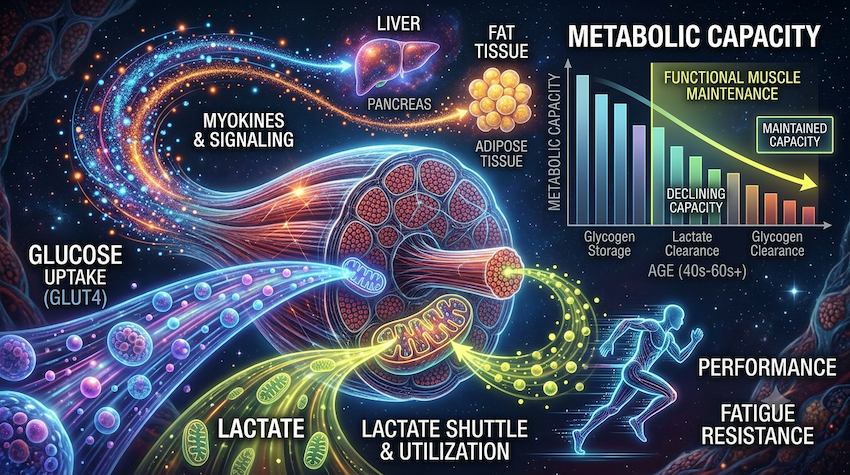
When muscle contracts during exercise, it secretes a diverse array of signaling molecules known as myokines—substances responsible for intercellular communication. These myokines can influence tissues throughout the body, including the liver, adipose tissue, brain, and immune system, contributing to a wide range of physiological processes such as enhanced lipid metabolism, systemic anti-inflammatory effects, and neuroprotection.
A decrease in muscle mass or a decline in muscle activation directly weakens the core foundation of this metabolic network. Long before physical force output drops, the underlying biochemical network stalls, manifesting directly as a decline in athletic performance.
The Glucose Regulator: How Muscle Manages Blood Sugar
Among the metabolic duties performed by muscle, blood glucose regulation (maintaining glucose tolerance) is the most prominent.
Carbohydrates digested and absorbed from meals or race nutrition enter the bloodstream as glucose, raising blood sugar levels. Skeletal muscle is responsible for the majority of insulin-stimulated glucose disposal in the body. Muscle acts as the body’s largest “glucose sponge.”
What is particularly critical for athletes is the unique glucose uptake pathway triggered directly by muscle contraction. While cells normally require insulin to absorb sugar, muscle contraction activates an insulin-independent pathway. This causes GLUT4 (glucose transporter 4) proteins to relocate to the cell membrane, pulling sugar directly from the blood into muscle cells.
This mechanism creates a powerful positive spiral:
- High muscle mass with efficient daily function: Superior glucose processing capability, ensuring smooth and reliable energy delivery during exercise.
- Reduced muscle mass with lower activity frequency: Increased insulin resistance, leading to impaired glucose tolerance and reduced metabolic flexibility (the ability to efficiently switch between burning fat and carbohydrates depending on the intensity).
Assuming training status remains equal, losing muscle mass can reduce the body’s total muscle glycogen storage capacity, as less muscle tissue means less total capacity to store muscle glycogen. During prolonged endurance efforts, this reduced storage capacity may become one factor influencing the ability to maintain power later in a race.
The Lactate Processor: Clearing and Reusing Fuel
For endurance athletes, lactate represents one of the most fascinating yet widely misunderstood physiological factors.
Historically, lactate was vilified as a waste product that causes fatigue and halts performance. Modern exercise physiology has substantially changed our understanding of lactate; it should not be viewed simply as a fatigue-causing waste product. According to the “Lactate Shuttle Theory” pioneered by Dr. George Brooks, lactate is a highly mobile, versatile, and efficient energy fuel.
During high-intensity effort, lactate produced in fast-twitch muscle fibers travels through the bloodstream and intercellular spaces to other fibers and organs. There, it is taken up by mitochondria-dense slow-twitch fibers and cardiac muscle, where it is oxidized and recycled into ATP (energy).
This transport and recycling process relies heavily on lactate transporters such as MCT1, mitochondrial density within muscle fibers, oxidative capacity, and capillary density.
It is crucial to clarify that having more muscle mass does not automatically translate to higher lactate clearance capacity. What determines lactate processing efficiency is not sheer bulk, but the oxidative capacity and mitochondrial quality of the muscle fibers.
Nevertheless, skeletal muscle is one of the major sites of lactate uptake and oxidation during exercise. Preserving muscle mass while elevating its quality—particularly mitochondrial density, oxidative capacity, and the expression of lactate transporters such as MCT1—stands as a fundamental pillar for enhancing endurance performance.
Why Muscle Loss Can Undermine Endurance Performance
Why does a decline in muscle mass dismantle performance far faster than expected?
Changes in raw strength are typically hard to notice until muscle loss becomes severe. However, degradations in metabolic systems and energy efficiency begin much earlier.
1. Reduced Glycogen Storage Capacity
Holding training status constant, losing muscle tissue means less total capacity to store muscle glycogen. No matter how perfect your nutrition strategy is, a smaller muscle container caps your maximum fuel storage, limiting late-race endurance and power retention.
2. Impaired Amino Acid Reservoir Function
Muscle also represents a major protein reservoir in the body and plays an important role in whole-body amino acid metabolism. When muscle mass is reduced, maintaining and rebuilding muscle tissue becomes more challenging, particularly when training load, energy intake, and protein intake are not well matched.
3. Increased Relative Intensity
When muscle mass and muscle function decline, maximum force and power capacity may also decline. Consequently, a pace or cycling power that once felt comfortably sustainable may therefore represent a greater fraction of the athlete’s current capacity, increasing relative intensity and perceived effort (RPE), which accelerates fatigue accumulation.
What Athletes in Their 50s and Beyond Must Protect
The age-related loss of muscle mass and function is known as sarcopenia, and competitive athletes are far from immune. For athletes in their 50s and beyond, simply chasing mileage or training load metrics (such as CTL) is often insufficient to prevent muscle regression.
Recent consensus emphasizes that muscle strength is more clinically relevant than muscle mass alone for identifying and characterizing sarcopenia, with physical performance providing additional information about functional impairment. For masters athletes, this reinforces an important point: preserving muscle function matters just as much as preserving muscle mass.
Here is the common trap for masters athletes:
- High mileage in running and cycling strips away overall body weight.
- Lighter body weight yields temporary speed gains, particularly on climbs.
- However, aggressive or poorly managed weight loss can also reduce lean tissue and muscle function.
- As a result, maximum power drops, relative intensity at normal training paces increases, running mechanics may become harder to maintain under fatigue, potentially reducing late-race resilience.
Athletes in their 50s and beyond must focus not on the scale or superficial lean appearance, but on protecting functional muscle capable of high mechanical and metabolic output.
Preserve “Functional Muscle,” Not Just Muscle Size
What practical approach should endurance athletes adopt?
The goal is not to maximize muscle size for its own sake. The objective is to maintain and refine functional muscle that sustains power and maintains mechanical efficiency over long durations.
Focusing on three core pillars is essential:
1. Maintain Neuromuscular Drive
Aging impairs not only muscle mass but also neuromuscular function—the ability of the nervous system to efficiently recruit muscle fibers. Incorporating periodic short sprints, plyometrics, or heavy-resistance strength work helps preserve the ability to recruit high-threshold motor units effectively.
2. Build Postural Stability to Elevate Running Economy
Maintaining functional capacity in core and gluteal stabilizing muscles helps maintain running mechanics under fatigue and make effective use of elastic energy stored and released by the muscles and tendons. This preserves biomechanical form and minimizes wasted energy expenditure.
3. Prioritize High-Quality, Timely Protein Nutrition
Without adequate building blocks, no amount of training stimulus can improve muscle metabolic capacity. Because anabolic resistance tends to increase with age, adequate high-quality protein intake—providing sufficient essential amino acids and leucine—becomes increasingly important for supporting muscle protein synthesis.
Conclusion
Skeletal muscle is far more than a set of mechanical cables; it is a sophisticated, highly adaptive, and powerful metabolic control center.
Losing muscle or suffering a decline in muscle function extends far beyond a loss of strength. It directly shrinks the body’s metabolic capacity for regulating glucose, processing lactate, and supporting recovery from training stress.
As the years accumulate, viewing muscle not as weight to be shed, but as a vital metabolic foundation to be guarded and nurtured is an important foundation for maintaining long-term, resilient athletic performance.
By integrating the perspective of muscle as a metabolic organ into your daily training, you can build a truly efficient, durable body built to last.
References
- Pedersen BK. Muscle as a secretory organ. Compr Physiol. 2013;3(3):1337-1362.
PubMed: https://pubmed.ncbi.nlm.nih.gov/23897689/ - Richter EA, Hargreaves M. Exercise, GLUT4, and skeletal muscle glucose uptake. Physiol Rev. 2013;93(3):993-1017.
PubMed: https://pubmed.ncbi.nlm.nih.gov/23899560/ - Brooks GA. The Science and Translation of Lactate Shuttle Theory. Cell Metab. 2018;27(4):757-785.
PubMed: https://pubmed.ncbi.nlm.nih.gov/29617642/ - Cruz-Jentoft AJ, et al. Sarcopenia: revised European consensus on definition and diagnosis. Age Ageing. 2019;48(1):16-31.
PubMed: https://pubmed.ncbi.nlm.nih.gov/30312372/
コメント