
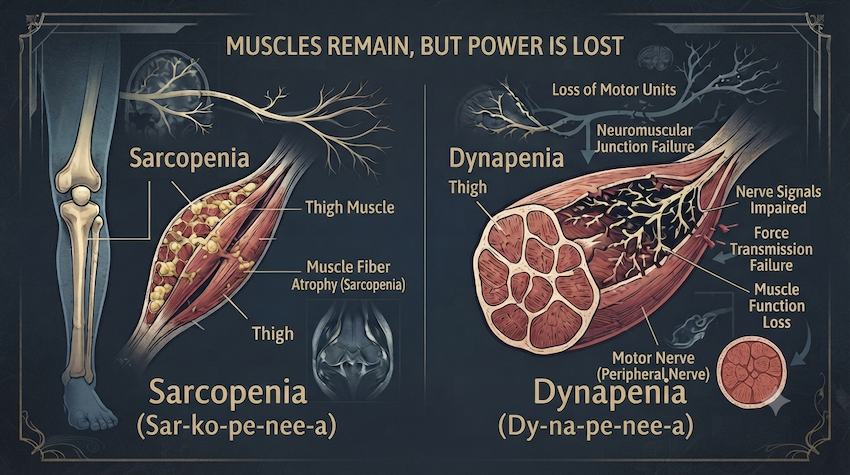
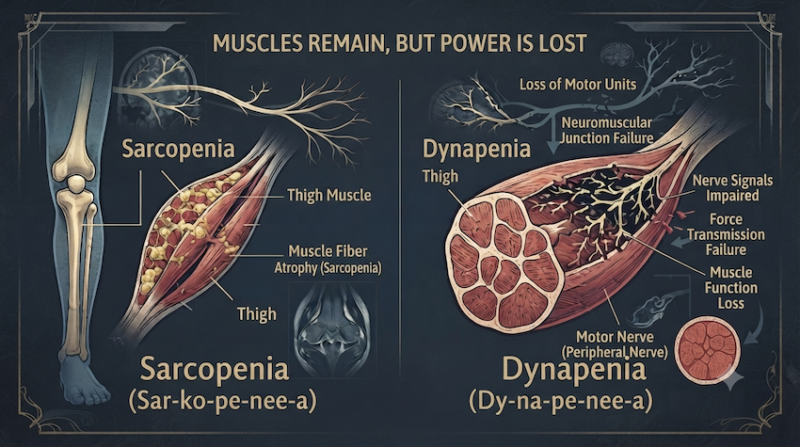
When physical strength declines with age, it is easy to assume that “muscle mass has decreased.” But is that truly the whole story? Even when muscle mass has not significantly declined, the ability to generate force can drop.
To conceptualize age-related loss of muscle strength separately from the loss of muscle mass, researchers Clark and Manini proposed the term “dynapenia” in 2008.
Differentiating Sarcopenia and Dynapenia
| Feature | Sarcopenia | Dynapenia |
| Primary Characteristic | Loss of muscle strength and physical function accompanied by muscle mass loss | Loss of muscle strength that cannot be explained by muscle mass loss alone |
| Appearance & Weight | Tends to show visible changes such as weight loss or thinning muscles | Little to no change in body weight or physical appearance |
| Detectability | Relatively easy to notice | Difficult to notice and prone to being overlooked |
Because a drop in force production does not manifest as noticeable changes in appearance or body weight, individuals must monitor themselves closely. Signs include finding it harder to climb stairs or unexpectedly stumbling on level ground.
Why Force Generation Declines Even Without Muscle Loss
There are several reasons why strength can drop even when muscle mass is preserved. A combination of factors is at play, including functional decline at the neuromuscular junction (the connection transmitting commands from nerves to muscles), qualitative changes within the muscle tissue, alterations in the central nervous system, and shifts in micro-inflammation and hormone balance.
While sarcopenia involves both a reduction in muscle mass and strength—often accompanied by thinning thighs, weight loss, lowered grip strength, slower walking speed, and difficulty on stairs—dynapenia refers to a loss of muscle strength that cannot be fully explained by the loss of muscle mass alone. Because external physical changes are minimal, it remains hidden in plain sight. Research shows that muscle strength declines at a faster rate than muscle mass. This helps explain why muscle mass alone cannot capture age-related changes in physical capacity.
The Four Core Drivers of Decreased Force Output
- Neurological Decline
Physical force is not generated by muscles alone; it relies on a complete neural pathway comprising the brain, spinal cord, motor neurons, and muscle fibers. With aging, the number of motor neurons decreases, nerve conduction velocity slows, and stimulation to muscle fibers diminishes. One important change is a reduced ability to recruit high-threshold motor units and generate force rapidly. - Functional Deterioration of Fast-Twitch Fibers
Muscle fibers consist of slow-twitch fibers (high endurance, dense with mitochondria, resistant to fatigue) and fast-twitch fibers (capable of generating massive force, explosive power, and high speed). Aging disproportionately impacts fast-twitch fibers, partly because daily life and low-intensity exercise rarely provide them with sufficient stimulation. Consequently, individuals struggle to lift heavy loads, climb stairs quickly, brace against sudden shifts, or recover from slips. - Compromised Muscle Quality
Measuring muscle mass only reveals total kilogram weight. Inside the tissue, however, intramuscular fat infiltration, mitochondrial dysfunction, alterations in muscle proteins, and reduced neural drive take place. The same amount of muscle can perform differently at different ages because muscle quality and neuromuscular function also change. Muscle mass alone does not fully determine functional capability. - Loss of Explosive Power
Age-related deterioration advances faster in muscle strength than in muscle mass, and even faster in muscle power. Muscle power is the product of force and velocity—the ability to generate a large amount of force rapidly. While one might climb stairs at a leisurely pace, catching a train or bracing after losing one’s footing requires true muscle power. Rapidly repositioning a leg to catch oneself on a slippery surface relies on instantaneous neurological capability, not just maximal strength.
Why Endurance Athletes Are Particularly Blind to This Risk
Individuals engaged in endurance training are far from immune. For instance, a runner in their 50s with a high $\text{VO}_2\text{ max}$ who logs substantial weekly mileage and completes marathons may still experience a decline in single-leg stability, explosive acceleration on inclines, or the neuromuscular reaction time needed to correct a stumble.
Endurance training builds cardiorespiratory fitness and mitochondrial density, but maximum strength, fast-twitch recruitment, and neural drive operate on a separate physiological axis. This does not mean endurance training is flawed—it remains indispensable for endurance performance. However, stimuli that build aerobic capacity alone will not maintain these distinct neural and strength capacities. Even when the engine (cardiorespiratory system) remains youthful, the chassis (strength and nervous system) can age, creating a performance gap where sudden, high-velocity force output fades.
How to Maintain Strength and Power With Age
How can dynapenia be countered?
- Targeted Strength Training
Movements such as squats, deadlift variations, lunges, calf raises, and single-leg exercises can be valuable tools for maintaining strength and neuromuscular function. They serve not merely for hypertrophy, but as critical stimuli for the nervous system. - Low-Volume High-Intensity Stimuli
Comfortable aerobic exercise alone may prove insufficient. Incorporating hill sprints, short-burst sprints, appropriately loaded resistance exercises, and plyometric movements helps maintain communication pathways between the brain and skeletal muscle. - Protein Intake
Sufficient protein, essential amino acids, and leucine stimulation remain vital for preserving tissue structure. However, nutrition alone cannot resolve dynapenia; building blocks must be accompanied by the neural commands required to deploy them.
Conclusion
The physical transformations of aging extend far beyond simple muscle atrophy. Force generation can plummet even when muscle bulk remains intact, and explosive power declines at an even steeper trajectory than maximum force.
While sarcopenia has entered the mainstream lexicon, focusing solely on muscle mass obscures these underlying shifts. The framework of dynapenia shifts the perspective from “how much muscle is present” to “how effectively that muscle can generate force.”
For masters endurance athletes striving to maintain performance well into their 50s and beyond, logging miles does not guarantee high-velocity force production. If a runner notices a slower initial stride, diminished acceleration on hills, or reduced single-leg stability, turning attention toward these distinct neuromuscular attributes is well worthwhile.
This is not a critique of endurance training. Rather, it is about pairing sport-specific conditioning with the explosive and forceful stimuli required to keep the entire system responsive.
The goal is not simply to preserve muscle mass, but to preserve the ability to use that muscle when it matters.
That is why dynapenia is a concept worth knowing as we get older.
References
・Clark BC, Manini TM. Sarcopenia ≠ Dynapenia. J Gerontol A Biol Sci Med Sci. 2008;63(8):829–834.
PubMed
・Cruz-Jentoft AJ, et al. Sarcopenia: revised European consensus on definition and diagnosis. Age Ageing. 2019;48(1):16–31.PubMed / PMC
・Bean JF, Kiely DK, et al. The relationship between leg power and physical performance in mobility-limited older people. J Am Geriatr Soc. 2002;50(3):461–467.
PubMed

コメント