
“If you’re going to do ten reps, you do ten reps straight through.”
When you lift weights, you rarely question this assumption. Once you start a set, you keep going until you hit your target number. Even as the final few reps become grueling, you don’t stop. You may only end the set once the final few reps have become extremely difficult. That is simply what we tend to think a “set” is supposed to be.
Yet, it is also a slightly strange premise. Why must repetitions be chained together into a single, unbroken block?
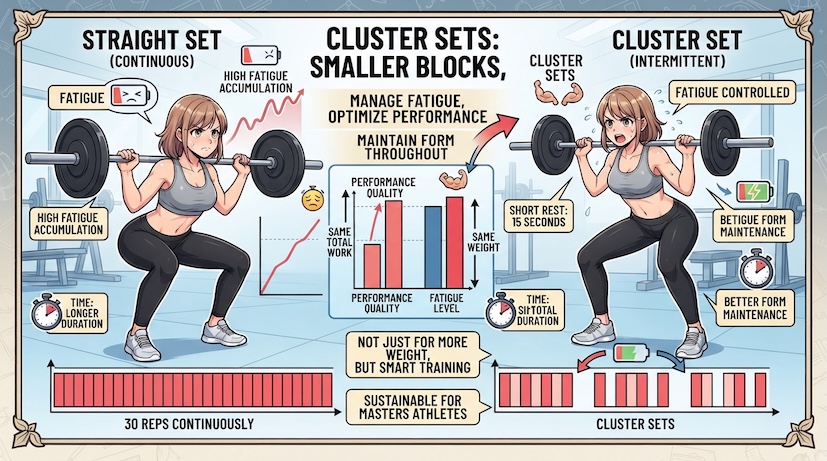
Take the same weight and perform a set number of repetitions. You could knock them all out at once in a single block. Or, you could break them up into smaller pieces with short rests in between. The total number of repetitions is identical. The weight used is identical. And yet, the way fatigue accumulates in your body can be quite different.
This brings us to the concept of cluster sets. It is not simply a method for handling heavier weights, nor is it merely a way to squeeze out more repetitions. It is simply a method of looking closely at how you distribute the same amount of work.
- 1. The Dogma of “Going to the End”
- 2. Stopping Before Fatigue Takes Over
- 3. The Same Reps, a Different Accumulation of Fatigue
- 4. Preserving Repetition Quality with Brief Rests
- 5. Cluster Sets Are Not a Magic Hack for Hypertrophy
- 6. Short Rests Still Leave You Out of Breath
- 7. For Masters Athletes, Tomorrow is Part of the Set
- 8. Training Isn’t Just About “More”
1. The Dogma of “Going to the End”
We cling to the idea of performing continuous, all-out sets for good reason. The intense fatigue that builds up at the end of a set and the struggle to push through a phase where every single rep grows heavier have often been treated as the most important part of a workout.
If a weight is meant for ten reps, hitting that tenth rep is what gives the effort meaning. Stacking the weights back on the rack halfway through, taking a breath, and then starting again can feel like a compromise made by someone unwilling to truly push themselves.
You want to maintain your strength and muscle mass. You want to raise the quality of your training for your sport. Naturally, you find yourself adding more weight, increasing the rep count, piling on sets, and driving as close to failure as possible. As you continue training, “increasing the stimulus” becomes your default setting. Of course, there is nothing inherently wrong with that. But is increasing load or stimulus really the only path forward?
Even if you lift the same weight and complete the exact same total number of repetitions, what is the difference between grinding through them in one unbroken, lengthy set versus breaking them down into smaller blocks of repetitions separated by short rests?
2. Stopping Before Fatigue Takes Over
Here, we can shift our perspective just a little bit.
In the latter half of a set, movement velocity drops due to fatigue. If you push even further, maintaining proper form becomes difficult. That said, straight sets are not inherently wrong. There are certainly situations where some degree of fatigue and declining repetition quality is accepted as part of the training stimulus.
Still, you do not have to choose that approach every single time.
Suppose you perform a certain number of repetitions with a given weight. Instead of bundling them into one long set, you divide them into small blocks of a few reps each, with brief pauses in between. You repeat this structure.
When people see this approach for the first time, many react with skepticism: “Isn’t that too light?” or “If you rest in the middle, haven’t you failed to properly push yourself?”
However, there is a distinct difference here.
“Resting mid-set” and “reducing the total training load” are not the same thing.
Taking a short break is not merely interrupting your workout to slack off. It is a variable used to manage how fatigue accumulates. You take one long set and break it down into several smaller blocks.
So, what actually happens inside the body when you adopt this approach of breaking the work into smaller blocks?
3. The Same Reps, a Different Accumulation of Fatigue
For example, suppose you perform a total of 30 repetitions with a certain weight. You could perform them as three conventional sets of 10, or break those sets into smaller blocks with short rests between them.
When performed as a single long set, fatigue accumulates as you move into the later phases. Your movement speed per repetition drops, your form starts to break down, and you end up grinding out the final reps in a state of exhaustion.
On the other hand, when you break the work into small blocks and stop after just a few reps, you curtail the buildup of fatigue heading into the next block. While a short rest does not reset your energy levels completely, it gives you a chance to reset and begin the next block with better control, making it easier to maintain stability right from the very first rep of the next round.
Even with the exact same 30 repetitions, not every rep is executed under identical conditions.
Repetitions performed in a state of advanced fatigue versus repetitions performed in a relatively fresh state—aided by a short pause—can differ in both movement velocity and force production.
4. Preserving Repetition Quality with Brief Rests
Let us look a bit closer at the mechanics of taking short, mid-set pauses.
When you continue high-intensity repetitions without stopping, the physiological demands of repeated muscle contractions increase, while neuromuscular fatigue also accumulates. As a result, it gradually becomes harder to generate force. If you push straight through to absolute failure, the metabolic burden mounts, and your movement loses its sharpness.
What happens if you insert a brief pause—lasting perhaps ten-odd seconds—into this sequence?
Ten seconds of rest does not magically restore your muscles to baseline.
Even so, compared to pressing on without a break, it allows some recovery to occur before the next block begins. As a result, you may be able to maintain higher movement velocity and force output in the next block than you would without the pause.
In other words, the purpose of a short rest is not to wipe away fatigue entirely. Rather than eliminating fatigue, the short rest helps prevent fatigue from accumulating too rapidly and makes it easier to maintain movement quality across the following blocks.
5. Cluster Sets Are Not a Magic Hack for Hypertrophy
By this point, you might be tempted to think, “If breaking things up preserves movement quality, does that mean it will make my muscles grow bigger?”
However, the world of training is rarely that simple.
Studies comparing cluster sets to traditional straight sets do exist. Looking at the research data, we cannot definitively say that cluster sets consistently outperform straight sets when it comes to muscle hypertrophy.
When total sets, total repetitions, and other training variables are equated, long-term muscle growth tends to show little to no significant difference between the two methods.
Hypertrophy is driven by multiple factors, not just one. Mechanical tension, repetition volume, set count, effort level, training frequency—multiple variables are involved. Cluster sets are simply one method of altering how you distribute your rest periods.
Even if breaking sets into smaller blocks helps preserve repetition quality, muscle growth itself is not governed by a single clever technique. Cluster sets alone will not drastically alter your hypertrophy outcomes.
Does this mean the method is useless? Far from it. The issue is not treating this as a secret cheat code, but rather understanding how to position it as a tool for balancing fatigue and stimulus.
6. Short Rests Still Leave You Out of Breath
At this juncture, another characteristic worth noting comes into play.
When you continue to perform repetitions with short rests during weight training, you end up getting surprisingly out of breath.
A few repetitions.
A short rest.
Another few repetitions.
Because the rest periods are brief, your breathing and heart rate do not have time to fully drop before the next block kicks off.
Here, we must be careful not to make the short-sighted leap of thinking, “My heart rate went up, so this must be endurance training.”
It is true that performing weight training with short rests can keep your heart rate elevated. However, that does not directly translate into improvements in aerobic capacity.
What matters here is not the fact that “lifting weights makes your heart feel like cardio.” Rather, it is that inserting short pauses changes the overall burden on your body, extending beyond localized muscle fatigue to influence systemic load. That alone can give you another useful option for structuring your training.
7. For Masters Athletes, Tomorrow is Part of the Set
This way of thinking proves especially useful for masters athletes who juggle multiple disciplines in parallel.
Masters athletes do not spend all of their time inside a weight room.
Their training involves multiple disciplines. Morning runs, weekend bike rides, and swimming drills form their routine. Their daily lives are built on a foundation of mixed activities.
Suppose you have a scheduled running workout the day after a heavy lifting session.
What happens if lingering fatigue from yesterday’s gym work carries over?
You have a job, too. Sleep quality fluctuates day to day.
Therefore, evaluating a workout solely by asking, “Did I push myself as hard as possible today?” makes little sense. You have to consider what kind of footprint that training leaves on the days that follow. You aren’t just optimizing a single workout; you are looking at how to avoid breaking a whole week.
What happens if you treat every trip to the gym as an obligation to go to absolute failure, repeatedly using straight sets to drain the tank?
The next morning, you wake up with deeply sore muscles, throwing a wrench into your next scheduled workout. Trying to push through your other commitments in that state can cause your form to break down and potentially increase the risk of injury.
You worked hard in the weight room to build strength, only to carry excessive fatigue into your primary sport training for days afterward. For anyone balancing multiple endurance sports, that is a scenario worth avoiding.
For a masters athlete, the goal is not merely hitting a wall of individual workout failure. It is about maintaining and sustaining overall training volume over a span of weeks and months without letting different workouts interfere with one another.
This is precisely where knowing options outside of grinding every single set to the bitter end becomes valuable.
When handling heavy loads, you can modulate the stress through methods other than simply adding weight. You can secure the necessary repetitions and stimulus while avoiding excessive fatigue. As an approach for keeping your conditioning intact while continuing to lift, breaking up your repetitions serves as a practical, viable option.
8. Training Isn’t Just About “More”
When we want to build or maintain strength and muscle mass, or elevate our athletic capacity, our reflex is always to chase “more.”
Heavier weights.
Higher rep counts.
More sets.
More exhaustion.
When you trap yourself in a mindset fixated entirely on “adding more,” you inevitably hit a wall somewhere. That is especially true when your available energy is constrained by age, work, and the daily shifts in your physical condition.
When programming a weight training session, our eyes naturally gravitate toward weight, reps, and sets. Yet “when to rest” is often overlooked or locked into rigid habits.
Do ten reps all at once.
Or break them up with short pauses.
What is worth taking away from cluster sets is not a strict formula of “how many reps to do and how many seconds to rest.”
What this method reveals is that training stimulus and fatigue magnitude are not determined solely by weight and repetition count. Even with the exact same weight and the exact same number of reps, where you take your pauses changes the entire trajectory of how fatigue accumulates.
For instance, if you plan to perform a given number of squats, you can divide them into smaller chunks with brief rests in between. The key is not to look for an easy way out compared to a standard set, but rather to secure the required repetitions while cutting off the block before fatigue drastically deforms your movement.
“Go heavier.”
“Do more reps.”
“Push harder.”
Instead of focusing solely on increasing those variables, sometimes it pays to consider how to divide the exact same work.
Weight training also allows for this kind of design.
The longer you train, the more useful it can become to ask not only “what should I add?” but also “where should I break things up?”
コメント