
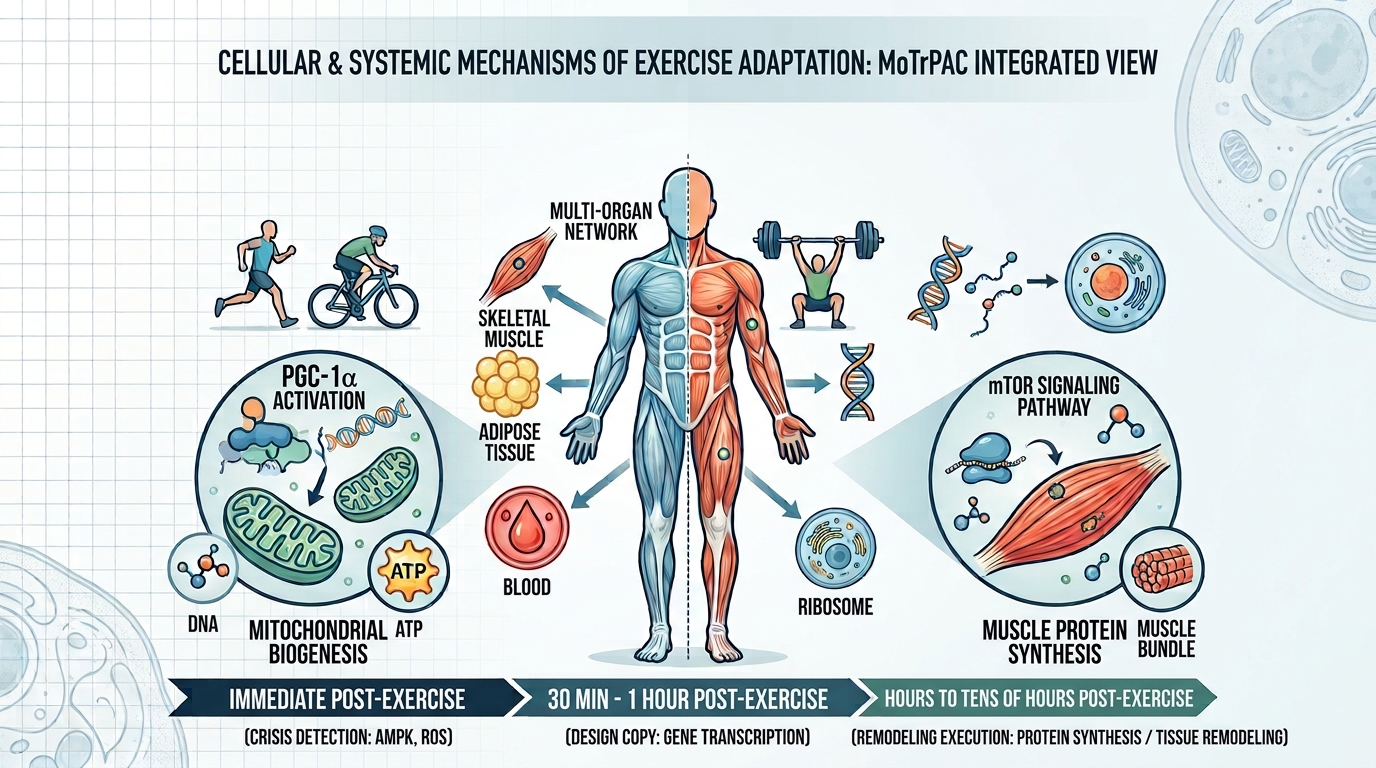
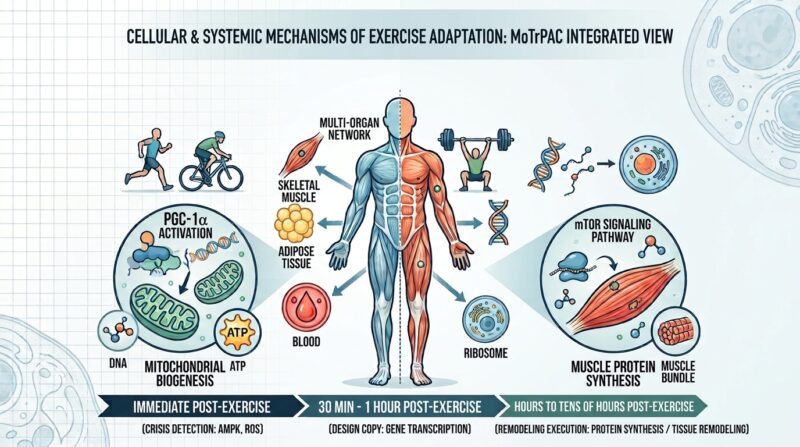
What actually happens inside your body when you exercise? Muscles contract, heart rate rises, and sweat begins to flow. The changes we can physically feel are merely a small fraction of the whole picture. In fact, even a single session of exercise alters gene expression, mobilizes proteins and metabolites, and initiates complex signal transduction among skeletal muscle, adipose tissue, and the bloodstream. Behind the universally known phenomenon that “exercise transforms the body,” what is truly taking place? To unravel these answers at the molecular level, the National Institutes of Health (NIH) is leading a massive research project: MoTrPAC (Molecular Transducers of Physical Activity Consortium). In this article, we will trace the “changes that occur inside the body from a single session of exercise” revealed by MoTrPAC research and explain how our bodies adapt to physical activity.
- 1. The Multi-Organ Network Activated by Exercise
- 2. From Metabolic Perturbation to Structural Remodeling: The Temporal Cascade
- 3. Endurance vs. Resistance Exercise: Driving Distinct Programs
- 4. Application for Athletes: Refinement of Responses in Trained Individuals and Strategic Approaches
- 5. Limitations of This Research
- 6. Conclusion: Consistency is the Ultimate Strategy
1. The Multi-Organ Network Activated by Exercise
“Exercise improves health.” “Running builds stamina.” These are facts many people know through experience, but few can explain what is happening at the cellular level the moment exercise occurs. Muscles fatiguing, heart rate rising, sweating—the changes we can perceive are only a small fraction of the reality. Behind the scenes, not only skeletal muscle but also adipose (fat) tissue, blood, and organs throughout the body exchange information to prepare for the next physical demand. In recent years, a massive project has been underway to elucidate the molecular mechanisms behind how exercise transforms the body. This initiative is MoTrPAC (Molecular Transducers of Physical Activity Consortium), led by the National Institutes of Health (NIH). MoTrPAC is one of the world’s largest research projects dedicated to comprehensively analyzing the systemic effects of exercise across diverse molecular features, including genes, proteins, metabolites, and lipids. While conventional studies typically examined isolated targets—such as “muscles only” or “blood only”—MoTrPAC analyzes multiple tissues within an integrated framework to reveal how the entire body functions as an interconnected network in response to exercise. In the series of MoTrPAC studies highlighted here, sedentary adults without regular exercise habits engaged in either endurance or resistance exercise. Detailed molecular profiling was conducted on samples of skeletal muscle, adipose tissue, and blood collected before and after the exercise sessions. Remarkably, despite being just a single session of exercise, researchers observed an extraordinary degree of change, with statistically significant alterations identified across a vast number of molecular features.
A Synchronized System Across Three Domains
We tend to think of exercise simply as “muscles contracting to consume energy.” In reality, exercise is a major signaling event where cells across the entire body engage in active dialogue. The primary strength of MoTrPAC research lies in not limiting the scope to a single tissue; instead, samples were collected simultaneously from three interconnected domains: skeletal muscle, adipose tissue, and the circulating blood that connects them. Rather than reacting uniformly, each tissue demonstrated a distinct timeline and role, coordinating in a remarkably synchronized fashion:
- Skeletal Muscle: Facing the direct physical workload, skeletal muscle exhibited the most dramatic and sustained responses. Significant molecular changes appeared immediately after exercise ceased, with many alterations deepening and persisting over time. Muscles do not merely contract; they regulate energy metabolism, repair tissue, and prepare to rebuild the body for future demands.
- Adipose Tissue: With the onset of exercise, signals to mobilize lipids as an energy source surge rapidly. Substantial changes emerge early in the post-exercise period, with the nature of the molecular response evolving over time. Adipose tissue is not a passive storage depot, but an active, dynamic metabolic organ supporting energy supply during and after exercise.
- Blood: A wide variety of proteins, metabolites, and lipids showing significant post-exercise changes were identified in circulating blood. Among these were candidate “exerkines”—exercise-responsive signaling molecules that may include muscle-derived myokines, adipose-derived adipokines, liver-derived hepatokines, and other factors involved in inter-organ communication. The reasons why exercise is believed to improve glucose metabolism, suppress chronic inflammation, and positively impact brain function stem from the existence of this body-wide information network.
2. From Metabolic Perturbation to Structural Remodeling: The Temporal Cascade
When fatigue dissipates the day after exercise, or when endurance and strength improve after several months, these outcomes cannot be explained merely by simple muscle recovery. They are driven by complex cellular adaptation processes. The MoTrPAC research visualized this sequence along a clear timeline. The body does not instantly transform the moment exercise occurs. It first senses the stimulus, processes the information within the cell, generates the necessary blueprints, and only then begins rebuilding the physical structure. To use a construction analogy, the stimulus from exercise is like a flood of detailed architectural blueprints and material purchase orders arriving at a renovation site.
Step 1: Sensing the “Energy Crisis” in the First Few Minutes
Upon initiating exercise, ATP (adenosine triphosphate) in muscle cells is consumed rapidly. Cells sense this change as an “energy deficiency,” activating energy sensors such as AMPK. Additionally, shifts in calcium concentration and the generation of moderate levels of reactive oxygen species (ROS) create various downstream signals. While ROS often carries a negative connotation, moderate ROS produced by exercise acts as an essential signal informing cells that “the current capacity is insufficient” and “we need to adapt and grow stronger.” Receiving this crisis signal is what triggers the body to initiate the adaptation process.
Step 2: Activation of Gene Transcription in Early Post-Exercise (Copying the Blueprint)
Early in the post-exercise period, signals generated within the cell travel to the nucleus, activating the expression of various genes. A prime example is PGC-1α, a well-known transcriptional coactivator regulating mitochondrial biogenesis. When PGC-1α is activated by endurance training, cells begin moving toward creating more mitochondria. At this stage, the physical structure of the body has not yet changed. What has changed is the “blueprint” (transcripts) dictating what kind of tissue will be built going forward.
Step 3: Protein Synthesis Hours to Tens of Hours Later (Executing the Renovation)
Once the blueprints are ready, actual protein synthesis begins based on those templates. Proteins that form mitochondria, metabolic enzymes, proteins associated with vascular adaptation, and structural muscle proteins required for hypertrophy are gradually synthesized over hours to tens of hours. What we call the “training effect” is precisely the accumulation of this post-exercise remodeling (tissue restructuring). This is why sleep and nutrition are paramount. No matter how high the quality of a workout, if adequate recovery is lacking afterward, the body will run short on both the raw materials and the time required to rebuild itself.
3. Endurance vs. Resistance Exercise: Driving Distinct Programs
The research clearly demonstrated that endurance exercise and resistance exercise (strength training) activate markedly different sets of genes in their initial stages. Distinct physical stimuli evoke clear differences in both the magnitude and nature of gene expression.
- Endurance Exercise: Demanding continuous energy expenditure and oxygen transport, endurance exercise broadly drives pathways associated with mitochondrial biogenesis and angiogenesis—such as PGC-1α—adapting the body toward enhanced aerobic capacity.
- Resistance Exercise: Accompanied by high mechanical tension and micro-damage to tissue, resistance exercise induces programs centered around mTOR signaling, driving protein synthesis, muscle hypertrophy, and structural reinforcement of tissues (such as strengthening tendons and connective tissue). Because each modality drafts a different architectural blueprint, strategically combining stimuli according to one’s goals becomes essential.
From here, we examine “practical application strategies” to translate these cutting-edge scientific insights into daily training routines.
4. Application for Athletes: Refinement of Responses in Trained Individuals and Strategic Approaches
A critical factor must be considered here: the subjects in this study were “sedentary adults” without regular exercise habits. Understanding this premise is crucial for athletes and experienced individuals who have accumulated years of training when designing their own training strategies.
Differences in Molecular Responses Between Beginners and Trained Athletes (Perspective)
When a sedentary individual exercises for the first time, it represents an unaccustomed, major “crisis” for the body. Consequently, a vast array of genes and proteins react simultaneously, provoking a broad, systemic molecular response. For seasoned athletes who have trained for years, however, exposing the body to an exercise session of identical intensity and duration is likely processed as a “familiar, routine stimulus.” Because mitochondria and metabolic enzymes are already well-developed, cells do not experience the same degree of acute crisis. Rather than the reaction becoming inherently “weaker,” it is thought that the molecular response becomes more efficient, streamlined, and refined into targeted, specific pathways. This presents a unique challenge for competitive athletes. Repeating the same stimulus reduces its relative load on the body, meaning that adjusting the volume, intensity, or nature of the stimulus may be necessary to elicit further adaptation. Therefore, experienced individuals require a deliberate differentiation of training stimuli.
Three Strategic Approaches for Athletes
① Building the Foundation: “Low-to-Moderate Intensity Training (Z2)”
Training in the low-to-moderate intensity zone—commonly referred to as Zone 2 (Z2) or around the first lactate threshold (LT1)—forms a vital foundation in endurance sports. At the cellular level, repeated training at this intensity can stimulate molecular pathways associated with mitochondrial and metabolic adaptations while generally allowing a relatively high training volume to be accumulated. A single session will not produce dramatic changes. However, by repeating workouts before the previous stimulus completely fades, similar molecular responses are repeatedly induced, compounding small adaptations over time. This is analogous to repeatedly compacting a solid concrete foundation when building a house; omitting this step makes achieving long-term performance gains impossible.
② Pushing the Ceiling: “High-Intensity Training”
On the other hand, high-intensity workouts such as VO₂max intervals or training near the second lactate threshold (LT2) re-create an intentional “energy crisis” in cells through rapid ATP depletion and lactate accumulation. This strongly disrupts signaling pathways that remain unbothered during routine daily training, triggering further expansion of aerobic capacity.
③ Supporting Endurance from the Side: “Resistance Training”
Even for endurance athletes, strongly activating mTOR-centered pathways through resistance exercise is highly beneficial. This is not intended merely for muscle hypertrophy, but to improve motor unit recruitment, reinforce tendons and connective tissues, and enhance neuromuscular efficiency. Consequently, this translates directly into improved running economy, injury prevention, and sustained torque output on the bike, establishing a resilient molecular foundation that maintains form in the late stages of long races.
5. Limitations of This Research
While this study represents a monumental leap forward in exercise physiology by comprehensively mapping acute exercise responses in humans, several limitations exist. Although the analysis detailed post-exercise molecular responses over time, it primarily captures relatively short-term responses to a single acute bout of exercise. Tissue remodeling extending beyond 24 hours, as well as long-term adaptations resulting from weeks or months of consistent training, cannot be fully explained by this single dataset alone. Furthermore, whether highly trained athletes exhibit the exact same timeline and magnitude of molecular responses requires further investigation. Thus, it is important to note that this research alone cannot account for 100% of all training theories.
6. Conclusion: Consistency is the Ultimate Strategy
The greatest achievement of MoTrPAC is not simply reconfirming that “exercise changes the body,” but visualizing the vast, interconnected molecular network that underpins those changes. Even when we believe we are only training our muscles, circulating blood is carrying information, genes are being transcribed, proteins are being synthesized, and cells are communicating—working together as an integrated whole to redesign the body for the future. Molecular responses triggered by a single workout are not permanent; signals fade over time, eventually returning to baseline. However, by exercising again before those signals disappear entirely, small changes compound like interest, gradually guiding the body toward higher levels of adaptation. A single workout today will not make you dramatically stronger overnight. Yet even a single session can initiate the molecular processes that contribute to future adaptation. The body you have tomorrow is shaped, in part, by the exercise you perform today. That is why patience and consistency remain among the most powerful strategies in training.
References
Note: References 1 through 4 include studies made publicly available as preprints as of September 2026.
- Multi-Omic, Multi-Tissue Responses to Acute Exercise in Sedentary Adults: Findings from the Molecular Transducers of Physical Activity Consortium. PMID: 42164870
- Integrative Multi-omics Analysis of the Human Skeletal Muscle Response to Endurance or Resistance Exercise: Findings from the Molecular Transducers of Physical Activity Consortium (MoTrPAC). PMID: 41867825
- Blood Biochemical Responses to Acute Exercise: Findings from the Molecular Transducers of Physical Activity Consortium (MoTrPAC). PMID: 41835387
- Molecular Transducers of Physical Activity Consortium (MoTrPAC): Initial Insights into the Dynamic Human Responses to Exercise. PMID: 41867848
- Molecular responses to acute exercise and their relevance for adaptations in skeletal muscle to exercise training. PMID: 36395350
- The molecular athlete: exercise physiology from mechanisms to medals. PMID: 36603158
- Molecular aspects of the exercise response and training adaptation in skeletal muscle. PMID: 39059515
- PGC-1α regulation by exercise training and its influences on muscle function and insulin sensitivity. PMID: 20371735
- Molecular profiling of high-level athlete skeletal muscle after acute endurance or resistance exercise – A systems biology approach. PMID: 38141850

コメント