
Late in a race, when legs grow heavy and maintaining momentum demands every ounce of focus, many athletes reach for a caffeinated gel. I also use caffeinated fueling strategies during long training sessions and events.
Why do we rely on caffeine during racing? Traditional explanations—such as “it boosts fat burning to spare energy” or “it sharpens focus so you can push harder”—frequently circulate through endurance communities. Recent research clarifies what the underlying mechanisms are and highlights common misconceptions held by athletes.
Caffeine is not a shortcut to instant fitness. When aligned with individual physiology and training routines, however, it serves as a practical tool for workout execution and race-day strategy.
- 1. Does Caffeine Actually Improve Race Performance?
- 2. The Fat-Burning Hypothesis vs. Modern Evidence
- 3. What Happens in the Brain: Blocking Adenosine
- 4. Practical Applications for Endurance Athletes
- 5. Dosing Strategies: Timing, Intake, and Side Effects
- 6. Determining Individual Dose Requirements
- 7. Daily Coffee Habits and Caffeine Tolerance
- 8. Prioritizing Sleep and Recovery
- 9. Evaluating Caffeine for Post-Exercise Recovery
- 10. Caffeine Is a Tool, Not a Shortcut
1. Does Caffeine Actually Improve Race Performance?
Solid evidence in sports science supports caffeine as an effective ergogenic aid for endurance exercise. Its benefits are recognized across meta-analyses and within guidelines published by the International Society of Sports Nutrition (ISSN).
Historically, caffeine was listed on the World Anti-Doping Agency (WADA) Prohibited List before being removed in 2004 and placed in the Monitoring Program. Today, caffeine is not prohibited under WADA rules. This history is a reminder that caffeine has long attracted attention as a substance capable of influencing exercise performance.
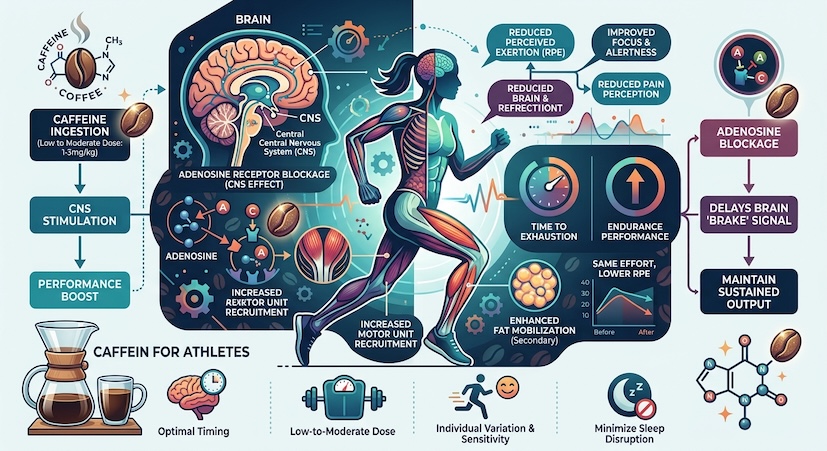
Caffeine acts on the central nervous system and can influence perceived exertion, alertness, and pain perception, among other physiological responses. These effects may help athletes sustain a given physical workload more effectively. Rather than upgrading physical motor capability directly, caffeine helps athletes utilize their existing engine.
2. The Fat-Burning Hypothesis vs. Modern Evidence
A long-standing classical theory explains caffeine’s benefits through the following pathway:
- Caffeine ingestion occurs.
- Sympathetic nervous system activity increases, accelerating free fatty acid mobilization.
- Muscle glycogen consumption decreases due to greater reliance on fat oxidation.
- Glycogen sparing delays fatigue during late-stage endurance efforts.
Caffeine can indeed promote fatty acid mobilization from adipose tissue. However, increased fat oxidation may be one physiological effect of caffeine, but it does not appear to fully explain its ergogenic effects on endurance performance. In practice, performance improvements persist across varied exercise intensities and carbohydrate availability levels.
3. What Happens in the Brain: Blocking Adenosine
Understanding caffeine’s interaction with the central nervous system requires examining the molecule adenosine.
Adenosine and Neurological Signaling
Adenosine is a neuromodulator involved in the regulation of sleep, wakefulness, and neural activity. As adenosine signaling increases, it promotes sleepiness and reduces arousal. This signaling contributes to sleepiness, reduced arousal, and changes in how effort is perceived.
Receptor Antagonism
Caffeine acts as an adenosine receptor antagonist, binding primarily to adenosine A1 and A2A receptors and preventing adenosine from exerting its usual effects.
This mechanism triggers several central nervous system responses:
- Changes in Perceived Exertion (RPE): The same running pace or power output may feel more manageable.
- Reduced Perception of Discomfort: Sensations of muscular discomfort under high workloads may be blunted.
- Sustained Alertness: Blocking adenosine receptors can help maintain alertness and vigilance, particularly when fatigue or sleepiness is present.
Caffeine does not eliminate structural muscle damage or physical fatigue. It simply shifts subjective perception, making a pace that typically triggers slowing down feel manageable for longer.
4. Practical Applications for Endurance Athletes
Based on its central nervous system mechanisms, caffeine can provide distinct advantages across several endurance scenarios:
- Pacing Long Events (Marathons, Road Races): Helps maintain mental focus and reduces the psychological effort required to hold a steady pace.
- High-Intensity Efforts (Hill Climbs, Time Trials): May reduce the perception of discomfort during demanding efforts.
- Late-Stage Multisport Racing (Triathlons): May help restore alertness when entering the run leg after significant cumulative fatigue.
- Early-Morning Starts: Mitigates grogginess when racing occurs before circadian alertness peaks.
Response variations remain common due to genetic differences in caffeine metabolism and individual baseline sensitivity.
5. Dosing Strategies: Timing, Intake, and Side Effects
Planning caffeine use requires distinguishing between pre-race and in-race applications.
Pre-Race Intake
Caffeine is absorbed relatively quickly, with peak blood concentrations often occurring within roughly 30–60 minutes, although the timing varies between individuals and formulations. For athletes who want caffeine to be active around the start of a race, pre-race intake is commonly timed within this general window.
In-Race Ingestion
For middle- and long-distance events, taking caffeine during later stages supports declining concentration. Athletes utilize gels, liquids, or tablets depending on gastrointestinal tolerance, total target dosage, and personal preference.
Managing Dosage Risks
Research also suggests that lower doses may provide performance benefits in some settings, although the minimum effective dose is not firmly established and individual responses vary.
Higher doses increase the likelihood of adverse side effects:
- Elevated heart rate and palpitations
- Gastrointestinal distress and stomach cramps
- Excessive nervousness, anxiety, or compromised pacing judgment
- Impaired sleep quality post-exercise
For habitual caffeine users, moderate caffeine intake during exercise does not appear to cause clinically meaningful dehydration under typical conditions. Managing gastrointestinal comfort and heart rate spikes remains the primary practical priority.
6. Determining Individual Dose Requirements
Rather than following a fixed dose, athletes should test caffeine during training and determine how much they personally tolerate and benefit from.
Calculating intake relative to body mass provides a useful baseline. For a 60 kg athlete:
- 1 mg/kg = 60 mg
- 2 mg/kg = 120 mg
- 3 mg/kg = 180 mg
Testing different intake levels during routine training sessions helps establish individual boundaries:
- Identify the minimum dosage required to notice heightened alertness.
- Monitor for signs of gastrointestinal distress or elevated heart rate.
- Evaluate how late-day caffeine intake affects evening sleep quality.
7. Daily Coffee Habits and Caffeine Tolerance
Athletes often ask whether daily coffee consumption creates tolerance, neutralizing caffeine’s race-day benefits, and whether a pre-race “washout” period (abstaining for several days) is necessary.
While habitual caffeine intake can lead to adaptations in adenosine signaling over time, current research shows that regular consumers still experience meaningful ergogenic benefits without abstaining. Abruptly stopping habitual caffeine use introduces risks of withdrawal symptoms, including severe headaches, fatigue, irritability, and reduced concentration. For regular consumers, the stress of complete withdrawal before a target race often outweighs the potential performance gain.
8. Prioritizing Sleep and Recovery
The most critical decision regarding caffeine is knowing when not to use it. Elevating today’s training performance at the expense of tomorrow’s recovery undermines long-term development.
Caffeine’s elimination half-life varies considerably between individuals, commonly falling in the range of roughly 3–7 hours. This means that caffeine consumed in the afternoon can remain in the body well into the evening and potentially interfere with sleep.
Caffeine consumed later in the day can delay sleep onset and reduce sleep quality, including aspects of slow-wave sleep. A typical negative cycle unfolds as follows:
- Consuming caffeine for an evening workout increases temporary training output.
- Sleep quality decreases that night.
- Recovery slows, leaving residual fatigue the following day.
- Subsequent training quality declines over time.
For athletes aiming to sustain high-level performance over years, sleep serves as the most effective recovery tool available. Strategic restraint during evening workouts preserves overall training consistency.
9. Evaluating Caffeine for Post-Exercise Recovery
Some cellular and animal studies indicate that co-ingesting caffeine alongside carbohydrates post-workout may accelerate muscle glycogen resynthesis rates.
However, caffeine should not be considered a primary recovery strategy. Evidence for meaningful improvements in practical post-exercise recovery remains less established than the evidence for caffeine’s ergogenic effects during exercise. Furthermore, consuming caffeine post-workout frequently interferes with sleep.
Effective recovery relies on four fundamental practices:
- Replenishing carbohydrates
- Ingesting adequate protein
- Restoring fluid and electrolyte balance
- Securing high-quality sleep
10. Caffeine Is a Tool, Not a Shortcut
Caffeine works best as an addition to a solid training and recovery foundation:
- Structured, consistent training progression
- Prioritized sleep and physiological recovery
- Adequate daily hydration and fueling strategies
- Measured race pacing
When these baseline elements are missing, caffeine cannot substitute for physical readiness. It does not create fitness; it can simply help an athlete express more of the capacity they have already developed through training.
References
- Guest NS, VanDusseldorp TA, Nelson MT, et al. International Society of Sports Nutrition Position Stand: Caffeine and Exercise Performance. J Int Soc Sports Nutr. 2021;18(1):1. Published 2021 Jan 2. https://pubmed.ncbi.nlm.nih.gov/33388079/
- Wang Z, Qiu B, Gao J, Del Coso J. Effects of Caffeine Intake on Endurance Running Performance and Time to Exhaustion: A Systematic Review and Meta-Analysis. Nutrients. 2022;15(1):148. Published 2022 Dec 28. https://pubmed.ncbi.nlm.nih.gov/36615805/
- Gardiner C, Weakley J, Burke LM, et al. The effect of caffeine on subsequent sleep: A systematic review and meta-analysis. Sleep Med Rev. 2023;69:101764. https://pubmed.ncbi.nlm.nih.gov/36870101/
コメント