
- In my 50s, my maximum heart rate is lower than it used to be.
- Running at the same pace feels much harder.
- Even with high-volume training and long runs, my body does not respond the way it did when I was younger.
- Most athletes react by thinking: My heart is failing.
As the years pass, maximum heart rate declines, and race results from the events I regularly use as benchmarks confront me with some harsh numbers. Every time that happens, it is tempting to brush it off with, It is just age; nothing I can do. I used to vaguely assume that a drop in heart rate meant my cardiovascular system was simply deteriorating.
However, is the heart really the only thing failing? Back in the day, the exact same heart rate easily produced sub-4-minute-per-kilometer paces. Now, I have to fight desperately just to scrape by at that speed. My training volume is actually higher now than it was back then, so why will not my body respond?
The source of that unease may lie deeper—within the structural and functional changes occurring in our muscles. These changes are not simply a matter of age-related decline. They also reflect how the body adapts to the environment and training stimuli it experiences over time.
Why do we, in our 50s, need to build an expansive Zone 2 foundation, combine threshold intervals and HIIT, and integrate resistance training? Let us organize the mechanics behind this through scientific data and daily sensory feedback. This is not a dry academic review, but a record of how I confront physical changes day in and day out through actual training.
- Chapter 1: Why Looking Only at the Heart Does Not Explain Age-Related VO2max Decline
- Chapter 2: VO2max Is Not Just an Engine—It Reflects the Entire Oxygen-Use System
- Chapter 3: Four Age-Related Changes That Affect Oxygen Use in Muscle
- Chapter 4: The Reality Faced by Athletes in Their 50s
- Chapter 5: Why Zone 2 Alone Is Not Enough—And HIIT Alone Is Not Enough
- Chapter 6: Perspectives From a 50-Something Athlete: The Body Can Still Adapt
Chapter 1: Why Looking Only at the Heart Does Not Explain Age-Related VO2max Decline
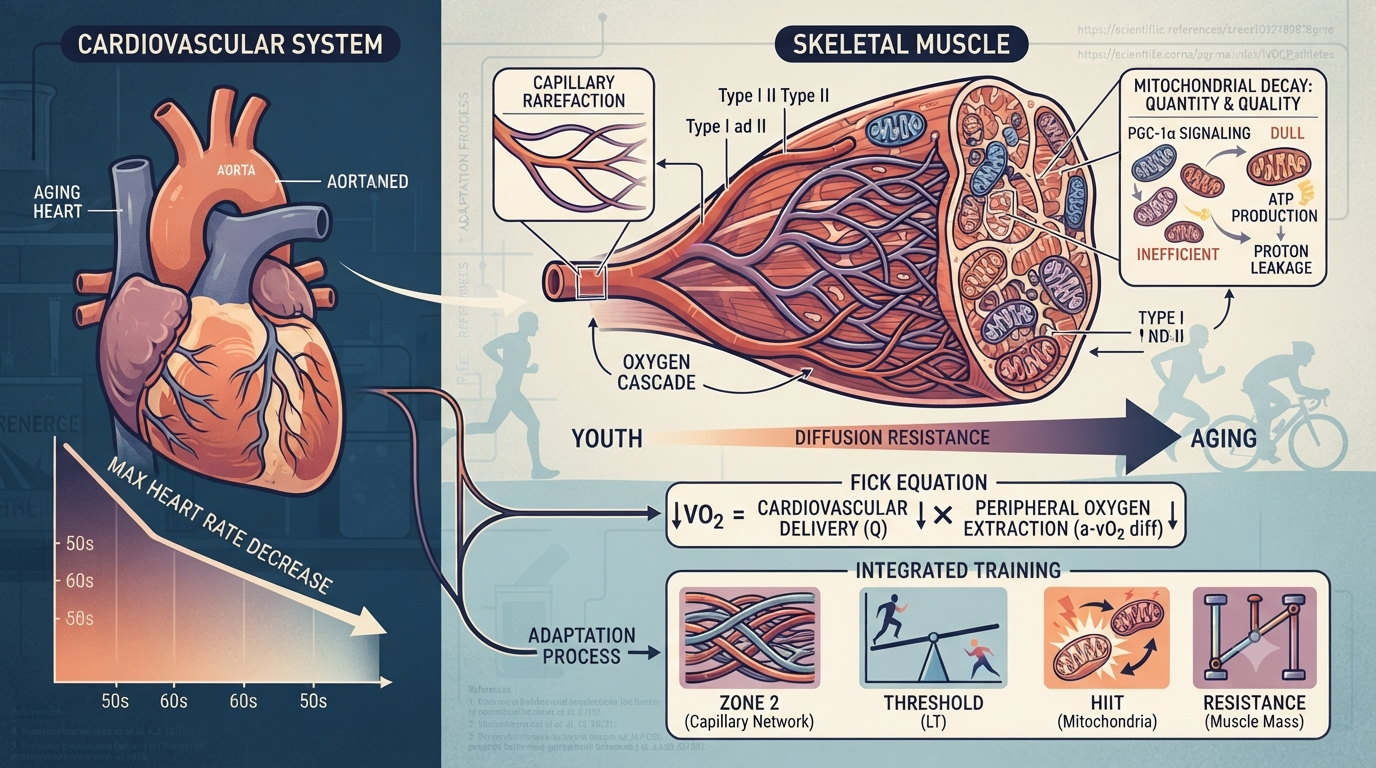
A useful framework for understanding the factors that limit VO2max is the Fick principle. Whole-body oxygen consumption is determined by the product of cardiac output and the arteriovenous oxygen difference:
VO2 = Cardiac Output (Q) * Arteriovenous Oxygen Difference (a-vO2 difference)
Traditional exercise physiology frequently focused on the first half of this equation: the decline in cardiac output, or the deterioration of the heart’s pumping function. Aging brings various changes to the cardiovascular system, accompanied by a drop in maximum heart rate. In young adults, central factors such as cardiac output make a major contribution to VO2max, but peripheral factors become increasingly important with age.
Yet, current understanding in exercise physiology is no longer a simplistic binary choice between the heart or the muscles. VO2max is determined by both the capacity to transport oxygen and the capacity of the muscles to extract and utilize it.
As prior research in exercise physiology demonstrates, the age-related decline in VO2max cannot be explained by declines in maximal cardiac output alone; the decline in peripheral oxygen utilization plays a crucial role.
In fact, there is one common point of misunderstanding here. VO2 refers to the rate of oxygen consumption. Although the term maximal oxygen uptake is commonly used, VO2max does not simply measure the lungs’ ability to take in oxygen.
Oxygen must be taken up by the lungs, transported through the cardiovascular system, delivered to the working muscles, and ultimately utilized by the mitochondria to produce ATP. VO2max reflects the integrated capacity of this entire oxygen transport and utilization pathway during maximal exercise.
This is why the decline in VO2max after 50 cannot be explained by changes in the cardiopulmonary system alone. Not only the volume of oxygen the heart can transport, but also the capacity of the muscles to extract and use that oxygen are vital components defining VO2max.
Chapter 2: VO2max Is Not Just an Engine—It Reflects the Entire Oxygen-Use System
Many people view VO2max like a car engine displacement or purely as cardiopulmonary capacity. However, looking at the journey inhaled oxygen takes before it is actually utilized by the body reveals that a vast array of systemic mechanisms beyond just the heart are involved.
Oxygen entering the lungs from the atmosphere moves from the alveoli into the blood, carried by hemoglobin. The heart pumps this blood systemically, routing oxygen from arteries down into capillaries. Finally, oxygen entering the muscle cells is utilized for energy production in the mitochondria. VO2max reflects how well this entire chain of processes functions during maximal exertion.
In short, when considering a drop in VO2max, we cannot omit the perspective of how much oxygen delivered to the muscles can actually be utilized, alongside how much blood the heart can pump. The arteriovenous oxygen difference in Fick principle is an important indicator of how much oxygen the working muscles extract from the blood.
With aging, changes occur on this peripheral side as well. Muscle capillaries, the transfer of oxygen from blood to muscle fibers, mitochondrial volume and function, and the structural state of the muscle tissue itself shift over time, altering the muscle oxygen utilization capacity. Recent research indicates that these peripheral oxygen utilization aspects play an important role, especially when considering the drop in VO2max in middle-aged and older adults.
However, this does not mean the heart is not aging. Central functions—such as maximum heart rate and maximum cardiac output—also decline with age. The key is viewing VO2max reduction not as an isolated heart problem, but through both the lens of the transport side and the utilization side.
Previously, I wrote an article titled “Aging”? No, It’s Just “Degeneration.” — Face Reality, Masters Athletes. In that article, I argued that physical changes should not be viewed simply as deterioration, but through the dual lens of normal aging and the specific stimuli the body has received over time. We can approach VO2max in much the same way.
Of course, training alone cannot completely halt age-related changes. However, peripheral capacities such as muscle capillaries, mitochondria, muscle mass, and muscular strength possess aspects that can still be stimulated and adapted through exercise.
That is precisely why considering endurance performance past the age of 50 requires more than just the mindset of pushing the heart harder. Maintaining the capacity to transport oxygen must go hand-in-hand with maintaining and enhancing the state in which muscles can utilize that delivered oxygen. This intersection is the core of navigating aging and training.
Chapter 3: Four Age-Related Changes That Affect Oxygen Use in Muscle
Why does the muscle oxygen utilization capacity decline? Elements imposing resistance on the flow of oxygen involve multiple interconnected alterations: muscle mass, neuromuscular function, mitochondria, capillaries, and tissue architecture.
- Sarcopenia and Neuromuscular and Muscle Fiber ShiftsSarcopenia—the age-related loss of muscle mass—is not merely a phenomenon of shrinking overall volume.Simultaneously, the motor neurons driving muscle fibers drop out, and innervation patterns reorganize. Consequently, Type II fibers are particularly vulnerable to age-related atrophy, while fiber-type composition also changes as motor units are remodeled, and changes in neuromuscular function and neuromuscular junctions also contribute to the decline in muscle function.When this happens, it can reduce the amount of muscle available for high-intensity exercise and impair power production, affecting maximum effort oxygen utilization capabilities. Furthermore, these shifts in fiber composition impact the metabolic flexibility of the entire muscle.
- Quantitative and Qualitative Changes in MitochondriaMitochondria—the cellular power plants—can change in both content and function with aging and declining physical activity levels, although habitual physical activity can preserve many aspects of mitochondrial function. One major regulatory factor tied to mitochondrial biogenesis is PGC-1 alpha. Exercise stimuli promote mitochondrial adaptation via PGC-1 alpha and other pathways, but aging can alter these signaling pathways, although exercise remains a potent stimulus for maintaining or increasing mitochondrial adaptations.Additionally, shifts occur in the protein complexes comprising the electron transport chain and in mitochondrial quality control, impacting the capacity to utilize oxygen for ATP production.For masters athletes, nutrition also matters. Persistent low energy availability or inadequate carbohydrate intake relative to training demands can compromise recovery and may limit the adaptations expected from training.
- Capillary RarefactionCapillaries form the microvascular network that delivers oxygen close to individual muscle fibers. A drop in capillary density or function impacts the environment for transferring oxygen from blood to muscle cells.Furthermore, reduced endothelial function impacts vasodilation responses and blood flow regulation required during exercise. In other words, even if the heart pumps blood, if the downstream microvascular network is impaired, oxygen delivery and utilization by the working muscles may be constrained.
- Changes in Muscle Tissue and the Oxygen Diffusion EnvironmentAge-related increases in intramuscular fat and connective tissue can alter the structural environment surrounding muscle fibers. These changes may influence the distance and conditions through which oxygen must move before reaching the sites of utilization.The accumulation of these changes over decades gradually impacts both the oxygen delivery system and the peripheral muscle utilization system.
Chapter 4: The Reality Faced by Athletes in Their 50s
Before you realize it, have you ever sighed while watching your Garmin device display a VO2max value lower than before? Of course, a Garmin VO2max is an estimate rather than a laboratory measurement, and it can be influenced by heart rate, pace, power, fatigue, and environmental conditions. Or have you struggled with the sensation that, despite logging the exact same training volume as your youth, your heart rate refuses to rise, your legs feel heavy, and your old staying power is missing?
When evaluating the frustrations faced by 50-year-old athletes, this idea of a peripheral bottleneck provides an important perspective.
- Heading out for a morning run, but your heart rate stays flat while your legs burn out first.
- Trying to maintain a Zone 2 pace, but failing to hit historical speeds.
- Slower recovery after key workouts, leaving a deep core heaviness in the muscles.
We cannot attribute all of this simply to a weakening heart. The vascular systems transporting oxygen, the capillaries receiving it, and the mitochondria and muscle tissues utilizing it are all experiencing age-related alterations.
Chasing workouts that merely push heart rate up like the old days without recognizing these structural changes may fail to yield the adaptations you expect.
Chapter 5: Why Zone 2 Alone Is Not Enough—And HIIT Alone Is Not Enough
Faced with these physiological changes, how should we select our training? Training modalities should not be distinguished merely by how grueling they are, but by which functional components of the body they specifically stimulate.
- Zone 2 (Low-to-Moderate Intensity Continuous Exercise): Building the Capillary Roadway and Metabolic Foundation
As someone logging over 1000km on the bike and hundreds of kilometers running monthly, I have learned that Zone 2 is far from an easy workout. Regular endurance exercise provides repeated vascular and metabolic stimuli that can support adaptations in skeletal muscle oxidative capacity, mitochondrial function, and substrate utilization. Furthermore, long-term training adapts peripheral circulation like capillaries. Building and maintaining an extensive oxygen-delivery network is one reason this type of training is so valuable. - Threshold Training: Enhancing High-Load Processing Capacity
Training near the lactate threshold, where the balance between lactate production and clearance begins to shift substantially, helps develop the metabolic capacity needed to sustain high exercise intensities. Through methodologies like Norwegian-style threshold training, repeatedly accumulating controlled amounts of threshold work without excessive fatigue helps maintain and elevate high aerobic capacities. - High-Intensity Interval Training (HIIT): Upgrading the Power Plants
High-intensity efforts serve as powerful stimuli for mitochondrial adaptation. The metabolic stress induced by exercise stimulates signaling pathways involved in mitochondrial biogenesis, mediated by PGC-1 alpha and other cascades. A recent systematic review and meta-regression found that endurance training, high-intensity interval training, and sprint interval training can all increase skeletal muscle mitochondrial content and capillarization. The review also concluded that the ability to adapt to exercise training is maintained throughout life. - Resistance Training: Maintaining the Architecture
No matter how exceptional the mitochondrial and vascular adaptations built by aerobic exercise, if the structural muscle housing them shrinks, overall systemic function collapses. Mechanical loading through foundational movements such as squats and hinges provides an important stimulus for maintaining muscle mass, strength, and functional capacity.
Relying on a single training method leaves you flying on one engine, and may leave important parts of the system undertrained. This is precisely why programming that integrates multiple modalities is necessary.
Chapter 6: Perspectives From a 50-Something Athlete: The Body Can Still Adapt
As a 50-something athlete, I feel certain truths more intensely than ever. In my 20s and 30s, I thought running fast was just a matter of training the cardiopulmonary system. But hitting my 50s taught me otherwise.
The root cause of distress is not simply that the heart got weaker. The internal processes occurring at the same heart rate are completely different. Back then, my muscles seemed to make better use of the oxygen delivered to them. Today, however, I must intentionally rebuild every single link: the delivery network, the capillaries that supply the muscles, and the mitochondria that use the oxygen.
That is why training in your 50s is not a carbon copy of your youth. It is the art of cultivating a different body using a different approach.
At 56 years of age, I set my sights on the pinnacle of long-distance triathlon, dedicating myself to daily training:
- Building and maintaining an extensive capillary network through high-volume Zone 2 training.
- Utilizing strategic threshold stimuli and HIIT to spur mitochondrial adaptations and elevate oxygen utilization capacity.
- Preserving muscle mass as the structural foundation of the system through resistance training, helping prevent age-related declines in muscle function.
Aging and loss of adaptability are not the same thing.
Age-related declines in maximum heart rate and alterations in cardiopulmonary function are physical realities. Yet, they cannot fully account for the drop in VO2max. A 2024 longitudinal study found that age-related declines in peak VO2 were more closely associated with reduced peripheral oxygen utilization than with reduced cardiac output, with the relationship appearing stronger in adults aged 50 and older.
Furthermore, a 2026 modeling study estimated that the maximal oxygen extraction coefficient declines with age, from about 0.80 at age 20 to about 0.60 at ages 75 to 80, while estimated peripheral resistance nearly doubles. The authors suggested that this progressive increase in peripheral resistance may make a substantial contribution to the age-related decline in VO2max. These findings provide another perspective on why age-related changes in VO2max cannot be adequately explained by cardiac pump capacity alone.
Crucially, the body’s capacity to adapt to training is not lost with age. A 2025 systematic review and meta-regression analysis found that endurance training, HIIT, and SIT induce robust mitochondrial and capillary adaptations in skeletal muscle, and concluded that the ability to adapt to exercise training is maintained throughout life.
The heart is only one part of the equation. If we want to maintain aerobic performance as we age, we also need to preserve the muscles’ ability to receive, extract, and use oxygen. That means training the entire system—not simply chasing a higher heart rate.
This is the approach I believe makes the most sense for athletes who want to keep developing, even as the years pass.
- Proctor DN, Joyner MJ. Skeletal muscle mass and the reduction of VO₂max in trained older subjects. J Appl Physiol. 1997. PMID: 9134886
- Betik AC, Hepple RT. Determinants of VO₂max decline with aging: an integrated perspective. Appl Physiol Nutr Metab. 2008. PMID: 18347663
- Distefano G, Goodpaster BH. Effects of Exercise and Aging on Skeletal Muscle. Cold Spring Harb Perspect Med. 2018. PMID: 28432116
- AlGhatrif M, et al. Longitudinal decline in peak V̇O₂ with aging in a healthy population is associated with a reduction in peripheral oxygen utilization but not in cardiac output. Am J Physiol Heart Circ Physiol. 2024. PMID: 38874616
- Capelli C, et al. Cardiovascular and peripheral factors affecting the decay of maximal oxygen uptake across the spectrum of age in humans. Eur J Appl Physiol. 2026. PMID: 41160092
- Mølmen KS, Almquist NW, Skattebo Ø. Effects of Exercise Training on Mitochondrial and Capillary Growth in Human Skeletal Muscle: A Systematic Review and Meta-Regression. Sports Med. 2025. PMID: 39390310

コメント