
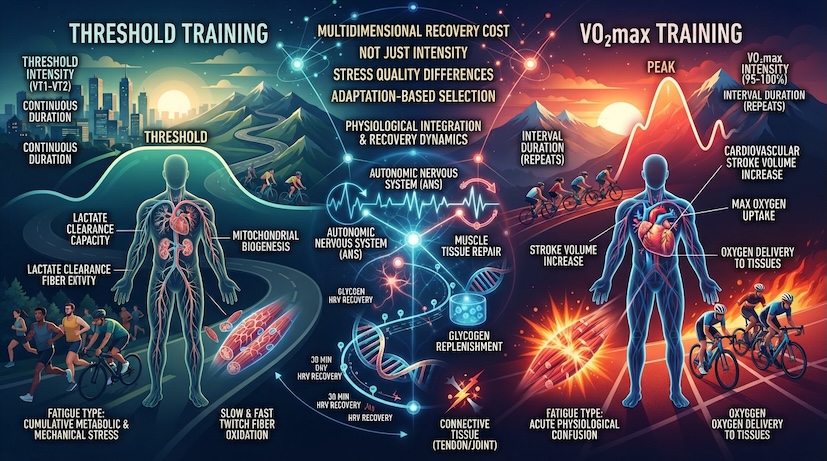
In endurance sports, setting training intensities and managing fatigue are ever-present central challenges. In particular, “threshold training” has long been recommended in many programs based on the premise that it carries a lower burden on the body and allows for more frequent implementation due to quicker recovery compared to high-intensity interval training (VO₂max training).
However, can we truly say that because the exercise intensity is lower, the overall recovery cost is smaller? Is it really rational to judge the value of training based solely on a single axis of “speed of recovery”?
This article re-evaluates the true value of threshold training and VO₂max training from the perspectives of physiological adaptations, autonomic nervous system responses, musculoskeletal loads, and age-related changes in recovery capacity.
- 1. The Limitations of the Notion That “Low Intensity Equals Easy Recovery”
- 2. The Impact of Stimulus Duration and “Total Work”
- 3. Autonomic Nervous System Recovery Dynamics in Physiological Research
- 4. Multiple Evaluation Axes Governing Recovery Costs
- 5. Differences in Target “Physiological Adaptations”
- 6. Design Perspectives for Masters Athletes (40s, 50s, 60s)
- 7. Selection Criteria Based on Event Discipline and Target Race Distance
- 8. Conclusion: Stop Choosing Workouts Based on “Low Recovery Cost”
- References
1. The Limitations of the Notion That “Low Intensity Equals Easy Recovery”
For years, a simple model has been accepted among athletes: “Higher intensity demands more time to recover, while lower intensity allows for faster recovery.” Based on this model, threshold training performed near the lactate threshold (LT) is concluded to have a “lower cost” than high-intensity intervals close to maximal oxygen uptake.
However, physiological stress from exercise is not determined solely by intensity. To capture the loading structure of training comprehensively, it is necessary to analyze multiple variables—such as exercise duration and total work—alongside exercise intensity.
- High Intensity (VO₂max domain): The exercise intensity per unit of time is exceptionally high, triggering substantial acute physiological stress even within a short duration.
- Moderate-to-High Intensity (Threshold domain): The intensity per unit of time is relatively restrained, but the exercise duration tends to be set longer, leading to accumulated mechanical and metabolic stimulus values.
It is not possible to directly calculate actual recovery costs or mechanically derive necessary recovery times using simple calculations or multiplications of “intensity multiplied by time.” While total work and exercise duration are important variables influencing recovery costs, they do not themselves act as single indices that directly dictate recovery costs.
Nevertheless, even if exercise intensity is kept low, longer exercise durations accumulate energy expenditure, metabolic stress, and sustained mechanical loading over extended periods. In other words, jumping to the conclusion that “threshold training always has a lower recovery cost” simply by comparing the “intensity” element is problematic from a physiological standpoint.
2. The Impact of Stimulus Duration and “Total Work”
When evaluating the breadth of training load, a vital perspective is the combination of exercise intensity and duration, along with the resulting influence of “total work.”
For example, let us compare a session consisting of six 3-minute intervals performed at 96% of VO₂max with a session consisting of 30 minutes of continuous running in the lactate threshold zone (midpoint between VT1 and VT2).
| Metric | Threshold Training | VO₂max Intervals |
| Primary Exercise Intensity | Midpoint between VT1 and VT2 | Approx. 96% VO₂max |
| Main Work Interval Duration | 30 minutes continuous | 18 minutes of high-intensity running |
| Recovery Between Intervals | — | 10 minutes of active recovery |
| Metabolic Response (Lactate, etc.) | Relatively stable | Rapid and high |
| Pacing & Structural Demand | Continuous moderate load | Intermittent high load |
While instantaneous surges in local blood lactate concentration and rating of perceived exertion (RPE) tend to be higher during VO₂max intervals, a threshold training session maintaining continuous exercise for 30 minutes places a sustained metabolic demand on active muscle fibers and contributes to muscle glycogen utilization. Simultaneously, it exerts sustained tension stress on trunk muscles maintaining posture and tissues surrounding lower-limb joints.
Although the stress per unit of time is higher in a VO₂max run, a threshold run with its longer duration can result in a substantial cumulative load on energy metabolism and the musculoskeletal system. Consequently, it is problematic to judge that “threshold runs place low burdens and always entail lower recovery costs than VO₂max runs” based solely on intensity; instead, they must be captured multi-dimensionally as differences in the “quality” of fatigue and stress.
3. Autonomic Nervous System Recovery Dynamics in Physiological Research
Addressing the question of “how the recovery speeds of threshold runs and high-intensity intervals are evaluated,” a representative study approaching this from the behavior of the autonomic nervous system is the experiment by Seiler, Haugen, and Kuffel (2007) [1].
Research Design and Results by Seiler, Haugen, and Kuffel (2007)
Seiler and colleagues investigated nine highly trained male runners (mean age $28 \pm 6$ years, mean VO₂max $72 \pm 5$ ml/kg/min, mean weekly training volume $14 \pm 3$ hours) by having them perform multiple sessions of varying exercise intensities to compare and verify post-exercise heart rate variability (HRV) and autonomic nervous system recovery behaviors.
Main Exercise Protocols (60-Minute Sessions):
- Threshold Condition: 20-minute warm-up + 30 minutes of continuous running at an intensity halfway between the first ventilatory threshold (VT1) and second ventilatory threshold (VT2) (approx. 80–85% VO₂max) + 10-minute cool-down.
- VO₂max Condition (Intervals): 20-minute warm-up + six 3-minute intervals at roughly 96% VO₂max equivalent (interspersed with 2-minute active recoveries) + 10-minute cool-down.
Measured Variables and Results in the Study:
- Blood Lactate Concentration: Blood lactate concentration during exercise averaged $2.7 \pm 0.8$ mmol/L in the threshold condition, compared to a markedly higher average of $7.1 \pm 1.6$ mmol/L in the VO₂max condition.
- Autonomic (HRV) Recovery: Measuring the return of heart rate and HRV parameters—indicators of parasympathetic nervous activity—following exercise cessation revealed that in both conditions, parasympathetic indices recovered toward baseline levels approximately 30 minutes post-exercise. The delay in HRV recovery was essentially identical between the two conditions, with HRV returning to baseline at approximately 30 minutes in both cases.
Accurate Interpretation and Limitations of the Research Results
These experimental results demonstrate that even for sessions with substantial discrepancies in exercise intensity, blood lactate concentration, and RPE (rating of perceived exertion), a properly controlled 30-minute threshold run and short-duration VO₂max intervals exhibited nearly identical autonomic recovery dynamics evaluated via post-exercise HRV, with HRV returning to baseline at approximately 30 minutes in both conditions.
However, these findings do not allow us to conclude that the overall physical recovery costs of a threshold run and a VO₂max run were the same.
What was evaluated in this study was primarily the recovery dynamics of the autonomic nervous system and HRV following exercise. The overall physical recovery process from exercise involves diverse physiological processes beyond the autonomic nervous system, which cannot be directly measured solely through HRV assessments.
- Muscle Glycogen Resynthesis Process: The recovery speed of energy stores depleted during exercise.
- Repair of Micro-injuries in Muscle Tissue (DOMS): The structural repair process of muscle fibers and cell membranes.
- Mechanical Load on Connective Tissues (Tendons and Ligaments): The metabolism and repair of tissues surrounding joints.
- Central and Peripheral Neuromuscular Fatigue: The recovery of neural transmission and muscle contraction functions ranging from the motor cortex to muscles.
- Next-Day and Subsequent Exercise Performance: The reproducibility of maximum strength or power output.
Furthermore, it is inappropriate to interpret a high blood lactate concentration during exercise itself as a “primary factor directly inhibiting recovery.” Lactate is an intermediate metabolite generated during metabolic processes and serves as an energy substrate oxidized and utilized by slow-twitch fibers and the myocardium. High or low blood lactate concentrations do not necessarily exhibit a one-to-one correspondence with the functional recovery of muscles or the duration of residual fatigue on subsequent days.
4. Multiple Evaluation Axes Governing Recovery Costs
To properly evaluate recovery processes following training, it is essential to consider multiple evaluation axes comprehensively, rather than remaining confined to single autonomic indices or subjective intensity frameworks.
【Multi-dimensional Evaluation Axes of Recovery Costs】

 [Autonomic] ──────── Restoration process of Heart Rate Variability (HRV)
 [Metabolic] ──────── Utilization and resynthesis speed of muscle glycogen
 [Connective] ─────── Mechanical stress on muscles, tendons, and joints (tension and impact)
 [Endocrine] ──────── Hormone response dynamics (cortisol, testosterone, etc.)
 [Central]   ──────── Dynamics of central and peripheral neuromuscular fatigue
- Mechanical and Structural LoadRunning in the VO₂max domain involves higher peak impact forces upon ground contact and faster movement speeds, imposing greater mechanical stress on tendons, joints, and the muscles supporting the stance phase. On the other hand, threshold running generally involves a longer duration of repeated ground contact, which can accumulate mechanical loading over the course of the session.
- Metabolic LoadThreshold runs drive continuous energy consumption primarily within slow-twitch fibers and some fast-twitch fibers, placing a burden on muscle glycogen. High-intensity intervals acutely stimulate glycolytic metabolism in fast-twitch fibers, but the energy consumption and total work across the entire session may be greater during longer-duration threshold runs.
- Neural and Endocrine System LoadHigh-intensity interval workouts and prolonged threshold workouts may involve central and peripheral neuromuscular fatigue. While indices such as the “cortisol-to-testosterone ratio” are sometimes referenced in research as endocrine markers, they do not serve as infallible metrics capable of determining an individual’s recovery state through isolated blood draws or measurements alone; rather, they must be interpreted comprehensively alongside long-term training stress dynamics and clinical contexts [2].
Thus, both sessions differ in the “quality” of fatigue and the “physiological systems acted upon,” and cannot be compared along a singular, one-dimensional axis of “which one recovers faster.”
5. Differences in Target “Physiological Adaptations”
Broadening our perspective away from the recovery-cost comparison of “which is easier to recover from,” it is critical to view training from the perspective of what kind of physiological adaptations (returns) each intensity brings to the body.
Primary Adaptations Associated with Threshold Training
- Lactate Clearance and Utilization Capacity: Endurance training has been associated with increased expression of monocarboxylate transporters (such as MCT1), which facilitate lactate transport and utilization in oxidative muscle fibers [3].
- Running Economy: Relates to the optimization of neuromuscular control that enhances movement efficiency and suppresses oxygen consumption per unit distance at a given submaximal pace [4].
- Oxidative Capacity of Slow-twitch Fibers: Endurance training promotes mitochondrial adaptations that support sustained aerobic energy production.
Primary Adaptations Associated with VO₂max Training
- Adaptations in the Circulatory System and Cardiac Output: High-intensity interval training can provide a strong cardiovascular stimulus and has been shown to improve stroke volume and VO₂max [5].
- Oxygen Delivery Capacity to Peripheral Tissues: Provides a strong cardiovascular stimulus and can improve oxygen delivery to working muscles [5].
- Development of Oxidative Capacity in Fast-twitch Fibers (Type II): High-intensity exercise recruits fast-twitch fibers and can contribute to their aerobic adaptation [5].
Relationship Between Both Training Types
These adaptations are not mutually exclusive—occurring in only one training type—rather, they manifest with overlapping effects. For example, improvements in cardiac output and peripheral oxygen delivery capacity are characteristically explained by VO₂max training, but capillary network expansion and mitochondrial adaptation are also promoted multi-dimensionally across aerobic exercise in general, including threshold training.
Furthermore, it is not a simple causal relationship where “threshold performance will not rise unless the VO₂max ceiling is raised.” Threshold-domain performance is determined by composite factors such as VO₂max, the percentage utilization of VO₂max (%VO₂max), and running economy [4]. VO₂max is one of the important foundational indices supporting threshold performance, and both are mutually influential.
6. Design Perspectives for Masters Athletes (40s, 50s, 60s)
For aging masters athletes, considering physiological changes associated with aging is critically important when designing training programs.
Scientific Insights on Age-Related Physiological Changes
- Alterations in Connective Tissue Properties (Tendons and Ligaments)As people age, the collagen fiber structure and elastic properties of tendons and connective tissues change, which has been reported to affect the stiffness of structures like the Achilles tendon and impact-absorption capacity. Consequently, attention must be paid to tissue resilience and recovery processes against mechanical stimuli during high-intensity, high-speed exercise.
- Age-Related Changes in Maximum Heart Rate and VO₂maxDue to age-related declines in maximum heart rate and reductions in stroke volume, VO₂max tends to decline gradually. However, it has been demonstrated that regular and appropriate maintenance of high-intensity stimuli can suppress this rate of decline.
- Changes in Autonomic Nervous System Function and Recovery ResponsesIt is known that indices of parasympathetic nervous activity at rest and post-exercise tend to decline with age. However, among masters athletes who have maintained long-term training, autonomic nervous system function is frequently preserved well, and it is not universally true that all older adults shift toward sympathetic dominance. Observation tailored to individual adaptation states is necessary.
Effective Strategies for Masters Athletes
If masters athletes interpret “threshold runs as low-burden” and implement them at excessively high frequencies, they risk accumulating repetitive loads on connective tissues and chronic fatigue. Conversely, if high-intensity stimuli are completely excluded under the premise of “avoiding injuries,” stimuli maintaining the upper limits of cardiorespiratory function may become insufficient.
- Options for Training Intervals Tailored to Individual Differences (e.g., Consideration of 9–10 Day Cycles):Rather than fixing training programs rigidly to a “7-day (1-week) cycle,” using, for example, a 9–10-day cycle can be considered as one option for accommodating individual differences in recovery capacity.
- Utilization of Split Formats (Interval Formats):For instance, instead of performing a continuous 30-minute threshold run, splitting it into formats such as “10 minutes $\times$ 3 reps (with short rests of about 2 minutes in between)” may help reduce form breakdown and localized mechanical stress while maintaining total exercise time and a similar metabolic stimulus.
7. Selection Criteria Based on Event Discipline and Target Race Distance
The ultimate criterion for selecting training stimuli is not the cost aspect of “which is easier to recover from,” but rather how consistently that stimulus aligns with the performance requirements of the target event.
Multi-dimensional Determinants According to Event Distance and Duration
- Distances such as 5,000m (5km run):Performance in a 5,000m race is not determined by a single index; it involves complex interactions among multiple factors, including VO₂max, vVO₂max (the minimum velocity eliciting VO₂max), running economy, lactate dynamics, specific adaptations to race pace, and neuromuscular capacity [4]. While VO₂max is one of the primary determinants, the ability to balance aerobic and anaerobic energy contributions while sustaining a high speed is also important.
- Half Marathons, Full Marathons, Long-Distance Triathlons, etc.:In long-duration events, high priority is placed on energy supply efficiency over extended periods, fat oxidation capacity, economy at specific paces, and the ability to sustain a high %VO₂max (utilization rate).
Regardless of the event distance, rather than leaning toward only one type of stimulus, training should be structured around the demands of the target event within an annual plan (periodization).
8. Conclusion: Stop Choosing Workouts Based on “Low Recovery Cost”
In selecting training menus, relying on a single yardstick of “low-risk, low-cost workouts that seem to offer a high return” has its limits.
- Threshold Training Also Entails Distinct Physiological Stress.Considering the prolonged exercise duration, total work, utilization of muscle glycogen, and sustained loads on postural muscles, it is problematic to judge that “threshold training always has a low recovery cost” based solely on intensity.
- HRV Recovery Illustrates One Facet of Physical Recovery.Seiler et al. (2007) demonstrated that autonomic recovery dynamics evaluated via HRV were nearly identical (both returning to baseline within approximately 30 minutes), but the recovery processes of muscle tissue, connective tissue, the neuromuscular system, and energy stores proceed on distinct timescales.
- Reverse-Engineer from “Required Adaptations” Rather Than “Ease of Recovery.”It is vital to clarify where one’s current challenges lie (improving the upper limit of cardiorespiratory function, enhancing metabolic efficiency, race-pace endurance tailored to the discipline, etc.) and select stimuli that match those objectives.
Breaking away from simplified selection methods driven by “doing this workout because recovery is fast,” and adopting the perspective: “What adaptations do I currently need? How should I design the appropriate load and recovery periods as a set to achieve them?” This approach provides a more rational way to improve athletic performance over the long term while reducing injury risk.
References
- Seiler, S., Haugen, O., & Kuffel, E. (2007). Autonomic recovery after exercise in trained athletes: intensity and duration effects. Medicine and Science in Sports and Exercise, 39(8), 1366–1373.PubMed: 17762370
- Urhausen, A., Gabriel, H., & Kindermann, W. (1995). Blood hormones as markers of training stress and overtraining. Sports Medicine, 20(4), 251–276.PubMed: 8571004
- Dubouchaud, H., Butterfield, G. E., Wolfel, E. E., Bergman, B. C., & Brooks, G. A. (2000). Endurance training, expression, and physiology of LDH, MCT1, and MCT4 in human skeletal muscle. American Journal of Physiology-Endocrinology and Metabolism, 278(4), E571–E579.PubMed: 10751188
- Bassett, D. R., Jr., & Howley, E. T. (2000). Limiting factors for maximum oxygen uptake and determinants of endurance performance. Medicine and Science in Sports and Exercise, 32(1), 70–84.PubMed: 10647532
- Helgerud, J., Høydal, K., Wang, E., Karlsen, T., Berg, P., Bjerkaas, M., … & Hoff, J. (2007). Aerobic high-intensity intervals improve VO2max more than moderate training. Medicine and Science in Sports and Exercise, 39(4), 665–671.PubMed: 17414804
コメント