
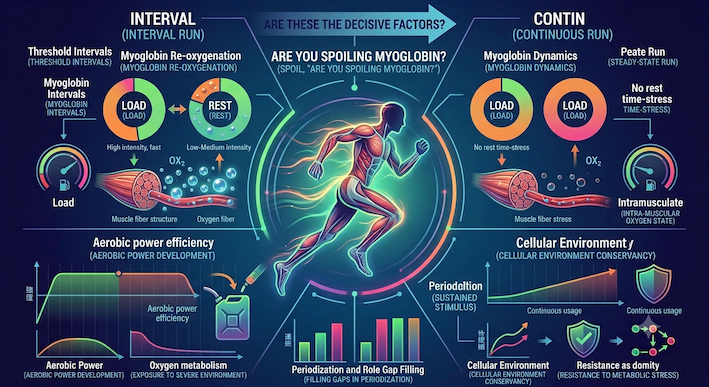
Disclaimer: This article is built upon exercise physiology insights (metabolic signaling, intramyocellular oxygen dynamics, and intracellular environment) as a starting point to construct training hypotheses and a theoretical framework. The term “intracellular maintenance capacity” used in this text does not refer to an established, standardized physiological metric; rather, it is a convenient metaphorical term unique to this article used to describe a muscle cell’s ability to sustain functionality amidst continuous exercise-induced environmental stress. Please read this as a conceptual framework.
In the previous article, we addressed the balance between VLamax and aerobic capacity, presenting the premise that “tempo running (continuous running) is not the universal foundation for everything, but rather a tool to bridge the ‘adaptational gap’ remaining after building a strong aerobic base via threshold intervals.”
However, a very simple yet fundamental question naturally arises:
“If the total workload (running distance or energy expenditure) and intensity (near LT2/VT2) are identical, wouldn’t the adaptations occurring inside the body be exactly the same whether doing continuous or interval running?”
The logic that “applying the same load at the same intensity for the same total volume yields the same results” seems convincing on the surface.
Yet, when we look closely at the temporal and microscopic environment inside muscle cells, a distinct possibility emerges: imposing a continuous, uninterrupted load (tempo running) and imposing an intermittent load interspersed with short rest periods (interval running) subject the cells to vastly different temporal patterns and qualities of stress.
In this article, we will carefully examine and delve deeper into the distinct stimuli provided by tempo running versus threshold intervals from the perspective of myoglobin behavior—which contributes to intramyocellular oxygen storage and transport—and the cell’s internal tolerance to continuous stress.
- 1. The Strength of Threshold Intervals and the “Temporal Structure of Stimuli”
- 2. Uninterrupted Stress and “Intracellular Maintenance Capacity” in Continuous Running
- 3. The Gap Between “Energy Production Capacity” and “Intracellular Maintenance”
- 4. Expanding the Hypothesis Across Event Distances
- 5. Conclusion: Looking at the “Temporal Structure and Emphasis” Rather Than a Binary Choice
- References
1. The Strength of Threshold Intervals and the “Temporal Structure of Stimuli”
First, let us outline the mechanism behind why cruise intervals (threshold split runs) are utilized as such a powerful training tool.
Maintaining High Oxidative Capacity to Maximize Total Workload
By inserting short rest periods of 60 to 90 seconds between 1,000m or 2,000m repeats, the body’s cardiorespiratory and metabolic systems do not fully reset, while some of the physiological disturbances associated with the preceding repetition are partially relieved.
These brief rest intervals may allow the intramyocellular oxygen environment to partially recover (e.g., through reoxygenation of myoglobin), potentially allowing the next repetition to begin with a relatively restored oxidative environment.
The primary strength of threshold intervals lies in this ability to accumulate a high total volume of work at a relatively high intensity while managing fatigue, efficiently stacking aerobic stimuli.
A Thought Experiment: “Pampering Myoglobin”
From the perspective of aerobic development (mitochondrial adaptation and upregulation of oxidative enzymes), this approach is extremely logical.
However, there is an interesting way to interpret this phenomenon from another angle.
To borrow a vivid expression, one could frame it as: “By frequently restoring the oxygen environment during rest intervals, we spare the cells from being exposed to harsh conditions where intramyocellular oxygen levels drop severely (= pampering myoglobin).”
To be clear, this is not an established physiological concept, but rather a metaphor meant to intuitively visualize muscle oxygen dynamics under continuous versus intermittent stimuli. Nonetheless, this metaphor offers a sharp insight when evaluating training stimulus patterns.
2. Uninterrupted Stress and “Intracellular Maintenance Capacity” in Continuous Running
What changes occur within the cellular environment during continuous tempo running, where pace is sustained without rest intervals?
Unrelenting Temporal Stress
In continuous tempo running, there are no rest breaks that allow the intramyocellular oxygen environment to recover between repetitions. Instead, the muscle remains exposed to the exercise-induced oxygenation demands continuously, with the precise oxygenation pattern depending on exercise intensity, muscle recruitment, and oxygen delivery.
Furthermore, even when a runner reaches a physiological steady state, glycolytic flux and the associated metabolic turnover continue, exposing the muscle cells to sustained metabolic demand.
For the purpose of this discussion, we define “intracellular maintenance capacity” as the muscle cell’s ability to maintain structural and operational integrity despite fluctuations in oxygenation, pH, and ionic balance. Continuous tempo running can be viewed as a session specifically applying sustained pressure to this maintenance capacity.
Key Signaling Pathways and the “Nuance” of Adaptations
Major signaling molecules that trigger aerobic adaptation (such as AMPK and PGC-1α) are activated in both continuous and intermittent exercise, driven primarily by exercise intensity and total workload.
This does not mean continuous tempo running fails to train mitochondria; both methods provide aerobic stimulation.
However, even when the same primary signaling pathways are activated, differences in the duration of the stimulus, intramyocellular oxygenation, and temporal patterns of metabolic stress may influence the relative emphasis (or nuance) of downstream gene expression and adaptive responses.
3. The Gap Between “Energy Production Capacity” and “Intracellular Maintenance”
Let us categorize the limiting factors of endurance performance across middle and long distances:
- Aerobic Power / Energy Production Capacity ➔ Can be developed effectively through threshold intervals, which can make it easier to accumulate a substantial amount of work while controlling fatigue.
- Tolerance to Continuous Metabolic Stress (Intracellular Maintenance Capacity) ➔ May be preferentially challenged by sustained, continuous loading such as tempo running.
If an athlete extensively executes threshold intervals and develops a high-capacity aerobic engine, but their ability to sustain function under continuous, harsh cellular conditions remains relatively underdeveloped, a gap is created. It is precisely at this moment that introducing continuous tempo runs gains a clear purpose.
A Practical Hypothesis to Bridge the Gap
Bridging this gap does not require year-round, perpetual tempo running.
In the late phase of a periodized plan—once the general aerobic base (mitochondrial volume, capillary density, and cardiorespiratory capacity) is thoroughly established—introducing weekly tempo runs for a few weeks to apply “continuous load” serves as a rational practical hypothesis.
The exact frequency and duration required to achieve adaptation vary depending on individual performance levels, race distance, and existing training background, making a one-size-fits-all rule impractical. Nevertheless, from the viewpoint of the temporal structure of physiological stimuli, the strategy of “upgrading the engine via intervals, then finishing with a few weeks of continuous runs to align cellular tolerance” represents a plausible practical framework.
4. Expanding the Hypothesis Across Event Distances
This perspective on “tolerance to continuous load” changes depending on the event characteristics—ranging from middle distance (800m–1500m) to long distance (5000m to marathon).
Theoretical Considerations for Middle-Distance Runners
(Note: This represents the most speculative portion of our hypothesis.)
Middle-distance runners with a relatively high VLamax have a greater glycolytic contribution to energy production and may therefore experience substantial metabolic stress during high-intensity and threshold-oriented interval training.
Consequently, one possible hypothesis is that, for some middle-distance athletes, the additional stimulus provided by continuous tempo running may be smaller than it is for athletes whose training already places less emphasis on glycolytic stress. In such athletes, a training approach that places greater emphasis on interval formats may therefore be a reasonable hypothesis to explore.
The Long-Distance and Marathon Perspective
Conversely, in long-distance events like the marathon, race intensity is substantially lower relative to VO2max, creating a physiological environment distinct from the acute oxygen demands of short-duration, high-intensity efforts.
For marathon runners, continuous running can serve several important functions that are distinct from those provided by intervals: they build resilience against compound limitations such as prolonged mechanical loading, muscle fatigue, glycogen depletion, and thermal stress. Thus, continuous runs fulfill a valuable role complementary to intervals.
5. Conclusion: Looking at the “Temporal Structure and Emphasis” Rather Than a Binary Choice
Debating whether cruise intervals or continuous tempo runs are superior is a false dichotomy.
- Cruise Intervals: A tool that partially restores the intramyocellular oxygen environment via rest periods, allowing high total workload to be accumulated while managing fatigue to efficiently develop aerobic energy systems.
- Continuous Tempo Running: A tool that provides uninterrupted load without formal rest, potentially challenging the muscle cells to adapt to sustained metabolic stress and, within the conceptual framework of this article, developing what we describe as intracellular maintenance capacity.
While both methods elicit aerobic adaptations, the fundamental takeaway is that even with identical total workloads, the temporal environment experienced by muscle cells differs depending on whether the stimulus is continuous or intermittent.
By utilizing intervals to expand the capacity of the aerobic engine, and strategically integrating targeted tempo runs when resilience against continuous fatigue is lacking, athletes can potentially better individualize their training.
Rather than running continuous miles simply because “that is how a base is built,” understanding how the temporal structure of a stimulus shapes cellular adaptation can provide a useful framework for designing more individualized training plans.
References
- Postnikova G, Shekhovtsova E. Myoglobin: Oxygen Depot or Oxygen Transporter to Mitochondria? A Novel Mechanism of Myoglobin Deoxygenation in Cells. Biochemistry (Mosc). 2018. PMID: 29618303
PubMed - MRS Evidence of Adequate O₂ Supply in Human Skeletal Muscle at the Onset of Exercise. PMID: 25830362
PubMed - Wang L, Sahlin K. The effect of continuous and interval exercise on PGC-1α and PDK4 mRNA in type I and type II fibres of human skeletal muscle. Acta Physiol (Oxf). 2012. PMID: 21883960
PubMed - Signaling mechanisms in skeletal muscle: acute responses and chronic adaptations to exercise. PMID: 18380005
PubMed
コメント