
“I want to start exercising for my health, but I’m too busy with work to find a solid block of time.” “Between strength training and cardio, which one should I do—and how much—to be most efficient?”
I know many people struggle with these exact questions. As someone who has personally had a hard time fitting workouts into a packed daily schedule, I decided to take a careful look at the latest research data to organize a practical framework for getting the maximum return on limited time.
The catalyst for this was a Harvard University study published in 2026 (Zhang et al., 2026). This large-scale prospective cohort study, which tracked 147,374 people for up to 30 years, has provided concrete observational numbers for exercise patterns that were previously often discussed in vague terms.
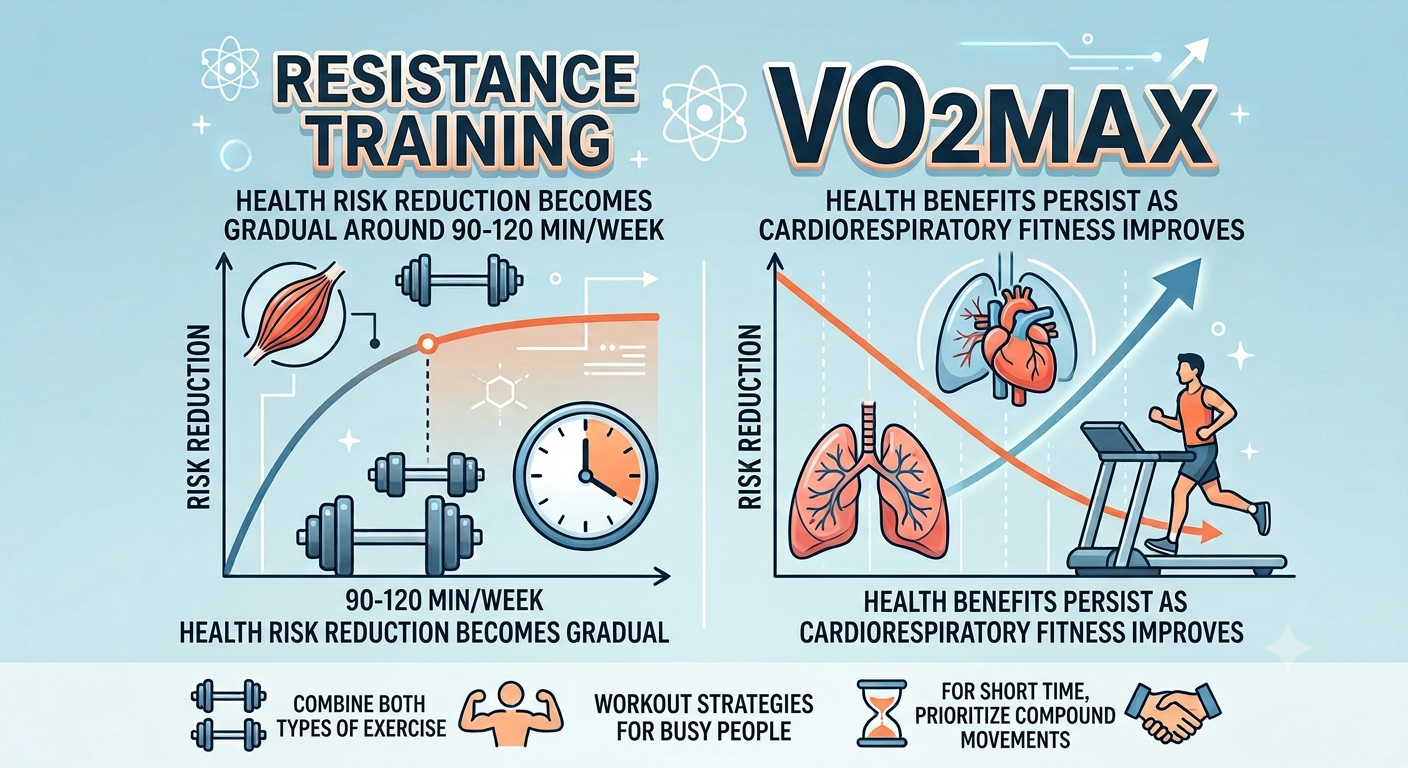
To put the conclusion first, the key is to maintain both regular resistance training and cardiorespiratory fitness (CRF). Previous meta-analyses have shown that participation in muscle-strengthening activities and higher CRF are independently associated with lower mortality risk. These represent two complementary aspects of physical health: resistance training helps maintain muscular strength and function, while aerobic exercise helps develop and preserve cardiorespiratory fitness. In fact, in the 2026 Zhang et al. study, groups combining specific volumes of both aerobic physical activity and resistance training—such as 30 to under 45 MET-hours/week of aerobic activity paired with 60–119 minutes/week of resistance training (HR 0.55)—showed substantially lower all-cause mortality risk compared to those with low activity in both.
- “Muscular Strength” and “Cardiorespiratory Fitness (CRF)”: Two Key Factors in Healthy Longevity
- 1. The Association Between Resistance Training and Lower Mortality Risk Levels Off Around 90–120 Minutes per Week
- Deep Dive: Why Muscle “Function (Strength)” Matters Alongside “Volume (Size)”
- 2. Cardiorespiratory Fitness (CRF) Shows No Clear Plateau Within Observed Ranges
- 3. [Practical Application] How to Allocate Limited Time
- Summary
- References
“Muscular Strength” and “Cardiorespiratory Fitness (CRF)”: Two Key Factors in Healthy Longevity
Under current scientific evidence, maintaining both muscular strength and cardiorespiratory fitness (CRF)—often evaluated via $VO_2\text{max}$—is considered particularly important when thinking about healthspan and healthy longevity.
In meta-analyses examining vast amounts of historical data, participation in muscle-strengthening activities and higher CRF have been shown to predict mortality risk independently. Note that muscle mass (size) and muscular strength (function) are not the same thing, and neither physical capacity can fully substitute for the other.
Indeed, recent observational research demonstrates that combining both aerobic physical activity and resistance training is associated with particularly low all-cause mortality risk.
1. The Association Between Resistance Training and Lower Mortality Risk Levels Off Around 90–120 Minutes per Week
Previously, a systematic review and meta-analysis of 16 cohort studies (Momma et al., 2022) reported a J-shaped association in which the maximum risk reduction for all-cause, cardiovascular, and total cancer mortality was observed at roughly 30 to 60 minutes per week of muscle-strengthening activities.
Building on this body of evidence with another large, long-term cohort, the 2026 Harvard study (Zhang et al., 2026) found that among groups performing resistance training, all-cause mortality risk was 13% lower in the 90–119 minutes/week group (HR 0.87; 95% CI 0.81–0.95) compared to non-participants, and leveled off in the 120+ minutes/week group (HR 0.92; 95% CI 0.86–0.98) with no clear additional reduction confirmed. (Differences in study populations, assessment methods, and statistical modeling across cohorts explain why exact peak ranges can vary slightly between studies.)
Importantly, even those training 120 minutes or more per week still had a lower mortality risk than those who did no strength training at all—meaning the benefits do not vanish beyond two hours.
■ Important Caveats When Interpreting This Data
- Observational context vs. WHO guidelines: Because Zhang et al. (2026) was an observational study assessing self-reported weekly duration via questionnaires rather than a controlled intervention prescribing exact sets, weights, repetitions, or exercises, 90–120 minutes/week should be viewed as an epidemiological reference point rather than a universal clinical prescription. By comparison, World Health Organization (WHO) physical activity guidelines recommend that adults perform muscle-strengthening activities involving major muscle groups on 2 or more days a week, alongside 150–300 minutes of moderate-intensity or 75–150 minutes of vigorous-intensity aerobic activity per week.
- Purpose matters: This research specifically evaluated mortality outcomes, not muscle hypertrophy, athletic performance, or quality of life (QOL). If your goal is muscle hypertrophy, maximal strength, or competitive performance, training beyond 90–120 minutes per week remains meaningful depending on your objectives. However, for busy individuals focused on mortality risk reduction, aiming for roughly 90–120 minutes per week serves as a practical, evidence-informed reference point.
Deep Dive: Why Muscle “Function (Strength)” Matters Alongside “Volume (Size)”
Another concept strongly supported in modern sports science and gerontology is that muscular strength and physical function—such as grip strength and chair-stand performance—are vital predictors of mortality risk alongside muscle mass.
In recent years, the concept of “Muscle Quality” has also been thought to be deeply involved in this functional capacity.
① What Grip Strength and Chair-Stand Tests Reveal About Overall Health
Large-scale cohort studies tracking hundreds of thousands of individuals—such as the UK Biobank (Celis-Morales et al., 2018) and the Tromsø Study (Johansson et al., 2023)—consistently show that lower grip strength and poorer chair-stand performance are strongly associated with higher all-cause mortality. Furthermore, a UK Biobank study examining both metrics together in 13,392 adults with type 2 diabetes (Wei et al., 2024) found that while lower handgrip strength was linearly associated with higher mortality risk, skeletal muscle mass showed a non-linear (U-shaped) relationship—suggesting that functional strength can be an even more direct predictor of survival than muscle mass alone in certain clinical populations.
Grip strength (a practical measure of handgrip strength that can also serve as a marker of overall muscular strength) and the 5-repetition chair-stand test (an assessment of lower-body functional performance involving strength, power, and mobility) provide complementary information about physical function. Notably, the Tromsø Study demonstrated that handgrip strength and chair-stand performance can identify different individuals at risk, meaning the two tests are not interchangeable.
These tests provide information about physical function and may reflect the combined influence of factors such as physical activity, nutritional status, aging, and chronic health conditions. However, they are functional performance measures rather than direct assessments of these underlying factors.
② Physiological Factors Related to “Muscle Quality”
Muscle quality does not yet have a single universal definition, and evaluation methods vary across studies, though it is generally thought to reflect factors such as intramuscular fat, neuromuscular function, and force output. Specifically, the following physiological factors are closely related:
- Myosteatosis (Fat Accumulation in Skeletal Muscle):A condition characterized by excessive fat accumulation within and around skeletal muscle. This can include intramyocellular lipids (lipid droplets inside muscle cells), intramuscular adipose tissue (fat between muscle fibers and fascicles), and intermuscular adipose tissue (fat between muscle groups). Myosteatosis is associated with aging, inactivity, and metabolic abnormalities, and is linked to poorer muscle quality and declines in strength and physical performance.
- Neuromuscular Function (Motor Unit Recruitment and Rate Coding):Force production depends not only on the number and types of motor units recruited by the nervous system, but also on their firing frequency (rate coding). The nervous system continuously adjusts these factors to regulate the amount of force generated by a muscle.
- Related Metabolic Factors (Mitochondrial Function):Mitochondrial function plays an important role in muscle energy metabolism and oxidative capacity. Age-related and metabolic changes in mitochondrial function may therefore contribute to declines in muscle endurance and overall physical performance.
When considering healthy longevity, what matters is not merely superficial size, but maintaining functional muscle capable of exerting appropriate force when needed.
2. Cardiorespiratory Fitness (CRF) Shows No Clear Plateau Within Observed Ranges
While the mortality-reduction association of resistance training levels off around 90–120 minutes per week, multiple large-scale studies consistently show that higher cardiorespiratory fitness (CRF)—commonly assessed via $VO_2\text{max}$ or $VO_2\text{peak}$—is associated with progressively lower mortality risk.
In an updated meta-analysis of 37 cohort studies involving 2,258,029 participants (Laukkanen et al., 2022), individuals in the highest third of CRF had a roughly 45% lower all-cause mortality risk compared to those in the lowest third, with every 1-MET increase in CRF associated with an approximately 11% lower risk. Similarly, a subsequent meta-analysis of 42 studies representing 3.8 million observations (Singh et al., 2025) found that each 1-MET higher CRF was associated with an approximately 14% lower risk of all-cause mortality. Within the fitness ranges observed across these cohorts, no clear threshold where higher CRF becomes detrimental to survival has been identified.
That said, because these findings come from observational studies—and cannot prove that infinite increases in training volume yield unlimited survival gains beyond studied ranges—it is most accurate to say that current evidence has not identified a clear plateau in the survival benefits associated with higher CRF. Building and maintaining aerobic stamina remains one of the most promising investments you can make in your long-term health.
3. [Practical Application] How to Allocate Limited Time
Based on these findings—along with practical coaching experience—here is an approach to efficiently incorporating exercise into a tight schedule.
① Start by Adding What You Are Currently Missing Most
If your routine consists entirely of aerobic exercise like running with zero resistance training, add even 30 to 60 minutes of strength work per week. Conversely, if you only lift weights at the gym without doing anything that elevates your heart rate, incorporate aerobic exercise. Introducing the exercise modality you currently lack can be expected to yield significant health benefits.
② If You Only Have 2 Days a Week, Combining Them on the Same Day Is Practical
A systematic review and meta-analysis of 43 studies on concurrent training (Schumann et al., 2022) found that combining aerobic and strength training does not significantly impair maximal strength or hypertrophy, though explosive strength (power) gains may be slightly blunted—particularly when both are performed within the exact same session. Therefore, while competitive athletes prioritizing explosive power may want to separate sessions or allow recovery hours between them, for busy individuals focused on health maintenance and general fitness, combining both on the same day is a highly practical way to keep a schedule from falling apart.
③ A Practical Order for Trimming Workouts During Busy Weeks
During weeks when you are inevitably too busy to complete your planned training volume, I recommend adjusting your routine in the following practical order rather than skipping workouts entirely:
- Trim auxiliary isolation exercises first (unless needed for targeted rehabilitation or specific weak points, omit single-joint movements for smaller muscle groups like arms or shoulders).
- Reduce the number of sets while maintaining load (e.g., drop from 3 sets down to 2 sets, keeping the weight challenging enough to preserve strength).
- Prioritize the main compound movements and remove optional extra work. When time is extremely limited, focus on maintaining challenging sets of the major movement patterns rather than trying to complete every planned accessory exercise or additional set.
Prioritizing multi-joint “compound” movements like squats—which engage multiple joints and large muscle groups simultaneously—allows you to preserve strength efficiently when time is scarce.
Summary
- For busy individuals aiming to support healthy longevity: Use approximately 90–120 minutes of weekly resistance training as an epidemiological reference point, rather than a universal prescription. Separately, allocate time to aerobic exercise—keeping general benchmarks such as the WHO guidelines (150–300 minutes of moderate-intensity or 75–150 minutes of vigorous-intensity aerobic activity per week) in mind—to build and maintain cardiorespiratory fitness.
- For those who love athletic performance or building muscle: You do not need to restrict yourself to the 90–120 minute observational benchmark associated with mortality risk. Set your training volume according to your specific goals, such as hypertrophy, maximal strength, or competitive performance.
While this article focused primarily on all-cause mortality as a health outcome, we must not forget that exercise offers numerous other benefits, including improvements in cognitive function, mental health, bone mineral density, activities of daily living, and overall quality of life (QOL).
At the same time, even the most ideal training program means nothing if you cannot stick with it. Finding a sustainable routine that fits naturally into your lifestyle is ultimately what matters most over the long term.
What current evidence demonstrates is that “the exercise you accumulate today is a solid investment in your future self.” Allocate your time wisely to match your own lifestyle.
References
1. Zhang Y, Lee DH, Rezende LFM, et al. (2026). Long-term resistance training with all-cause and cause-specific mortality: assessing dose-response and joint associations with aerobic physical activity. British Journal of Sports Medicine. PMID: 42230125
2. Momma H, Kawakami R, Honda T, Sawada SS. (2022). Muscle-strengthening activities are associated with lower risk and mortality in major non-communicable diseases: a systematic review and meta-analysis of cohort studies. British Journal of Sports Medicine. PMID: 35228201
3. Laukkanen JA, Isiozor NM, Kunutsor SK. (2022). Objectively Assessed Cardiorespiratory Fitness and All-Cause Mortality Risk: An Updated Meta-analysis of 37 Cohort Studies Involving 2,258,029 Participants. Mayo Clinic Proceedings. PMID: 35562197
4. Singh B, Cadenas-Sanchez C, da Costa BGG, et al. (2025). Comparison of objectively measured and estimated cardiorespiratory fitness to predict all-cause and cardiovascular disease mortality in adults: A systematic review and meta-analysis of 42 studies representing 35 cohorts and 3.8 million observations. Journal of Sport and Health Science. PMID: 39271056
5. Celis-Morales CA, Welsh P, Lyall DM, et al. (2018). Associations of grip strength with cardiovascular, respiratory, and cancer outcomes and all cause mortality: prospective cohort study of half a million UK Biobank participants. BMJ. PMID: 29739772
6. Wei L, Zeng J, Fan M, et al. (2024). Associations between handgrip strength and skeletal muscle mass with all-cause mortality and cardiovascular mortality in people with type 2 diabetes: A prospective cohort study of the UK Biobank. Journal of Diabetes. PMID: 37608605
7. Schumann M, Feuerbacher JF, Sünkeler M, et al. (2022). Compatibility of Concurrent Aerobic and Strength Training for Skeletal Muscle Size and Function: An Updated Systematic Review and Meta-Analysis. Sports Medicine. PMID: 34757594
8. Johansson J, Grimsgaard S, Strand BH, et al. (2023). Comparing associations of handgrip strength and chair stand performance with all-cause mortality—implications for defining probable sarcopenia: the Tromsø Study 2015–2020. BMC Medicine. PMID: 37981689
9. Correa-de-Araujo R, Addison O, Miljkovic I, et al. (2020). Myosteatosis in the Context of Skeletal Muscle Function Deficit: An Interdisciplinary Workshop at the National Institute on Aging. Frontiers in Physiology. PMID: 32903666
10. McGregor RA, Cameron-Smith D, Poppitt SD. (2014). It is not just muscle mass: a review of muscle quality, composition and metabolism during ageing as determinants of muscle function and mobility in later life. Longevity & Healthspan. PMID: 25520782
コメント