
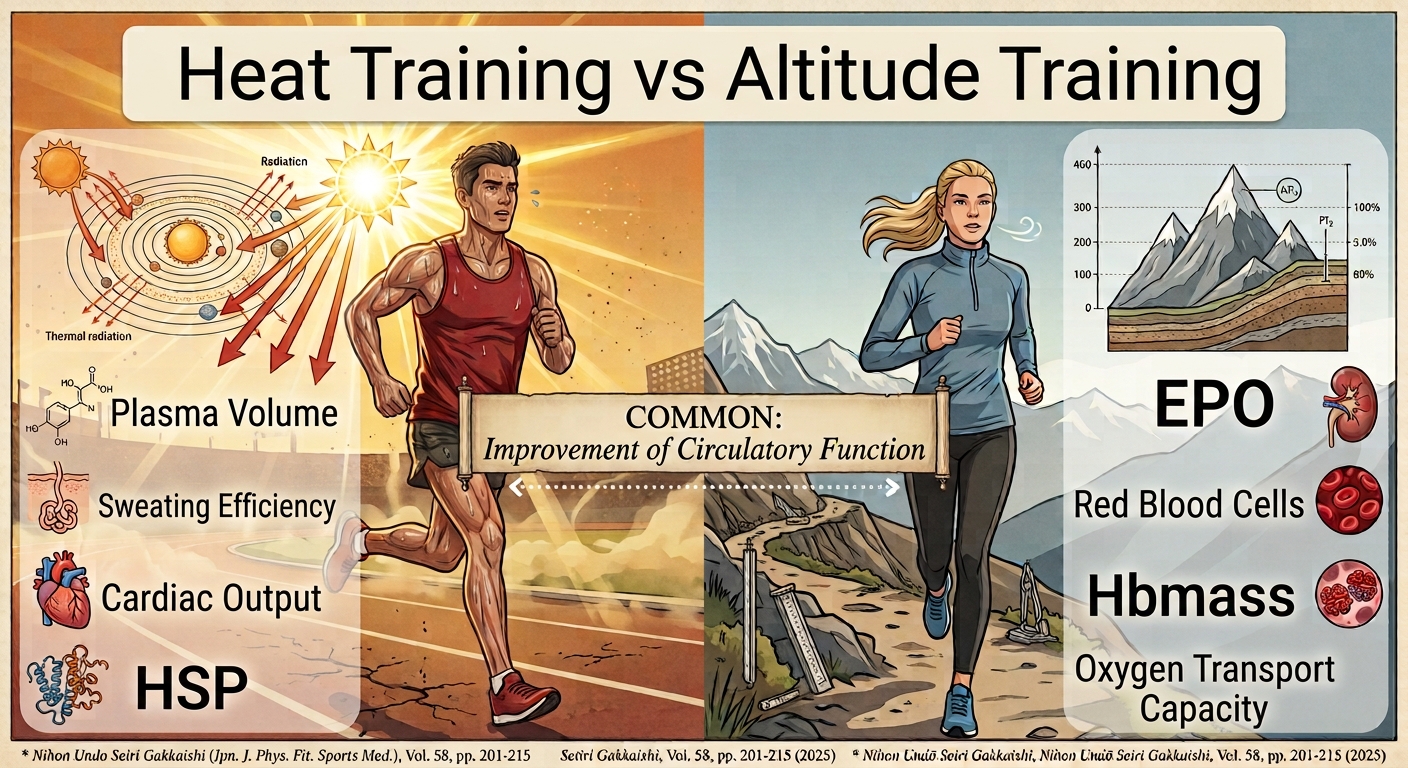
When marathoners, triathletes, and cyclists look to break through performance plateaus, altitude training almost always enters the conversation. However, traveling to high altitudes requires substantial financial investment and weeks away from daily life, making it a viable strategy for pros and elites while remaining out of reach for most amateur endurance athletes.
This practical barrier has led to a simple and provocative comparison: heat training is sometimes described as “poor man’s altitude training.” The premise sounds compelling: train in hot conditions to trigger physiological adaptations similar to those associated with high-altitude exposure without leaving home or purchasing expensive equipment.
Yet, looking through the lens of exercise physiology and biochemistry reveals a more nuanced reality. While the two methods share key cardiovascular overlap, conflating them misses critical physiological distinctions.
Here is a breakdown of how heat and altitude impose distinct internal loads, how the body adapts to each, and why heat training is a potent, independent physiological tool in its own right.
Internal Load: How Heat and Altitude Strain the Body
Both heat and altitude reduce external output—your pace or wattage drops at the same perceived effort compared to temperate sea-level conditions. However, the internal mechanisms causing this performance drop differ fundamentally.
- Heat Stress: Cardiovascular Conflict and Thermal Drift
- Altitude Stress: Reduced Oxygen Pressure and Cellular Hypoxia
- Plasma Volume Expansion vs. Initial Hemoconcentration
- The Decisive Line: Erythropoietin (EPO) and Red Blood Cell Mass
- Thermoregulatory Superiority
- Cellular Stress Response via Heat Shock Proteins (HSPs)
- Key References
Heat Stress: Cardiovascular Conflict and Thermal Drift
Training in the heat generates significant metabolic heat inside working muscles. To keep core temperature from spiking to dangerous levels, your nervous system dilates blood vessels near the skin surface, directing blood outward to dump heat into the environment.
This triggers three concurrent physiological struggles:
- Blood Flow Competition: Working muscles require substantial blood flow to support oxygen delivery, while the skin simultaneously requires increased circulation to dissipate heat. As thermal strain rises, meeting both demands places increasing stress on the cardiovascular system.
- Cardiovascular Drift: Profuse sweating drains plasma volume (the liquid portion of your blood). As circulating blood volume drops, the heart pumps less blood per beat (reduced stroke volume). To maintain cardiac output and supply oxygen to tissues, heart rate rises significantly.
- Central and Perceptual Fatigue: As thermal strain and core temperature rise, central nervous system function and the perception of effort may be affected, contributing to reduced voluntary exercise intensity and performance.
In short, performance degradation under heat stems from thermal overload and competing circulatory demands.
Altitude Stress: Reduced Oxygen Pressure and Cellular Hypoxia
At altitudes above 2,000 meters (6,500 feet), atmospheric pressure drops. While air still contains 21% oxygen, the lower ambient pressure decreases the “partial pressure of inspired oxygen” ($P_{I}O_2$), reducing how much oxygen diffuses from your lungs into your bloodstream.
This creates a distinct set of internal strains:
- Lower Arterial Oxygen Saturation ($SpO_2$): Less oxygen binds to hemoglobin, depriving cells and working muscles of required oxygen.
- Compensatory Cardiopulmonary Responses: Reduced oxygen availability increases the relative physiological strain of exercise. Ventilation rises, while cardiovascular responses change depending on exercise intensity, altitude, and the degree of acclimatization.
- Increased Relative Intensity (%$VO_2max$): Because maximum oxygen uptake ($VO_2max$) drops at altitude, running at a normal sea-level pace requires a much higher percentage of your altitude-adjusted $VO_2max$. The body shifts heavily toward carbohydrate metabolism (glycolysis) to generate energy faster under oxygen-scarce conditions.
Here, performance degradation stems directly from environmental oxygen deprivation.
Physiological Adaptations: Similarities and Critical Differences
While heat and altitude present different primary stresses, their long-term adaptations overlap in cardiovascular efficiency—yet diverge sharply when it comes to oxygen-carrying capacity.
Plasma Volume Expansion vs. Initial Hemoconcentration
The liquid component of your blood—plasma volume—responds in opposite directions during the initial stages of heat and altitude exposure:
- Heat Acclimatization: Dehydration and hemoconcentration (thicker blood) trigger the release of fluid-retaining hormones such as aldosterone and vasopressin. These signal the kidneys to reabsorb sodium and water, expanding plasma volume by 5% to 15% within 7 to 14 days.
- Altitude Acclimatization: Initially, plasma volume drops by 10% to 15% due to hyperventilation, dry air, and altitude-induced diuresis (increased urination). Over subsequent weeks, plasma volume may gradually recover toward baseline, while sufficiently strong and prolonged hypoxic exposure can stimulate erythropoiesis and increase hemoglobin mass. The magnitude of these responses varies considerably depending on the altitude, duration of exposure, and individual factors.
Although heat and altitude produce different changes in blood volume and oxygen availability, both can lead to physiological adaptations that improve endurance performance. However, the mechanisms are not identical.
Heat acclimation primarily expands plasma volume, which can improve venous return, support stroke volume, and reduce cardiovascular strain during exercise. These cardiovascular adaptations may contribute to improved aerobic performance, although the precise mechanisms underlying performance gains are likely multifactorial.
Research in trained cyclists, for example, has shown that 10 days of heat acclimation increased plasma volume by approximately 6.5% and was accompanied by improvements in maximal cardiac output, $VO_2max$, and time-trial performance under both cool and hot conditions.
The Decisive Line: Erythropoietin (EPO) and Red Blood Cell Mass
Unlike sustained hypoxic exposure, heat training is not generally considered a reliable stimulus for increasing erythropoietin production or hemoglobin mass.
Altitude training can increase the body’s oxygen-carrying capacity through increases in hemoglobin mass when the hypoxic stimulus is sufficient (depending on exposure duration, altitude elevation, individual responsiveness, and iron status).
Simply put:
- Altitude training can expand the oxygen carriers (hemoglobin mass) under sufficient hypoxic stimulus.
- Heat training primarily expands plasma volume and improves cardiovascular and thermoregulatory efficiency.
Distinctive Adaptations to Heat Training
Heat training is far from a second-rate substitute for altitude work; it produces distinct physiological adaptations that are particularly characteristic of repeated heat exposure.
Thermoregulatory Superiority
Consistent heat exposure alters sweating and cooling mechanisms:
- Lower Sweating Threshold: Sweating begins at a lower core temperature, slowing the initial rate of heat storage.
- Higher Sweat Rate & Efficient Skin Blood Flow: Sweat glands increase output while cutaneous vessels distribute heat more effectively.
- Electrolyte Conservation: Aldosterone upregulation enhances sodium reabsorption in sweat glands. Sweat becomes more dilute, preserving crucial electrolyte balance during prolonged efforts.
These adaptations reduce thermal and cardiovascular strain during exercise, helping athletes better maintain pacing and power output in hot conditions.
Cellular Stress Response via Heat Shock Proteins (HSPs)
Heat Shock Proteins (particularly members of the HSP70 family) help stabilize damaged or misfolded proteins and support cellular stress tolerance. Through these protective mechanisms, they may contribute to maintaining cellular and mitochondrial function during periods of thermal stress.
Pathophysiological Stress: How Damage Differs
Recovery profiles also differ based on how heat and altitude stress internal organs:
- Heat Stress & Systemic Inflammation: High core temperatures reduce gut blood flow (splanchnic vasoconstriction) as blood shifts to the skin. This temporary intestinal ischemia weakens the gut lining, allowing endotoxins (bacterial lipopolysaccharides) to leak into circulation. This endotoxemia can trigger a systemic inflammatory response, producing profound post-workout fatigue (Sawka et al., 2011).
- Altitude Stress & Oxidative Load: Exercise under hypoxia increases reactive oxygen species (ROS), causing cellular oxidative stress. Additionally, altitude can suppress appetite (risking muscle catabolism) and disrupt sleep architecture via periodic breathing patterns.
Comparison Table: Heat vs. Altitude Adaptation
| Adaptive Parameter | Heat Training | Altitude Training |
| Plasma Volume | Rapid Expansion (+5% to +15%) | Initial drop, followed by slow recovery |
| Stroke Volume (SV) | Often improved through plasma volume expansion and reduced cardiovascular strain | Responses depend on altitude exposure and acclimatization; not uniformly increased during altitude exposure |
| Submaximal Heart Rate | Often reduced following heat acclimation | May change following acclimatization, depending on the altitude exposure and testing conditions |
| EPO Secretion & Red Blood Cells | Not a reliable stimulus for increasing EPO or hemoglobin mass | Can increase with sufficient duration and magnitude of hypoxic exposure |
| Oxygen Carrying Capacity ($Hb_{mass}$) | Generally unchanged | Can increase following sufficient hypoxic exposure |
| Sweat Rate & Electrolyte Retention | Dramatically Improved | Minimal impact |
| Cellular Heat-Stress Response | Strong induction of heat-shock proteins | Not a primary adaptation |
| Primary Driver of Adaptation | Cardiovascular expansion & thermoregulation | Oxygen-carrying capacity ($Hb_{mass}$) & non-hematological factors |
Reframing Heat Training for Endurance Athletes
For most amateur endurance athletes, altitude training is simply not a realistic option. It requires time, money, travel, and access to specialized environments that are available to only a small minority of athletes.
Heat, however, is different. It arrives every summer, whether we are elite athletes or recreational competitors.
Rather than viewing hot conditions simply as an obstacle to training, we can also recognize them as a physiological challenge that—when managed safely and progressively—can stimulate meaningful cardiovascular and thermoregulatory adaptations.
Heat training is not an inferior substitute for altitude training. It is a different form of environmental stress with its own physiological advantages. For athletes who cannot travel to the mountains, that does not make heat a compromise—it makes it an accessible opportunity already waiting outside the door.
Key References
- Lorenzo, S., Halliwill, J. R., Sawka, M. N., & Minson, C. T. (2010). Heat acclimation improves exercise performance. Journal of Applied Physiology, 109(4), 1140–1147. DOI: 10.1152/japplphysiol.00495.2010. (PubMed)
- Sawka, M. N., Leon, L. R., Montain, S. J., & Sonna, L. A. (2011). Integrated physiological mechanisms of exercise performance, adaptation, and maladaptation to heat stress. Comprehensive Physiology, 1(4), 1883–1928. (PubMed)
- Périard, J. D., Racinais, S., & Sawka, M. N. (2015). Adaptations and mechanisms of human heat acclimation: Applications for competitive athletes and sports. Scandinavian Journal of Medicine & Science in Sports, 25(S1), 20–38. (Wiley Online Library)
- Gore, C. J., Clark, S. A., & Saunders, P. U. (2007). Nonhematological mechanisms of improved sea-level performance after hypoxic exposure. Medicine & Science in Sports & Exercise, 39(9), 1600–1609. (PubMed)
コメント