
- Highlighting the Hidden Vulnerability of Powerful-Looking Athletes
- 1. Unraveling Heat Dissipation via the Surface Area-to-Volume Ratio
- 2. Physiological Considerations: Internal Heat Production and Cardiovascular Strain
- 3. The Sweating Dynamic: Evaporation Constraints and Humidity
- 4. Cold Environments: A Different Thermal Balance
- 5. Aligning Body Traits with Environmental Conditions
- 6. Heat Mitigation Strategies for Larger Athletes
- Conclusion
- References
Highlighting the Hidden Vulnerability of Powerful-Looking Athletes
When you look at broad-framed, muscular athletes or tall, sleek competitors, don’t they naturally project an image of strength and power? Speaking for myself, whenever I spot people like that at a race venue, I get completely intimidated. I catch myself holding my head in my hands, thinking, “Man, I’ve come to the wrong place…” (laughs).
However, in actual races—especially demanding long-distance competitions or endurance events held in the heat of summer—it is not uncommon to observe these larger athletes struggling with the heat or experiencing a decline in speed during the latter stages of the race.
This is not simply a matter of mental toughness or inadequate training. Heat tolerance is complex and influenced by acclimatization, pacing, hydration, and recovery. However, physical and physiological principles suggest that body size itself can create certain thermoregulatory challenges in hot environments.
It is a bit like fitting a powerful, high-output engine into a vehicle without giving it a cooling system large enough to handle the heat it produces. This article explores why larger athletes may face greater thermoregulatory challenges in the heat and examines practical thermal management strategies to help them manage harsh conditions effectively.
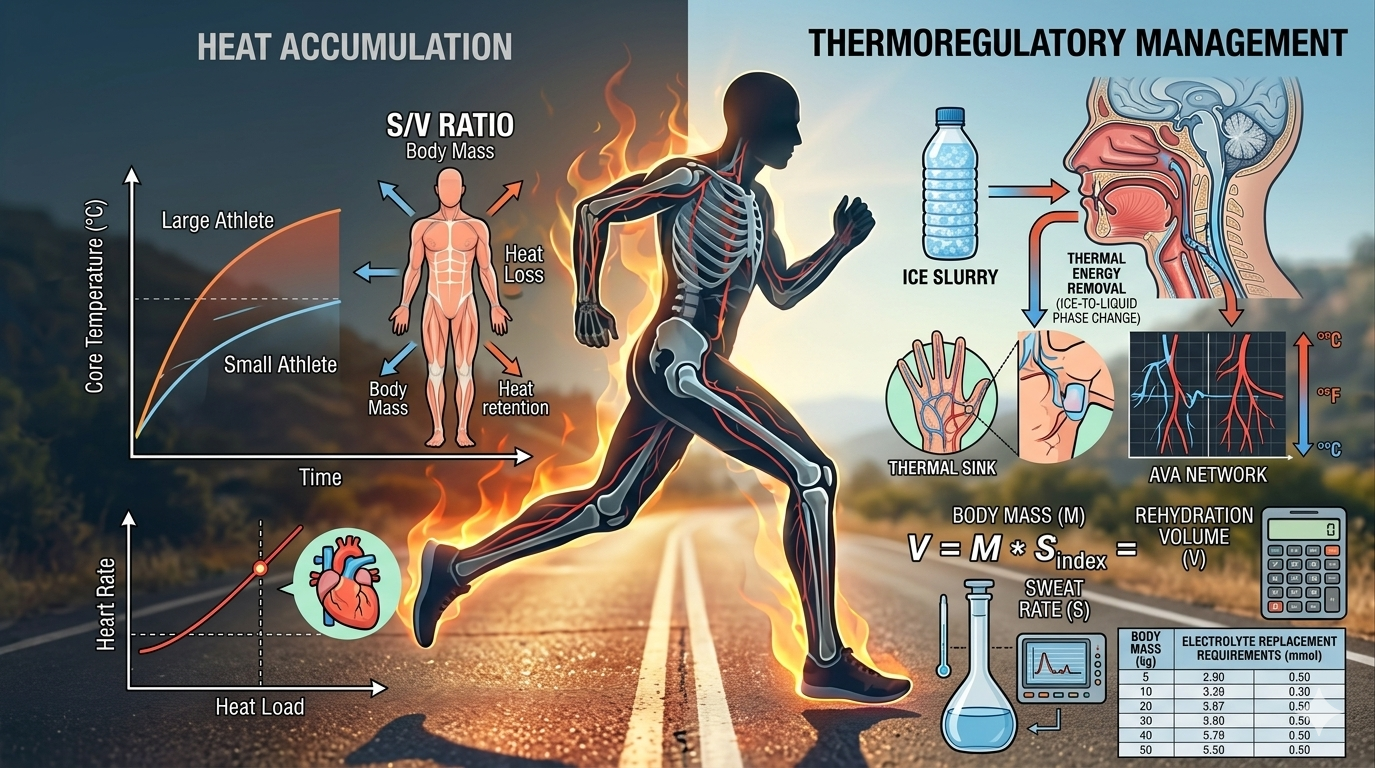
1. Unraveling Heat Dissipation via the Surface Area-to-Volume Ratio
The first aspect to consider involves a physical constraint associated with body size. This is not a question of effort or willpower, but rather a geometric property of how body dimensions scale.
The Relationship Between Body Mass and Skin Surface Area
When human beings exercise, metabolic heat is generated internally. Two basic factors are particularly important for heat exchange:
- Where most exercise-related heat is produced: Working muscles and other metabolically active tissues (closely linked to overall body mass and volume).
- Where heat is dissipated to the environment: The skin surface (proportional to total surface area).
As body size increases, body mass and volume expand faster than surface area. As a result, larger athletes generally have less surface area relative to their body mass through which to exchange heat with the environment. In hot conditions, this geometric reality can make it more challenging to dissipate internally generated heat efficiently.
2. Physiological Considerations: Internal Heat Production and Cardiovascular Strain
Beyond spatial geometry, exercise in warm conditions introduces complex demands on internal blood flow distribution.
Heat Production and Output
Larger athletes may generate greater absolute power outputs in some sports and situations. During exercise, only a portion of metabolic energy is converted into mechanical work, while much of the remaining energy is ultimately released as heat.
Because larger athletes may produce greater absolute power and perform more total metabolic work in some sports and situations, they may also generate more heat in absolute terms. Under hot conditions, if heat production exceeds the body’s rate of heat dissipation, heat gradually accumulates within the body.
The Competition for Blood Flow
As core body temperature rises, skin blood flow increases to facilitate heat loss to the surroundings. At the same time, active muscles require substantial blood flow to support oxygen delivery and sustained exercise output.
This competition for cardiovascular resources between the skin and active muscles contributes to cardiovascular strain. As thermal stress increases, the cardiovascular system must work harder to support both demands, which can accelerate fatigue and lead to a sudden decline in performance.
3. The Sweating Dynamic: Evaporation Constraints and Humidity
It is often assumed that because larger individuals frequently produce higher total sweat volumes, they automatically cool themselves more effectively. However, sweating alone does not guarantee effective body cooling.
Sweat Volume vs. Evaporative Cooling
While total sweat output may be higher in larger athletes, cooling occurs primarily through phase change—when sweat evaporates from the skin and absorbs heat. Under hot or humid conditions, sweat production may exceed the rate at which sweat can effectively evaporate. Un-evaporated sweat simply drips off or saturates clothing, increasing fluid loss without providing a proportional cooling benefit.
The Compounding Impact of High Humidity
High humidity makes it more difficult for sweat to evaporate efficiently because the ambient air already contains a large amount of water vapor. For larger athletes who already have less surface area relative to body mass, these environmental constraints may add another layer of difficulty to thermal regulation.
4. Cold Environments: A Different Thermal Balance
While a larger frame can present heat-management challenges in hot weather, these same physical characteristics can potentially provide advantages in colder environments.
Thermal Retention Properties
A lower surface area relative to total mass means that in cold ambient temperatures, less body heat is lost to the surroundings compared to smaller-bodied individuals. Furthermore, in some sports, larger athletes may also generate greater absolute amounts of metabolic heat during exercise, which can help offset heat loss in colder conditions.
Depending on factors such as body composition, clothing, wind, and exercise intensity, smaller athletes may lose heat more rapidly in cold or wet conditions. In contrast, larger athletes often retain generated heat more effectively, which can help maintain consistent performance when temperatures drop.
5. Aligning Body Traits with Environmental Conditions
Recognizing how physical characteristics interact with ambient temperature allows athletes to tailor their approach according to the race environment:
| Body Type | Potential Thermal Characteristics |
| Larger-bodied athletes | May retain heat more easily in hot conditions, but lose heat more slowly in cold environments. |
| Smaller, lighter athletes | May exchange heat more readily with the environment because of a higher surface-area-to-mass ratio. |
Tactical Adjustments Based on Physical Traits
This structural difference does not mean larger athletes cannot perform well in summer events. Rather, it underscores the value of adapting strategies to the environment:
- In Hot-Weather Races: Focus on proactive thermal management, disciplined pacing, and active cooling strategies to prevent early thermal strain.
- In Cooler Races: Capitalize on natural heat retention to maintain high power outputs and execute assertive pacing.
Anecdotally, in watching middle- and long-distance races, I have often noticed that larger athletes who demonstrate impressive power during cycling segments sometimes experience disproportionate deceleration during the late stages of a hot run. While individual outcomes depend on many factors, incorporating structured cooling protocols can help mitigate these late-race struggles.
6. Heat Mitigation Strategies for Larger Athletes
Physical constraints can be effectively managed through thoughtful preparation and smart tactical execution. Below are three practical approaches to help larger athletes navigate hot racing conditions:
① Internal Cooling (Pre-Cooling)
Lowering core temperature prior to an event can reduce overall thermal strain. Consuming an ice slurry (a smooth mixture of crushed ice and liquid) in the period leading up to competition has been shown to lower core temperature more effectively than cold fluids alone in some situations.
As with any pre-race strategy, athletes should avoid consuming volumes that cause gastrointestinal discomfort and should thoroughly test ice-slurry protocols during training prior to race day.
② Practical External Cooling
While pouring water over the head provides quick sensory relief, applying cold water or ice to areas such as the head, neck, face, and exposed skin can provide practical relief and help increase heat loss during competition.
Additionally, the palms contain specialized arteriovenous structures involved in thermoregulation, and palm cooling has been explored as a potential cooling strategy. In practical settings, briefly holding a cold bottle or applying cooling to the palms may offer a simple and convenient option, although its effectiveness will depend on the conditions and the overall cooling strategy.
③ Individualized Hydration and Electrolyte Management
Hydration needs are not dictated solely by body mass, nor is there a single hourly fluid recommendation that applies to everyone. Sweat rates vary substantially between individuals based on exercise intensity, environmental conditions, clothing, and heat acclimatization.
The most practical approach is to estimate your individual sweat rate by measuring body mass before and after training sessions under similar environmental conditions, taking fluid intake into account. Sodium replacement should likewise be individualized based on factors such as sweat sodium concentration, expected duration, and fluid intake strategy.
Conclusion
A broad frame, tall stature, and solid muscle mass offer clear power-generation advantages in many athletic disciplines. However, in hot environmental conditions, greater body volume presents distinct heat-management considerations that require careful attention.
Rather than relying purely on willpower, acknowledging these physical realities allows athletes to take a strategic, science-informed approach. Understanding how body size influences heat production and heat exchange can help athletes develop more effective strategies for pacing, cooling, hydration, and heat acclimatization—ensuring they reach the finish line with their potential fully realized.
References
- Cramer, M. N., & Jay, O. (2014).Selecting the correct exercise intensity for unbiased comparisons of thermoregulatory responses between groups of different mass and surface area.Journal of Applied Physiology, 116(9), 1123–1132.
- Focus: The relationship between body mass, surface area, and thermoregulatory responses during exercise.
- PubMed Direct Link: PMID: 24505102
- Havenith, G. (2001).Individualized model of human thermoregulation for the simulation of heat stress response.Journal of Applied Physiology, 90(5), 1943–1954.
- Focus: Influence of body mass, surface area, and environmental factors on heat loss and thermal strain.
- PubMed Direct Link: PMID: 11299289
- Galloway, S. D., & Maughan, R. J. (1997).Effects of ambient temperature on the capacity to perform prolonged cycle exercise in man.Medicine & Science in Sports & Exercise, 29(9), 1240–1249.
- Focus: High ambient temperatures, cardiovascular strain, and endurance performance capacity during cycling.
- PubMed Direct Link: PMID: 9309637
- DOI Direct Link: DOI: 10.1097/00005768-199709000-00018
- Siegel, R., Maté, J., Brearley, M. B., Watson, G., Nosaka, K., & Laursen, P. B. (2010).Ice slurry ingestion increases core temperature capacity and running time in the heat.Medicine & Science in Sports & Exercise, 42(4), 717–725.
- Focus: Efficacy of pre-cooling via ice slurry ingestion on reducing core temperature and enhancing endurance in warm conditions.
- PubMed Direct Link: PMID: 19952832
- Sawka, M. N., Burke, L. M., Eichner, E. R., Maughan, R. J., Montain, S. J., & Stachenfeld, N. S. (2007).American College of Sports Medicine position stand. Exercise and fluid replacement.Medicine & Science in Sports & Exercise, 39(2), 377–390.
- Focus: Individual variation in sweat loss, fluid replacement strategies, and body-mass monitoring protocols.
- PubMed Direct Link: PMID: 17277604
コメント