

Your legs do not hurt, and there is no muscle soreness. There is no joint discomfort, and you have been recovering well and getting enough sleep. Yet, when you stand at the starting line and attempt to raise your pace, your body fails to move. Even at the familiar jog pace, your heart rate spikes, and even though your legs themselves still feel strong, the characteristic rebound pushing off the ground cannot be felt.
It is neither injury, muscle soreness, nor sleep deprivation. Why do key workouts fail?
Serious runners have undoubtedly faced this barrier multiple times.
When executing high-intensity threshold runs (LT runs), muscle tissue damage in the periphery is often minimal, leading to the brain mistakenly concluding that the entire planned training volume can be successfully completed again the following day. However, upon starting to run, the body fails to respond as expected, leading to the assumption that cumulative fatigue has not fully dissipated.
Yet, is that truly the case? This leads to the fundamental question of this article: What kind of fatigue, in what specific tissue and mechanism, is actually occurring?
Is it within the muscle itself? The nervous system? Energy metabolism? Or a complex combination of these factors?
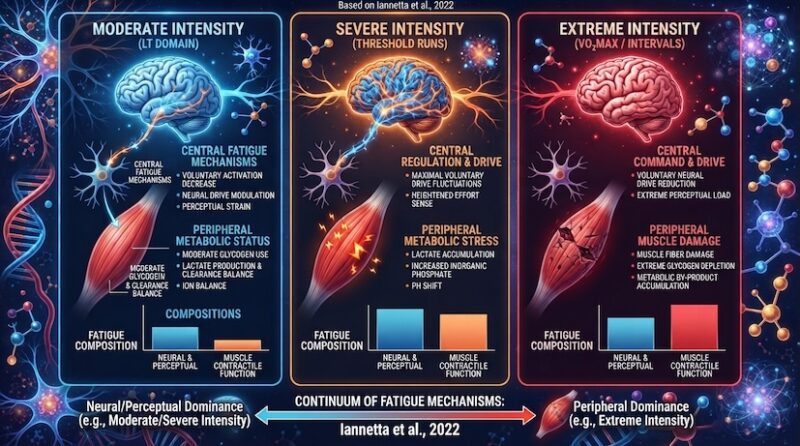
The research conducted by Daniela Iannetta and colleagues (Iannetta et al., 2022) addresses this question by analyzing how neuromuscular function and perceptual fatigue components vary at the point of task failure across different exercise intensities. The findings demonstrate that fatigue does not simply increase or decrease as a whole; rather, its physiological and perceptual components vary according to exercise intensity. Even when exercise ends at task failure, the physiological and perceptual factors contributing to fatigue differ depending on the exercise intensity domain. This article examines why the quality of fatigue shifts according to intensity and how to apply these distinctions to training design.
- Chapter 1: The Era of Evaluating Fatigue by “Type” Rather than “Quantity”
- Chapter 2: The Physiological Reality of Varying Fatigue Components
- Chapter 3: Why Threshold Runs Drain Mind and Body Despite Minimal Muscle Soreness
- Chapter 4: Why VO2max Intervals Impact Peripheral Muscle Contractile Function
- Chapter 5: The Trap of Intermediate Intensity Zones
- Chapter 6: The Paradigm Shift of Aging and Recovery Capacities in Masters Athletes
- Chapter 7: Practical Management Strategies Guided by Fatigue Quality
- Chapter 8: Conclusion──Governing Fatigue Quality for Advanced Development
- References
Chapter 1: The Era of Evaluating Fatigue by “Type” Rather than “Quantity”
Historically, athletes and coaches in endurance sports managed fatigue by focusing primarily on cumulative external work volumes, such as running distance in kilometers, training duration, or Training Stress Score (TSS).
While treating fatigue as a monolithic mass and pushing through via youth and high recovery capacity may yield adaptations during earlier years, relying solely on total training volume metrics presents critical limitations for masters-level runners whose physiological structures, hormonal profiles, and recovery capacities change with age.
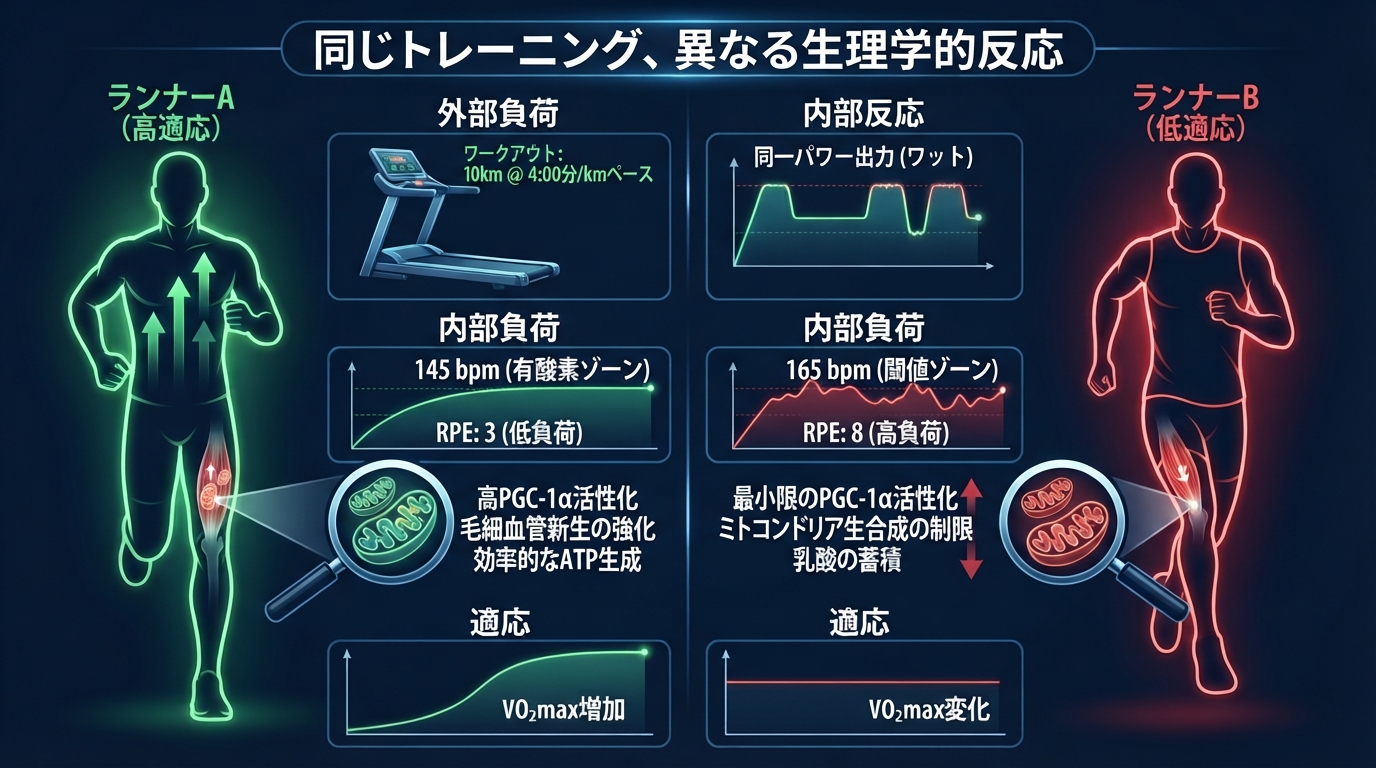
Even with identical numerical loads or durations, the specific tissue sites and qualitative types of damage sustained depend entirely on exercise intensity settings.
Modern exercise physiology understands fatigue not as a simple physiological depletion, but as a complex phenomenon constituted by multiple factors, including decrements in exercise performance and perceived exertion. Concluding that training can resume because muscle soreness is absent often leads to unintended performance drops or chronic fatigue accumulation.
The root cause of stagnation, unexplained slumps, or preventable injuries is not an absolute deficit in training volume, but a mismatch in menu placement and recovery strategy driven by a failure to identify where and what kind of fatigue resides internally.
The objective shifts from quantifying the degree of exhaustion to accurately identifying the specific anatomical sites and chemical or neurological mechanisms generating the fatigue, enabling optimized prescription.
Chapter 2: The Physiological Reality of Varying Fatigue Components
To establish how fatigue composition changes with exercise intensity, Daniela Iannetta and colleagues (Iannetta et al., 2022) investigated the effects of different exercise intensity domains on neuromuscular function and subjective perception at the point of task failure.
Research Overview
Iannetta and colleagues measured maximal voluntary contraction (MVC), twitch force in response to electrical stimulation, voluntary activation (an index of central fatigue), and perceptual responses upon task failure across moderate, heavy, severe, and extreme exercise intensity domains.
Fatigue as a Composite Construct
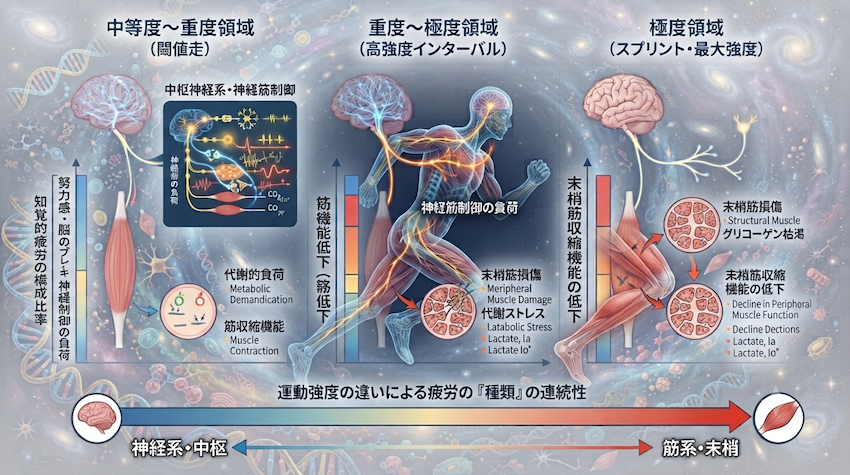
A critical finding from Iannetta et al. is that higher exercise intensity does not uniformly scale all fatigue components equally. Instead, the internal composition of fatigue mechanisms shifts depending on the intensity domain. While moderate, heavy, and severe domains involve varying degrees of perceived exertion, neuromuscular control, and central regulation, the extreme domain exhibits a significantly greater contribution from peripheral muscle contractile function decline at task failure.
Consequently, fatigue must be understood as a composite construct of multiple physiological and perceptual processes.
| Exercise Intensity Domain | Dominant Fatigue Components and Characteristics (Iannetta et al., 2022) |
| Moderate Intensity | Metabolic load and peripheral/central demands are relatively moderate. Prolonged execution displays distinct fatigue profiles. |
| Heavy / Severe Intensity (e.g., Threshold Runs) | Sustained high output demands elicit perceptual load, neuromuscular control adjustments, and central regulation factors not fully explained by peripheral structural damage alone. |
| Extreme Intensity (e.g., VO2max / Supramaximal Intervals) | Marked prominence of peripheral muscle contractile function decline, accompanied by high perceptual strain and metabolic stress. |
Note: Central fatigue refers to a reduction in voluntary neural drive to motor neurons during maximal effort.
Note: Peripheral muscle contractile function represents the mechanical capacity of muscle tissue to physically generate force and recoil in response to stimuli.
The primary components of fatigue shift significantly based on the chosen training protocol.
Chapter 3: Why Threshold Runs Drain Mind and Body Despite Minimal Muscle Soreness
As suggested by Iannetta et al., sustained loading in the heavy to severe intensity domains—such as threshold runs—involves specific roles for perceived exertion, neuromuscular control adjusting movement output, and central regulation.
Rather than pointing to a single mechanism, this reflects the interaction of neuromuscular and perceptual processes involved in sustaining high output over time, while minimizing localized structural damage like muscle fiber micro-tears. Continuous command transmission and regulation processes within the neuromuscular system generate distinct operational loads.
This explains the common scenario among serious runners where muscular soreness is absent, yet output generation and forward propulsion are impaired prior to a session.
The unique physiological characteristics of the threshold (LT2) domain explain why sustained threshold efforts impose heavy demands on neuromuscular control and perception despite lower absolute speeds than supramaximal intervals. Threshold training operates near the maximal limit where blood lactate production and systemic clearance rates remain balanced. (Note: Lactate functions as an intermediate metabolic substrate supporting energy production rather than a direct fatiguing toxin; exercise-induced performance decline involves multiple metabolic factors, including pH shifts, inorganic phosphate accumulation, and ion balance disruptions.) Unlike intermittent high-intensity protocols, threshold runs lack structured recovery intervals, demanding sustained psychological and physiological tension across extended durations.
Threshold training functions not merely as muscular loading, but as a specialized stimulus that generates perceived exertion and neuromuscular control demands through sustained high-output maintenance, even in the absence of structural muscle soreness or joint pain.
Consequently, superimposing high-intensity threshold or key workouts consecutively based solely on the absence of muscle soreness forces repetitive output on a fatigued neuromuscular system, degrading movement execution and increasing overtraining risk.
Chapter 4: Why VO2max Intervals Impact Peripheral Muscle Contractile Function
In contrast, extreme-intensity protocols such as VO2max intervals place primary strain on peripheral muscle contractile function.
At very high running intensities, heavy force production, landing impacts, rapid eccentric muscle actions, and metabolic stress can combine to contribute to peripheral fatigue.
Post-session sensations such as heavy legs or diminished ground-reaction responsiveness reflect multiple peripheral fatigue factors, including glycogen depletion, localized inflammatory responses, peripheral muscular fatigue, autonomic shifts, and psychological load.
Because the restoration of peripheral muscle function and mechanical stress recovery requires multi-day cellular repair processes distinct from neural recovery, the frequency and spacing of VO2max sessions necessitate strict planning.
Chapter 5: The Trap of Intermediate Intensity Zones
Understanding these distinct fatigue characteristics highlights the importance of training placement when utilizing intermediate intensity zones situated between LT and VO2max.
Stagnation often stems from uncalculated, repetitive use of intermediate intensities lacking clear purpose. Effective training design separates sessions dedicated to neuromuscular control adaptation (LT domain) from those targeting peripheral and cardiorespiratory strain (VO2max domain) to establish distinct functional contrasts.
Chapter 6: The Paradigm Shift of Aging and Recovery Capacities in Masters Athletes
While younger athletes could absorb mixed fatigue states and achieve supercompensation via high recovery rates, masters-level runners face strict physiological recovery differentials based on the quality of fatigue.
Considering age-related changes in neuromuscular properties and the diminished anabolic capacity of peripheral tissues, recovery management requires precision.
The primary hazard for masters runners is conflating neural command system fatigue with muscular fatigue, using youth-based recovery assumptions.
Ignoring neuromuscular fatigue and stacking key sessions based on a lack of muscular soreness drives the command system into chronic exhaustion, resulting in sudden coordination breakdown and performance slumps. Conversely, utilizing cardiorespiratory markers to schedule VO2max sessions while muscular tissue remains compromised increases tendon and joint strain.
Diagnosing internal system loading status enables targeted application strategies tailored to physiological realities.
Chapter 7: Practical Management Strategies Guided by Fatigue Quality
Optimizing training architecture requires establishing primary operational principles centered on protecting subsequent key sessions.
Practical Management Tactics by Fatigue Type
- Post-VO2max Interval Management (Peripheral Focus):
- Avoid high-impact running speed work due to peripheral structural strain.
- Utilize low-impact aerobic modalities such as swimming or easy cycling to maintain light aerobic activity while reducing mechanical loading.
- Post-Threshold / LT Run Management (Neuromuscular / Perceptual Focus):
- Refrain from consecutive threshold or complex speed sessions despite the absence of local muscle soreness.
- Enforce strict Zone 2 lower-limit heart rate caps during easy jogs to allow recovery of neuromuscular output regulation and perceptual freshness.
Sample Weekly Load Distribution and Fatigue-Based Model:
  Tuesday:    [Key 1] LT2 Threshold Run (approx. 40 min continuous) → High neuromuscular control and perceived effort load.
  Wednesday:  Easy Jog (Strict Zone 2 heart rate cap) → Neuromuscular output regulation and perceptual recovery (protecting key sessions).
  Thursday:   [Key 2] VO2max Intervals → Strong peripheral muscle contractile function and metabolic stress stimulus.
  Friday:     Easy Swim or Bike (Low load) → Tissue repair and blood flow enhancement.
  Saturday:   [Key 3] Long Ride / Long Run → Aerobic base building and integrated endurance capacity.
  Sun - Mon:  Context-dependent adjustment and conditioning.
This alignment with optimization principles provides a framework for controlling training stress to prevent self-induced overtraining, ensuring that primary physiological adaptations remain uncompromised by superfluous fatigue.
Chapter 8: Conclusion──Governing Fatigue Quality for Advanced Development
- Even with identical external work volumes (distance or TSS), the internal composition and ratio of fatigue vary fundamentally based on exercise intensity.
- Extreme-intensity protocols exhibit a greater contribution from peripheral muscle contractile function decline upon task failure.
- Threshold training (LT2) generates demands on perceived exertion and neuromuscular control despite the absence of structural muscle soreness or joint pain.
- Intermediate intensity zones require careful placement based on specific fatigue properties.
- The core principle of training architecture is the precise control of fatigue properties to protect the execution quality of primary key sessions.
Training is not an exercise in indiscriminate physical exhaustion.
The resolution and precision with which internal physiological stimuli and repair mechanisms are managed determine athletic progression. The tools for continuous performance development lie within the understanding of internal bodily systems.
References
Iannetta, D., Zhang, J., Murias, J. M., & Aboodarda, S. J. (2022). Neuromuscular and perceptual mechanisms of fatigue accompanying task failure in response to moderate-, heavy-, severe-, and extreme-intensity cycling. Journal of Applied Physiology, 133(2), 323–334. PubMed
コメント