
- Introduction
- 1. Why Does Heart Rate Decrease?──The Basic Mechanism of Cardiac Output
- 2. The Athlete’s Heart: Structural and Autonomic Adaptations
- 3. Cardiovascular Adaptation to Energy Deficiency
- 4. RED-S and the Major Illusion That “Weight Loss Equals Peak Condition”
- 5. Proper Interpretation of HRV (Heart Rate Variability)
- 6. A “Low” Result Alone Does Not Tell Us What Is Happening Inside the Body
- 7. How to Distinguish Between Physiological Bradycardia and Concerning Bradycardia
- 8. The Limitations of Garmin and Wearable Devices
- Conclusion and Insights from a Field Perspective
- References and Related Studies
Introduction
Many of us check our resting heart rate (RHR) on our sports watches every morning.
“42 bpm today. I must be in good shape.”
“It dropped to 38 bpm recently. Did my cardiorespiratory fitness improve?”
Indeed, a low resting heart rate, or bradycardia, is not uncommon among endurance athletes.
However, a low resting heart rate can reflect either a beneficial adaptation or a potentially concerning change. In fact, extremely low resting heart rates can also be observed in athletes suffering from disordered eating or chronic energy deficiency.
The assumption that “the lower it is, the healthier and more elite the athlete” is a misleading way to interpret resting heart rate from an exercise physiology perspective. RHR is not a simple ranking metric like a 100-meter dash time or FTP; its meaning varies entirely depending on the physiological context behind the change.
This article provides an in-depth examination from an exercise physiology perspective, comparing the physiological adaptations of the athlete’s heart with potentially concerning bradycardia associated with energy deficiency and RED-S (Relative Energy Deficiency in Sport), and exploring how wearable device metrics should be interpreted.
1. Why Does Heart Rate Decrease?──The Basic Mechanism of Cardiac Output
The concept of “cardiac output,” which is the fundamental equation of the cardiovascular system, is indispensable when discussing heart rate:
$\text{cardiac output} = \text{heart rate} \times \text{stroke volume}$
Cardiac output is the total volume of blood pumped by the heart into the body per minute. When we are at rest, the cardiovascular system must maintain sufficient cardiac output to meet the body’s physiological demands.
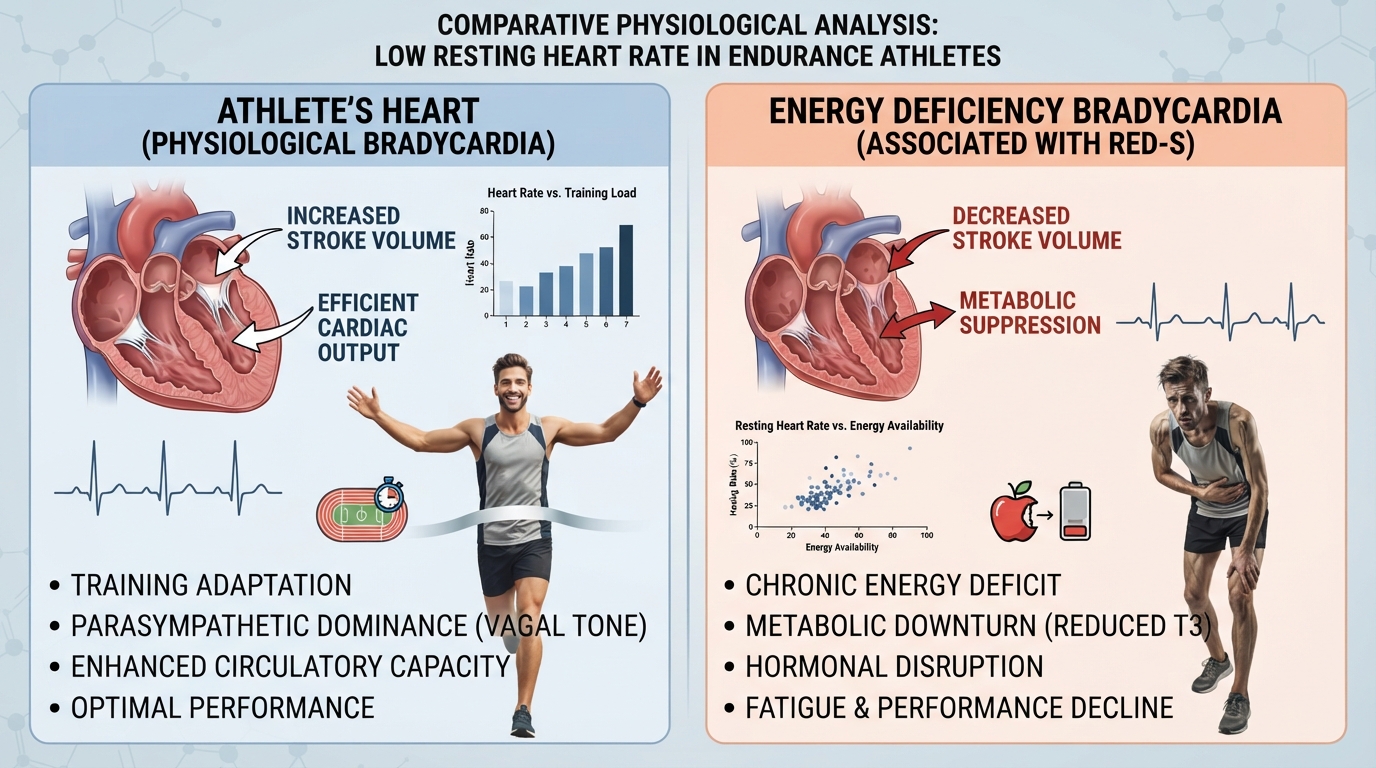
The key point here is that if stroke volume increases, the body can maintain the cardiac output required to meet physiological demands with a lower heart rate. This difference in basic principles is the critical dividing line between a healthy athlete’s heart and bradycardia caused by energy deficiency.
2. The Athlete’s Heart: Structural and Autonomic Adaptations
When endurance training is continued over a long period, the heart alters its structure and function to adapt to the load. This is the so-called “athlete’s heart.” Research on the athlete’s heart, beginning with the meta-analysis by Pluim et al. (2000), details how long-term endurance training induces physiological cardiac adaptations.
Left Ventricular Enlargement and Physiological Myocardial Hypertrophy
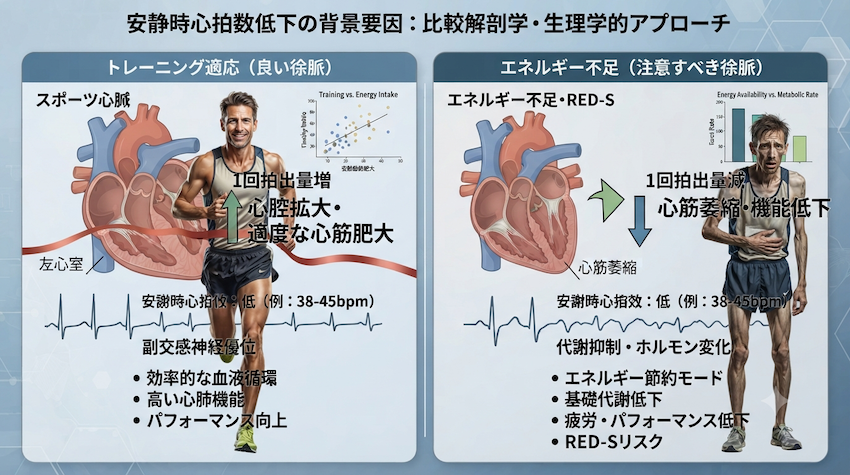
In endurance training, because endurance exercise requires the circulation of large volumes of blood, the heart (especially the left ventricular chamber) expands, and the myocardium hypertrophies appropriately to match. This dramatically increases the volume of blood the heart can fill and eject with each beat (stroke volume).
Activation of the Autonomic Nervous System (Vagal Tone)
The sinoatrial (S-A) node, which paces the heartbeat, is controlled by the autonomic nervous system. As training adaptation progresses, parasympathetic influence on the heart, particularly through vagal activity, increases, placing the brakes on resting heart rate.
Through the combination of these adaptations, resting bradycardia emerges as a consequence of structural and autonomic adaptations that improve the heart’s pumping efficiency. The crucial point here is that a low heart rate itself is not the direct goal of training adaptation; rather, resting heart rate drops simply as a consequence of structural and neural changes in the heart’s pumping efficiency and circulatory capacity. This is generally considered a physiological adaptation associated with endurance training and athletic performance.
3. Cardiovascular Adaptation to Energy Deficiency
On the other hand, heart rate can decrease for entirely different reasons. That reason is chronic energy deficiency.
When energy availability drops and the body falls into a chronic energy deficit, it may adapt by reducing energy expenditure and prioritizing essential physiological functions. This process is not merely “dieting”; it is a defensive reaction involving the entire metabolic and endocrine systems.
Hypothalamus-Pituitary-Thyroid Axis Changes and Metabolic Suppression
When energy deficiency is sensed, the secretion of thyroid hormones (particularly the active form, T3) decreases via the hypothalamus in the brain. This can reduce metabolic activity and impair thermoregulation, thereby lowering overall energy expenditure.
Ripple Effects on the Cardiovascular System and Myocardial Changes
As part of the adaptation to lower metabolism, autonomic nervous system-mediated suppression of heart rate occurs. Furthermore, in severe and prolonged states of energy deficiency, myocardial structure and function may also be affected, potentially reducing cardiac pumping capacity, including stroke volume.
Whereas the athlete’s heart involves bradycardia driven by increased stroke volume and autonomic adaptation, bradycardia from energy deficiency involves different physiological backgrounds, such as alterations in the metabolic-endocrine systems and impacts on the cardiovascular system.
4. RED-S and the Major Illusion That “Weight Loss Equals Peak Condition”
As highlighted in the 2018 IOC consensus statement led by Mountjoy et al., RED-S (Relative Energy Deficiency in Sport) is not simply a matter of “eating too little.” Simply put, it is a state in which the energy available to the body is chronically insufficient to support both exercise demands and normal physiological functions. Even without strict dieting, increased training volume can lead to heavy energy expenditure through exercise, leaving insufficient energy to maintain basic physiological functions. It is a condition that can affect multiple physiological systems, including metabolism, immune function, bone health, hormonal regulation, and cardiovascular function.
At this point, many endurance athletes fall into a major illusion: the misconception that they are in great shape.
The Trap of “Lighter Equals Peak Condition”
During periods of heavy training accumulation, several changes often occur simultaneously:
- Weight decreases
- Resting heart rate drops
- HRV (Heart Rate Variability) may appear elevated
Seeing this, athletes tend to conclude, “My weight dropped, my body feels lighter, and my RHR went down—my cardiorespiratory fitness has peaked!” However, a decrease in body weight during heavy training does not necessarily mean that body fat has been reduced. It can also reflect glycogen depletion, changes in hydration status, and, in more severe cases, loss of muscle tissue.
Even though the body has entered an energy-saving mode to adapt to critical energy deficiency—resulting in weight loss and a lowered heart rate—athletes often misinterpret the drop in heart rate as an improvement in condition and push training loads even higher. This is a potentially important pitfall in the early stages of RED-S.
Continuing training in this state dramatically raises the risk of further health and performance consequences, including:
- Chronic fatigue and performance plateaus
- Reduced bone health and increased risk of bone stress injuries
- Immune function decline leading to infection vulnerability
- Endocrine disruptions such as menstrual irregularities or decreased testosterone
5. Proper Interpretation of HRV (Heart Rate Variability)
Along with heart rate, HRV (Heart Rate Variability) is frequently used in condition management. However, HRV also cannot be simply judged as “higher is better, lower is worse.”
As demonstrated in the ECSS/ACSM Joint Consensus Statement on overtraining syndrome by Meeusen et al. (2013), excessive training loads and inadequate recovery can alter autonomic regulation and contribute to a state of accumulated fatigue. Particularly when chronic energy deficiency and severe fatigue combine, in some cases, HRV may appear relatively high or may not show an obvious deterioration even when an athlete is experiencing substantial fatigue. However, HRV changes alone cannot be used to diagnose overtraining or energy deficiency. Therefore, HRV should not be used as an absolute health barometer by itself, but rather handled cautiously as an auxiliary reference value.
| Resting Heart Rate (RHR) | Heart Rate Variability (HRV) | General Interpretation / Potential Example |
| Low | Stable / Appropriate | Possible healthy training adaptation (physiological bradycardia) |
| High | Low | Suspicion of accumulated fatigue, acute stress, sleep deprivation, or overtraining |
| Low | Fluctuating widely / Unusual | Cannot be judged alone; evaluate alongside fatigue, sleep, diet, and performance |
6. A “Low” Result Alone Does Not Tell Us What Is Happening Inside the Body
Let us organize an important point here.
Even if your resting heart rate drops to 40 bpm, you cannot conclude simply from that number that “the heart has grown stronger.” What matters is not the absolute value of “what bpm is good,” but how that numerical value has shifted from your baseline and what is happening in your body alongside that change.
In the case of the athlete’s heart, stroke volume has increased through training. In other words, because the heart can pump a larger volume of blood with a single beat, fewer beats are required to meet demand. The low heart rate is not the direct goal; rather, heart rate drops as a consequence of the heart’s enhanced efficiency in circulating blood.
On the other hand, energy deficiency tells a completely different story.
When a state of insufficient energy intake persists, the body shifts away from actively enhancing athletic capacity toward prioritizing life-sustaining functions and suppressing energy expenditure. Heart rate may drop as part of this broader energy-conservation response.
In short, “the heart’s performance has improved, so fewer beats suffice” and “the body is reducing heart rate as part of a broader energy-conservation response” look identical on the surface in terms of numbers, but their underlying meanings are entirely different.
Compounding this difficulty, to the athlete themselves, the early stages of both look strikingly similar.
Weight drops, RHR falls, and the body “feels light.” In some cases, HRV looks fine. Under these conditions, you naturally want to believe that “training is going well.”
However, what you truly need to look at is not how far the number has dropped, but what is happening alongside that number.
Can you maintain the same pace more easily than before? Can you complete high-intensity sessions as scheduled? Does rest effectively clear your fatigue? Are you eating enough food? Is the change in your body weight intentional and appropriately managed?
Only by stacking these observations together can you determine whether a drop in RHR is an adaptation or a warning.
This applies to metrics beyond RHR as well. The numbers displayed by sports watches do not directly look into your physical state; they merely observe a fraction of the changes occurring inside your body from the outside.
That is precisely why athletes need the habit of considering why their body is showing a particular metric, rather than chasing a “lower RHR.”
7. How to Distinguish Between Physiological Bradycardia and Concerning Bradycardia
How can you tell whether your drop in resting heart rate is a training adaptation or energy deficiency? Compare the checklist below:
| Check Item | Training Adaptation (Physiological Bradycardia) | Energy Deficiency (Potentially Concerning Bradycardia) |
| Performance | Improving or stably maintained | Declining or plateaued |
| Fatigue | Adequately relieved by proper rest and sleep | Chronic; malaise persists despite rest |
| Appetite & Diet | Healthy appetite, consuming appropriate portions | Suppressed appetite or engaging in extreme dietary restriction |
| Weight Changes | Stable at an appropriate body weight | Unintended rapid loss or difficulty maintaining body weight |
| Training Quality | Successfully completing target intensities and volumes | Unable to maintain target paces, fatiguing rapidly |
| Autonomic / Endocrine | Normal thermoregulation and reproductive/endocrine function | Increased cold intolerance, menstrual dysfunction, reduced libido, or other endocrine disturbances |
Note: The above are general tendencies and indicators; individual differences apply.
8. The Limitations of Garmin and Wearable Devices
For modern athletes, wearable devices such as Garmin and Apple Watch are indispensable training partners. Checking RHR, HRV, and Body Battery in bed every morning has become a daily routine for many.
However, the numbers displayed on device screens are merely physiological signals captured at a particular moment.
A device can tell you, “Your heart rate is 38 bpm,” but it cannot tell you the reason—whether it reflects physiological cardiac adaptations associated with endurance training or whether it is associated with energy deficiency and its effects on metabolism and cardiovascular function.
Instead of getting swept up in numbers and playing a ranking game where “lower is always better,” it is essential to comprehensively observe the background behind those metrics: nutritional status, sleep quality, mental state, and daily fatigue.
Conclusion and Insights from a Field Perspective
I also check my resting heart rate on my Garmin every morning. When I see a low number, I naturally want to feel reassured that “I’m in good shape this morning.” However, the deeper I dive into exercise physiology, the more acutely I realize the importance of correctly identifying the physiological mechanisms hidden behind those numbers.
For endurance athletes, a low resting heart rate is never a badge of honor proving that lower is better.
Rather than being tossed about by the numbers themselves, you must calmly decode the background context leading to those metrics—whether adequate energy and nutrient intake is being maintained, or whether the body is responding to prolonged energy deficiency by reducing energy expenditure. Understanding that context is essential for maximizing performance while maintaining long-term health and sustainability as an athlete.
[Disclaimer and Notice]
This article is intended for informational and educational purposes based on general knowledge of exercise physiology. If you experience a marked drop in resting heart rate accompanied by severe fatigue, dizziness, lightheadedness, or a sudden decline in performance, do not rely on self-diagnosis and consult a qualified sports medicine physician or healthcare professional.
References and Related Studies
- Mountjoy, M., et al. (2018). “IOC consensus statement on relative energy deficiency in sport (RED-S): 2018 update.” British Journal of Sports Medicine, 52(11), 687-697. PMID: 29773536
- Pluim, B. M., et al. (2000). “The athlete’s heart: a meta-analysis of cardiac structure and function.” Circulation, 101(3), 336-344. PMID: 10645932
- Meeusen, R., et al. (2013). “Prevention, diagnosis, and treatment of the overtraining syndrome: joint consensus statement of the European College of Sport Science and the American College of Sports Medicine.” Medicine & Science in Sports & Exercise, 45(1), 186-205. PMID: 23247672
コメント