
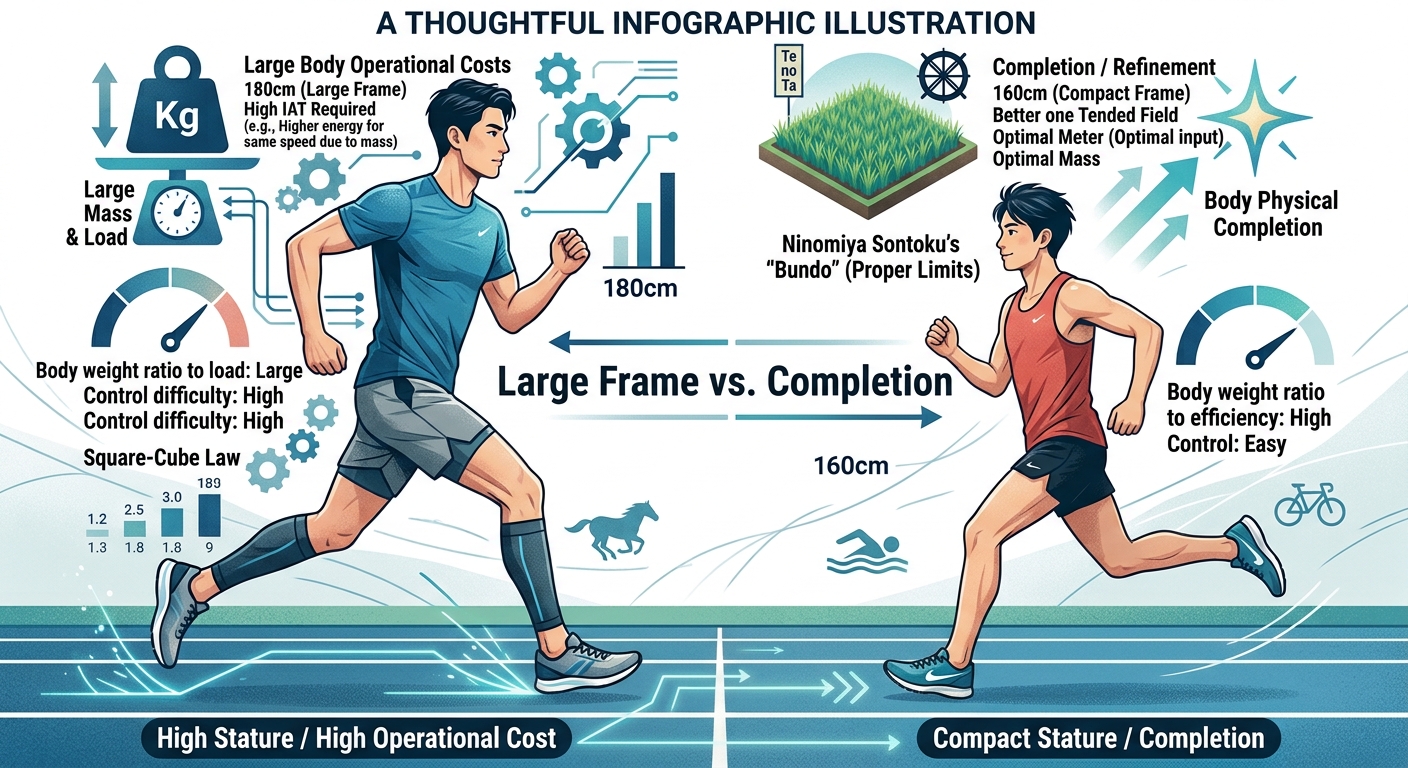
If you often think, “I train consistently, but struggle with pacing or stability over longer distances,” looking at your body through the lens of movement efficiency and structural load management may offer a helpful perspective. Read on to explore the biomechanical reasoning and practical insights.
This happened while I was training at my local swimming pool. Other swimmers would occasionally strike up a conversation and say:
“You’re so tall, I’m jealous!” “Being tall must give you such a natural advantage in the water!”
I am sure there was no malice behind these comments. I took them as genuine compliments mixed with lighthearted envy. Yet, every time I heard this, a question would cross my mind:
“If someone hasn’t fully mastered controlling a 160 cm frame, would growing to 180 cm automatically make them faster? If movement control isn’t established, could a larger frame present its own challenges?”
You see a similar narrative in sports media. When a tall athlete performs well, commentators frequently cite their “gifted physical frame.” Conversely, when a smaller athlete succeeds, it is often framed as “overcoming their compact stature”–as if height were an absolute, unconditioned advantage in every scenario. I have long held a quiet skepticism toward this simplified view.
To be sure, when elite athletes dedicate years to perfecting every aspect of their physical conditioning–refining neuromuscular recruitment, force production, and technique–a longer reach or stride length can serve as a potent asset.
However, for citizen runners and hobby racers who train within the constraints of daily life–especially as we age and become more attuned to our physical limits–can we truly say that “taller equals unconditionally better”?
In physical terms, possessing a larger body means managing a larger system, which can involve higher total mechanical work and greater force demands.
In this article, I would like to explore the biomechanical realities of body size through geometric scaling and mechanical principles, reflecting on what true “Physical Completeness” means for citizen athletes.
Geometric Scaling Principles: The Idealized “Square-Cube” Model
No matter how much height is praised, human biomechanics operates within basic geometric and physical parameters. One fundamental concept often used to illustrate scale is the Square-Cube Law.
This mathematical principle states that when an object scales up uniformly in all dimensions (maintaining exact geometric similarity), its length, surface area, and volume increase at different rates.
The Geometric Model vs. Human Biomechanics
To illustrate this mathematically, imagine a simplified geometric model of a person whose height increases by 10% (e.g., from 165 cm to 181.5 cm) while maintaining exact proportions:
- Length of limbs: Increases by 1.10x (+10%)
- Cross-sectional area: Increases by 1.10 x 1.10 = 1.21x (+21%)
- Total volume / mass: Increases by 1.10 x 1.10 x 1.10 = 1.33x (+33%)
In basic mechanics, muscle force potential is closely related to muscle cross-sectional area. In a strictly proportional geometric model, a 10% increase in height yields a 21% increase in theoretical force potential, alongside a 33% increase in mass.
| Metric (Geometric Model) | Base Scale (165 cm) | 10% Scaled Model (181.5 cm) | Change |
| Height (Length) | 1.00 | 1.10 | +10% |
| Cross-Sectional Area (Potential Force Scaling) | 1.00 | 1.21 | +21% |
| Volume / Mass (Mass Scaling) | 1.00 | 1.33 | +33% |
Note: This table reflects a simplified geometric model assuming perfect shape similarity. Real human anatomy does not scale geometrically, as muscle mass distribution, limb proportions, neural recruitment, and allometric scaling relationships vary significantly among individuals.
This geometric model highlights a key physical principle: as physical dimensions grow, supporting and moving body mass relative to muscular output requires deliberate conditioning. In actual athletes, maintaining an optimal power-to-weight ratio depends heavily on training, body composition, and sport-specific demands rather than height alone.
A larger frame represents a high-capacity system. Height itself does not guarantee performance; rather, managing greater leverage and mass requires adequate functional strength, structural stability, and refined movement technique.
Controlling Extended Levers and Joint Moments
There is also a mechanical consideration regarding limb length.
When swinging a leg during running or moving an arm in swimming, longer limbs mean mass is distributed further from the joint center (the axis of rotation). In physics, increasing the distance between mass distribution and the pivot point increases the moment of inertia.
This means that depending on mass distribution, accelerating and decelerating longer segments may require greater muscular torque at the joints. While longer limbs offer potential reach and leverage, efficiently controlling these extended levers requires precise neuromuscular control and joint stability.
A Lesson from Agriculture: Scale vs. Tending
To consider the relationship between body size and movement control, we can draw a conceptual parallel from traditional agricultural wisdom.
Traditional agricultural wisdom offers a useful analogy: cultivating a manageable area thoroughly can be more productive than attempting to manage an area beyond one’s capacity. A related idea, though in a different context, can be found in the Edo-period scholar Ninomiya Sontoku’s principle of “Bundo”—setting the limits of expenditure according to one’s realistic means. By analogy, citizen athletes can also benefit from matching the demands of their training to the resources available for development and recovery.
Yield Is Determined by Care, Not Just Acreage
Imagine a farmer managing a field larger than their current resources permit. Despite working continuously, maintaining fine details across the entire area becomes difficult. Weeds may go unnoticed, and crop quality may vary.
Conversely, a field scaled appropriately to the farmer’s resources allows for meticulous care–checking soil conditions, managing nutrients, and weeding regularly. Such a field can produce highly reliable, high-quality yields per unit area.
While this is an agricultural metaphor rather than a biological law, it provides a useful way to think about physical management: total scale is only as valuable as one’s ability to maintain and control it.
Focusing on Manageable Development
Consider this concept in the context of citizen athletics. Elite athletes often have extensive time, coaching, and recovery support to systematically develop their physical capacity.
Citizen athletes, by contrast, balance training with work, family, and daily commitments. Training time and recovery resources are naturally bounded. Consequently, most athletes operate with areas of movement, strength, or endurance that remain under-developed.
Under these practical constraints, having a larger physical frame expands the structural and physiological system that must be conditioned and maintained. Height and reach are potential assets, but realizing their benefit depends on developing the strength, mobility, and skill required to support them.
Structural Loads and Considerations with Age
In younger athletes, recovery capacity and tissue characteristics may make it easier to tolerate certain mechanical loads. As athletes age, however, tissue properties can change, making load management an important factor in training consistency.
Connective Tissue Changes with Age
With advancing age, changes occur in the cellular environment, extracellular matrix structure, and mechanical characteristics of tendons. These biological shifts can alter tissue function and healing, making load management important for maintaining training consistency.
During running, ground reaction forces can reach several times body weight depending on speed and running style. When body mass is higher, the absolute ground reaction force required to support and propel the body at a given acceleration increases accordingly.
Higher body mass can increase the absolute external forces involved in running, but the resulting loads on individual tissues depend on movement mechanics, muscle forces, and running velocity. Body mass alone cannot determine the precise stress experienced by individual joints or connective tissues. For mature athletes, managing training loads and recovery is therefore important for maintaining consistency.
Sport-Specific Scenarios Where a Larger Frame Offers Advantages
While managing a larger frame requires adequate strength and movement control, height and limb length provide clear biomechanical opportunities in specific sports.
Hydrodynamics in Swimming
Research on Olympic and World Championship medalists in 50 m and 100 m freestyle found that the average height of medalists increased over time.
A taller swimmer with longer limbs may benefit from greater stroke reach. However, the extent to which this translates into faster swimming depends on stroke mechanics, stroke rate, propulsion, and drag. Height can provide a physical advantage, but it does not automatically produce greater swimming efficiency.
Flat-Terrain Cycling and Absolute Power Output
In road cycling and time trialing on flat terrain, aerodynamic drag and absolute power output are major determinants of speed.
On flat courses, the rider with higher absolute power often holds an advantage, as gravity plays a reduced role compared to climbing. Larger riders often possess greater total muscle mass, allowing them to generate higher absolute wattage. While a larger rider generally presents a larger frontal area and may have a higher drag area (CdA), an efficient aerodynamic position can help limit aerodynamic resistance.
Conclusion: Realizing Potential Through Physical Completeness
Height and physical size offer unique mechanical attributes–some advantageous, others demanding greater operational input. In amateur athletics, however, raw physical dimensions rarely dictate outcomes on their own. Performance depends far more on how effectively an athlete has conditioned and mastered their existing physical system.
Consider a hypothetical comparison:
- Athlete A: Has a compact frame, but has developed exceptional movement efficiency, strength-to-weight management, and pacing control through consistent, targeted training.
- Athlete B: Has a naturally tall, high-capacity frame, but possesses gaps in functional stability, movement economy, or sport-specific endurance.
In endurance racing, Athlete A will frequently outperform Athlete B, not because a compact frame is inherently superior, but because Athlete A has achieved a higher degree of functional completeness relative to their physical dimensions.
Physical height is largely influenced by genetics. It sets important structural parameters, but does not define athletic mastery.
There is no need to view physical size as an absolute advantage or disadvantage. Real athletic progression comes from understanding your own mechanical characteristics, managing structural loads effectively, and refining the movement of the body you have. The true satisfaction of citizen athletics lies in that continuous, methodical process of physical development.
References
- Folland JP, Mc Cauley TM, Williams AG. Allometric scaling of strength measurements to body size. Eur J Appl Physiol. 2008;102(6):739-745. PMID: 18172672
- Bus SA. Ground reaction forces and kinematics in distance running in older-aged men. Med Sci Sports Exerc. 2003;35(7):1167-1175. PMID: 12840638
- Korcari A, Przybelski SJ, Gingery A, Loiselle AE. Impact of aging on tendon homeostasis, tendinopathy development, and impaired healing. Connect Tissue Res. 2023;64(1):1-13. PMID: 35903886
- Mazzilli F. Body Height and Swimming Performance in 50 and 100 m Freestyle Olympic and World Championship Swimming Events: 1908-2016. J Hum Kinet. 2019;66:205-213. PMID: 30988854
- Swain DP. The influence of body mass in endurance bicycling. Med Sci Sports Exerc. 1994;26(1):58-63. PMID: 8133740

コメント