
- Introduction: The Missing Limiter Behind High-Volume Training
- 1. The Real Meaning of Durability in Endurance Training
- 2. Why Muscular Condition Determines Training Capacity
- 3. Muscle Condition: The Hidden Variable in Training Consistency
- 4. The Cost of Excessive Intensity
- 5. The Relationship Between Intensity Control and Long-Term Adaptation
- 6. Practical Implications for Training Design
- 7. Durability as the Foundation of Sustainable Progress
Introduction: The Missing Limiter Behind High-Volume Training
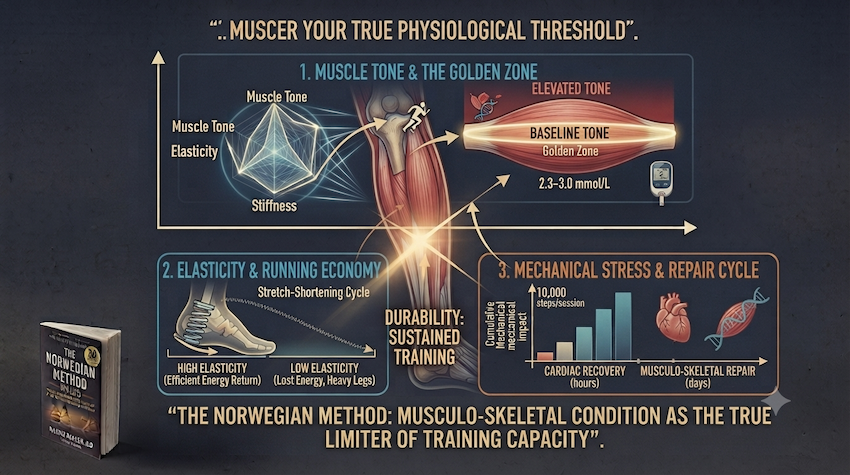
In the Norwegian training model, durability represents far more than the ability to resist fatigue. In Bakken’s framework, it refers to the ability to maintain a high-quality muscular state while repeatedly absorbing training stress over weeks and months, ensuring that high-volume training stress translates into sustained physiological adaptations rather than premature structural breakdown.
Many runners naturally assume that cardiovascular and pulmonary capacities dictate the ultimate boundaries of running performance. Because maximal oxygen uptake dominates the existing training literature—readily measurable, strongly correlated with performance, and responsive to training—this assumption seems logical. However, one of the most critical insights throughout this methodology is the reality that, for the vast majority of runners, the cardiovascular system is often not the primary factor limiting training volume.
The key limitation emphasized in this methodology is the muscular system rather than the cardiorespiratory system.
Compared with the time required for muscles and connective tissues to repair and adapt, cardiovascular recovery often occurs relatively quickly. The root of the problem lies elsewhere. It resides in the phenomenon occurring upon every footstrike: impact loads reaching two to four times an individual’s body weight are repeatedly absorbed by muscles, tendons, and connective tissues.
This impact repeats thousands of times within a single session, scaling to tens of thousands over the course of a week.
Repairing and adapting to this accumulated mechanical load demands extensive time—far exceeding the duration required by the cardiovascular system. This asymmetry, where the heart stands ready while the musculature lags behind, generates the fundamental predicament ultimately faced by most runners. Consequently, the Norwegian approach prioritizes preserving the muscles’ capacity to absorb high-quality training rather than continually increasing physiological stress beyond what the muscular system can tolerate.
1. The Real Meaning of Durability in Endurance Training
Understanding why muscles play such an important role requires examining a concept that is often overlooked in practical endurance training: muscle tone.
In this context, muscle tone refers to the baseline muscular tension that reflects the current condition of the neuromuscular system. This tension is shaped through the interaction of a muscle’s viscoelastic properties, structural tissue elements, and signaling from the nervous system. Willpower cannot directly control this tension, yet training methodology exerts a powerful influence over it.
Crucially, high-intensity training sessions trigger a surge in muscle tone. Even during intentional relaxation attempts, muscles maintain a heightened baseline tension compared to normal states. The greater the session intensity, the more pronounced the rise in tension. Moreover, and of vital importance, higher intensities demand significantly longer durations for muscle tone to return to baseline levels. The implications for training structure design are profound.
Many runners gradually adapt to a suboptimal muscular state and begin to perceive it as normal. Having trained for years under a state of chronically elevated muscle tone, they mistake heavy legs for their permanent default condition, remaining oblivious to the sensation of natural lightness.
Forced reductions in training volume—prompted by illness or vacations—frequently lead runners to unexpectedly discover the actual sensation of running. While they attribute this newfound buoyancy purely to rest, that conclusion represents only a partial truth. In reality, they are experiencing a return to a baseline they never knew existed.
Deliberately creating situations to experience this baseline in its purest form ranks among the most valuable practices a runner can adopt. How does the body feel when muscle tone returns to its optimal state? How effortless can the act of running become? Most individuals find the answer astonishing. Experiencing a healthier muscular state can help athletes recognize when their condition begins to decline, enabling the early detection of subtle signals long before muscular degradation forces a mandatory halt.
2. Why Muscular Condition Determines Training Capacity
Closely tied to muscle tone is muscular elasticity, defined as the capacity of stretched tissue to return to its original length. While both muscles and tendons possess elastic properties, running performance depends fundamentally on how the entire muscle-tendon unit functions. Elastic energy accumulates during impact and releases during propulsion, whereas muscle fibers primarily handle force generation, tension regulation, and timing.
When this system operates smoothly, energy transfers seamlessly through the stretch-shortening cycle, rendering running mechanics efficient. A spring-forward sensation emerges with minimal effort. Diminished elasticity strips away this spring quality, causing running mechanics to feel sluggish and demanding greater energy expenditure to sustain identical paces.
Muscle tone, elasticity, and stiffness interconnect closely, yet each measures a distinct facet of muscular condition:
- Muscle tone represents baseline tension during rest.
- Elasticity reflects the capacity to recover original length following elongation.
- Stiffness denotes resistance to deformation under load.
Under optimal training, muscle tone remains moderate, elasticity stays high, and stiffness maintains equilibrium. Conversely, deviations drive these properties in directions that complicate running, regardless of cardiovascular conditioning.
The sensation of heavy legs is not simply psychological. It reflects measurable changes in muscular function and readiness. The Norwegian method operates directly on this understanding: high-volume training succeeds exclusively when adequate recovery accompanies it. Rigorously managing intensity and preventing drift outside the Golden Zone maintains muscular states within predictable parameters, allowing athletes to accurately gauge their current standing and understand the amount of training stress they can currently absorb.
This exact factor enables athletes to gradually increase total training load to very high levels and normalizes executing double threshold sessions on a single day. Because intensity remains capped within manageable limits, muscles thoroughly absorb the stimulus. With this stable foundation secured, instead of guessing muscular endurance limits, athletes gain a reliable benchmark to incrementally introduce progressive elements.
3. Muscle Condition: The Hidden Variable in Training Consistency
Assuming that heavy legs invariably signal fatigue and overtraining requiring complete rest represents a common misconception. However, fatigue and elevated muscle tone are distinct entities. Even following total rest, sufficient sleep, and optimal nutrition, heavy legs persist if muscle tone has not receded to baseline levels.
Numerous runners stumble at this exact juncture. Confronted with heavy legs, they conclude they have succumbed to overtraining, illness, or fundamental errors. The core issue lies not in insufficient rest; rather, muscles require movement to restore their optimal state, not passive cessation.
The methodology emphasizes that following intensive training blocks, relying solely on complete rest often leads to stagnant or heavier feelings. Only by incorporating short, easy runs specifically tailored to lower muscle tone does the distinction become clear. Lowering tension demands physical movement, specifically of the correct modality. High intensity elevates tension, while low intensity reduces it. Complete rest yields negligible results, as muscular tension remains stagnant without stimuli to guide tissues back to their natural state—or conversely, if tension eventually subsides, elasticity deteriorates due to a complete lack of stimulus.
Low-intensity running can often be more effective than complete rest for restoring muscle condition after demanding sessions. Yet, discipline remains paramount. When the body signals fatigue, instinct demands rest. Venturing out for an easy run with heavy legs requires trust—the absolute conviction that the intensity is low enough to avoid counterproductivity.
This introduces one of the greatest pitfalls. Many runners grasp the concept of active recovery but fail to maintain sufficiently low intensities. Embarking on light runs, they allow pacing to drift into moderate intensities simply because it feels natural, accumulating stress without testing or balancing variables. Unstructured, improper light runs—paced too fast to reduce tension yet too slow to generate training stimuli—drive the primary plateaus experienced by recreational runners. Training volumes are high, yet correct pacing is chronically absent. Hard days run excessively hard, and easy days are not easy enough. Consequently, muscle tone remains chronically elevated, leaving runners baffled by their stagnation.
4. The Cost of Excessive Intensity
Understanding why intensity management holds such critical importance becomes straightforward at this point. High intensity inevitably elevates muscle tone, an unavoidable reality. However, this relationship is non-linear. Training merely a few percentage points above threshold—entering the supra-threshold zone—notably amplifies tension compared to threshold training while drastically extending the time required to return to baseline.
This pattern is a recurring observation within Bakken’s training philosophy. When runners complete sessions slightly above optimal targets due to excessive intensity, the repercussions surface immediately. The subsequent day brings pronounced leg heaviness. Inadequate muscular recovery elevates the relative strain of the following session, driving tension even higher. Within a week, even easy recovery runs turn agonizing.
The risks triggered by excessive intensity extend beyond a single subpar workout; they completely dismantle control over the entire recovery window. Whether easy mileage days interspersed before the next hard workout suffice to normalize muscle conditions remains unpredictable. This unpredictability inflicts severe instability on systematic training structures, obscuring the daily physical status of the body.
This issue becomes particularly pernicious because the escalation of muscle tone does not follow a linear curve. A threshold exists where physiological responses amplify disproportionately, varying by individual characteristics and daily status. Running at 90 percent of threshold allows consistent training week after week with predictable responses. However, a marginal intensity exceedance—pushing mere seconds faster per kilometer on a given day—elicits an entirely different muscular reaction. Tension spikes precipitously, and recovery time can increase dramatically.
While a fully satisfactory explanation for this inflection point remains elusive, repeated observations in endurance training indicate that this transition point is real. It functions as a resistance ceiling within the musculature; breaching this boundary triggers tension-augmenting mechanisms operating entirely differently from lower intensities. Whether driven by specific motor unit recruitment patterns, metabolite accumulation, or yet-undiscovered factors requires further clarification.
Certainty lies in the fact that this inflection point consistently resides above threshold intensity. Many runners mistakenly view the difference between threshold training and training 10 percent above it as a linear load increase. Yet, concerning muscle tone response, a fundamental qualitative divergence exists. Threshold training safely stays beneath this inflection point, whereas supra-threshold training amounts to gambling with boundary breaches.
This mechanism explains why utilizing high-intensity intervals performed at 3,000m or 5,000m race paces as foundational training carries massive risks. The danger does not stem from intensity per se, but from operating within an exceptionally narrow margin for error. Executing a single session slightly too hard or too long on a day when muscles have failed to return to baseline shatters control, derailing not just one workout, but disrupting the entire subsequent training week. Training programs often fail when they overlook the non-linear muscular response to loads, the existence of sub-threshold boundaries, and the reality that last week’s resilience guarantees nothing for this week.
5. The Relationship Between Intensity Control and Long-Term Adaptation
Herein lies the core of the training philosophy presented throughout this work: threshold training correctly executed within Bakken’s designated “Golden Zone” elicits a completely distinct muscular response compared to supra-threshold training.
Bakken’s approach is built around the idea that threshold training can create a more predictable muscular response than repeated supra-threshold efforts. While muscle tone rises reliably with each workout, it remains strictly within predictable limits. Recovery durations stay uniform. Athletes can often return to another high-quality session within a predictable timeframe.
This predictability is far from a trivial detail. It forms the foundational pillar supporting the entire training architecture. When muscle tone responses are predictable, structured planning becomes possible. Systems can be constructed. Training volume accumulates progressively from week to week without plunging unexpectedly into inescapable pits.
Threshold training yields high returns at low risk. It effectively stimulates cardiorespiratory and metabolic systems while dodging the excessive muscular strain associated with high-intensity protocols. In essence, it enables building without breaking.
Just as the Golden Zone represents an optimal training intensity range, Bakken suggests that athletes should also seek an optimal muscular state. This idea reflects one of the broader themes of the Norwegian method: understanding and managing muscle condition as a foundation for consistent training. Remarkably, despite this target state remaining consistent among runners, relatively few athletes consistently achieve this state without structured oversight.
6. Practical Implications for Training Design
Training decisions should consider muscle condition alongside fitness, and sometimes even before it. Questions must extend beyond mere session intensity to encompass the muscular state at a workout’s initiation and its projected condition upon completion.
- Intensity management is not mere formalism. In threshold workouts, running 5 to 10 seconds per kilometer faster than target pace is no minor infraction; it serves as the critical branching point between maintaining predictable recovery and forfeiting control over an entire week.
- Easy days are not passive days off. They function as active recovery sessions engineered to return muscle tone to baseline levels. Utilizing hydrotherapy or cross-fiber massage serves this exact objective: priming musculature for the upcoming week.
- Unexplained plateaus warrant scrutinizing muscle tone shifts. When running form stagnates inexplicably, easy sessions feel laborious, and motivation dips mysteriously, the root cause rarely points to inadequate fitness. Instead, muscle tone drifting from baseline requires dedicated time and targeted loading profiles to rectify.
Later chapters provide detailed analyses of the physiological implications, measurement techniques, and weekly management strategies governing these phenomena.
7. Durability as the Foundation of Sustainable Progress
Part I establishes that true limitations on progression reside not in willpower, but in control. Control over intensity, paired with control over the muscular state that dictates the repeatability of high-quality training from week to week. When this control fractures, a cascading collapse ensues.
The breakdown occurs progressively rather than through a single dramatic failure. Stride length subtly deadens, threshold execution grows erratic, and recovery slows incrementally. Soon, strategic weekly planning deteriorates into ad-hoc daily damage control.
Slender margins determine whether training compounds into steady advancement or devolves into erratic form fluctuations. Consequently, muscular condition must command status equal to physiological fitness in planning paradigms. Muscle condition dictates training frequency, target execution precision, and the longevity of consistent performance gains.
Subsequent chapters translate these concepts into concrete weekly schedules and session structures. Every starting point anchors to this single principle: governing intensity, safeguarding muscle quality, and accumulating continuous progress through disciplined execution. Running fast takes second place to preserving the capacity to train with high quality tomorrow. That principle forms the bedrock of the Norwegian method, anchoring all practical applications developed in Part II, and this principle provides the foundation for understanding how double threshold training becomes possible within the Norwegian model.
Note:
This article provides an independent interpretation and discussion of the training concepts presented in Marius Bakken’s The Norwegian Method Applied. It is intended to help readers better understand the ideas behind the Norwegian Method and is not a reproduction of the original text.
コメント