


How do you determine your lactate threshold? Is it via your GPS watch? A 30-minute time trial? Or perhaps the conventional “4.0 mmol/L” benchmark?
Marius Bakken’s answer is none of the above.
While popular running literature easily feeds us convenient numbers, Bakken’s conclusion—derived from over 5,500 lactate tests—was stark and simple:
— Your threshold cannot simply be calculated from a formula. It has to be discovered through your own physiology.
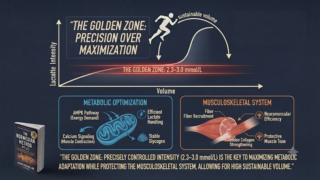
While Chapter 1 explored the philosophy and physiological background of the “golden zone”—delivering high physiological stimulus without excessive fatigue, allowing it to be repeated frequently—Chapter 2 moves away from theory into pure practical application: how to accurately locate your individual threshold.
1. A 14-Year-Old’s First Encounter with Threshold Testing
It all began with a small physiological laboratory test Bakken experienced when he was 14 years old.
The lab was a 30-minute drive from his home. At the center was a treadmill surrounded by a lactate analyzer, test strips, and lancets. Instead of race-day nerves, his mind was filled with a single question: Are my numbers good enough?
- Initial stage: “1.8 mmol/L. Continue.”
- Mid-stage: “2.3 mmol/L,” “3.4 mmol/L.”
- Late stage: Numbers relentlessly climbing to 4.5, 5.9, and 7.3 mmol/L as the pace increased.
Finally, when he reached his physical limit and could no longer cling to the belt, the physiologist Moser drew a graph and gently placed a mark at the deflection point of the curve.
“Right here. This is your threshold.”
From that moment on, “hard effort” ceased to be a vague sensation and became a visualized, objective fact. Bakken gained the conviction that the threshold was real, measurable, and trainable. However, it was also the beginning of an endless quest: the realization that generic formulas and population averages could never pinpoint it.
2. What Over 5,500 Lactate Tests Taught: The Myth of a “Universal Method”
Bakken did not arrive at his method through theory alone; he reached it through the grueling trial and error of over 5,500 lactate measurements.
After thousands of tests, he came to a more practical conclusion: lactate testing is valuable, but lactate alone cannot tell the whole story. The key to the Norwegian approach is not dismissing metrics, but integrating multiple signals generated by the body. Because lactate, heart rate, the talk test, and subjective feeling sometimes align and sometimes conflict, Bakken concluded that one must never rely on a single metric; instead, you must combine multiple approaches to understand what the body is actually telling you.
This led him to challenge the long-standing “4.0 mmol/L” guideline. While 4.0 mmol/L is a useful starting point for many runners, Bakken’s extensive testing proved the danger of applying it universally. In well-trained runners, the golden zone typically sits around 2.3 to 3.0 mmol/L. Using 4.0 as a blanket marker is like handing everyone the exact same shoe size.
This led Bakken to another important principle: when your measurement is uncertain, your training intensity should include a larger safety margin.
This mindset becomes the powerful philosophy running through the entire method.
3. Why Measure with Multiple Methods? The 3-Point Method and Analyzing “Discrepancies”
The human body is not a machine. Fatigue, sleep quality, temperature, and even whether it is morning or night cause heart rate and threshold perception to fluctuate daily. Consequently, because wearable devices estimate threshold indirectly, their values may not always reflect your current physiological state.
This is why Bakken advocates the 3-Point Method (Triangulation)—crossing multiple distinct approaches.
Crucially, the goal is not just to get all three numbers to line up neatly. If they disagree, the real value lies in analyzing why. For example:
- Lactate is normal, but heart rate is abnormally high: Suspect environmental heat stress or dehydration.
- Lactate is low, but the talk test feels terribly difficult: Read it as accumulated sleep deprivation, mental stress, or nervous system fatigue.
Failing to brush off these “discrepancies between numbers and sensations” and analyzing them instead serves as the ultimate compass for understanding your body’s daily state.
Let’s look at the practical methods you can use in the field.
4. Practical Approach ①: The Talk Test
As coaches have understood through decades of empirical experience, how freely you can speak while running is an exceptional barometer of your threshold location, even without a lactate meter.
- Simple Talk Test: If you can speak full sentences in a single breath, you are below the threshold. If you can only utter a few words before needing to breathe, but short phrases are possible, you are right at the threshold (the golden zone). If you can barely manage a single word, you have exceeded the threshold. Recite a fixed song lyric or phrase each time, and check the exact moment you are forced to take a breath.
- Extended Talk Test: A protocol based on joint research with physiologist Carl Foster. Perform 5 to 8 intervals of 3 minutes each, stepping up the pace progressively. During the final 30 to 40 seconds of each interval, recite a passage out loud and evaluate your response: “Yes,” “Yes, but…”, or “No.” The zone where you can answer “Yes, but…” is precisely your golden zone.
5. Practical Approach ②: VDOT Tables and the 30-Minute Time Trial
Jack Daniels’ VDOT tables, which calculate training paces from recent race results, are powerful tools. While Daniels’ “T-pace” represents roughly a 60-minute sustainable pace, choosing a “slower pace” by adding 8 to 12 seconds to your standard T-pace is necessary to stay securely within the golden zone. This creates a small buffer that keeps the effort closer to the sustainable intensity Bakken is targeting.
Additionally, the 30-Minute Time Trial, based on research by McGehee et al., is effective:
- Run continuously for 30 minutes at the fastest steady pace you can sustain (use the first 10 minutes to settle into a rhythm).
- Take the average heart rate of the final 20 minutes as your estimated threshold heart rate.
- Subtract 4 to 7 beats from that heart rate to target your golden zone.
6. Practical Approach ③: Measured Max Heart Rate and the “Hill Protocol”
Age-predicted formulas ($220 – \text{age}$) can cause errors of 10 to 12 beats and are unreliable. Finding your true maximum heart rate requires direct measurement.
- Hill Protocol: Using a steady-grade hill course that takes 2 to 3 minutes to climb, perform 3 efforts after a thorough warm-up (1st effort: control; 2nd effort: hard; 3rd effort: maximum intensity from the start), with 3 to 4 minutes of rest in between. The highest recorded heart rate is your true maximum heart rate.
- For well-trained runners, the threshold heart rate is then calculated as roughly 80% to 87% of maximum heart rate.
7. Practical Approach ④: Lactate Profiling
If you have access to a lactate meter, you should periodically perform a step test on a treadmill or a flat, identical course, increasing pace in 5-minute intervals. By plotting lactate against pace, three zones emerge: a low stable zone, an accelerating transition zone, and a steep zone—allowing you to define your threshold not as a single point, but as a range.
8. Common Pitfalls
- Blindly trusting a single method: Because no single test protocol has flawless precision, cross-check with multiple methods.
- Ignoring discrepancies: Pushing through a planned pace when numbers or feelings are misaligned.
- Treating watch numbers as absolute: Wearable device estimates often drift high, so always build in margins using heart rate.
- Ignoring subjective signals: If the talk test or perceived exertion says it feels “hard,” you have already crossed past the golden zone, regardless of what the numbers say.
Summary of Chapter 2
The threshold is not something you measure once and forget. It is something you continually check, fine-tune, and adjust by listening to what your body is telling you.
The conclusion Bakken reached after over 5,500 lactate tests was surprisingly simple:
— “If in doubt, slow down.”
The biggest mistake to avoid in threshold training is going too fast. A slightly slower intensity can be stacked again tomorrow and the day after. But an intensity that is slightly too fast can rob you of several days of training.
Bakken repeats this stance throughout the book—not because it is passive, but because it is the most effective strategy for building long-term adaptation through consistent training.
(Next time, we will look at how to actually structure your training using this threshold.)
Note:
This article provides an independent interpretation and discussion of the training concepts presented in Marius Bakken’s The Norwegian Method Applied. It is intended to help readers better understand the ideas behind the Norwegian Method and is not a reproduction of the original text.
Previous Post
Next Post

コメント