
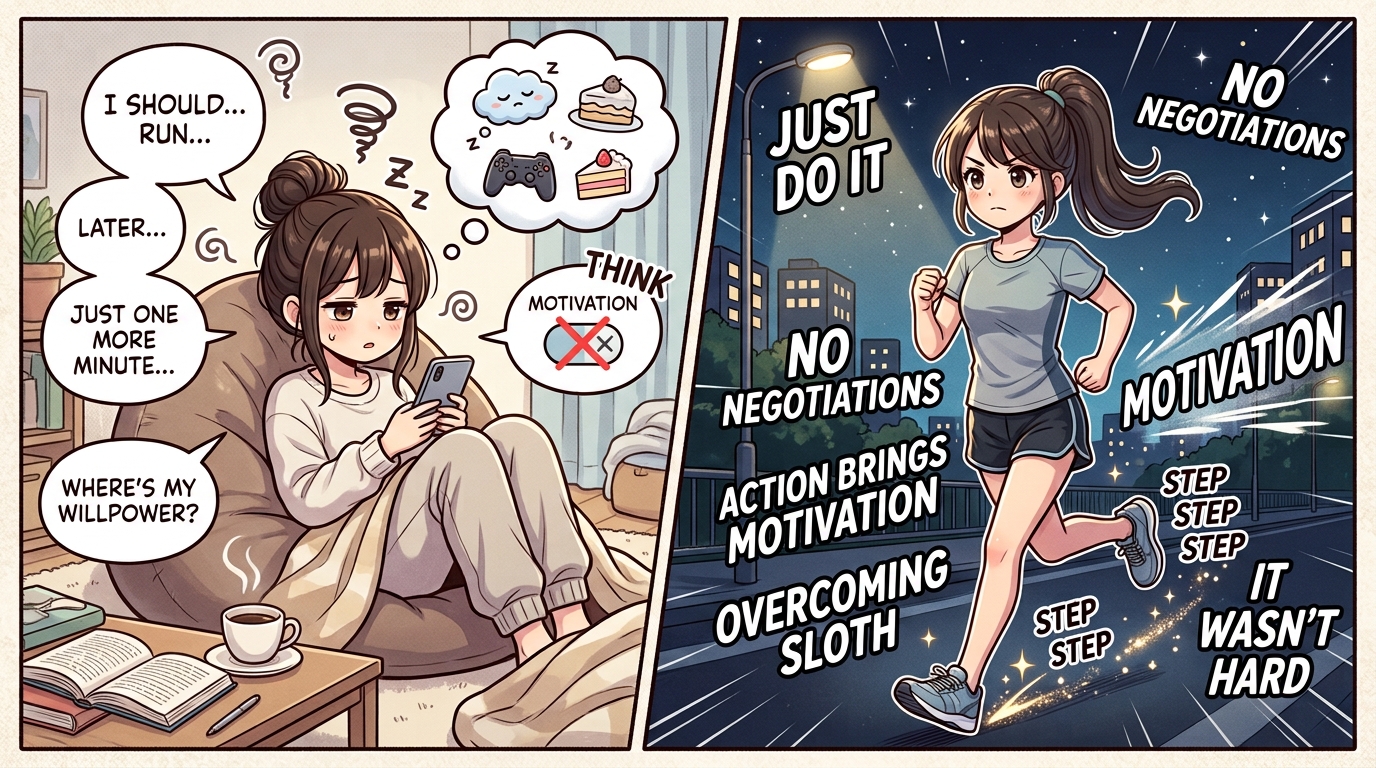
“Well, I guess it’s time to go for a run…”
That’s what I’m thinking first thing in the morning.
But I don’t start running right away.
“I’ll go for a run right after I finish this,” I tell myself, and start doing something else. Once this is done, I’ll run. No, wait, let me grab a cup of coffee first. Once I finish my coffee, I’ll definitely go for a run… Oh, before I know it, it’s already noon. Guess I’ll eat lunch first.
After lunch, I start feeling a bit sleepy. Let me rest for just a little bit. When I wake up, it’s already 3:00 PM. “Well, there’s still plenty of time,” I think, and before I know it, evening arrives.
“Maybe I’ll just skip it today…” No, no, I really need to run.
With that thought in mind, I keep slacking off. From morning till now, the thought “I have to run” is stuck in the back of my head, yet my body refuses to move. Then I realize the outside has gone dark, and the end of the day is drawing near.
Eventually, I drag myself up, change into my running gear, and step outside. But as I run through the dark, the same thought crosses my mind every time:
“…What on earth am I even doing?”
It wasn’t that my body couldn’t move.
My legs didn’t hurt either.
It wasn’t because I was busy with something else and ran out of time.
I simply spent an entire day just getting around to starting a run.
And as I soak in the bath after returning home, I think to myself:
“Couldn’t I have made much better use of today?”
I know I could have gone for a run much earlier in the day, yet I spent the whole day procrastinating, and that makes me furious with myself. Once I actually start running, I can easily keep going for 10, 20, or 30 minutes. Why on earth did it take me so long to do something so simple? I should have just gone running right from the start.
Even though I think this way, when another day comes, I end up doing the exact same thing. I never seem to learn, do I? On other days, just like today, I find myself scrolling through social media or watching videos, trying to get myself in the mood, while endlessly waiting for motivation to strike.
By the way—is “motivation” really that important in the first place?
When we try to start something, we tend to believe in a specific order as if it’s common sense:
Get motivated → Take action.
Without realizing it, we spend our time waiting for motivation to appear.
But could the reverse actually be true?
Take action → Motivation follows afterwards.
When you think about it this way, the whole story of “I can’t move because I’m not motivated” starts to look a bit different.
Perhaps the real problem isn’t a lack of motivation.
We think we can’t move because we aren’t motivated, but in reality, it might simply be that because we don’t act, motivation never shows up.
Trying to Get Motivated Is Exhausting
You lack motivation. So you try to generate motivation.
That whole process is bothersome to begin with.
Listening to music, drinking coffee, watching videos.
“I’ll run after I do this,” or “Ah, I need to do that first.” You keep finding reasons to put it off.
But while doing all that, time just slips away.
You’re using your energy just trying to get motivated.
Kind of ridiculous, isn’t it?
Emotions are vague and fleeting things.
Like all our everyday emotions—happiness, sadness, sleepiness, and laziness—motivation fluctuates wildly. Having it in the morning only for it to vanish by afternoon is a daily occurrence.
If you make something this unstable a “condition” for deciding what you do each day, your behavior will start to fluctuate along with it.
“I won’t do it today because I don’t feel motivated.”
“I’ll do it today because I feel motivated.”
Instead of being yanked around by your emotions like that, why not just stop trying to get yourself motivated? If you have the energy to spend on getting motivated, channel it straight into that very first, small “action” instead.
“Motivation → Action” Isn’t the Only Direction
We tend to think of motivation as a one-way street:
“Feel motivated → Take action.”
However, if you reflect on your daily life, you will notice that the arrow also points in the opposite direction.
- You didn’t feel like it, but going outside for a casual walk lifted your mood.
- You started cleaning just a small part of your room, and before you knew it, you were tidying up everywhere.
- You decided to just do one set of strength training, and ended up completing your entire scheduled workout.
In other words, there is a clear flow of “Take action → Feel a bit more inclined → Take further action.”
Motivation is less of a “fuel” required before taking action, and more of a “result” that shows up after you’ve started moving. You don’t need to prepare a massive wave of motivation right from the beginning. Simply getting started is often enough for your emotions to catch up later.
Stop Negotiating With Yourself Every Time
When you train regularly, there will inevitably be days when you think, “I don’t want to run today.”
When that happens, try to stop holding an emergency meeting inside your head.
“Should I really do this right now?”
“Why not just run twice as much tomorrow?”
“But I’ll feel guilty if I rest… What should I do?”
This kind of inner conflict can be surprisingly draining.
If you have a clear, legitimate reason to rest your body—such as injury prevention or severe physical fatigue—you should definitely rest without hesitation. That isn’t a matter of “motivation”; it’s simply proper condition management.
However, if you simply don’t feel like it, there is no need to let your feelings decide whether you should do it or not.
Put on your running gear.
Lace up your shoes.
Open the door and step outside.
Just get out there and start running.
Once you start running, even if you felt completely unmotivated at first, you’ll often find yourself settling into your run before you know it.
There are plenty of days when you end up thinking, “I’m really glad I ran today.”
Even in the fields of sports psychology and exercise science, studies have found that autonomous motivation and past behavior are associated with exercise adherence. So I have no intention of denying the existence of motivation itself. But my own experience also tells me that we don’t need to be trapped by the idea that we can’t move until motivation strikes.
Let’s Stop Waiting for Motivation
If you think “I’m not in the mood today,” you’ll probably end up procrastinating again.
Having days where you don’t feel motivated is completely normal. Nobody is bursting with motivation every single day of the year.
That’s precisely why there is no need to sit around waiting for motivation to arrive.
Searching for “how to get motivated” or wasting time on rituals and routines designed to get you in the mood—let me put an end to all of that today.
Put on your gear.
Lace up your shoes.
Step outside.
Regardless of whether you “feel like it or not,” simply decide in advance: “I am running today.”
That way, you won’t have to negotiate with yourself every single time about whether to run or rest.
Stop checking whether you have motivation or not.
Just doing that will make things so much easier.
Rather than spending an entire day trying to get motivated, use that time to run.
If you have energy to spend on generating motivation, use it to take that very first step.
Stop looking for a motivation switch.
There was never a convenient button like that in the first place.
References
Cid, L., Monteiro, D., Bento, T., Jacinto, M., Vitorino, A., Teixeira, D. S., et al. (2025). Tell Me What You’ve Done, and I’ll Predict What You’ll Do: The Role of Motivation and Past Behavior in Exercise Adherence. Healthcare, 13(15), 1879. PubMed
Teixeira, P. J., Carraça, E. V., Markland, D., Silva, M. N., & Ryan, R. M. (2012). Exercise, physical activity, and self-determination theory: A systematic review. International Journal of Behavioral Nutrition and Physical Activity, 9, 78. PubMed

コメント