
When maintaining a consistent training routine, muscle soreness after exercise—commonly known as DOMS (Delayed Onset Muscle Soreness)—is a familiar experience, particularly after unaccustomed exercise or a significant change in training load. In this article, we will examine the physiological mechanisms behind DOMS, the effects of age and sex, and what it signifies for the body based on modern sports science.
We hope this serves as a useful reference for your training plans and self-care strategies.
What Is DOMS (Delayed Onset Muscle Soreness)?
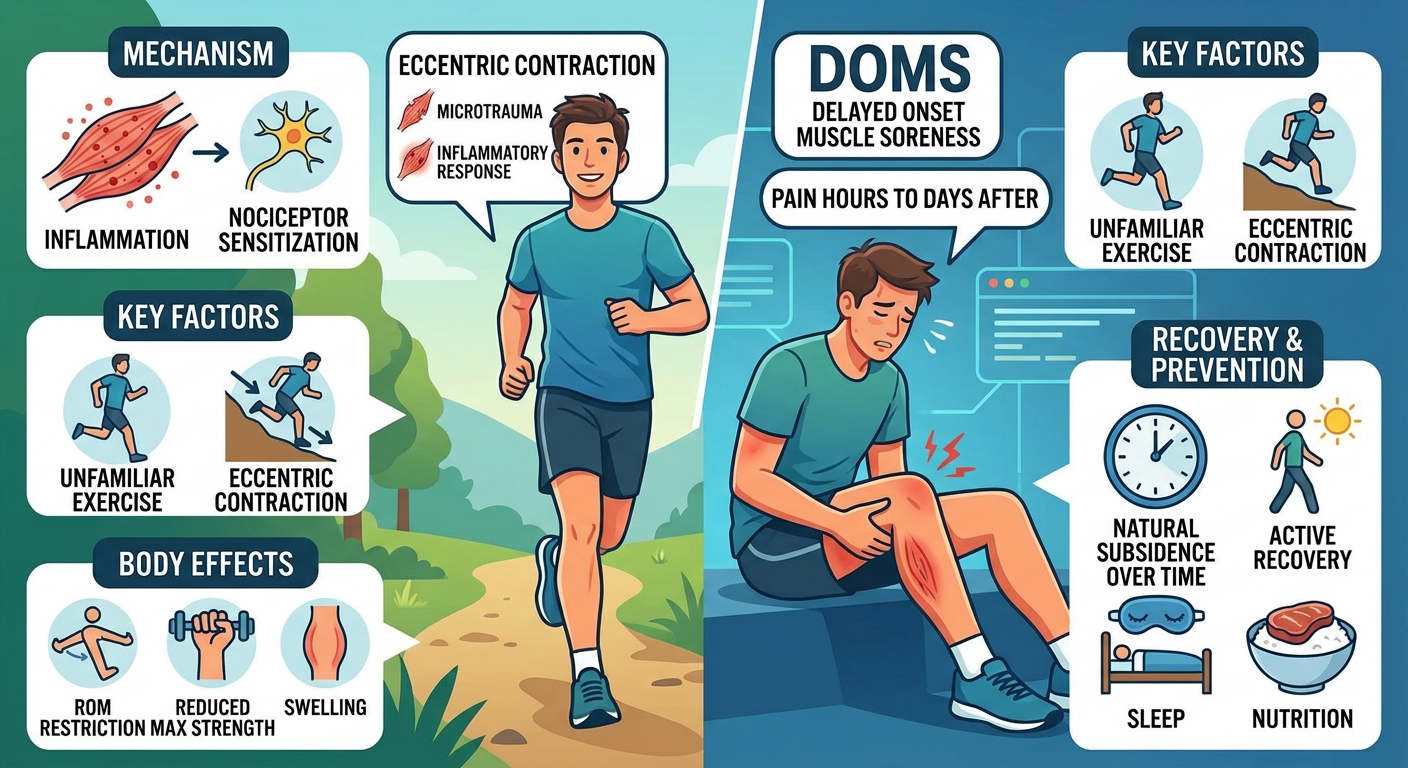
DOMS stands for Delayed Onset Muscle Soreness. It refers to a transient period of muscle pain, discomfort, and temporary functional decline that reaches its peak hours to days after exercise, rather than immediately after a session.
Physiologically, DOMS is recognized not just as localized pain, but as a temporary reduction in muscle function. It typically manifests through a combination of the following symptoms:
- Exercise-Induced Muscle Pain: Pain is minimal at rest but intensifies when moving the affected muscle or applying pressure (palpation).
- Restricted Range of Motion (ROM): Temporary stiffness in the muscles and surrounding connective tissues reduces smooth joint mobility.
- Reduction in Peak Muscle Strength: Exercise-induced changes in muscle function, involving both peripheral and neural factors, can temporarily reduce the ability to produce maximum force.
- Localized Swelling (Edema): Fluid accumulates within the muscle tissue as a result of the inflammatory response described below.
The Detailed Mechanisms Behind DOMS
The traditional theory that lactic acid accumulation causes delayed muscle soreness is no longer supported by modern sports science. Lactate, often incorrectly referred to as lactic acid, is rapidly utilized and cleared after exercise. Its accumulation cannot explain DOMS, which typically peaks 24–72 hours after exercise.
Although the exact mechanisms underlying DOMS are not yet fully understood, current research suggests that several interconnected processes are involved, including mechanical stress, inflammatory signaling, and the sensitization of sensory nerve endings. The following sections outline some of the key mechanisms currently being investigated.
1. Microscopic Damage (Microtrauma)
During exercise—particularly during eccentric contractions (where the muscle lengthens while exerting force)—microscopic damage can occur to the contractile structures within muscle cells, the cytoskeleton, and the surrounding connective tissues.
2. Inflammatory Response
Immune cells, including neutrophils and macrophages, may participate in the response to exercise-induced muscle damage. These cells contribute to the removal of damaged cellular components and the subsequent tissue remodeling process. This response can involve localized inflammation.
3. Nociceptor Sensitization
Nociceptors (pain-sensing nerve endings) are located within the muscle and its surrounding connective tissues, including the epimysium, perimysium, fascia, and tendons. These sensory nerve endings can become sensitized by inflammatory and neurochemical mediators, contributing to the pain experienced during movement or palpation. These processes may contribute to the delayed onset of pain, although the precise mechanisms responsible for the timing of DOMS are not yet fully understood.
Primary Factors That Trigger DOMS
The primary triggers of DOMS relate more to the mode of muscle action and unfamiliarity of movement than to duration or intensity alone.
- Eccentric Contractions: Compared to concentric contractions (where muscles shorten under load), eccentric contractions can impose substantial mechanical strain on active muscle fibers, particularly during unfamiliar or high-load movements, making exercise-induced muscle damage more likely. Examples include downhill running (where the quadriceps absorb heavy braking forces upon impact) or slowly lowering a heavy weight.
- Unfamiliar Movements: Even athletes with high levels of physical fitness are prone to DOMS when introducing new movements or unfamiliar training protocols, as mechanical load distributes unevenly across unprepared tissues.
Do Age and Sex Influence DOMS?
Scientific research has highlighted several key observations regarding how age and sex influence DOMS.
Age-Related Differences
It is commonly believed that muscle soreness takes longer to appear with age. However, current research provides little evidence that aging itself significantly delays the onset of DOMS. In fact, a 2025 systematic review and meta-analysis found that older adults did not experience greater exercise-induced muscle damage than younger adults. Muscle soreness and certain markers of muscle damage were actually greater in younger adults in the studies analyzed. Therefore, the relationship between aging and DOMS is more complex than the common belief suggests.
Sex-Based Differences
Estrogen has been suggested to have protective effects on cell membranes and to modulate inflammatory responses. However, whether these effects translate into meaningful differences in DOMS between men and women remains unclear. Research findings on sex differences are inconsistent, and no definitive conclusion has been reached.
Is DOMS Good or Bad for the Body?
DOMS is not a simple indicator of “workout success.” It must be evaluated through multiple lenses:
DOMS Does Not Directly Correlate with Muscle Growth
While it was once assumed that “stronger soreness equals better workout results,” modern sports science shows that the presence or intensity of DOMS does not necessarily correlate with muscle hypertrophy or strength gains. In fact, muscle protein synthesis, neural adaptations, strength gains, and muscle hypertrophy can occur even when DOMS is minimal or entirely absent.
Structural Adaptation (The Repeated Bout Effect)
Experiencing an exercise stimulus that induces DOMS confers a protective adaptation: subsequent sessions of similar exercise produce far less soreness. This is known as the Repeated Bout Effect.
These adaptations involve changes in muscle fibers, connective tissues, and the nervous system, helping to reduce muscle damage, soreness, and functional impairment during subsequent bouts of similar exercise.
A reduction in DOMS over time does not mean your workout has lost its effectiveness. It often indicates that your body has successfully adapted to the stimulus; therefore, the absence of DOMS alone should never be taken as a sign of an ineffective training session.
DOMS as a Warning Sign of Excessive Load
When soreness is severe enough to significantly interfere with daily activities or walking, it may indicate that the exercise imposed a substantial stress on the muscles. Although DOMS is generally a temporary response to unfamiliar exercise, severe or disproportionate pain should not automatically be dismissed as normal muscle soreness. Excessive pain, significant swelling, marked weakness, or dark-colored urine warrant medical evaluation.
Timeline for Recovery and Practical Approaches
Because DOMS is not an acute traumatic injury, it resolves naturally over time. A general timeline typically follows this pattern:
Recovery Timeline
- 0 to 12 Hours Post-Exercise: Muscle tightness or mild discomfort may develop, although noticeable soreness is often still minimal.
- 24 to 72 Hours: Muscle soreness typically reaches its peak during this period.
- 72 to 96 Hours: Pain and stiffness generally begin to subside.
- 5 to 7 Days: Symptoms usually resolve, although recovery may take longer following particularly strenuous or unfamiliar exercise.
Recovery Strategies and Lifestyle Management
While no quick fix instantly eliminates DOMS, practical daily care can ease discomfort and support your body’s natural repair mechanisms:
- Active Recovery: Engaging in very light activity (e.g., easy walking, gentle jogging, or low-intensity cycling) may temporarily alleviate pain and stiffness. However, active recovery does not necessarily accelerate the underlying muscle repair process, and its benefits can vary depending on the individual and the type of exercise performed.
- Gradual Progression: When initiating a new training program or introducing unfamiliar exercises, gradually increasing training volume and intensity allows the body to adapt to the new demands. In particular, introducing eccentric loading progressively can help reduce the severity of DOMS through the repeated bout effect.
- Nutritional Support and Sleep: Consuming adequate protein and energy, together with maintaining sufficient sleep, supports muscle protein synthesis, tissue repair, and overall recovery following exercise.
Managing DOMS from an Athlete’s Perspective
For endurance athletes—such as long-distance triathletes—it is crucial to embrace the mindset that “training to the point of extreme muscle soreness every session is not necessarily good training.”
In long-distance training, fatigue management and the ability to sustain consistent, high-quality volume over extended blocks take priority. Training loads that constantly induce severe DOMS can compromise training frequency and quality, ultimately hindering performance gains.
Rather than using DOMS as the sole benchmark for session quality, athletes should assess overall readiness using subjective fatigue, sleep quality, and movement efficiency. Building a sustainable routine that allows training stress to be absorbed while maintaining consistency is an important foundation for long-term athletic development.
Summary
DOMS is a natural physiological response reflecting the body’s adaptive process, but it should not be viewed through a simplified rule of “more pain equals better results.” Consistently balancing appropriate training stress with adequate recovery remains the true foundation for long-term athletic progress.
References
- Mizumura K, Taguchi T. Neurochemical mechanism of muscular pain: Insight from the study on delayed onset muscle soreness. The Journal of Physiological Sciences. 2024;74(1):4. PMID: 38267849
- Fernandes JF, Wilson LJ, Dingley AF, et al. Advancing Age Is Not Associated With Greater Exercise-Induced Muscle Damage: A Systematic Review, Meta-Analysis, and Meta-Regression. Journal of Aging and Physical Activity. 2025;33(6):606–624. PMID: 40174882
- Afonso J, Clemente FM, Nakamura FY, et al. The Effectiveness of Post-exercise Stretching in Short-Term and Delayed Recovery of Strength, Range of Motion and Delayed Onset Muscle Soreness: A Systematic Review and Meta-Analysis of Randomized Controlled Trials. Frontiers in Physiology. 2021;12:677581. PMID: 34025459
コメント