
Would you be surprised if you were told that among the things we daily believe to be “good for our health,” there are actually “micro-doses of poison” or “bodily stress” hidden inside?
Take “polyphenols,” for instance, known as essential compounds for anti-aging and health maintenance. In reality, these are chemical defense substances (i.e., micro-doses of poison) produced by plants to protect themselves from external threats such as pests and ultraviolet rays. Furthermore, the “radium and radon hot springs” that many people visit seeking relaxation expose people to very low levels of radiation, which scientifically represents a clear stressor to living organisms. Even “exercise”—the very symbol of good health—is, at the cellular level, a continuous series of stressors placed on the body.
When I first learned that polyphenols—which I believed were good for health—were actually “plant poisons,” and that radon hot springs were “radiation stress,” I was shocked, thinking, “Wait, aren’t they supposed to be good for you!?” However, once I understood the underlying mechanism of why such poisons and stressors work positively for the body, my perspective on the human body shifted significantly.
“Why are such poisons and stressors good for the body?”
At the core of this concept lies the famous phrase left by the 16th-century physician Paracelsus: “The dose makes the poison.” In this article, we will explore the mechanism and essence of “Hormesis”—a phenomenon where stimuli that are harmful at high doses trigger the body’s defense systems and yield beneficial effects precisely because they are present at low levels.
1. What Is Hormesis?
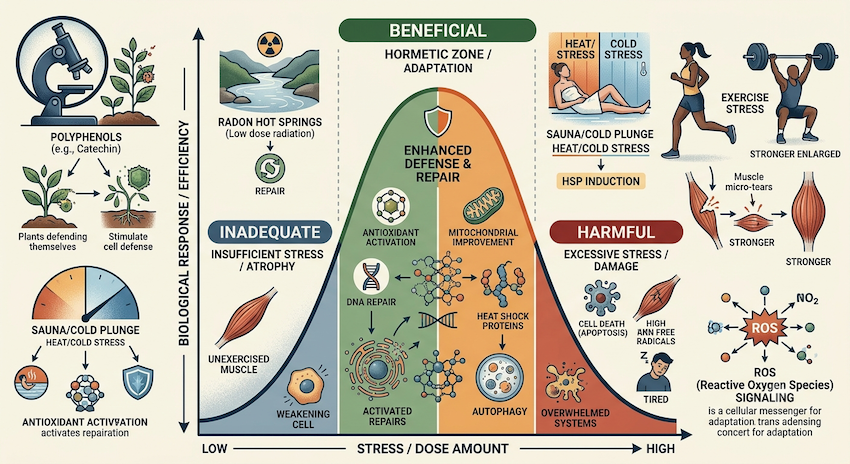
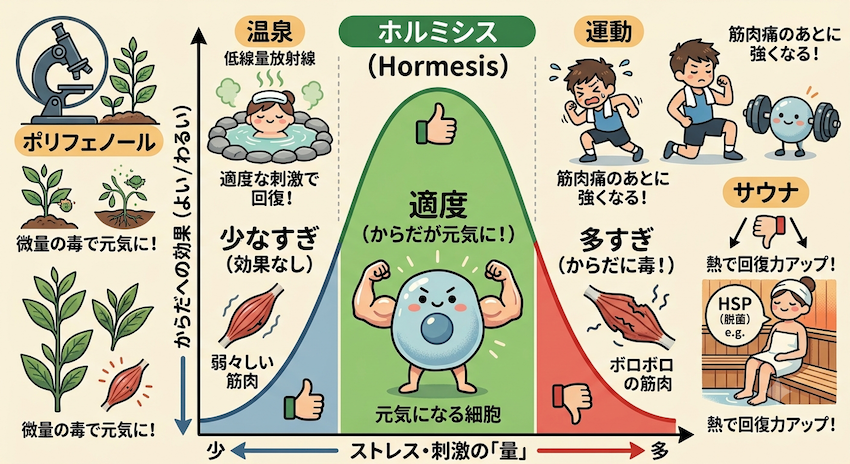
Hormesis refers to a phenomenon in which the body’s response changes dramatically depending on the amount or intensity of a specific substance or stimulus. It is often illustrated as a U-shaped or inverted J-shaped relationship:
- Insufficient Stimulus (Deficiency): If there is too little stimulus, there may be insufficient stimulus to drive meaningful adaptation, and the body may gradually become less resilient.
- Optimal Stimulus (Beneficial): An appropriate amount of stress temporarily activates the body’s defense functions, making it stronger than before.
- Excessive Stimulus (Overload): The stress exceeds the body’s processing capacity and recovery limits, causing damage to outweigh adaptation and eventually overwhelming the body’s capacity to cope.
In short, it is the principle that “appropriate stress within a recoverable range makes the body stronger.”
2. Why Does “Stress” Make the Body Stronger?
Why does a load that should inherently be negative work positively for the body? The reason lies in the “adaptive response” (stress response)—a defensive system acquired by living organisms through the process of evolution.
When the body senses minute amounts of stress or load, it recognizes it as a stressor and mobilizes its defense systems necessary for survival:
- Activation of Antioxidant Enzymes: Enhances the capability to counter internal reactive oxygen species.
- Activation of DNA Repair Mechanisms: Helps repair damaged DNA.
- Improvement in Mitochondria Quantity, Function, and Quality Control: Increases the efficiency of the cellular energy powerhouses.
- Induction of Heat Shock Proteins (HSP): Assists in repairing damaged proteins and refolding them into correct structures.
- Promotion of Autophagy: Decomposes and recycles unneeded proteins and cellular organelles.
After the stimulus subsides, the operation of these defense systems builds a body that is ultimately more resilient than it was prior to the exposure.
3. Concrete Examples of Hormesis Hidden in Daily Life and Training
As touched upon at the beginning, many activities we engage in daily for “good health” share this common principle of hormesis.
- Radium & Radon Hot Springs (Low-Dose Radiation):In radium and radon hot springs long favored for thermal therapy, individuals are exposed to extremely low-dose radiation environments. While high doses of radiation are harmful to the human body, low doses may stimulate internal defense systems such as antioxidant enzymes and DNA repair mechanisms, a relationship actively studied in connection with hormesis. However, research in this field is ongoing, and a full scientific consensus regarding its health benefits has not been fully established.
- Plant-Derived Compounds (Polyphenols and Other Phytochemicals):Polyphenols such as catechins in tea, as well as compounds like sulforaphane found in broccoli sprouts, were originally chemical defense substances (micro-doses of poison) produced by immobile plants to protect themselves from pests and UV rays. When humans consume these in appropriate amounts, they may gently stimulate the body’s internal defense systems, which may enhance the activity of detoxification enzymes and antioxidant networks. Hormesis is thought to be involved in these actions. (Note: The health benefits of plant compounds involve multiple mechanisms, including direct actions alongside such stimulation.)
- Saunas & Cold Plunges (Thermal & Cold Stress):The intense heat of a sauna places substantial thermal stress on the body, but it is believed to prompt the production of heat shock proteins (HSP). Similarly, the cold stress from a cold plunge triggers adaptive responses such as maintaining vascular function and activating brown adipose tissue.
- Exercise & Strength Training:Exercise is, in itself, a series of physiological stressors. Running or performing hard training temporarily increases reactive oxygen species (specifically termed “ROS”), damages muscle fibers, causes inflammation, and depletes energy (ATP) inside the body. While these are locally negative events, the body responds as if similar demands may occur again, adapting by increasing mitochondria and capillaries while improving cardiovascular function and oxidative stress tolerance. Muscle hypertrophy, in which muscle tissue adapts to resistance training and becomes larger and stronger over time, is another example of this mechanism.
A New Perspective on Reactive Oxygen Species (ROS)
Once viewed purely as harmful agents, reactive oxygen species are now understood to act as important messengers sending signals to cells to “become stronger.” Consequently, some studies suggest that consuming excessive amounts of high-dose antioxidant supplements, such as Vitamin C or E, immediately after exercise may blunt these important signals and potentially reduce some training adaptations.
4. The Essence of Long-Term Growth in Triathlon and Other Endurance Sports
The principle of hormesis is particularly relevant to endurance sports and high-intensity training.
Approaches targeting LT1 (the first lactate threshold), threshold runs, $\text{VO}_2\text{max}$ intervals, long rides, or weight training all impose strong stressors on the body. However, providing adequate recovery periods following appropriate loads allows various tissues—including mitochondria, capillaries, the heart, muscles, and tendons—to adapt, leading to enhanced performance.
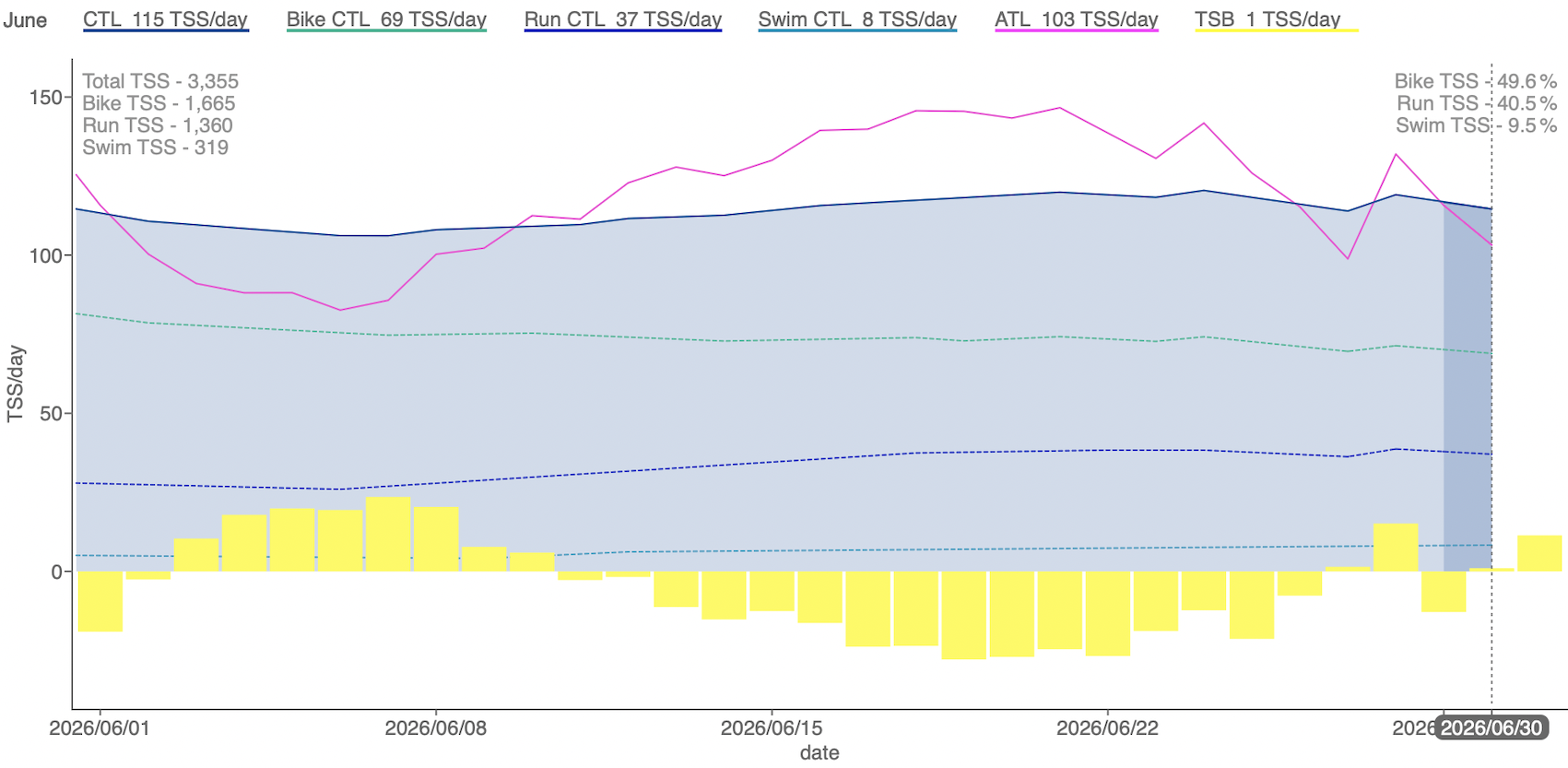
What matters most here is the balance between “appropriate stimulus” and “sufficient recovery.” To gain adaptation (fitness), a corresponding amount of stress is indispensable; however, repeating excessive high-intensity training daily or failing to take adequate rest can easily push the stress beyond the range in which it remains adaptive.
There is a phrase worth keeping in mind:
“Fatigue builds up faster than fitness.”
When the body’s processing and recovery capacity fails to keep pace with the load, the benefits of hormesis disappear, fatigue accumulation takes over, and the risks of performance decline, injury, and overtraining rise significantly.
Summary
Hearing that “poison and stress make the body stronger” may sound paradoxical at first, but understanding the concept of hormesis brings clarity to various daily phenomena.
In daily training activities like exercise and strength training, one directly experiences this exact hormetic mechanism. Rather than simply piling on hard loads continuously, combining appropriate stimuli with sufficient recovery enables the body to adapt step-by-step, steadily growing stronger than before.
The body does not become strong in a purely “comfortable and easy environment,” nor can it adapt when subjected to “excessive stimuli” or “extreme stress” that overwhelm its capacity. Applying “moderate, recoverable stress at the margin” is what activates the body’s internal adaptation switches. Controlling this delicate balance represents the true depth and fascination of physical conditioning.
People naturally tend to seek out things that are purely “good for the body.” However, living organisms did not evolve in a purely “comfortable environment.” They survived and became more resilient by experiencing moderate stress and adapting to it.
Remaining healthy does not require eliminating stress entirely. Rather, it means repeatedly applying appropriate stress followed by sufficient recovery. This is the very mechanism for becoming stronger that life has acquired over hundreds of millions of years of evolution.
コメント