
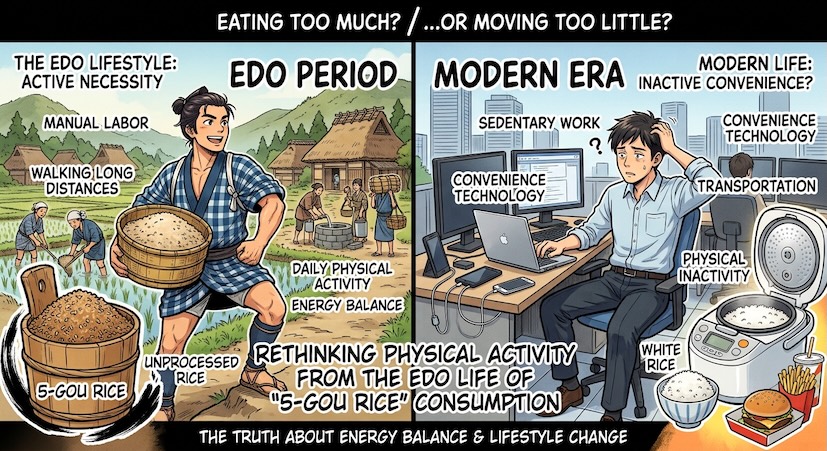
In modern health and fitness discussions, “overeating” is frequently identified as the primary culprit behind obesity and lifestyle-related diseases. Reducing food intake and restricting calorie consumption are widely regarded as the gold standard for maintaining health.
However, a look back at historical records raises fundamental questions about this modern consensus.
For example, during Japan’s Edo period (1603–1867), the basic unit of stipend for samurai, known as ichinin-buchi (one-person allowance), was based on an allowance of 5 go of rice per day (one go is a traditional Japanese volume measure; one go of uncooked brown rice weighs roughly 150 g). Moving forward in history, Kenji Miyazawa’s famous poem Ame ni mo Makezu (Unbeaten by the Rain) contains the well-known line: “eating four go of unpolished rice a day.”
Why was a lifestyle built on such a massive staple food requirement able to exist?
If people in those times generally maintained stable body weight despite the physical demands of daily life, there must have been a reason their energy intake and expenditure remained broadly balanced.
This article uses the diet and lifestyle of the Edo period as a mirror to reflect on modern life. Drawing on historical records, exercise physiology, and epidemiological evidence, we explore whether we are truly “overeating” or simply “moving too little.”
- 1: The Discrepancy of “5 Go of Rice” and Historical Reality
- 2: Not “How Many Steps,” But “What Was Automated”
- 3: The Physiological Complexity of Estimating Energy Expenditure
- 4: Are Modern Humans Lacking “Exercise” or “Daily Activity”?
- 5: You Train for 1 Hour—What About the Other 23 Hours?
- 6: Redesigning Modern Life Without Idealizing the Past
- Conclusion: Are We “Overeating” or “Moving Too Little”?
- References
1: The Discrepancy of “5 Go of Rice” and Historical Reality
To begin, we must accurately decipher the historical and nutritional meaning behind numbers like “5 go of rice” or “4 go of brown rice.”
What the “5 Go Per Day” Stipend Really Meant
The ichinin-buchi stipend granted to samurai—5 go per day (roughly equivalent to 1.8 koku per year under the traditional accounting convention)—did not represent the amount of rice a single individual actually consumed daily.
Rather, 1 buchi served as a computational unit for salaries and employment in the social system of the time. Samurai used this rice to feed their families and servants, or sold/converted a portion of it into silver currency through rice brokers (fudasashi) to purchase side dishes, clothing, housing, and everyday goods.
Was 5 go merely an abstract symbol, then? Not at all. It functioned for centuries as a standard unit of rice-based compensation because it represented a socially established allowance of rice associated with supporting one person’s livelihood.
Kenji Miyazawa’s “4 Go of Brown Rice” and Energy Density
The “four go of brown rice” in Miyazawa’s poem was also not a literal record of his own daily meals, but an idealized depiction of a farmer working hard under harsh environmental conditions.
How much energy does 4 go of brown rice actually contain?
- Weight: Assuming 1 go of brown rice is about 150 g, 4 go equals approximately 600 g.
- Energy Content: Converted at roughly 350 kcal per 100 g of raw rice, 600 g yields about 2,100 kcal.
When cooked, the rice absorbs water and increases in weight to roughly 1.2–1.3 kg, but the caloric content is determined at the raw stage. Hearing “2,100 kcal from rice alone” might sound like overeating, but there is a trap regarding “energy density.”
The modern diet contains a high proportion of fat (about 9 kcal per gram) found in meat, oils, dairy products, and processed foods, making meals caloric despite a smaller visible volume.
Compared with many modern diets, the diet of many Edo-period commoners was relatively low in fat and relied heavily on carbohydrates, particularly rice, as a source of energy.Furthermore, meals were not composed solely of rice; small portions of miso, pickled vegetables, beans, and occasionally fish accompanied the staple.
In short, to obtain the necessary total energy from a low-fat diet, the physical volume (go count) of the staple food inevitably had to be large.
Unexpected Figures from the Choshu Domain Data
Let us examine a historical dataset that challenges common assumptions.
In works by historian and food-culture scholar Nobuo Harada, historical records such as the Bocho Fudo Chushinan from the Tenpo era (1830s–1840s) have been used to estimate the amount of food energy available per person per day in rural areas of the Choshu Domain.
The estimated figures are as follows:
- Estimated available energy per person per day: Approx. 1,861 kcal
- Energy ratio from grains: 86.4%
- Fat ratio: Approx. 5.5%
Does 1,861 kcal seem surprisingly low?
To be clear, this figure represents the “available energy per person” calculated from regional agricultural production in rural Choshu, rather than a nationwide average or individual data from heavy manual laborers like blacksmiths or palanquin bearers.
Nevertheless, this data reveals a crucial fact:
People in the Edo period were not consuming astronomically high calorie diets to offset massive energy expenditure. In fact, their estimated available energy was comparable to—or, depending on the region and period, even lower than—modern estimates of daily energy requirements for adult men (whose estimated daily energy requirement ranges from 2,200 to 2,700 kcal).
Why, then, did a society require a staple food baseline like “5 go of rice”? The answer lies in the structure of how they lived and moved.
2: Not “How Many Steps,” But “What Was Automated”
Claims that “people in the Edo period walked 30,000 steps every day” lack empirical backing, as nationwide pedometer data did not exist.
What matters when analyzing physical activity in the Edo period is not speculative step counts, but a physical comparison: “Which tasks now handled by machines and infrastructure were carried out by human bodies back then?”
| Aspect of Life | Modern Society | Edo Period | Nature of Physical Load |
| Transportation | Cars, trains, buses, elevators | Mostly walking | Prolonged low-intensity movement using full-body musculature |
| Water Supply | Running water, water heaters, faucets | Drawing and hauling water from wells or rivers | Moderate-to-high intensity load carrying engaging core and limbs |
| Laundry | Automatic washing machines, dryers | Scrubbing in tubs, wringing, carrying | Continuous muscular effort centered on upper body and back |
| Cooking & Fuel | Gas stoves, IH, microwaves | Chopping firewood, starting fires, operating bellows | Core engagement and physical labor in sustained postures |
| Cleaning | Vacuum cleaners, robot vacuums | Sweeping with brooms, wiping floors on hands and knees | Core and lower-body exertion in deep forward-flexed postures |
| Labor & Industry | Industrial machinery, automated lines, desk work | Manual farming, construction, craftwork | Multi-directional physical loads throughout the entire day |
It is worth noting that people in the past were not performing high-intensity workouts from morning till night.
While tasks like hauling water or chopping wood involved localized high physical strain, long-distance walking, floor scrubbing, and agricultural work consisted mostly of sustained low-to-moderate intensity activity.
Rather than concentrating intense exercise into a single session, a wide variety of low-to-high intensity physical activities were naturally woven throughout daily life from morning to night.
Physical activity was embedded in everyday life rather than separated into a dedicated period of “exercise.”
3: The Physiological Complexity of Estimating Energy Expenditure
Let us examine the relationship between caloric intake and energy expenditure from a physiological standpoint.
Intuitively, one might assume that “eating more equals moving more,” but human energy metabolism does not follow a simple additive formula.
Why Intake Does Not Directly Equal Activity
Even if an exact historical food log existed for a specific individual, it would be impossible to directly calculate their daily physical activity level from it. Human Total Energy Expenditure (TEE) is mediated by numerous variables:
- Body composition (weight, muscle mass), age, and sex
- Basal Metabolic Rate (BMR) (energy spent at rest for respiration and thermoregulation)
- Diet-Induced Thermogenesis (DIT/TEF) (energy cost of digestion and absorption)
- Intestinal absorption efficiency (percentage excreted unabsorbed)
- Thermoregulatory costs dictated by ambient temperature
Not all consumed calories are channeled into physical movement; a substantial portion is allocated to basal metabolism and body temperature regulation.
The Perspective of Long-Term Energy Balance
Looking at this from the reverse angle yields a physiological principle:
If people in the past consumed large volumes of grain-based staples while generally maintaining body weight, this suggests that their overall energy expenditure, including daily physical activity, was sufficient to balance their energy intake over time.
The Constrained Energy Expenditure Model
Recent research in anthropology and exercise physiology (Pontzer et al., 2016; Pontzer & Trexler, 2026) indicates that increasing physical activity does not cause total energy expenditure to rise indefinitely in a linear fashion.
According to the Constrained Total Energy Expenditure model, as daily physical activity increases, the extra activity does not simply add onto total energy expenditure in a 1:1 ratio. Instead, other internal metabolic processes adjust, partially offsetting the increase in total energy expenditure.
Therefore, simplifying history by claiming that “people in the past expended many times more calories than modern humans” is scientifically inaccurate.
Even within this constrained framework, however, a fundamental difference remains between modern lifestyles—characterized by prolonged sitting and minimal movement—and historical lifestyles where physical movement was required throughout the day: the structure and distribution of physical activity across 24 hours.
4: Are Modern Humans Lacking “Exercise” or “Daily Activity”?
Let us turn our focus to the issues facing modern society.
According to the National Health and Nutrition Survey (2023) by Japan’s Ministry of Health, Labour and Welfare, the average daily step count for Japanese adults was 6,628 steps for men and 5,659 steps for women, continuing a long-term downward trend.
Media and healthcare settings often summarize these findings with a single phrase: “Modern people don’t get enough exercise.” However, understanding the core problem requires distinguishing between four distinct concepts of movement:
Four Concepts of Physical Movement
- Physical ActivityAny bodily movement produced by skeletal muscles that requires energy expenditure above resting levels. This encompasses work, domestic chores, transportation, and leisure activities.
- ExerciseA subcategory of Physical Activity that is planned, structured, repetitive, and purposeful, aimed at improving or maintaining physical fitness (e.g., running, weight training, swimming).
- NEAT (Non-Exercise Activity Thermogenesis)The energy expended through everyday physical activities that are not planned exercise or sports, such as standing, walking, household chores, and incidental movement during work.
- Sedentary BehaviorAny waking behavior characterized by energy expenditure ≤1.5 METs while sitting, reclining, or lying.
Modern technological advancement and infrastructure have systematically removed Physical Activity—especially NEAT—from daily routines.
As a result, individuals increasingly need to schedule intentional Exercise because much of the physical activity once embedded in daily life has disappeared.
The fundamental issue facing modern humans is not merely a lack of gym visits, but the depletion of overall Physical Activity (NEAT) throughout daily life.
5: You Train for 1 Hour—What About the Other 23 Hours?
This structural problem applies to master-level athletes who engage in structured training such as running, cycling, or weightlifting.
Consider someone who spends one hour a day performing intense Exercise at a gym or on the road. This is undoubtedly a beneficial habit for cardiovascular health and physical fitness.
Physiologically, however, “engaging in structured exercise” and “having high overall daily physical activity” are distinct factors.
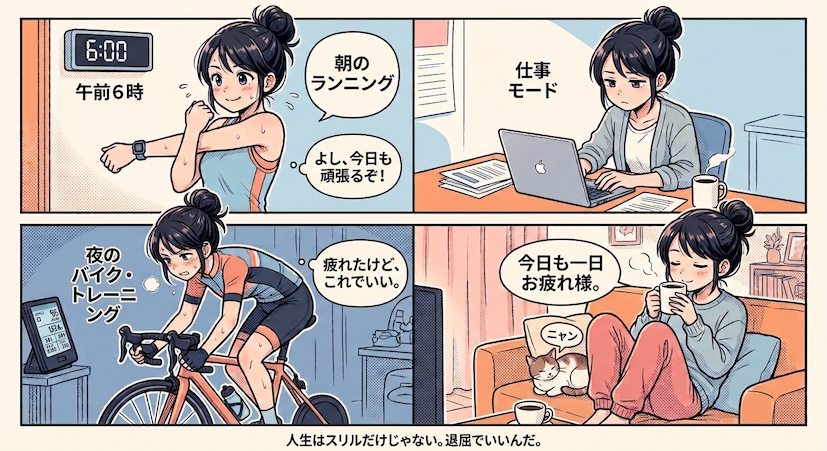
If an individual runs for an hour in the early morning, but then commutes by car, sits at a desk for eight hours, and lounges on a couch in the evening, that single hour of Exercise is surrounded by 23 hours dominated by Sedentary Behavior.
Epidemiological research and international guidelines (Katzmarzyk et al., 2019) emphasize that promoting physical activity and reducing sedentary behavior should be considered as complementary, but distinct, health targets.
A systematic scoping review of longitudinal studies on Japanese adults (Shibata et al., 2026) similarly found evidence linking prolonged sedentary behavior with a range of adverse health outcomes among Japanese adults, highlighting sedentary behavior as a health issue distinct from insufficient physical activity.
This is not to suggest that a one-hour workout is rendered useless by sitting. The cardiovascular and musculoskeletal benefits of Exercise are substantial and irreplaceable.
Rather, it highlights the need to address three distinct components:
- Engaging in Exercise
- Increasing NEAT (daily activity)
- Reducing Sedentary Behavior (sitting time)
These components operate through distinct physiological mechanisms. Relying solely on a one-hour workout while remaining immobile for the remaining 23 hours leaves a significant gap in overall daily activity structure.
6: Redesigning Modern Life Without Idealizing the Past
Comparing modern life to the Edo period is not an argument for returning to historical living conditions or romanticizing the past as healthier or happier.
Historical evidence documents the harsh realities of life in the Edo period:
- Threats of infectious diseases like tuberculosis and cholera
- Chronic conditions stemming from micronutrient deficiencies, such as beriberi
- Absence of modern medical technology and public sanitation
- Occupational injuries and physical wear resulting from heavy manual labor
- Substantially shorter average life expectancy
Modern conveniences—appliances, transportation, climate control, and advanced healthcare—are major achievements of human technological progress. Eliminating hard physical labor has provided undeniable benefits.
The goal is not to discard modern conveniences, but to recognize that automation has removed the physical movement once built into daily life, resulting in physical inactivity and excessive sedentary time.
Conclusion: Are We “Overeating” or “Moving Too Little”?
Returning to our opening question: Are modern humans “overeating” or “moving too little”?
Synthesizing historical nutritional patterns with modern exercise physiology points to a clear conclusion.
Modern humans are not simply consuming too many calories. By losing much of the movement once embedded in daily life, we have fundamentally changed the relationship between eating and moving in everyday life.
In the past, people did not set aside dedicated time to exercise for health; the process of living was the physical activity.
Today, because movement has been designed out of daily routines, we must consciously incorporate both structured exercise and strategies to interrupt prolonged sitting.
Whether you are an athlete pursuing training goals or a professional working at a desk, consider your 24-hour routine:
How much of your day involves active use of your body?
Alongside scheduling workouts, small changes such as walking one stop farther, standing periodically, or doing household tasks manually can help restore some of the everyday movement that has disappeared from modern life.
References
- Ministry of Health, Labour and Welfare. National Health and Nutrition Survey (2023). [in Japanese]
- Harada N. Rekishi no Naka no Kome to Niku: Shokuseikatsu no Bunka-shi. Heibonsha, 1993. [in Japanese]
- Harada N. Edo no Shoku-seikatsu. Iwanami Shoten, 2003. [in Japanese]
- Pontzer H, Durazo-Arvizu R, Dugas LR, et al. Constrained Total Energy Expenditure and Metabolic Adaptation to Physical Activity in Adult Humans. Current Biology. 2016;26(3):410-417. PubMed (PMID: 26832439)
- Pontzer H, Trexler ET. The evidence for constrained total energy expenditure in humans and other animals. Current Biology. 2026;36(4):1013-1025.e4. PubMed (PMID: 41653928)
- Katzmarzyk PT, Powell KE, Jakicic JM, et al. Sedentary Behavior and Health: Update from the 2018 Physical Activity Guidelines Advisory Committee. Medicine & Science in Sports & Exercise. 2019;51(6):1227-1241. PubMed (PMID: 31095080)
- Shibata A, Ishii K, Owen N, Oka K. Sedentary Behavior and Health Consequences: A Systematic Scoping Review of Prospective and Longitudinal Studies in Japan. Journal of Epidemiology. 2026;36(1):1-19. PubMed (PMID: 40819887)
コメント