
1. Overview and Definition
Hormesis is a biological phenomenon in which a physical, chemical, or environmental stimulus (stressor) that is generally harmful or toxic at high doses induces beneficial adaptive responses at low doses (mild stimulation).
- Etymology: Derived from the Greek word “hormaein” (meaning “to impel” or “to urge on”).
- Core Concept: Based on the pharmacological principle “The dose makes the poison,” it refers to the process by which an organism responds and adapts to low levels of stress.
Rather than simply meaning “a small amount of poison is good for you,” the concept focuses on the organism’s response mechanism: “an organism’s adaptive and protective response to mild stress leads to the maintenance of biological function and enhanced resistance.”
2. Mechanisms of Hormesis
When an organism is exposed to mild stress, multiple signaling pathways and gene expressions are induced to maintain and restore homeostasis.
- Sensing Low-Level Stress: Cells detect mild stressors such as heat, reactive oxygen species (ROS), metabolic strain, or minor cellular damage.
- Activation of Biological Defense Systems: Specific response pathways are activated—such as the Nrf2 pathway involved in antioxidant enzyme expression, the induction of heat shock proteins (HSPs) that enhance stress tolerance, DNA repair mechanisms, and autophagy.
- Acquisition of Adaptation and Resilience: The combined action of these multiple defense systems increases stress tolerance and resistance to functional decline compared to the pre-stimulus state.
3. Major Fields and Examples Associated with Hormesis
Hormesis is researched across various fields, including toxicology, physiology, and exercise physiology.
| Field | Subject / Phenomenon | Mechanism & Description |
| Exercise & Training | Exercise Load (Mechanical & Metabolic Stress) | Physical strain on muscle fibers, metabolic load, and the temporary production of ROS act as signals that induce mitochondrial adaptation and the maintenance or improvement of muscle function. |
| Plant-Derived Compounds | Polyphenols, Sulforaphane, etc. | Ingesting compounds that plants produce for self-defense is being studied for its potential to stimulate human cellular response mechanisms and induce endogenous detoxification and antioxidant systems. |
| Environmental & Thermal Stress | Low-Dose Radiation, Sauna, Cold Plunge, etc. | The link between low-dose radiation (such as radon or radium springs) and hormesis remains under research without established scientific consensus, though it is discussed as an example of physical stress response. Thermal stressors like saunas are also discussed in the context of heat shock responses. |
| Nutrition & Metabolism | Caloric Restriction, Transient Energy Deficit | Mild nutritional or energy deficit stress is thought to stimulate cellular metabolic signals and autophagy, promoting adaptive responses to environmental changes. |
4. Conceptual Models of the Hormetic Curve
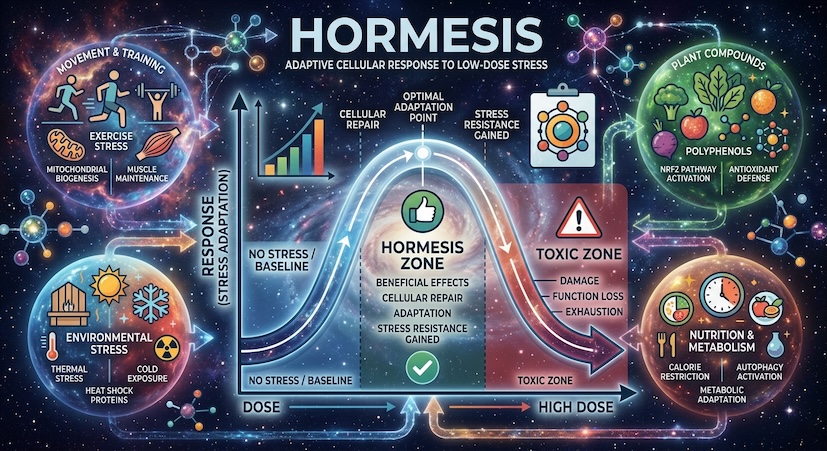
When explaining hormesis, the dose-response relationship is often illustrated using an “inverted U-shaped” or “J-shaped” curve.
- No/Low Stimulation Zone: Below a certain threshold or in the absence of stimulation, adaptive responses are not markedly observed.
- Hormetic Zone (Low Dose): Mild stress leads to adaptive and beneficial responses, such as maintained survival rates or enhanced stress tolerance.
- Toxic/Damage Zone (High Dose): The stress exceeds the organism’s adaptive and processing capacity, leading to tissue damage, functional decline, or injury.
Note: The magnitude of response and the effective dose range vary depending on the individual organism and the type of stimulus; there are no universal, fixed numerical boundaries.
5. Frequently Asked Questions (FAQ)
Q1. Does adding more stress or stimulation make the body progressively stronger?
A. No. Loads that exceed an organism’s capacity for adaptation and recovery directly cause functional decline and damage.
The essence of hormesis lies in the response to manageable, low-level stimulation. Excessive stress beyond this threshold results in destruction, fatigue, and pathological impairment rather than positive adaptation.
Q2. Does taking antioxidant supplements after exercise reduce its benefits?
A. Some studies suggest that high-dose antioxidant supplements may blunt the body’s adaptive response to exercise.
Reactive oxygen species (ROS) generated during exercise also function as signaling molecules that prompt cellular adaptation. Ingesting large doses of antioxidants like vitamin C or E via supplements right after a workout may interfere with this signaling, potentially weakening some of the training adaptations.
6. Summary
Hormesis is not merely a “health strategy involving tiny amounts of toxins,” but a comprehensive concept describing “the biological mechanism by which an organism responds to moderate environmental stress to adapt, strengthen, and maintain itself.”
Rather than eliminating stress entirely, providing appropriate stimuli within the limits of the body’s recovery capacity—and combining them with adequate rest—is the key to unlocking the adaptive capabilities inherent to living organisms.
コメント