
1. Overview and Definition
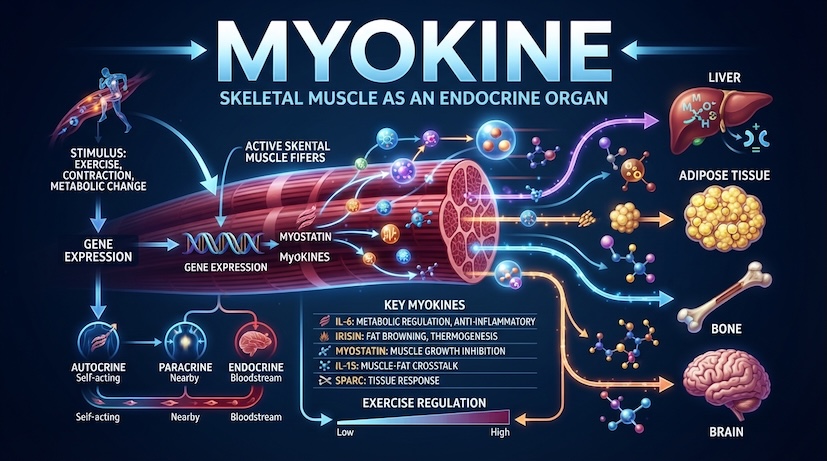
A myokine is a general term for cytokines, peptides, proteins, and other signaling molecules produced and secreted by skeletal muscle that transmit signals to the muscle itself, surrounding tissues, and distant organs. While skeletal muscle was once primarily viewed as a contractile organ for movement or a storage site for amino acids, it is now recognized as a tissue that also produces and secretes diverse signaling molecules.
- Etymology: A coinage derived from “myo-” (muscle) and “cytokine.”
- Mechanisms of Action: Myokines function through multiple pathways: autocrine action (acting on the cell that secreted them), paracrine action (acting on neighboring tissues), and endocrine action (acting on distant organs via the bloodstream).
Furthermore, the concept of a “myokine” is not limited to substances secreted in response to exercise; its fundamental definition is based on their origin in skeletal muscle. While exercise is an important stimulus that regulates secretion, basal expression and secretion can also be observed at rest, and are further modulated by metabolic states and other factors. In addition, exerkines is a broader term for signaling molecules released or altered in response to exercise. These molecules can originate from skeletal muscle as well as other tissues and organs, and myokines represent the muscle-derived component of this broader concept.
2. Mechanisms of Myokines
In response to skeletal muscle contraction, metabolic states, and various internal or external stimuli, specific gene expression and intracellular signaling pathways are regulated within muscle fibers, leading to the synthesis and release of diverse myokines.
- Sensing and Response to Stimuli: In skeletal muscle, calcium signaling and cellular energy-sensing pathways are activated in response to mechanical stress and fluctuations in energy metabolism.
- Induction of Gene Expression: Driven by increases in intracellular calcium ion concentration and the action of energy sensors, the expression of genes encoding specific myokines is regulated.
- Information Transmission (Crosstalk): Released myokines bind to receptors on target tissues, contributing to metabolic regulation and inter-tissue crosstalk.
3. Representative Myokines and Research Fields
Research on myokines spans multiple disciplines, including endocrinology, metabolism, and molecular biology.
| Substance Name | Main Characteristics and Actions | Overview |
| IL-6 (Interleukin-6) | Metabolic regulation and involvement in anti-inflammatory responses | While IL-6 is a cytokine also produced by the immune system, skeletal muscle also releases IL-6 during exercise. Muscle-derived IL-6 acts on the liver and adipose tissue to regulate glucose and lipid metabolism, and contributes to the broader metabolic and inflammatory responses to exercise. |
| Irisin | Crosstalk with adipose tissue | Animal studies suggest that irisin may be involved in the browning of white adipose tissue and thermogenesis. Meanwhile, its physiological role in humans and changes induced by exercise continue to be studied. |
| Myostatin | Regulation of muscle mass | A myokine that acts to suppress muscle hypertrophy and is studied for its role in regulating skeletal muscle growth and size. |
| IL-15 | Muscle-adipose tissue crosstalk | Research is ongoing into its potential role in muscle–adipose tissue crosstalk and lipid metabolism. |
| SPARC (Osteonectin) | Extracellular matrix and tissue response | SPARC is a secreted protein involved in the formation and regulation of the extracellular matrix. |
4. Expression and Fluctuation of Myokines
The expression and secretion of myokines vary depending on the type, intensity, and duration of exercise, as well as training status and nutritional state. Moreover, not all myokines respond to exercise in the same way; each substance exhibits distinct response patterns.
5. Frequently Asked Questions (FAQ)
Q1. Can myokines be directly obtained through dietary supplements?
- A. No. Specific myokines cannot be directly obtained through conventional dietary supplements. Myokines are signaling molecules produced and secreted by skeletal muscle cells, and their expression and secretion are regulated by exercise, muscle contraction, metabolic states, and other factors.
Q2. Do all myokines change in the same pattern?
- A. No. Responses vary by substance; some change transiently with exercise, others change with chronic training adaptations, and some do not show a consistent response to exercise.
6. Summary
The concept of myokines has expanded our understanding of skeletal muscle beyond its traditional role as a contractile organ, highlighting its function as a secretory organ that communicates with other tissues and organs.
The fact that changes in muscle activity and metabolic states generate signals that contribute to whole-body regulation provides an important perspective for understanding the multifaceted roles of skeletal muscle in human physiology.
コメント