
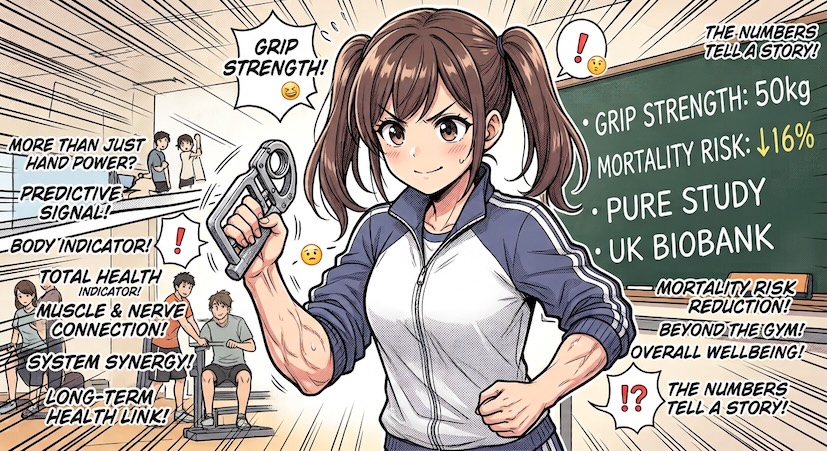
Grip strength seems like such a small thing. Why should it tell us anything about the rest of the body?
Most of us first encountered a hand dynamometer during a school physical or a routine health screening. Squeezing that mechanical or digital handle feels like an isolated test of forearm power—a measure of how hard you can crush an object with your fingers.
In epidemiology and preventive medicine, however, this simple measurement takes on a fundamentally different role.
Across large-scale global population studies tracking tens of thousands of individuals over many years, an intriguing statistical pattern consistently emerges: the force exerted by your hands turns out to be a surprisingly strong indicator of long-term health outcomes, disease incidence, and overall survival rates.
Why does a localized measurement of upper-body strength correlate so strongly with systemic health and physiological resilience? To answer this, we need to examine what large-scale data reveals, explore the physiological mechanisms beneath the surface, and consider how this metric can serve as a meaningful benchmark for athletic performance and healthy aging.
- The Statistical Connection: What Large Cohort Studies Show
- A Prognostic Signal, Not a Direct Pathological Cause
- Correlation vs. Causation: Why Hand Grippers Aren’t a Miracle Cure
- Why the Hands Reflect Systemic Health
- Beyond the Squeeze: The Functional Triad (“Grip, Stand, Walk”)
- Implications for Masters Athletes and Active Adults
- Using Functional Benchmarks to Guide Long-Term Training
- Measuring Beyond the Clock: Preserving the Human Foundation
- YouTube Video for This Article
The Statistical Connection: What Large Cohort Studies Show
The clinical interest in grip strength gained international prominence through the Prospective Urban Rural Epidemiology (PURE) study, led by researchers at McMaster University.
In this prospective cohort study, investigators tracked 139,691 adults aged 35 to 70 across 17 diverse countries over a median follow-up period of roughly four years. After adjusting for potential confounding variables—including age, sex, educational attainment, smoking status, alcohol consumption, physical activity levels, and pre-existing medical conditions—the researchers identified a clear statistical association.
For every 5-kilogram lower grip strength recorded at baseline, the risk of all-cause mortality was approximately 16% higher (hazard ratio of 1.16). This inverse relationship extended beyond general mortality; lower grip strength was similarly linked to higher risks of cardiovascular mortality, non-cardiovascular death, and incident myocardial infarction.
PURE Study Finding (139,691 participants, 17 countries):
For every 5 kg lower grip strength at baseline ──► ~16% higher risk of all-cause mortality
This pattern is not isolated to a single dataset. Broad-scale investigations—such as the UK Biobank cohort tracking over 500,000 middle-aged and older adults—have demonstrated comparable inverse associations between grip strength and cardiovascular, respiratory, and cancer-related outcomes. Comprehensive meta-analyses consolidating observational research across community-dwelling populations further confirm that lower muscular strength persistently correlates with higher all-cause and cardiovascular mortality risks.
A Prognostic Signal, Not a Direct Pathological Cause
One of the most striking findings from the PURE trial was that grip strength demonstrated a prognostic association with all-cause mortality comparable to that of systolic blood pressure.
While this comparison highlights the clinical relevance of muscular strength, it requires careful interpretation regarding underlying biological roles:
┌────────────────────────────────────────────────────────────────────────┐
│                        PATHOLOGICAL ATTACKER                           │
│ Systolic Blood Pressure ──► Direct arterial wall stress ──► Disease    │
├────────────────────────────────────────────────────────────────────────┤
│                         PHYSIOLOGICAL MARKER                           │
│ Systemic Health Status ──► Neuromuscular Integrity ──► Grip Strength   │
└────────────────────────────────────────────────────────────────────────┘
- Systolic Blood Pressure: Represents a direct mechanical strain on the arterial wall. Uncontrolled hypertension actively damages blood vessels and organs over time, making it a target for direct medical intervention. Lowering high blood pressure directly reduces cardiovascular event risks.
- Grip Strength: Does not act as a direct driver of vascular damage. Weak grip strength does not “cause” arterial plaque or organ failure; rather, it reflects underlying physiological reserves and systemic vitality.
If blood pressure functions as a direct target for physiological control, grip strength operates as a composite gauge dashboard—an indicator reflecting the broader condition of the machine beneath the hood.
Correlation vs. Causation: Why Hand Grippers Aren’t a Miracle Cure
Upon reading epidemiological findings, a common impulse is to assume that targeted local training will reverse the underlying risk: “If higher grip strength correlates with longer survival, buying a hand-squeeze device and building forearm muscles should extend life expectancy.”
This reasoning confuses correlation with causation.
Observational data demonstrates that individuals with higher baseline muscular strength experience lower event rates over time. It does not demonstrate that artificially isolating and strengthening small forearm muscles alters systemic mortality risks.
       [ Systemic Health / Vitality ]
               /            \
              ▼              ▼
     ( Higher Grip )    ( Longer Life )
            │
    [ Squeezing Gripper ] ──► ( Forearm Muscle ) ──x──► ( Broader Health Factors )
If hand strength is simply a downstream reflection of an active lifestyle, adequate skeletal muscle mass, balanced nutrition, and intact neurological function, then selectively strengthening the forearm with a gripper would not necessarily address the broader factors associated with long-term health.
Current evidence supports viewing grip strength not as a target for isolated intervention, but as an accessible functional marker of overall physical capacity and health.
Why the Hands Reflect Systemic Health
Why should a localized contraction of the hand muscles serve as such a sensitive proxy for systemic health?
Grip strength relies on the coordinated output of several physiological systems working simultaneously:
  ┌─────────────────┐
  │  Central Drive  │  (Brain & Spinal Cord)
  └────────┬────────┘
           │ Neuromuscular Junction
           ▼
  ┌─────────────────┐
  │ Peripheral Output│ (Motor Units & Skeletal Muscle)
  └────────┬────────┘
           │ Metabolic Support
           ▼
  ┌─────────────────┐
  │ Vascular Delivery│ (Oxygen & Nutrient Supply)
  └─────────────────┘
1. A Proxy for Whole-Body Muscle Mass and Quality
While grip strength directly tests upper-limb force, it correlates well with total body skeletal muscle mass, lower-limb strength, and general physical capacity. Accurately assessing total body composition requires specialized diagnostic equipment like Dual-energy X-ray Absorptiometry (DEXA) or Magnetic Resonance Imaging (MRI). Dynamometry offers a practical, low-cost proxy for functional muscle mass. Notably, long-term observational studies—such as the Health, Aging and Body Composition Study—indicate that muscle strength, rather than muscle quantity alone, serves as the primary predictor of longevity in older populations.
2. A Barometer for Metabolic and Inflammatory Status
Chronic inflammation, metabolic dysfunction, and inadequate nutrition can affect muscle function and physical capacity, sometimes before obvious clinical symptoms appear. While grip testing does not directly measure inflammatory cytokines or blood glucose levels, systemic health disruptions and nutrient deficiencies frequently manifest downstream as subtle declines in physical output.
3. Neuromuscular and Vascular Integrity
Squeezing a dynamometer with maximal effort requires an intact motor pathway: rapid signal transmission from the motor cortex through the spinal cord, across peripheral nerve fibers, and across neuromuscular junctions to activate skeletal muscle motor units. Sustained muscular activity also depends on adequate blood flow to deliver oxygen and metabolic substrates.As a result, grip capacity offers an integrated snapshot of nervous system recruitment, muscle physiology, and vascular support.
Beyond the Squeeze: The Functional Triad (“Grip, Stand, Walk”)
In geriatric medicine, clinical kinesiology, and preventive cardiology, grip assessment is rarely evaluated in isolation. It is typically combined with simple, highly validated functional mobility tests to form a holistic picture of physical resilience.
┌────────────────────────────────────────────────────────────────────────┐
│                        THE FUNCTIONAL TRIAD                            │
├───────────────────────┬────────────────────────┬───────────────────────┤
│        GRIP           │         STAND          │         WALK          │
│    Grip Strength      │ 5-Times Sit-to-Stand   │    Gait Speed Test    │
│  (Upper-Body / Nerve) │ (Lower-Body / Balance) │  (Systemic Control)   │
└───────────────────────┴────────────────────────┴───────────────────────┘
5-Times Sit-to-Stand Test (5STS)
- How it works: Cross your arms over your chest while seated in a standard chair, then stand up completely and sit back down five times as quickly as possible without using your hands for support.
- What it reveals: Evaluates explosive lower-extremity power, dynamic balance, postural control, and basic functional mobility required for daily activities.
Gait Speed Assessment
- How it works: Measures walking speed in meters per second over a short, measured distance (typically 4 to 10 meters) at a comfortable or rapid pace.
- What it reveals: Walking requires the complex integration of lower-body muscular endurance, joint range of motion, balance, central nervous system coordination, and cardiorespiratory delivery. Gait speed is widely used as a functional measure in geriatric and preventive health research.
Together, testing how you grip, stand, and walk provides a comprehensive, low-cost functional snapshot across upper-limb force, lower-body power, and dynamic mobility without requiring specialized lab equipment.
Implications for Masters Athletes and Active Adults
For endurance runners, cyclists, triathletes, and active adults in their 40s, 50s, 60s, and beyond, discussions about grip strength and functional screening might initially seem irrelevant:
“I run marathons every year and log high weekly mileage.”
“My VO2max and power output are high. Why should I care about grip strength?”
It is true that sport-specific performance metrics—such as race times, Functional Threshold Power (FTP), or maximal oxygen uptake—do not directly depend on grip strength. A dedicated long-distance runner may have exceptional aerobic conditioning while exhibiting modest or average upper-body strength due to sport-specific adaptations and leaner upper-body muscle mass.
However, a high level of specialized endurance conditioning does not automatically guarantee balanced, age-related functional preservation across all body systems:
     Endurance Training                Age-Related Baseline
  ┌───────────────────────┐          ┌───────────────────────┐
  │ High Aerobic Capacity │  ≠       │ Balanced Full-Body    │
  │ Leg Local Endurance   │          │ Muscular Power        │
  │ Lower Body Fat        │          │ Neuromuscular Range   │
  └───────────────────────┘          └───────────────────────┘
Relying exclusively on sport-specific performance figures can sometimes hide subtle imbalances or systemic issues:
- Functional and Movement Asymmetries: High aerobic fitness can coexist with dynamic balance deficits, reduced core stability, or declining upper-body force generation.
- Overuse and Overtraining: High-volume training without adequate recovery can lead to central nervous system fatigue, diminishing motor unit activation across unworked muscle groups.
- Metabolic and Nutritional Deficits: Strict caloric restrictions aimed at optimizing power-to-weight ratios can unintentionally trigger lean muscle catabolism and metabolic fatigue, showing up as unexpected declines in functional strength tests.
Using Functional Benchmarks to Guide Long-Term Training
For active adults and masters athletes, assessments like grip force, sit-to-stand speed, and gait speed should not be treated as isolated exercises to train for their own sake. Instead, they serve as neutral, objective health checks outside your primary sport.
                  [ Track Neutral Indicators ]
                     (Grip, Stand, Walk)
                              │
               ┌──────────────┴──────────────┐
         [ Unexplained Decline ]     [ Stable Performance ]
               │                             │
    ┌──────────┴──────────┐          (Maintain Current
    │ Check Root Causes:  │           Training Program)
    ├─────────────────────┤
    │ • Resistance Work   │
    │ • Rest & Fatigue    │
    │ • Protein Intake    │
    │ • Daily NEAT        │
    └─────────────────────┘
If your functional markers show an unexpected drop over time despite steady endurance performance, it offers a helpful prompt to review your broader lifestyle habits:
- Resistance and Strength Training Balance: Are you omitting full-body resistance training in favor of exclusive aerobic mileage? Preserving neuromuscular capacity and skeletal muscle quality during middle and older age requires structured, multi-joint resistance work alongside cardiovascular exercise.
- Recovery and Nervous System Fatigue: Is elevated central nervous system fatigue from intense training blocks dampening peripheral motor unit recruitment?
- Protein Intake and Energy Availability: Is your total protein and caloric intake sufficient to support muscle protein synthesis and prevent catabolism during high-volume periods?
- Non-Exercise Physical Activity (NEAT): Are long sedentary periods between structured workouts leading to subtle decreases in overall daily movement?
Measuring Beyond the Clock: Preserving the Human Foundation
A Body That Can Perform Is Not Necessarily a Body That Functions Well for Life
For masters athletes who continue to pursue sport as they age, the goal is not simply to add more years to life.
It is also about how long we can continue to run on our own legs, ride a bicycle, travel where we want to go, and move through everyday life with a capable and resilient body.
That may be one of the most important things we are really trying to preserve through training.
The extensive scientific literature linking higher grip strength with lower mortality risk is not telling us to “train our hands.” Rather, it reminds us that maintaining physical function and activity across the body is an important foundation for long-term health.
Pursuing faster race times and higher power outputs is a wonderful challenge. But occasionally stepping away from those performance metrics and asking whether we can still grip, stand, and walk well may give us a different perspective on our physical condition.
Having more than one way to measure the body—beyond race times, power output, and VO₂max—may be part of what allows us to keep doing the sports we love for many years to come.
A Personal Thought That Came to Mind While Writing About Grip Strength
While researching grip strength for this article, I found myself thinking about something that has nothing to do with epidemiology or physiology.
Babies are often born with their hands tightly clenched.
It almost seems as if they are reaching into a new world, ready to grasp everything that lies ahead.
And at the end of life, those hands gradually open.
As if everything we have held onto in this world must eventually be released.
Of course, this is not a medical observation.
It is simply something I happened to think about while writing this article.
To grip and to let go.
Perhaps our lives unfold somewhere between those two gestures.
Seen in that light, the number displayed on a grip dynamometer—“how many kilograms?”—can begin to look a little different.
Grip strength is not merely a measure of how hard we can squeeze.
It is also a small, practical way of asking how well our body is functioning today.
And perhaps there is something quietly meaningful about the fact that we spend our lives using that body to grasp things, hold on to things, and move through the world—before, eventually, we let everything go.
That is what I found myself thinking about after spending time researching something as simple as grip strength.
References
- Leong, D. P., Teo, K. K., Rangarajan, S., Lopez-Jaramillo, P., Avezum, A., Orlandini, A., … & Yusuf, S. (2015). Prognostic value of grip strength: findings from the Prospective Urban Rural Epidemiology (PURE) study. The Lancet, 386(9990), 266-273.PMID: 25982160https://pubmed.ncbi.nlm.nih.gov/25982160/
- Celis-Morales, C. A., Welsh, P., Lyall, D. M., Steell, L., Petermann, F., Anderson, J., … & Sattar, N. (2018). Associations of grip strength with cardiovascular, respiratory, and cancer outcomes and all cause mortality: prospective cohort study of 502 293 UK Biobank participants. BMJ, 361, k1651.PMID: 29743200https://pubmed.ncbi.nlm.nih.gov/29743200/
- Wu, Y., Wang, W., Liu, T., & Zhang, D. (2017). Association of grip strength with risk of all-cause mortality, cardiovascular diseases, and cancer in community-dwelling populations: a meta-analysis of prospective cohort studies. Journal of the American Medical Directors Association, 18(6), 551-e17.PMID: 28285906https://pubmed.ncbi.nlm.nih.gov/28285906/
- Newman, A. B., Kupelian, V., Visser, M., Simonsick, E. M., Goodpaster, B. H., Kritchevsky, S. B., … & Harris, T. B. (2006). Strength, but not muscle mass, is associated with mortality in the Health, Aging and Body Composition Study. The Journals of Gerontology Series A: Biological Sciences and Medical Sciences, 61(1), 72-77.PMID: 16456196https://pubmed.ncbi.nlm.nih.gov/16456196/

コメント