
📌 Key Takeaways (Read this if you are short on time!)
- When aiming to break 20 minutes in the 5K (a pace of 4:00/km or 6:26/mile), relying solely on boosting VO2max (Maximum Oxygen Uptake) is insufficient.
- Two particularly important pieces are vVO2max (Velocity at VO2max), which expresses maximal aerobic capacity as actual running speed, and Running Economy, which reflects how much oxygen is required to run at a given speed.
- These components are supported by Neuromuscular & Movement Control, allowing force to be efficiently converted into forward propulsion, and LT1 (First Lactate Threshold), which establishes a baseline for running at lower relative physiological stress.
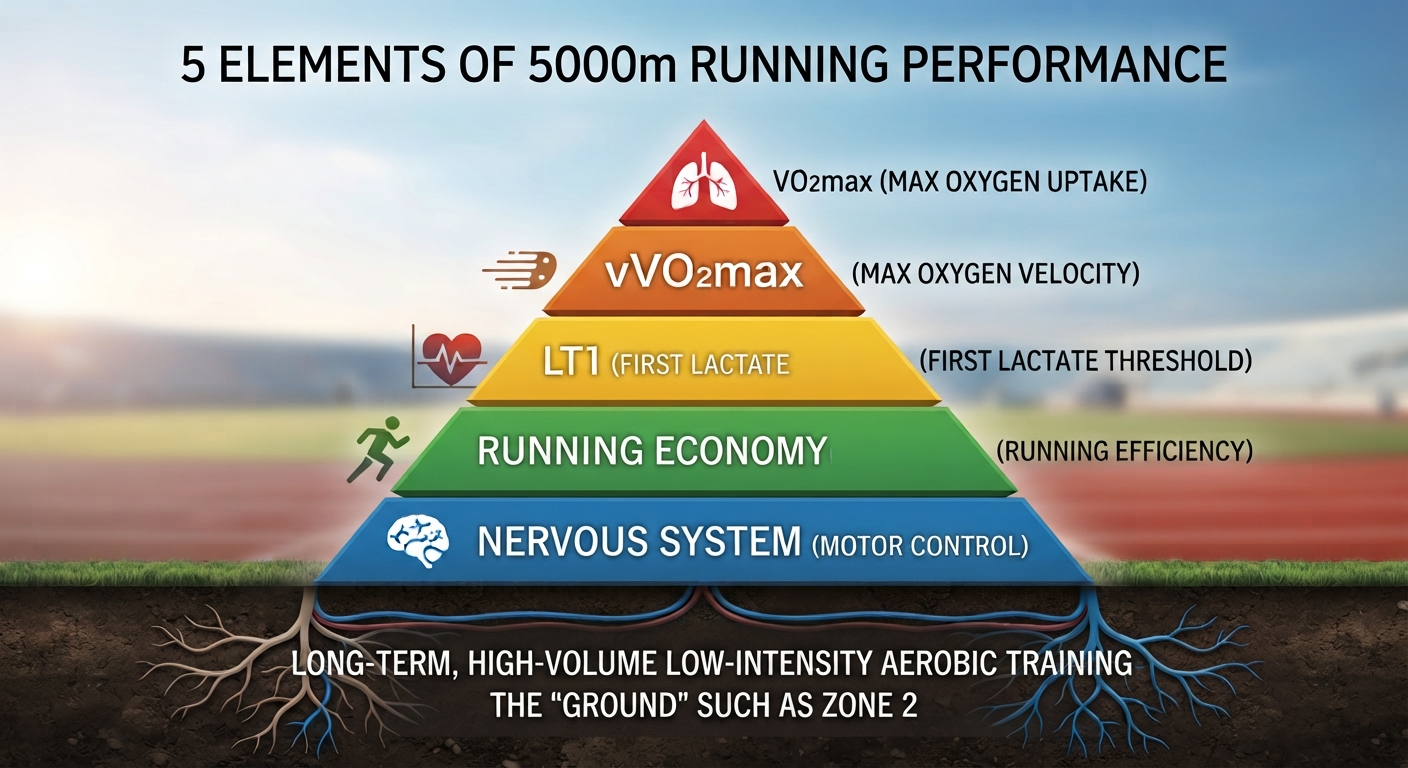
- This article outlines these five core physiological and performance elements, along with the vast “ground” that nurtures them over the long term: a high volume of Low-Intensity Aerobic Training (such as Zone 2).
If you are struggling to break the 20-minute barrier in the 5K, the first training method that likely comes to mind is high-intensity interval training that pushes your cardiovascular system to its limit. The belief that gasping for air to boost your VO2max (Maximum Oxygen Uptake) is the sole shortcut to speed is widely accepted.
However, this premise warrants a closer physiological examination.
If long-distance running performance were determined strictly by VO2max values, endurance athletes from other sports would be able to step onto the track and immediately run exceptional times. Consider elite road cyclists or cross-country skiers.
Some of these athletes register VO2max values reaching 80 to 90 ml/kg/min. Yet, if they put on running shoes, step onto a track, and attempt to hold a 4:00/km (6:26/mile) pace to finish a 5K under 20 minutes, they will not necessarily succeed. Even if their cardiovascular engine has capacity to spare, without biomechanical adaptation to running-specific ground impact forces, musculotendinous stiffness, and elastic energy storage and return, peripheral muscle fatigue and form breakdown occur rapidly.
This phenomenon highlights a common blind spot for runners: having a massive cardiovascular “engine” does not guarantee performance unless you have the running-specific mechanical and neuromuscular qualities needed to convert that capacity into running speed.
I am also a runner actively training to break the 20-minute barrier in the 5K. For me, questions like “Will raising my VO2max actually make me faster?” or “What should I prioritize with my limited training time?” are not abstract academic theories, but practical challenges I test on myself every day. Drawing from exercise physiology and personal application, this article breaks down the key components that come together to determine 5K performance.
- What It Takes to Maintain a 4:00/km Pace for 20 Minutes
- 1. VO2max: Understanding Maximum Oxygen Uptake
- 2. Why a High VO2max Alone Won’t Make You Fast
- 3. vVO2max: Converting Oxygen Capacity into Real Speed
- 4. Running Economy: Running Faster on the Same Amount of Oxygen
- 5. Neuromuscular & Movement Control: Translating Force into Propulsion
- 6. LT1: The Foundational Threshold Supporting Aerobic Capacity
- 7. Where Does LT2 Fit In? (Separating LT2 from vVO2max)
- 8. Zone 2: The Vast “Ground” That Cultivates Capacity
- 9. Conceptual Model: The 5 Core Elements and the Ground
- 10. Practical Training Setup to Build the 5 Elements and the Ground
- ① 【Building the Ground】 Low-Intensity Base Runs (Easy Runs / LSD)
- ② 【Movement Feel & Rhythm】 1+3 / 1+4 Jogs (Blending Pace and Aerobic Base)
- ③ 【Race Pace Efficiency】 400m Short Intervals
- ④ 【vVO2max Stimulus】 vVO2max Intervals
- ⑤ 【LT2 / Stamina】 Cruise Intervals (Threshold Training)
- ⑥ 【Neuromuscular Speed】 Strides & Short Hill Runs
- 11. Conclusion: Converting Max Capacity into Speed through Long-Term Low-Intensity Volume
- YouTube Video for This Article
What It Takes to Maintain a 4:00/km Pace for 20 Minutes
The 5K is an event requiring high aerobic energy contribution for roughly 20 minutes. Breaking 20 minutes demands maintaining a pace of 4:00 per kilometer (6:26 per mile / 15 km/h) consistently for that entire duration.
Achieving this level of performance cannot be done by maximizing a single physiological variable. Breaking down the required elements reveals several interacting capabilities and metrics:
- Maximal aerobic energy supply capacity centered on the cardiovascular system (VO2max)
- A performance metric reflecting the conversion of oxygen processing capacity into actual running speed (vVO2max)
- Efficiency of movement that minimizes oxygen cost at a given speed (Running Economy)
- Motor control to absorb ground reaction forces efficiently and direct them into forward propulsion (Neuromuscular & Movement Control)
- The baseline aerobic threshold allowing running at a relatively lower physiological load (LT1)
In this article, these are referred to as the “5 Core Elements.” No single element operates in isolation; they interact continuously to determine your overall race performance.
1. VO2max: Understanding Maximum Oxygen Uptake
A fundamental metric for 5K running is VO2max (Maximum Oxygen Uptake). First, let’s review the physiological process:
Uptake of oxygen from ambient air into the body (Respiratory System)
↓
Binding to hemoglobin in the blood and transport to working muscles (Cardiovascular System / Cardiac Output)
↓
Utilization of oxygen within muscle mitochondria to resynthesize ATP (Skeletal Muscle)
VO2max is expressed as the maximum rate of oxygen uptake per kilogram of body mass per minute ($\text{ml/kg/min}$).
Analogously, VO2max represents the “engine displacement” of a car. A higher-displacement engine can burn more fuel per unit of time and holds the potential to generate greater power output. A higher VO2max provides an excellent baseline potential for producing output in running.
2. Why a High VO2max Alone Won’t Make You Fast
However, possessing a high-displacement engine is entirely different from setting fast lap times on a race circuit. If the chassis is overly heavy, the suspension too soft to handle cornering, or the tires spinning without gripping the tarmac, that power cannot be converted into speed.
The example of elite non-running endurance athletes mentioned earlier illustrates this perfectly. Despite possessing a high VO2max (a massive engine), without functional adaptations in running mechanics, joint and tendon function, and elastic energy utilization, that raw physiological capacity cannot be translated directly into running velocity.
With every stride in running, you absorb impact forces several times your body weight. If you lack the mechanical efficiency—specifically stiffness in muscles and tendons—to handle that impact and absorb and reuse mechanical energy efficiently, your oxygen consumption capacity fails to translate into forward speed.
VO2max simply reflects the upper limit of achievable potential; a functional mechanism is required to convert that potential into actual running velocity.
3. vVO2max: Converting Oxygen Capacity into Real Speed
This brings us to vVO2max (velocity at VO2max).
vVO2max can be thought of as the running speed at which your maximal aerobic capacity is reached. It reflects the interaction between VO2max and the oxygen cost of running at a given speed, which is influenced in part by Running Economy.
To illustrate, consider two runners (Runner A and Runner B) with identical absolute VO2max values:
- Runner A: Reaches VO2max only after accelerating to a pace of 3:00/km (4:50/mile).
- Runner B: Reaches VO2max earlier, at a pace of 3:20/km (5:22/mile).
In this scenario, Runner A has the higher vVO2max. Despite having identical oxygen processing capacities, Runner A achieves higher top-end aerobic speed. This gives Runner A a higher velocity ceiling over target race pace.
For most runners, 5K race pace sits below their vVO2max velocity. However, because this percentage varies among individuals, 5K finish times cannot be calculated from vVO2max alone. The key insight is evaluating how much headroom your vVO2max provides over your target race pace of 4:00/km.
4. Running Economy: Running Faster on the Same Amount of Oxygen
Why do runners with identical VO2max values display different vVO2max speeds? A major factor is Running Economy.
Running Economy refers to the energy efficiency of movement—specifically, how little oxygen (energy) is consumed when running at a given submaximal velocity.
| Runner | Running Speed at the Same Oxygen Consumption |
| Runner A (High Economy) | 4:00 / km (6:26 / mile) |
| Runner B (Low Economy) | 4:20 / km (6:58 / mile) |
Even at an identical rate of oxygen metabolism, a runner with superior Running Economy sustains a faster pace. This difference in efficiency can contribute substantially to differences in vVO2max.
Running Economy is influenced by several interrelated factors:
- Physiological Factors: Muscle fiber characteristics and metabolic efficiency.
- Mechanical Factors: The storage and return of elastic energy in the Achilles tendon and other elastic tissues.
- Neuromuscular Control Factors: Suppression of unnecessary muscle activation and core stability to eliminate pelvic or rotational displacement.
- Ground-Contact Mechanics: Efficient foot-ground interaction that helps minimize unnecessary braking forces.
Runners with high economy absorb impact forces through muscles and tendons, returning that energy into forward movement with minimal metabolic waste.
5. Neuromuscular & Movement Control: Translating Force into Propulsion
Serving as the foundational mechanics for both Running Economy and running velocity is Neuromuscular & Movement Control.
Distance running is not merely a test of cardiorespiratory capacity; it requires continuous, precise neuromuscular coordination, with muscles being activated and relaxed at precisely timed intervals throughout every stride.
When electrical signals from the brain and spinal cord trigger muscle fibers with precise timing, ground impact forces are absorbed and recycled efficiently, offering key mechanical advantages:
- Proper Ground Contact and Stiffness: Ground reaction forces are smoothly converted into propulsion, preventing energy loss caused by excessive joint collapse or sinkage.
- Tension/Relaxation Cycling: Muscles fire precisely during force application and relax during phases when high muscle activity is not required, reducing unnecessary metabolic expenditure.
- Smooth Center-of-Mass Transit: Vertical and lateral oscillations are minimized, maintaining steady forward momentum.
Refining neuromuscular control enhances running smoothness and speed without necessarily requiring a proportional increase in cardiovascular demand.
6. LT1: The Foundational Threshold Supporting Aerobic Capacity
While velocity conversion and efficiency are critical, 5K performance remains predominantly aerobic. The metabolic anchor for this is LT1 (First Lactate Threshold).
As running speed increases incrementally from a low intensity, LT1 is identified as the point where blood lactate begins to rise above baseline in a sustained manner. Subjectively, it often corresponds to an intensity that can be sustained for a long time without heavy breathing.
Elevating your LT1 capacity allows you to cover a given pace at a lower relative physiological strain.
This adaptation stems from long-term aerobic conditioning, including improved mitochondrial function, higher capillary density, and enhanced fat oxidation pathways.
7. Where Does LT2 Fit In? (Separating LT2 from vVO2max)
It is helpful to clarify the distinction between vVO2max and LT2, as these terms are sometimes conflated in endurance training:
vVO2max and LT2 are distinct physiological concepts and should be categorized separately.
- vVO2max (Velocity at VO2max): The velocity corresponding to maximum oxygen uptake (maximum aerobic velocity). This is a high-intensity speed faster than 5K race pace.
- LT2 (Second Lactate Threshold / Upper Threshold): A high-intensity threshold associated with a marked rise in blood lactate and a rapid loss of metabolic steady state. Sustainable duration and velocity at LT2 vary by individual.
LT2 is not listed as a separate pillar in the 5-element model below, but that does not mean it is unimportant.
To break 20 minutes in the 5K, pushing your LT2 velocity closer to 4:00/km is a crucial target. However, focusing exclusively on LT2 training (threshold runs) without addressing underlying aerobic capacity (LT1) or velocity ceilings (vVO2max) can cap overall development.
LT2 is an important high-intensity threshold that links the aerobic foundation with the ability to sustain faster running.
8. Zone 2: The Vast “Ground” That Cultivates Capacity
To develop and sustain the five elements discussed, the most vital structural component is the “Ground” (The Foundation).
These five elements do not develop in isolation. They grow upon a vast foundation built through a high volume of low-intensity aerobic training accumulated over time.
A practical intensity framework for implementing this low-intensity work is Zone 2.
Defining Zone 2
The label “Zone 2” varies depending on the intensity model used (e.g., 3-zone vs. 5-zone models). Therefore, Zone 2 should not be treated as strictly identical to LT1.
Here, Zone 2 refers to a low-to-moderate intensity range where conversation remains easy, roughly around or below LT1 depending on the zone model being used.
Why High Volume at Low Intensity Is Necessary
Even when targeting a shorter distance like the 5K, dedicating the majority of training volume to low-intensity work remains essential for clear reasons:
- Accumulating Volume with Minimal Fatigue: High-intensity sessions impose significant autonomic and muscular fatigue, limiting total aerobic volume.
- Driving Long-Term Vascular and Cellular Adaptation: Low-intensity running performed over extended durations supports mitochondrial adaptations and capillary development over time.
- Building Capacity to Absorb High-Intensity Work: A solid low-intensity foundation allows the body to absorb high-intensity intervals and threshold sessions while limiting excessive fatigue.
At the same time, relying solely on Zone 2 running is insufficient to break 20 minutes. Achieving that goal requires pairing a low-intensity foundation with targeted workouts at race pace, vVO2max intensity, and neuromuscular speeds.
9. Conceptual Model: The 5 Core Elements and the Ground
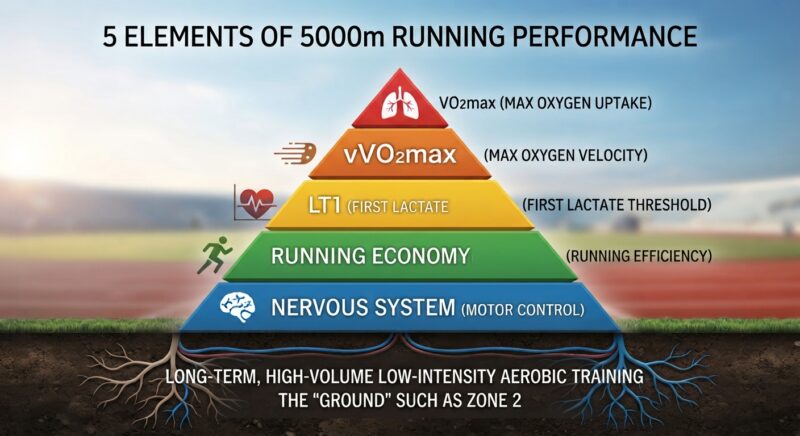
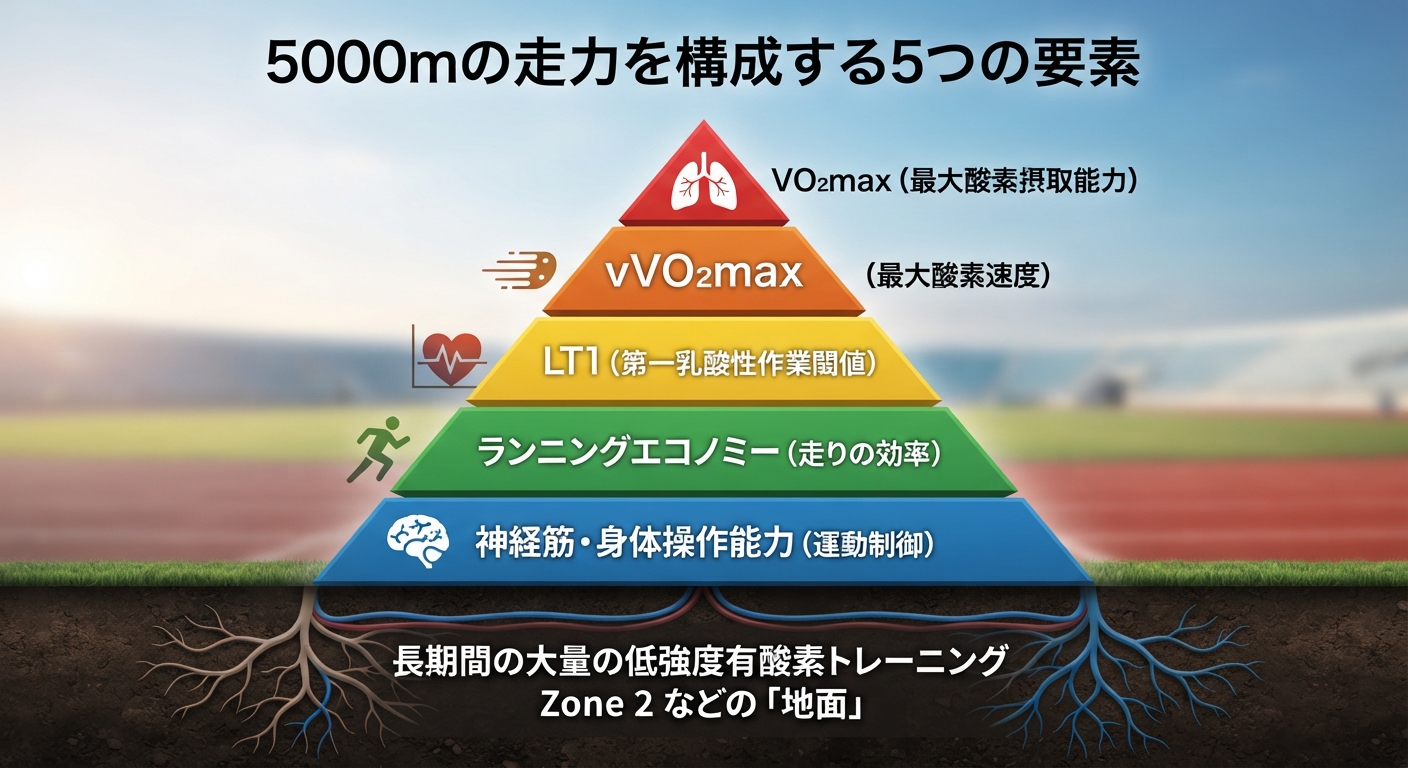
Integrating these concepts yields the following structural model for 5K performance:
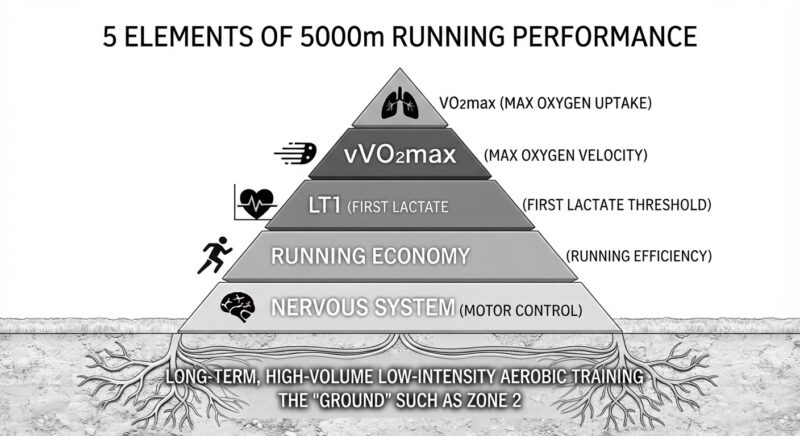
Note: This diagram does not represent a strict hierarchical sequence (e.g., training top-to-bottom). The five elements interact dynamically, supported by a broad base of long-term low-intensity training.
Improvements in neuromuscular control, running economy, LT1, and VO2max interact to elevate vVO2max—your maximal aerobic velocity. All of these components are supported by a broad base of long-term low-intensity training.
10. Practical Training Setup to Build the 5 Elements and the Ground
The goal is not to perform all of these sessions simultaneously, but to understand which stimulus targets which capability, selecting combinations based on your current strengths and weaknesses.
Below are practical workout examples designed to develop the five elements and the underlying foundation:
① 【Building the Ground】 Low-Intensity Base Runs (Easy Runs / LSD)
- Format: 30 to 90 minutes of easy jogging at a conversational pace (below LT1).
- Purpose: Builds the foundational “ground.” Supports capillary development and mitochondrial adaptations with minimal fatigue cost, expanding basic aerobic capacity.
② 【Movement Feel & Rhythm】 1+3 / 1+4 Jogs (Blending Pace and Aerobic Base)
- Format: Continuous repetitions of 100m at target 5K race pace, followed by 300m–400m of easy Zone 2 jogging.
- Purpose: Reinforces relaxed running mechanics at target race pace (4:00/km) without overtaxing the cardiovascular system. Recovery jogs keep heart rate controlled, integrating speed feel into an aerobic base.
③ 【Race Pace Efficiency】 400m Short Intervals
- Format: 8 to 12 × 400m at or near target 5K race pace (Recovery: 200m easy jog or walk).
- Purpose: Develops running economy and rhythm at target race pace while avoiding the fatigue-induced form breakdown common in longer repetitions like 1000m repeats.
④ 【vVO2max Stimulus】 vVO2max Intervals
- Format: 6 to 10 × 200m–400m at approximately vVO2max intensity (typically faster than 5K race pace), with easy jogging recovery.
- Purpose: Targets the vVO2max range to develop top-end aerobic speed and provide a strong stimulus for VO2max.
⑤ 【LT2 / Stamina】 Cruise Intervals (Threshold Training)
- Format: 4 to 5 × 1000m at LT2 / threshold pace (Recovery: 60 to 90 seconds of easy jogging).
- Purpose: Improves the ability to sustain high-intensity running near LT2 and maintain a pace close to race pace.
⑥ 【Neuromuscular Speed】 Strides & Short Hill Runs
- Format: 3 to 5 × 100m relaxed, progressive strides on flat ground or a gentle incline at the end of an easy run.
- Purpose: Activates neuromuscular pathways, rapid hip turnover, and proper ground contact alignment without introducing cardiovascular fatigue.
11. Conclusion: Converting Max Capacity into Speed through Long-Term Low-Intensity Volume
When striving to break 20 minutes in the 5K, it is easy to focus exclusively on high-intensity workouts designed to push VO2max.
However, distance running performance relies on a broader system of interconnected components:
- VO2max providing raw engine size
- vVO2max translating that capacity into actual running speed
- Running Economy minimizing energy expenditure
- Neuromuscular & Movement Control delivering efficient force application
- LT1 anchoring your aerobic baseline
- Low-Intensity Aerobic Training (Zone 2) providing the broad “ground” that supports long-term development
High-intensity workouts that raise your speed ceiling and low-intensity sessions that expand your base work together to support total performance.
Developing these core elements alongside a low-intensity foundation provides a practical framework for working toward the 20-minute barrier.
コメント