
For decades, the 2:1:1 ratio of leucine, isoleucine, and valine has been widely regarded as the standard formulation in branched-chain amino acid (BCAA) supplementation. Athletes across many sports routinely consume 2:1:1 products, assuming that this traditional proportion represents the ideal approach for athletic recovery.
However, if the primary goal of a nutrition strategy is to trigger muscle protein synthesis (MPS) and support post-training adaptation, is this classic 2:1:1 ratio truly optimal for everyone?
Recent advances in exercise physiology and molecular biology suggest that relying solely on fixed amino acid ratios oversimplifies how the body responds to nutrients. Rather than adhering strictly to historical formulas, modern research emphasizes the importance of absolute leucine availability, overall essential amino acid (EAA) completeness, and age-related metabolic changes.
This article re-examines the traditional 2:1:1 ratio, explains the molecular machinery behind leucine sensing, and provides practical, evidence-based nutrition strategies tailored for middle-aged and masters athletes.
- What Is the 2:1:1 BCAA Ratio?
- Why Leucine Plays a Unique Role: The Molecular Mechanism
- Understanding the “Leucine Threshold” Concept
- Aging and Anabolic Resistance: Younger Adults vs. Masters Athletes
- Rethinking 2:1:1: A Mathematical Reality Check
- Why BCAAs Alone Are Not Enough: The “Foreman vs. Building Materials” Analogy
- BCAA vs. EAA vs. Whey Protein: How to Choose
- Practical Supplementation Strategies for Masters Athletes
- FAQ
- Conclusion
- References
What Is the 2:1:1 BCAA Ratio?
The 2:1:1 ratio simply means that for every 2 grams of leucine, a supplement provides 1 gram of isoleucine and 1 gram of valine.
This ratio roughly resembles the relative proportion of leucine, isoleucine, and valine commonly found in mammalian skeletal muscle and high-quality animal proteins, such as whey and eggs. Early sports nutrition science established that BCAAs—unlike most other amino acids—are oxidized directly within skeletal muscle rather than the liver, making them a recognizable substrate during prolonged endurance exercise.
While 2:1:1 provides a familiar baseline, mimicking the composition of muscle tissue in a supplement does not automatically make it the most effective proportion for stimulating new muscle protein synthesis. Assuming 2:1:1 is optimal for every objective overlooks how individual amino acids operate as signaling molecules versus structural building blocks.
Why Leucine Plays a Unique Role: The Molecular Mechanism
Among the 20 amino acids that form human protein, leucine holds a distinct status. While most amino acids serve primarily as physical structural components, leucine acts simultaneously as a key nutrient signal that helps initiate intracellular protein construction.
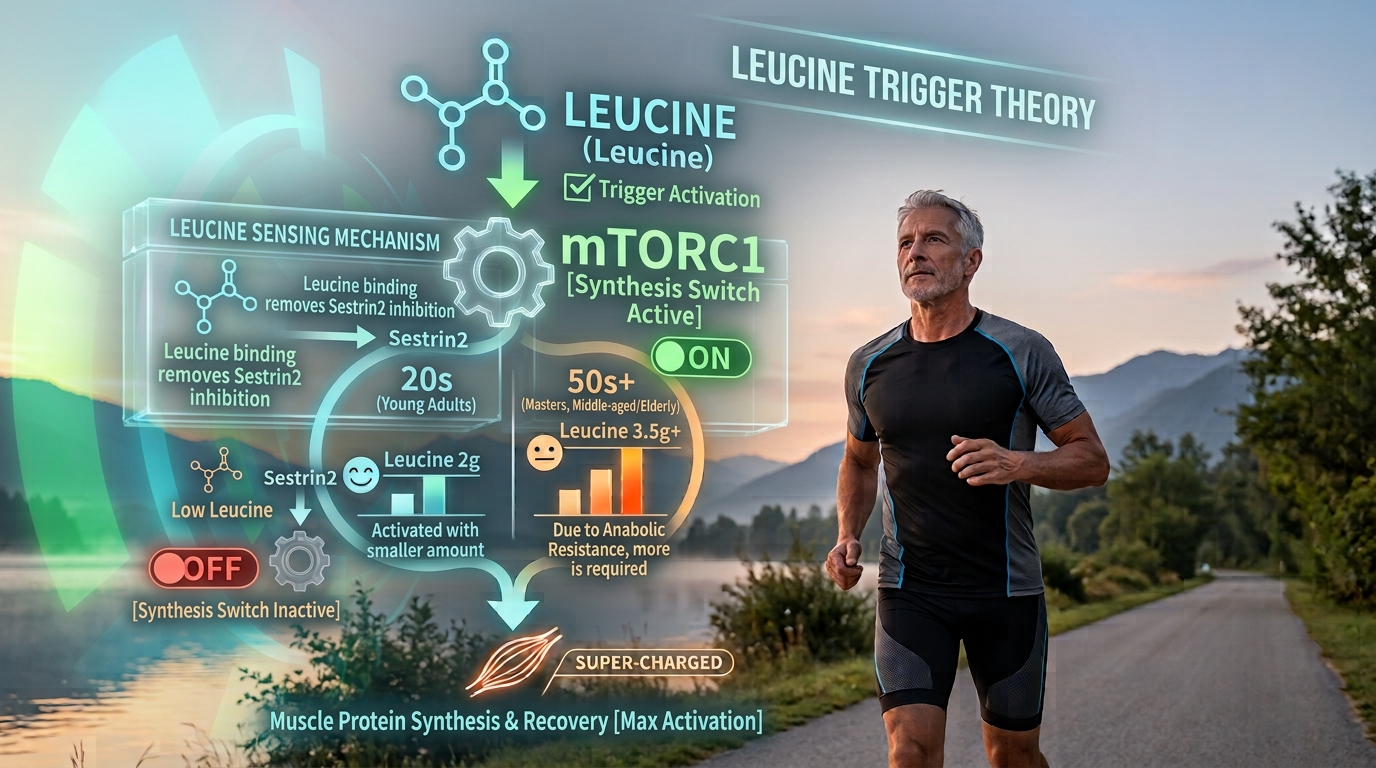
At the center of muscle tissue building is a signaling complex known as mTORC1 (mechanistic target of rapamycin complex 1). When mTORC1 is activated, it phosphorylates downstream target proteins that promote the initiation of muscle protein synthesis.
How does leucine interact with mTORC1? Modern structural biology has identified a sophisticated nutrient-sensing network:
- Sestrin2 Sensing: Under low-amino-acid conditions, a cytosolic protein called Sestrin2 exerts an inhibitory effect on the downstream complex GATOR2.
- Disinhibiting GATOR2: When intracellular leucine availability increases, leucine directly binds to Sestrin2. This binding event relieves the inhibitory effect on GATOR2.
- Rag GTPase Signaling: Once the inhibitory effect of Sestrin2 on GATOR2 is relieved, downstream Rag GTPase signaling promotes the recruitment of mTORC1 to the lysosomal membrane, an important step in mTORC1 activation.
Leucine availability is therefore an important component of the nutrient-sensing system that helps regulate mTORC1, although mTORC1 activation depends on multiple nutritional and physiological signals rather than leucine alone.
Understanding the “Leucine Threshold” Concept
Because leucine plays a pivotal role in metabolic signaling, researchers developed the concept of the leucine threshold (or “leucine trigger”).
Rather than viewing muscle protein synthesis as a linear response—where tiny increments of amino acids yield identical gains—the leucine threshold describes a dose-response relationship. Intracellular leucine concentrations must reach a sufficient availability within a given timeframe to robustly engage Sestrin2-GATOR2 signaling and facilitate translation initiation.
It is important to understand that the leucine threshold is a conceptual model rather than an absolute, universal number. The exact amount of leucine required to support a maximal anabolic response depends on several individual factors:
- Age and metabolic sensitivity
- Total muscle mass and training volume
- The overall protein quality and EAA content of the meal
- Timing relative to recent resistance or endurance exercise
For young, healthy individuals, a high-quality protein serving providing approximately 2 to 3 grams of leucine is often sufficient to stimulate a robust MPS response.
Aging and Anabolic Resistance: Younger Adults vs. Masters Athletes
As athletes age, skeletal muscle tissue undergoes subtle physiological shifts. One notable change is a condition known as anabolic resistance.
Anabolic resistance means that older muscle tissue may display a blunted synthetic response to a given dose of dietary protein or amino acids compared to younger muscle. Several age-related mechanisms contribute to this shift:
- Reduced Microvascular Perfusion: Lower capillary responsiveness following meals, leading to slower delivery of amino acids to muscle fibers.
- Impaired Intracellular Signaling: Decreased sensitivity of mTORC1 and downstream target proteins to circulating amino acid signals.
- Low-Grade Inflammation: Systemic inflammatory markers that can interfere with baseline protein turnover and anabolic pathways.
Because of anabolic resistance, older muscle may require a stronger nutritional stimulus to achieve a comparable MPS response under some conditions.
For this reason, providing around 2.5 to 3.5 grams of leucine per meal can be a practical target for many masters athletes, particularly when the overall protein dose per meal is relatively modest. However, this should be viewed as a practical strategy rather than a universal physiological rule.
Rethinking 2:1:1: A Mathematical Reality Check
This age-related perspective highlights why adhering strictly to a 2:1:1 ratio is not always necessary or efficient.
Consider a masters endurance athlete aiming to provide a practical target dose of 3.5 grams of leucine after a demanding workout.
If this athlete relies exclusively on a conventional 2:1:1 BCAA supplement:
- Leucine target: 3.5 g
- Isoleucine required (2:1:1): 1.75 g
- Valine required (2:1:1): 1.75 g
- Total BCAA dose needed: 7.0 grams
This scenario requires the athlete to consume additional isoleucine and valine simply to obtain the desired leucine dose, without clear evidence that proportionally increasing all three BCAAs provides additional benefit for MPS.
While isoleucine and valine are essential amino acids that participate in energy metabolism, neither possesses the unique mTORC1-activating potency of leucine. For an athlete focused on supporting recovery, insisting on a rigid 2:1:1 ratio scales up total BCAA volume without necessarily delivering an added anabolic advantage.
Why BCAAs Alone Are Not Enough: The “Foreman vs. Building Materials” Analogy
A common point of confusion in sports nutrition is whether drinking BCAAs alone is sufficient to repair and build muscle tissue. Understanding why BCAAs alone are incomplete requires distinguishing between signaling and substrate availability.
Consider a construction site analogy:
- Leucine is the Site Foreman: Leucine arrives at the muscle cell, interacts with Sestrin2/mTORC1, and signals the cell to initiate muscle protein synthesis.
- Essential Amino Acids (EAAs) are the Building Materials: Bricks, mortar, and steel beams represent the complete spectrum of 9 essential amino acids that the body cannot synthesize on its own.
If the foreman (leucine) gives the signal to start building, but there are insufficient building materials (the remaining 8 EAAs, such as lysine, methionine, threonine, etc.) available in the amino acid pool, sustained muscle protein synthesis will eventually be limited.
Because standard BCAA supplements supply only 3 of the 9 essential amino acids, they provide the signaling push without supplying the full array of structural precursors required to construct new muscle protein. To achieve optimal post-exercise muscle protein synthesis, your body requires both the signal and a complete set of building blocks.
BCAA vs. EAA vs. Whey Protein: How to Choose
To make informed dietary decisions, athletes can align their supplement selection with their specific daily scenarios and digestive needs:
| Supplement / Protein Type | Key Composition | Primary Physiological Role | Best Practical Application |
| Standard BCAA (2:1:1) | Leucine, Isoleucine, Valine only. | Supplies free-form amino acids without requiring heavy stomach digestion. | Intra-workout hydration: An optional source of free amino acids during prolonged exercise when solid food or larger protein servings are inconvenient. |
| High-Leucine Formulations | Elevated leucine ratio (e.g., 4:1:1 or 8:1:1). | Concentrates the leucine dose to help hit anabolic targets with lower total volume. | Supplemental option: May be considered when a meal provides adequate protein but relatively little leucine, although improving overall protein quality and quantity should generally come first. |
| Essential Amino Acids (EAAs) | All 9 Essential Amino Acids (including leucine). | Delivers both the mTORC1 signal and all required building blocks without gastric heaviness. | Post-workout / Fasted sessions: Ideal when rapid availability is desired before a complete whole-food meal. |
| Whey Protein Powder | Complete intact protein naturally rich in EAAs and leucine (~2.5–3.0g per 25–30g serving). | Supports maximal muscle protein synthesis while supplying complete protein nutrition. | Post-workout staple & Daily base: A highly complete, cost-effective foundation for overall daily protein needs. |
Practical Supplementation Strategies for Masters Athletes
To optimize recovery and support long-term training adaptations, consider these four practical guidelines:
- Prioritize Total Daily Protein Intake: Before focusing on amino acid ratios, ensure your overall daily protein intake is adequate for your training load (typically 1.4–2.0 g/kg/day for active endurance and hybrid athletes).
- Aim for Protein Adequacy Across Meals: Space meals 3 to 5 hours apart, aiming for servings that supply sufficient high-quality protein (e.g., 30–40g per meal) to naturally deliver an adequate dose of leucine and essential amino acids.
- Choose Whey or EAAs for Recovery: Following hard workouts, opt for Whey Protein or a complete EAA formula. Both can provide substantial amounts of leucine alongside the other essential amino acids required for muscle repair, depending on the formulation.
- Focus on Whole Protein Sources First: If a meal is low in high-quality protein, increasing the overall protein serving or choosing a more complete protein source is generally preferable to relying on leucine or BCAAs in isolation.
FAQ
Q1: Is the traditional 2:1:1 BCAA ratio completely useless?
No. A 2:1:1 BCAA formula can still serve as a convenient, light source of amino acids during extended endurance exercise when solid food is impractical. However, it is simply not the most complete or efficient option for post-workout muscle protein synthesis.
Q2: Should masters athletes replace BCAAs with EAAs or Whey for recovery?
For post-workout muscle recovery, EAAs or whey are generally preferable because they provide all nine essential amino acids, whereas BCAAs provide only three.
Q3: Can I just take large doses of L-leucine powder alone to build muscle?
No. Leucine helps trigger the signal to initiate synthesis, but without the remaining 8 essential amino acids present as building materials, muscle protein synthesis cannot be sustained. Clinical studies show that simply adding leucine to a low-protein diet without sufficient total EAAs does not lead to long-term gains in muscle mass or strength in older adults.
Conclusion
The conventional 2:1:1 BCAA ratio is a long-standing standard in sports nutrition, but it is not a rigid law of human physiology.
When the goal is supporting post-training recovery—particularly for middle-aged and masters athletes managing age-related anabolic resistance—the absolute leucine dose per serving and the completeness of the essential amino acid profile matter far more than adhering strictly to a historical formula.
2:1:1 is not sacred, but leucine alone is not a magic solution either. By prioritizing total daily protein, ensuring an adequate leucine stimulus per meal, and utilizing complete protein sources for recovery, athletes of any age can support training adaptations and maintain peak performance.
References
- Mamerow, M. M., et al. (2014). Dietary protein distribution positively influences 24-h muscle protein synthesis in healthy adults. The Journal of Nutrition, 144(6), 876–880. PMID: 24477298
- Morton, R. W., et al. (2018). A systematic review, meta-analysis and meta-regression of the effect of protein supplementation on resistance training-induced gains in muscle mass and strength in healthy adults. British Journal of Sports Medicine, 52(6), 376–384. PMID: 28698222
- Wolfson, R. L., et al. (2016). Sestrin2 is a leucine sensor for the mTORC1 pathway. Science, 351(6268), 43–48. PMID: 26449471
- Katsanos, C. S., et al. (2006). A high proportion of leucine is required for optimal stimulation of the rate of muscle protein synthesis by essential amino acids in the elderly. American Journal of Physiology-Endocrinology and Metabolism, 291(2), E381–E387. PMID: 16507602
- Wall, B. T., et al. (2013). Leucine co-ingestion improves post-prandial muscle protein accretion in elderly men. Clinical Nutrition, 32(3), 412–419. PMID: 23043721
- Wolfe, R. R. (2017). Branched-chain amino acids and muscle protein synthesis in humans: myth or reality? Journal of the International Society of Sports Nutrition, 14, 30. PMID: 28852372
- Moberg, M., et al. (2016). Activation of mTORC1 by leucine is potentiated by branched-chain amino acids and even more so by essential amino acids following resistance exercise. American Journal of Physiology-Endocrinology and Metabolism, 310(11), E874–E884. PMID: 27053525
- Devries, M. C., et al. (2018). Leucine, branched-chain amino acids, and muscle protein synthesis in aging skeletal muscle. The Journal of Nutrition, 148(8), 1218–1224. PMID: 29938080
- Verhoeven, S., et al. (2009). Long-term leucine supplementation does not increase muscle mass or strength in healthy elderly men. The American Journal of Clinical Nutrition, 89(5), 1468–1475. PMID: 19321567
コメント