
For endurance athletes undertaking high-volume training, carbohydrates are often viewed primarily as fuel for performance. However, emerging evidence in exercise physiology and sports nutrition suggests that carbohydrate availability may also influence the body’s recovery environment through hormonal and cellular signaling pathways.
This article examines a recent study by Panik et al. (2026) that evaluated how post-exercise carbohydrate availability affects acute markers of bone turnover, outlining practical recovery strategies for endurance athletes.
- 1. Moving Beyond the “Carbs = Fuel Only” Mindset
- 2. Experimental Design and Methodology
- 3. Biomarker Results and Data Analysis
- 4. How Carbohydrates May Influence Bone Metabolism
- 5. Training vs. Recovery Phases: Separating Train Low from Recover Low
- 6. Mechanical Impact Alone Does Not Build Strong Bones
- 7. Study Limitations and Context
- 8. Practical Takeaways for Endurance Athletes
- Reference
1. Moving Beyond the “Carbs = Fuel Only” Mindset
Carbohydrates have traditionally been treated as fuel to generate ATP in mitochondria. This perspective supported practices like “Train Low” (exercising with low carbohydrate availability to enhance fat oxidation) or the belief that substituting carbohydrates with other nutrients is fine as long as total caloric demands are met.
When looking at how the body initiates repair and adaptation following exercise-induced metabolic stress, carbohydrates serve a far broader function. They trigger hormonal responses and modulate cellular signals that shape the recovery process.
The referenced study controlled overall caloric intake to isolate how post-exercise carbohydrate availability specifically affects acute markers of bone turnover.
2. Experimental Design and Methodology
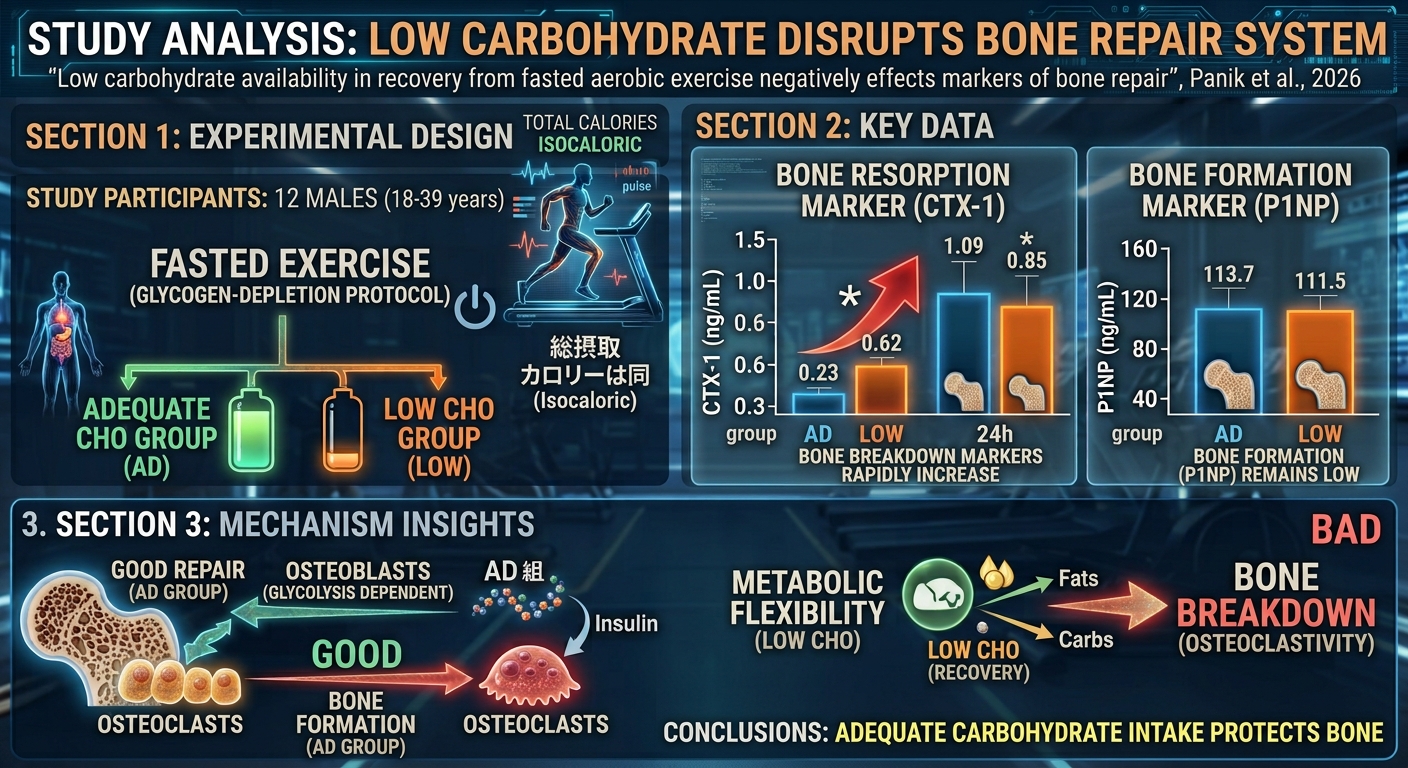
The study (Panik et al., 2026) was conducted by researchers at the U.S. Army Research Institute of Environmental Medicine (USARIEM). To eliminate confounding variables, the trial employed rigorous experimental controls.
Protocol Overview
- Participants: 12 healthy males aged 18–39.
- Standardization (Lead-in): For 48 hours prior to testing, all participants consumed an identical diet: carbohydrate 5.7 ± 0.6 g/kg/day, protein 1.2 ± 0.1 g/kg/day, and fat 1.0 ± 0.1 g/kg/day.
- Glycogen Depletion Session: In a fasted state, participants performed interval cycling alternating between 2 minutes at 90% VO2peak and 2 minutes of active recovery at 50% VO2peak. As fatigue set in, intensity was stepped down to 80%, 70%, and 60% VO2peak until participants could no longer complete the protocol. Total duration (~84–88 min), average power (~160–164 W), and mean heart rate (~159 bpm) were similar across conditions.
- Recovery Diets (24-Hour Period): During the initial 3-hour post-exercise window, participants received either a carbohydrate recovery beverage or a nutrient-free control. Over the subsequent 24 hours, diets were kept strictly isocaloric between two groups:
- AD Group (Adequate Carbohydrate): Carbohydrate at 6.0 g/kg/day
- LOW Group (Low Carbohydrate): Carbohydrate at 1.5 g/kg/day (missing calories were replaced with fat and protein)
Significance of the Design
Many previous studies have manipulated carbohydrate availability in ways that also changed overall energy intake, making it difficult to separate the effects of carbohydrate availability from those of energy deficiency. By matching total energy intake, this study was designed to better isolate the specific effect of carbohydrate availability on bone turnover markers.
3. Biomarker Results and Data Analysis
Blood samples were collected pre-exercise (PRE), immediately post-exercise (0h), 3 hours post-exercise (3h), and 24 hours post-exercise (24h) to measure bone turnover markers.
CTX-1 (Marker of Bone Resorption)
CTX-1 (C-terminal telopeptide of type I collagen) reflects type I collagen breakdown and is widely used as a marker of bone resorption.
- 3 Hours Post-Exercise: The AD group showed significantly lower levels (0.23 ± 0.10 ng/mL) compared to the LOW group (0.62 ± 0.26 ng/mL; P = 0.001). The effect size was extremely large (Cohen’s d = -1.26; 95% CI: -1.8 to -0.72).
- 24 Hours Post-Exercise: At 24 hours, the AD group maintained significantly lower CTX-1 levels (0.85 ± 0.40 ng/mL) than the LOW group (1.09 ± 0.49 ng/mL; P = 0.001, d = -0.46).
P1NP (Bone Formation Marker)
P1NP (Procollagen Type 1 N-Terminal Propeptide) is released by osteoblasts during new bone matrix synthesis.
- 24 Hours Post-Exercise: P1NP was slightly higher in the AD group (113.65 ± 36.35 ng/mL) than in the LOW group (111.54 ± 36.52 ng/mL; P = 0.029). The effect size was modest (d = 0.19; 95% CI: 0.01 to 0.37).
Other Biomarkers (BAP, Total OC, TRAcP5b)
BAP and Total OC (osteoblast activity) alongside TRAcP5b (osteoclast count) showed main effects for time due to exercise stress, but no significant interaction effects between dietary conditions.
Data Interpretation
The primary finding is not that carbohydrate intake dramatically increases bone formation (P1NP), but rather that carbohydrate provision attenuates the spike in bone resorption markers (CTX-1) following intense exercise. Even with adequate total calorie intake, the low-carbohydrate condition was associated with higher CTX-1 concentrations throughout the 24-hour recovery period.
4. How Carbohydrates May Influence Bone Metabolism
Bone is a dynamic tissue that undergoes continuous remodeling through the coordinated actions of osteoblasts, which contribute to bone formation, and osteoclasts, which contribute to bone resorption.
Several physiological pathways may help explain why carbohydrate availability could influence this process:
- Cellular Energy Availability: Osteoblasts rely substantially on glycolytic metabolism during bone matrix synthesis, suggesting that cellular energy status may influence bone-forming activity.
- Insulin Signaling: Carbohydrate intake stimulates insulin secretion, and insulin signaling has been implicated in osteoblast function and bone metabolism.
- Post-Exercise Metabolic Environment: Prolonged or fasted exercise alters the body’s metabolic and hormonal environment. Restoring carbohydrate availability after exercise may help shift the body toward a more favorable recovery state.
- Bone Turnover Balance: If carbohydrate availability influences the metabolic environment during recovery, it may affect the balance between bone resorption and formation. The higher CTX-1 concentrations observed in the LOW condition in this study are consistent with this possibility.
These mechanisms should be regarded as plausible physiological explanations rather than direct findings of the present study. The researchers did not directly measure insulin, cortisol, PTH, or other hormonal mediators, nor did they directly assess osteoblast or osteoclast activity.
5. Training vs. Recovery Phases: Separating Train Low from Recover Low
These findings underscore the importance of separating the stimulus phase from the recovery phase in structured training.
Exercise Phase: AMPK Activation
Training with low glycogen availability activates AMPK (AMP-activated protein kinase), triggering PGC-1α expression to stimulate mitochondrial biogenesis and fat oxidation. This remains a valid protocol for improving metabolic efficiency in endurance sports.
Recovery Phase: Repair and Adaptation
Post-exercise carbohydrate consumption stimulates insulin responses and accelerates glycogen resynthesis, helping restore energy availability during recovery. When combined with sufficient protein for muscle protein synthesis (MPS), carbohydrate-rich recovery nutrition can help create a favorable environment for tissue recovery.
Executing a “Train Low” session should not automatically mean “Recover Low.” Extending carbohydrate restriction into the recovery period may alter the metabolic environment at a time when the body is repairing and adapting to the training stimulus.
6. Mechanical Impact Alone Does Not Build Strong Bones
Endurance athletes often assume that mechanical stress—such as ground impact forces during running—is sufficient to build strong bones. While mechanical loading provides a necessary remodeling stimulus, structural adaptation also requires adequate energy availability, balanced hormonal signaling, and sufficient nutrient support.
This balance becomes increasingly important as athletes age. Recovery capacity, muscle mass, bone health, and tissue remodeling can all change with advancing age, reducing the margin for error when training loads remain high.
For this reason, applying a strong training stimulus without providing an adequate recovery environment may create a mismatch in which repair and adaptation fail to keep pace with repeated physiological stress.
Mechanical stress provides an important signal for skeletal adaptation, but nutrition and energy availability help create the environment in which that adaptation can occur.
7. Study Limitations and Context
To apply these findings accurately, several contextual factors must be kept in mind:
- Acute 24-Hour Scope: The study evaluated short-term biomarker responses over 24 hours. It does not directly prove that short-term low-carbohydrate availability causes stress fractures or long-term bone density loss.
- High-Intensity Protocol: The exercise protocol involved prolonged, demanding interval cycling performed in a fasted state. The findings should not be assumed to apply directly to lower-intensity sessions such as typical Zone 2 training.
- Participant Demographic: The study examined young males (ages 18–39). Female athletes experience significant bone metabolism interactions linked to estrogen variations, meaning these results cannot be directly generalized to female populations.
- Secondary Analysis: The study was a secondary analysis of a parent trial originally designed to investigate substrate metabolism. The sample size was therefore not specifically powered for bone turnover outcomes, and the study should be interpreted as evidence of acute biomarker responses rather than clinical or long-term skeletal outcomes.
8. Practical Takeaways for Endurance Athletes
- Distinguish Between Training and Recovery: If you incorporate fasted or low-carbohydrate training to improve metabolic flexibility, transition into a structured recovery state immediately after completing the workout.
- Fuel for Recovery: Post-workout carbohydrates are not just fuel for the next session. They may also help create a recovery environment that is associated with a more favorable acute bone turnover response after demanding exercise.
- Prioritize Adaptive Capacity: Consistency in endurance training depends on maintaining an adequate recovery environment over time. Consuming sufficient carbohydrates following demanding sessions is one practical strategy for supporting recovery and allowing training adaptations to accumulate over repeated sessions.
Reference
- Panik KN, Wilson MA, Whitney CC, Carrigan CT, Margolis LM. Low carbohydrate availability in recovery from fasted aerobic exercise negatively effects markers of bone turnover in males. Performance Nutrition. 2026;2:9. https://doi.org/10.1186/s44410-026-00025-x
コメント