
Summer is almost here, bringing with it the relentless heat that tests every endurance athlete’s limits.
“No matter how hard I train, my pace won’t improve.” “I eat well, but my body feels heavy, and I can’t build speed.” Many athletes hit this exact wall during the summer months.
While this slump is often brushed off as mere “summer fatigue,” sports nutrition reveals a different root cause: a specific hormone in your body may be reducing your ability to absorb iron and manage iron availability.
That hormone is hepcidin—a key regulator of iron absorption and iron availability in the body.
First identified in the early 2000s, hepcidin is a relatively new concept in sports science. However, in modern endurance training and advanced coaching, it has rapidly changed how we understand and manage iron deficiency in athletes.
For endurance athletes putting in heavy mileage throughout the summer, understanding hepcidin is a game-changer for turning hard work into actual performance gains. Today, let’s break down how this complex hormone works and explore a scientifically backed approach to the dynamic management of iron.
Key Takeaways (Read this if you are in a rush!)
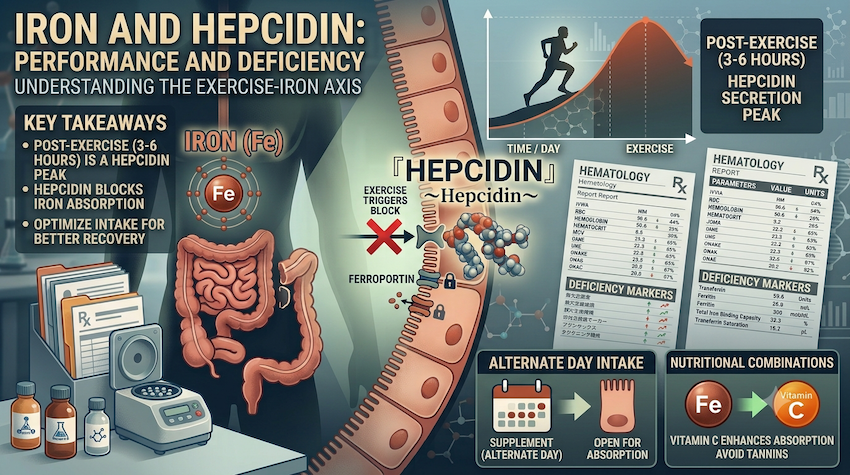
- Post-Exercise Spike: Immediately after hard training (3 to 6 hours post-exercise), a hormone called hepcidin spikes, significantly reducing iron absorption by closing the body’s “iron shutter.”
- Timing Is Everything: Eating iron-rich foods or taking high-dose supplements right after training yields very little absorption and mostly just strains your digestive system.
- Optimization Strategies: To maximize iron absorption, target times when the shutter is open—such as early morning before training (on an empty stomach)—or adopt an “alternate-day supplementation” strategy.
- Beyond Exercise: Latest research shows that besides exercise-induced inflammation, chronic low energy availability (often associated with insufficient carbohydrate intake) also impairs iron metabolism.
If you are training hard and taking iron but still feeling sluggish, read on to discover the science and solutions.
- Why Iron is Such a Tricky Nutrient
- Hepcidin: The Heavy-Duty Shutter for Iron Absorption
- Why Hepcidin Spikes in Endurance Athletes
- The Triple Threat of Iron Loss for Summer Endurance Athletes
- Practical Approaches to Dynamic Iron Management
- Fitting Strategy into Your Daily Routine
- Beyond Inflammation: Low Energy Availability (LEA) and Iron Metabolism
- Crucial Safety Warning: Self-Diagnosis is Dangerous
- Summary
Why Iron is Such a Tricky Nutrient
Before diving into hepcidin’s mechanisms, let’s review why iron (Fe) is such a delicate and challenging mineral for the human body.
In long-distance and endurance sports, oxygen-carrying capacity (hemoglobin levels) directly dictates the ceiling of your sustainable power output. However, iron possesses several tricky characteristics:
- Extremely Low Absorption Rate: Only about 10% to 20% of heme iron (from animal sources) and a mere 2% to 5% of non-heme iron (from plant sources) is actually absorbed by the body. The vast majority simply passes right through.
- Competes with Other Minerals: Iron shares the same absorption pathways in the small intestine with calcium, magnesium, and zinc. Taking large amounts of these minerals simultaneously lowers the absorption rate of iron.
- Unabsorbed Iron Strains the Gut: Excess iron remaining in the gut disrupts intestinal flora and irritates the stomach lining. This explains why some athletes experience constipation or stomach upset when they start taking iron supplements.
- Risks of Overconsumption: While iron deficiency impairs performance, blindly taking high-dose supplements carries serious risks. The human body has no efficient regulated pathway for actively eliminating excess iron, leading to tissue accumulation and organ damage (iron overload).
Iron isn’t a nutrient where “more is better.” You cannot simply add more to fix a deficiency. Instead, you must manage when it gets absorbed. The primary master controller of this absorption “shutter” is hepcidin.
Hepcidin: The Heavy-Duty Shutter for Iron Absorption
Hepcidin is a peptide hormone produced mainly by the liver. Simply put, it acts as a strict brake to prevent excess iron accumulation in the body.
The human body maintains iron balance through homeostasis:
- High Hepcidin Levels: The intestinal shutter locks down. No matter how much iron-rich food or high-dose supplements you consume, absorption efficiency drops significantly.
- Low Hepcidin Levels: The intestinal shutter opens. Iron is smoothly absorbed from food or supplements into the bloodstream and delivered where needed.
In short, resolving iron deficiency efficiently depends less on how much iron you consume and more on targeting the exact windows when the hepcidin shutter is open.
Why Hepcidin Spikes in Endurance Athletes
While this regulation system works smoothly for sedentary individuals, it gets disrupted in endurance athletes undergoing high training volumes. This is because hepcidin secretion is also triggered by systemic inflammation.
1. Exercise-Induced Inflammation and the IL-6 Trap
Hard training causes micro-damage in muscle tissue, prompting a surge of inflammatory cytokines like IL-6 (Interleukin-6). IL-6 signals the liver that the body is under stress, ordering it to produce hepcidin and lock down iron transport.
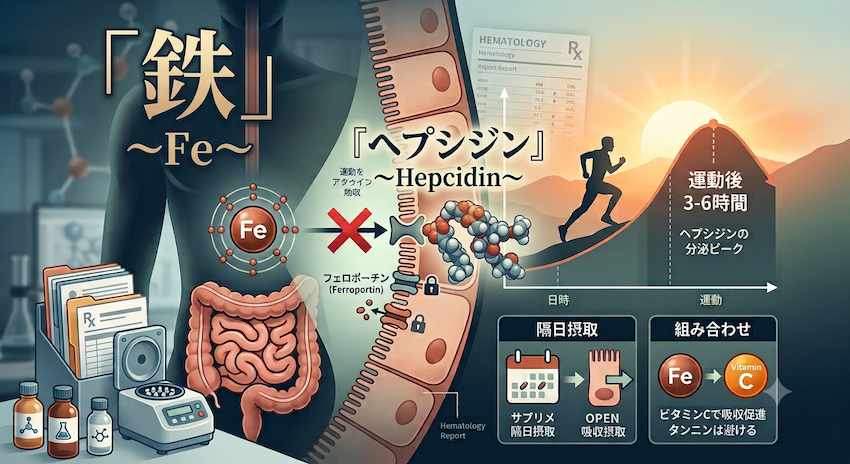
Numerous sports medicine studies confirm that hepcidin levels peak approximately 3 to 6 hours after exercise. Right after a hard session, your body’s iron absorption shutter is locked tight.
2. Added Heat Stress in Summer
Training in hot summer conditions imposes significant thermal stress. As heavy sweating leads to fluid loss, blood flow prioritizes working muscles and skin cooling over the digestive tract. This temporary gastrointestinal ischemia triggers mild gut inflammation.
The combination of heat stress on the digestive tract and exercise-induced muscle inflammation creates a double hit, driving hepcidin levels even higher in the summer.
The Triple Threat of Iron Loss for Summer Endurance Athletes
While hepcidin blocks iron entry at the gut, summer endurance athletes lose iron through three distinct pathways:
- Foot-Strike Hemolysis: The impact of running causes mechanical destruction of red blood cells in the capillaries of the feet. As monthly mileage reaches 300 km or 400 km, this physical destruction accounts for significant iron loss.
- Iron Loss Through Sweat: Sweat contains small amounts of iron. When training daily in high heat with heavy sweat loss, this accumulation becomes a noticeable amount over time that cannot be ignored.
- Gastrointestinal Micro-Bleeding: Reduced blood flow to the stomach and intestines during prolonged, intense exercise causes mucosal irritation, leading to microscopic bleeding in the GI tract.
Summer endurance athletes face a bucket with a hole in the bottom: the intake shutter at the small intestine is closed by hepcidin, while iron leaks out through the feet, sweat, and digestive system.
Practical Approaches to Dynamic Iron Management
How can athletes work with hepcidin to optimize iron supplementation?
1. Strictly Time Your Intake
- Avoid the 3-to-6-hour post-workout window: Taking iron with your first meal several hours after a hard morning workout coincides directly with the post-exercise hepcidin peak. Absorption will drop significantly, and unabsorbed iron may cause gastrointestinal discomfort.
- Target low-hepcidin windows: Take iron before workouts or when fully recovered. For most daily routines, hepcidin levels are lowest in the morning on an empty stomach. If you train in the evening, taking iron in the morning allows you to get ahead of the hepcidin curve. (If an empty stomach causes nausea, pair it with a light meal.)
2. Try Alternate-Day Supplementation
Recent sports nutrition studies show that taking high-dose iron supplements every other day results in higher overall absorption than daily intake.
High doses of iron can trigger hepcidin production as a protective response. Spacing doses every other day prevents hepcidin spikes, allowing the body to absorb iron more effectively when the shutter opens.
3. Know Your Boosters and Blockers
- Vitamin C Boosts Non-Heme Iron: Combining Vitamin C with plant-based (non-heme) iron converts it into a more absorbable form, improving intake efficiency.
- Tannins and Calcium Block Absorption: Tannins in coffee and tea inhibit iron absorption. Avoid them for an hour before and after taking iron. Similarly, taking iron alongside dairy (calcium) creates competition in the small intestine, lowering efficiency.
Fitting Strategy into Your Daily Routine
The final step is aligning these scientific principles with your personal schedule and daily habits.
Consider an athlete who trains hard during the day, eats two main meals (lunch and dinner), and drinks a protein shake in the morning instead of a traditional breakfast.
Because intense daytime training triggers a hepcidin spike during lunch and afternoon snacks, forcing iron-rich foods during these meals offers poor return on investment.
However, eating a heavy, solid meal early in the morning when hepcidin is lowest may strain the digestive system before a workout.
In this scenario, a practical strategy is to pair a well-absorbed iron supplement and Vitamin C with your morning protein shake before exercise. Alternatively, target morning intake on rest days or light recovery days when inflammation has subsided.
When eating two meals a day, timing iron intake around open hepcidin windows ensures no opportunity is wasted.
Beyond Inflammation: Low Energy Availability (LEA) and Iron Metabolism
While exercise-induced inflammation is a major factor driving hepcidin, recent research highlights another crucial element: Low Energy Availability (LEA).
Some athletes fail to recover from iron deficiency despite consistent training and adequate iron intake. Studies suggest that insufficient total energy intake—particularly carbohydrates—may be a key contributor to disrupted iron metabolism.
A Recent Case Study of Japanese Female Distance Runners
A 6-week nutritional intervention studied six competitive female distance runners in Japan running 100 km to 160 km per week. At baseline, all runners showed evidence of low energy availability (LEA), averaging a daily deficit of 548 kcal. Despite consuming an average of 14 mg of iron daily, five of the six runners showed clear evidence of iron depletion (Stage 1 iron deficiency).
Under sports dietitians’ guidance, the athletes increased their carbohydrate intake to target roughly 7 g per kg of body weight daily for 6 weeks. The intervention led to notable improvements:
- Significant reduction in energy deficit
- Restoration of resting metabolic rate
- Normalization of cortisol (stress hormone) levels
- Improved carbohydrate oxidation efficiency (respiratory quotient)
- Reversal of iron deficiency in most athletes
Although hepcidin levels were not directly measured in this specific study, the findings alongside existing research suggest that chronic energy deficiency negatively impacts iron metabolism.
Eating Less Does Not Guarantee Speed
In endurance sports, the belief that “lighter means faster” remains persistent. While reaching an optimal racing weight can benefit performance, restricting calories—especially carbohydrates—leads to Low Energy Availability (LEA) and performance decline.
Chronic energy deficiency contributes to REDs (Relative Energy Deficiency in Sport), bringing wide-ranging health and performance risks:
- Impaired iron metabolism
- Chronic fatigue
- Decreased resting metabolic rate
- Hormonal imbalances
- Reduced bone mineral density and stress fractures
- Declined athletic performance
Carbohydrates are Fuel, Not the Enemy
Modern endurance nutrition increasingly emphasizes matching fuel intake with training demands rather than unnecessary restriction. Elite sport has shifted focus from “how to restrict food” to “how to fuel adequately for the work required.”
If you maintain high training volumes, consume sufficient carbohydrates without guilt.
Training at the right intensity, fueling adequately for the workload, and prioritizing rest form the foundation of health, iron metabolism, and long-term athletic progress.
The goal is not to fight your physiology, but to understand it and work with it.
Crucial Safety Warning: Self-Diagnosis is Dangerous
Before implementing these strategies, an essential warning is necessary: do not rush to buy high-dose iron supplements without medical data. As noted, excess iron carries toxicity risks.
Fatigue and poor performance can stem from iron deficiency, overtraining syndrome, or simple carbohydrate depletion. Self-diagnosing and over-supplementing iron can cause severe organ stress and systemic fatigue.
Responsible athletes should follow these steps:
- Get Regular Blood Tests: Measure both Hemoglobin (Hb) and Serum Ferritin (stored iron) with a physician. Many athletes have normal hemoglobin but depleted ferritin—a condition known as latent iron deficiency.
- Determine Dosage with Medical Professionals: Work with a doctor or sports dietitian to establish an appropriate supplementation protocol based on lab results.
- Apply Hepcidin Knowledge to Timing: Once a supplementation plan is set, apply hepcidin timing principles—avoiding the 3-to-6-hour post-workout window and pairing non-heme iron with Vitamin C—to maximize safety and efficiency.
Summary
The discovery of hepcidin shifted sports nutrition from static iron management (“how much to take”) to dynamic iron management (“when and how to take it”).
Understanding your body’s physiological mechanisms and working with hormonal rhythms is an investment just as valuable as upgrading gear or updating training methodologies.
When summer training feels unrewarding despite your hard work, look beyond willpower and consider the underlying physiology of hepcidin.
To ensure your training efforts pay off, look not only at what you consume, but when you consume it.
Matching your nutrient timing with your body’s absorption windows serves as a powerful tool to conquer summer heat and unlock higher performance.
Modern sports nutrition has entered an era where timing is integral to performance. Understanding hepcidin is the first step in mastering that dynamic approach.
コメント