
I used to be quite reluctant to actively train my calves for running. In fact, I believed that “thinner calves are better.”
The reason was simple. In running, the more mass you have at the extremities of your limbs, the more energy it takes to move them with each stride. If you build up your calf muscles and make your lower legs heavier, it is like running with weights attached to your ankles, which I assumed would be disadvantageous for running economy.
Indeed, when looking at top runners from East Africa, such as Kenya, quite a few of them have extremely thin calves.
From this, I came to a rather simplistic conclusion:
“The thinner the calves, the better.”
“Long-distance runners have no need to intentionally build up their calves.”
Because of this mindset, even when considering strength training, I found little appeal in actively working on my calves.
However, after reading a specific research paper recently, I found myself rethinking that perspective.
Of course, reading this study does not flip my conclusion completely to “thicker calves are better.” Nor is it a simple story that enlarging muscles automatically improves running economy.
What I found much more fascinating was the perspective of how muscles and tendons work in coordination, rather than simply how large the muscles are.
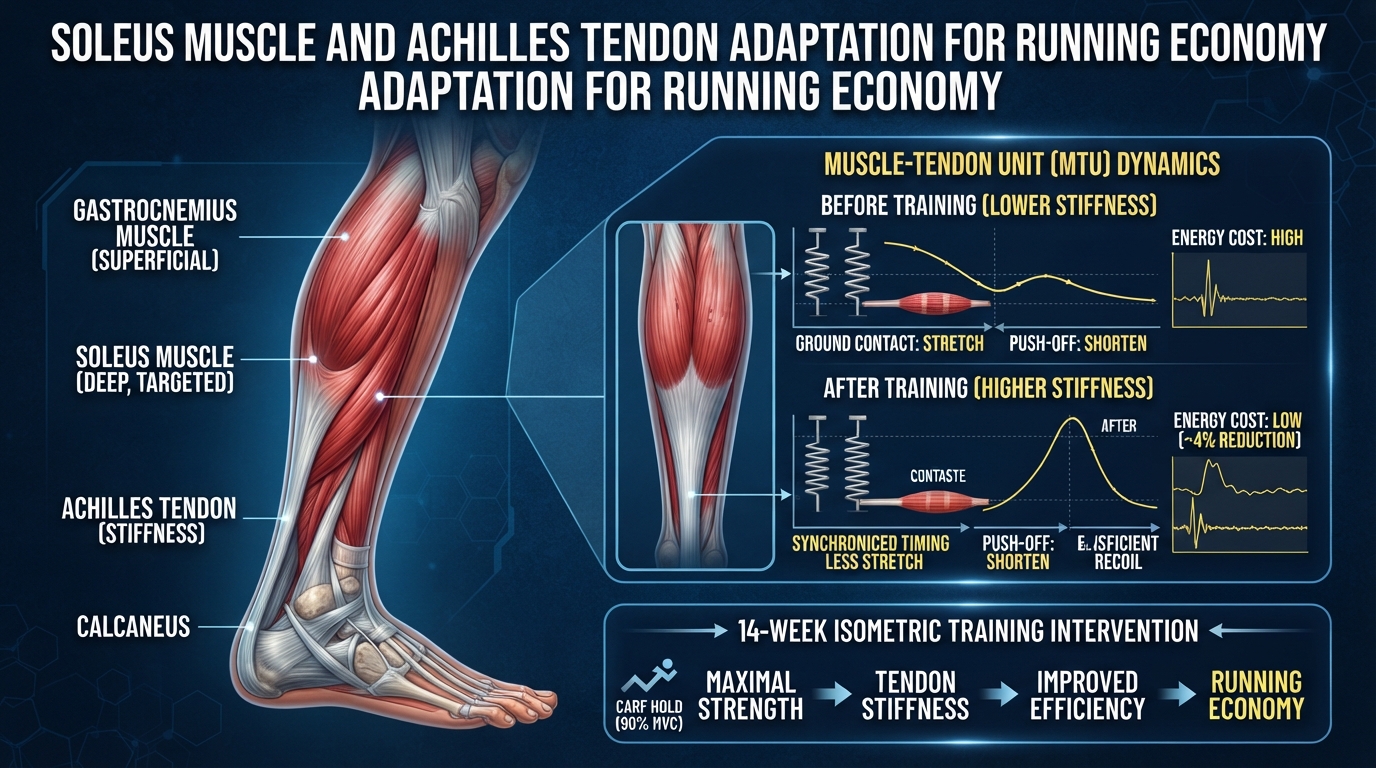
In a 2021 study by Bohm et al., recreational runners underwent 14 weeks of high-intensity plantar flexor training. The results showed that plantar flexor strength and Achilles tendon stiffness increased, while the energy cost of running decreased by about 4%.
Yet, the running form itself did not change significantly.
So, what on earth changed inside the body?
What makes this study so interesting lies beyond that surface observation. It is not simply a matter of “training your calves makes you stronger.” It involves questions such as: At what velocity do the soleus muscle fibers shorten? How do the Achilles tendons stretch and recoil? And how efficiently can muscles convert chemical energy into mechanical work?
In other words, it suggests that internal changes in the muscle-tendon units, changes that are barely visible from the outside, are related to running economy.
By examining this study by Bohm et al., I would like to explore the mechanisms behind why I began to rethink lower leg strength training, moving away from my old belief that “thinner calves are better.”
- The Full Picture of the Experimental Design Set by Bohm et al.
- Observed Changes and the Unavoidable “Invariance of Form”
- The “Soleus” as Protagonist and Its Unique Role
- Counterintuitive Dynamics: The “Muscle-Tendon Unit” and the Mystery of “59%”
- Vmax and Enthalpy Efficiency: What Muscle Fiber Shortening Velocity Means
- Changes in Neuromuscular Activity (EMG) and the Rejection of “Simple Strength Logic”
- Four Approaches to Lower Leg Training from My Perspective
- How I Would Structure a Training Menu (Proposed Example and Rationale)
- The Perspective of a Masters Runner and Training Limitations
- Summary
- References
The Full Picture of the Experimental Design Set by Bohm et al.
An important clue for exploring this question in depth is the original paper by Bohm et al. (2021). This study investigated how adaptations in the lower leg muscles and Achilles tendons affect the energy cost of running.
Adult recreational runners, including both men and women, participated in the study, with data from 13 subjects in the intervention group and 10 in the control group analyzed in the end. The intervention period lasted 14 weeks.
The intervention group performed high-intensity isometric (static) plantar flexion exercises. To picture it: “You apply strong force in the plantar flexors while keeping the ankle joint position fixed.”
This is a point easily misunderstood: it is not a calf raise. Unlike calf raises where you actively raise and lower your heels, you generate high force in the plantar flexors while keeping the ankle joint position fixed.
In the study, this force was exerted at a very high intensity, approximately 90% of maximum voluntary contraction (MVC), holding for 3 seconds followed by 3 seconds of rest, repeated 4 reps per set. This made up 5 sets per session, performed 3 to 4 times a week for 14 weeks.
In short, if you were to describe the exercise used in the study in one phrase, it is an isometric plantar flexion exercise designed to load the muscle-tendon unit without dynamic movement.
It is quite high-intensity, but the movement itself is extremely simple.
The researchers investigated how this 14-week intervention changed plantar flexor strength, Achilles tendon stiffness, soleus fascicle behavior, and the energetic cost of running, and explored whether changes in muscle-tendon mechanics could help explain the improvement in running economy.
Observed Changes and the Unavoidable “Invariance of Form”
Following the 14-week intervention, several notable changes were observed. The data showed that plantar flexor strength increased by about 10%, accompanied by a roughly 31% increase in Achilles tendon stiffness. Notably, the energy cost of running, calculated from oxygen consumption and other metrics, decreased by approximately 4%.
However, the most critical nuance when interpreting these results is avoiding the hasty causal conclusion that “energy cost dropped by 4% simply because strength increased by 10%.” In fact, measurements in this study revealed no statistically significant changes in macroscopic running form parameters such as stride length, cadence, contact time, flight time, or the kinematics of the ankle and knee joints.
In other words, the energy cost decreased even though external forms and movement patterns remained virtually unchanged, and that is precisely what makes this study so thought-provoking. Why did energy costs drop despite almost no alteration in external form? This paradoxical question serves as the starting point for investigating the underlying mechanisms.
The “Soleus” as Protagonist and Its Unique Role
What is crucial here is that this study does not discuss the “calves as a whole” lumped together; instead, it puts the soleus muscle, located deep within the triceps surae, in the clear starring role.
While the triceps surae also includes the superficial gastrocnemius, the gastrocnemius is a biarticular muscle involved in knee flexion and explosive power. In contrast, the soleus is a monoarticular muscle dominated by slow-twitch fibers, bearing a massive amount of mechanical work during upright posture and the stance phase of long-distance running. During running, the soleus is required to sustain continuous, intense contractions to support the body and generate forward propulsion.
What this paper addresses is not mere outward muscle hypertrophy, but the metabolic and mechanical aspects of how efficiently this soleus muscle utilizes energy within the cyclical movement of running.
Counterintuitive Dynamics: The “Muscle-Tendon Unit” and the Mystery of “59%”
Many people intuitively assume that “when a muscle shortens, the entire structure connected to it, including the tendon (the muscle-tendon unit: MTU), shortens along with it.” However, the actual behavior of muscle and tendon during running is not so straightforward.
One of the remarkably fascinating data points shown in the paper is this: “About 59% of the total soleus fascicle shortening occurred during the first part of stance, while the MTU was still lengthening.”
What does this number mean? During the early stance phase, the MTU as a whole lengthens while the soleus fascicles shorten, allowing mechanical work generated by the muscle to be transferred to and stored as strain energy in the Achilles tendon.
This coordination between muscle fiber shortening and Achilles tendon behavior is an important part of the mechanism underlying efficient force and energy transfer during running.
Vmax and Enthalpy Efficiency: What Muscle Fiber Shortening Velocity Means
Why did the adaptation of the muscle-tendon unit lead to a reduction in energy cost? This is where the relationship between muscle fiber shortening velocity and enthalpy efficiency (energy metabolic efficiency) becomes essential.
Muscles do not consume energy efficiently simply by generating strong force. There is a range of shortening velocities at which muscles can convert chemical energy into mechanical work more efficiently, with peak efficiency occurring at around 18% of maximum shortening velocity (Vmax) in the model used in this study.
This is a vital point for understanding the current study.
When a muscle’s shortening velocity changes, the metabolic cost required to perform a similar amount of mechanical work also shifts. Based on relationships between shortening velocity and enthalpy efficiency derived from prior literature, Bohm et al. estimated how efficiently the soleus muscle operated during running.
However, during submaximal running, the soleus operates below the velocity associated with maximal enthalpy efficiency.
What is fascinating is the change brought about by the training intervention.
After training, during the early stance phase where the MTU lengthens, the shortening velocity of the soleus muscle fibers shifted higher. Conversely, during the phase where the MTU shortens, the muscle fiber shortening velocity shifted lower.
According to the authors’ interpretation, the increase in Achilles tendon stiffness altered how the muscle fibers and tendon shared their respective motions within the muscle-tendon unit. This may have allowed soleus muscle fibers to operate closer to a more energy-efficient velocity range.
In other words, rather than becoming more energy-efficient simply because “we made the muscle bigger,” the combination of muscle and tendon allowed the muscle fibers to work with greater efficiency.
This is one of the reasons why this study should not be dismissed as a simple story of “increasing calf strength.”
Changes in Neuromuscular Activity (EMG) and the Rejection of “Simple Strength Logic”
Furthermore, the study measured neuromuscular activity using electromyography (EMG), reporting that soleus EMG during running decreased by about 12% following training.
Without altering outward form, the training was associated with changes in soleus fascicle shortening velocity and lower EMG activation during running. These findings suggest that the improved running economy cannot be explained simply by an increase in muscle strength or a change in running form. The paper evaluates multiple factors, emphasizing that complex metabolic and mechanical optimizations are at play, ones that cannot be explained by mere strength gains alone.
Without altering outward form, the shifted balance in stiffness between muscle and tendon was accompanied by lower EMG activation and altered fascicle shortening velocities. That right there is part of the intricate physiological puzzle behind the 4% drop in energy cost.
Four Approaches to Lower Leg Training from My Perspective
Beyond this point, what follows is not the direct factual proof of Bohm et al.’s study, but rather my own original thoughts and proposals on how I expand my thinking when building training regimens as a runner, touched by these profound insights.
To enhance the mechanical properties of the lower legs and Achilles tendons and encourage muscle-tendon coordination, I find it useful to categorize and consider the following four stimuli (approaches):
- 1. High-Load Strength Training (e.g., Heavy Calf Raises)
- Objective: To improve maximum strength and stimulate structural adaptation of the muscle-tendon tissue against high tension.
- Thoughts: By applying sufficient load to both the gastrocnemius and soleus from the stretched position to the contracted position, we raise the baseline of fundamental strength and tendon capacity.
- 2. Isometric (Static Contraction) Training
- Objective: To generate high-intensity tension without joint movement, stimulating neuromuscular recruitment and specialized tendon adaptation.
- Thoughts: This was the actual method adopted in the paper, and it serves as an interesting option in terms of applying high tension to the muscle-tendon unit without dynamic joint movement.
- 3. Single-Leg Force Production (e.g., Single-Leg Calf Raises)
- Objective: To check for left-right imbalances and enhance precision of force production during the “single-leg support phase,” which closely mimics running.
- Thoughts: Compared to bilateral training, single-leg support demands higher practical stability and localized loading. Therefore, it is worth considering from the standpoint of coordination and force generation under single-leg support.
- 4. Plyometric/Reactivity Training (e.g., Pogo Jumps, Ankle Hops)
- Objective: To leverage the stretch-shortening cycle (SSC) of the Achilles tendon, stimulating the ability to rapidly store and release energy.
- Thoughts: The paper did not directly test the effects of pogo jumps. However, introducing swift reactive stimuli, similar to actual running, to tendons whose foundation has been strengthened through strength or isometric training is, in my view, worth considering to help internalize elastic spring functions into practical running.
How I Would Structure a Training Menu (Proposed Example and Rationale)
When incorporating these approaches into an actual training schedule, mindlessly packing everything in at once must be avoided. Below is a “proposed example” that I envision implementing myself, based on the insights gained from this study.
| Exercise | Main Objective | Reps | Sets | Frequency | Intensity Approach | Rationale for Proposal | Direct Study Verification vs. My Consideration |
|---|---|---|---|---|---|---|---|
| 1. Heavy Calf Raises | Foundation for strength and tendons | 6-10 | 2-4 | about 2 times/week | High load, low-to-medium reps, controlled form | To raise the baseline of strength and tendon stiffness | My consideration |
| 2. Isometric Calf Holds | Securing high-intensity static tension | 3-5 seconds hold + rest | 4 reps x 5 sets | about 2 times/week | High-intensity static contraction tailored to personal state | An application inspired by the stimulus used in the paper | Based on my consideration |
| 3. Single-Leg Calf Raises | Left/right balance and single-leg support strength | 8-12 per leg | 2-3 | 1-2 times/week | Bodyweight to moderate load, focusing on stability | To mimic the single-leg support phase of running | My consideration |
| 4. Plyometrics (e.g., Pogo Jumps) | SSC utilization of the Achilles tendon | 10-20 | 2-3 | about 1-2 times/week | Controlled form, short ground contact time, rhythmic | To utilize elastic springs after strength and tendon adaptation | My consideration |
I must emphasize that these numbers and frequencies are not “scientifically proven absolute optimal values.” The conditions used in the paper, such as “90% MVC, 3 seconds, 4 reps x 5 sets, 3 to 4 times a week,” were strictly controlled protocols under laboratory conditions. They should not be blindly copied by everyday runners or masters runners who are already managing high running mileage and training loads.
Packing every exercise in daily elevates the risk of overuse syndromes from a total load perspective. Therefore, keeping an eye on individual fatigue levels and running schedules, a realistic approach would be to distribute the nature of the stimuli, for instance, “strength work twice a week, isometric work twice a week on separate days, and a light, small amount of plyometrics right before key workouts.”
The Perspective of a Masters Runner and Training Limitations
When bringing scientific insights into practical application, we must accurately recognize their limitations. The subjects in this study were relatively young recreational runners, and the sample size was limited. Furthermore, the intervention period was only 14 weeks, and it evaluated specific isometric exercises targeted at rearfoot-strike runners.
Therefore, we cannot conclude that “this study makes this training the sole correct answer for all runners or masters runners.” Considering my own age and physical background, I cannot apply young adult data unconditionally; it should be treated carefully as “high-quality evidence indicating the relationship between mechanical adaptation of the lower leg and energy efficiency.”
Moreover, the mindset that “the more you train your lower legs, the better” must also be curbed. Calves and Achilles tendons constantly receive immense ground reaction forces and loads from daily running itself. Superimposing unlimited high-intensity training on top of that runs the risk of preventing tissue recovery and causing injuries. The essence of training is always the cycle of “stimulus, recovery, adaptation,” and quantitative or qualitative pursuits that ignore recovery yield counterproductive results.
Summary
The study by Bohm et al. covered in this article demonstrated that calf training goes far beyond simple “strength gains.” It reveals a deeply profound physiological mechanism where changes in the coordination between muscles and the Achilles tendon may help explain enhancements in running energy efficiency (enthalpy efficiency).
Even without large changes in outward running form, inside the muscle-tendon unit, Achilles tendon stiffness increased, soleus muscle fiber shortening velocity shifted toward a more favorable range, and metabolic cost decreased as a result. This “invisible internal adaptation” provides a fresh perspective when considering how to make long-distance running more efficient.
Of course, specific training protocols cannot be recommended universally to everyone, but using the insights into mechanisms gained from this study as nourishment, carefully building stimuli such as strength, isometric contractions, and plyometrics while maintaining a dialogue with one’s own body, is something I believe will serve as a solid clue for constructing sensible training.
References
Bohm S, Mersmann F, Santuz A, Arampatzis A. Enthalpy efficiency of the soleus muscle contributes to improvements in running economy. Proceedings of the Royal Society B: Biological Sciences. 2021;288(1943):20202784. PMID: 33499791. PubMed
コメント