
Note: All first-person expressions in this text are derived from the experiences and analyses of author Marius Bakken.
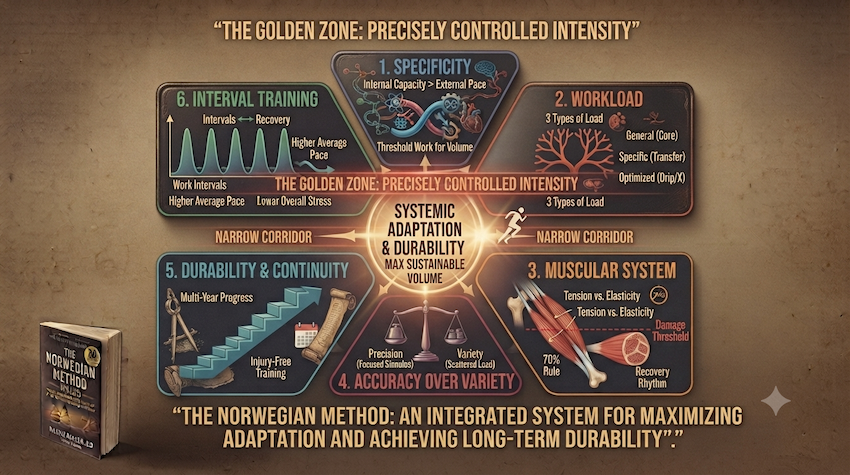
In Chapter 3, we shift our focus from the foundational philosophy of the Golden Zone and threshold training to view them as a comprehensive, long-term optimization system. Building upon the core principles established in the previous chapters, this section delves into the six fundamental rules underpinning the entire Norwegian Method, alongside the crucial biomechanical and muscular mechanisms—particularly how the muscular system often determines how much quality training an athlete can actually absorb—that determine daily training outcomes.
- 1. The Challenge: The 1990s Reality and the Evolution of Training Systems
- 2. The Core of the Norwegian Method
- 3. The Six Pillars Defining the Method
- 4. Conclusion of Chapter 3: Internal Reflection and Future Outlook
1. The Challenge: The 1990s Reality and the Evolution of Training Systems
In the late 1990s, East African dominance reshaped distance running on a global scale. As a young runner thrust into this highly competitive era, Marius Bakken faced a fundamental structural question.
Traditional Western approaches often lacked a systematic framework for accumulating large amounts of high-quality aerobic work while managing fatigue and injury risk. Developing a method capable of accumulating maximal quality work without breaking the body required a systematic fusion of trial, error, and precise blood lactate measurement. Out of this necessity, the Norwegian Method was forged.
2. The Core of the Norwegian Method
Unlike traditional training models that lack an integrated organizing principle and rely on fixed weekly routines, this method anchors its entire structure around a single fixed center.
That center is precision-controlled aerobic training at maximal volume, primarily limited by muscular system factors: threshold training within the Golden Zone.
The goal here is not to find the hardest intensity an athlete can tolerate, but the highest-value intensity that can be repeated consistently. This core is strictly protected above all other training interventions. Complex, flashy interval combinations and novel gimmicks are entirely eliminated in favor of a process that is simple, clear, and, above all, precise. Maintaining focus on this fixed target of maximal volume within the Golden Zone remains imperative.
3. The Six Pillars Defining the Method
Six foundational principles support and govern this central core.
Pillar 1: Specificity — Internal vs. External
A major misunderstanding in endurance training is the assumption that running at race pace requires massive amounts of running at race pace. This stems from a confusion between mechanical/external specificity and physiological/internal specificity.
For events ranging from 1,500m to 10,000m, true specificity does not mean constantly running at race pace; rather, it means building the internal capacity to sustain that race pace for extended durations.
Race-pace running imposes high mechanical stress, severely limiting total volume. Conversely, threshold training builds the engine by accumulating vast amounts of work in a zone that strengthens the body without excessive muscular destruction.
Pillar 2: Load — What to Prioritize and What to Repeat
Within limited recovery capacities, coaches and athletes must prioritize certain loads over others. The guiding question is not simply how much training the body can absorb, but what specific physiological benefit a load delivers relative to the muscular cost incurred.
Loads are categorized into three distinct types:
- General Load: The repeatable weekly core within the Golden Zone, centered on the highest sustainable volume of work performed near the lactate threshold. For elites, this is anchored by two double-threshold sessions per week. Minor variations—such as adjustments to interval lengths, intensities, recovery times, or running surfaces—are introduced to prevent stagnation and avoid repetitive strain on nerves and muscles, provided transitions remain entirely smooth.
- Specific Load: High-intensity elements introduced in minimal, carefully measured doses to transfer threshold fitness toward race pace. Examples include shorter intervals run as fast as possible within the correct intensity zone, or hill training designed to maximize neuromuscular recruitment and movement specificity.
- Optimized Load: Small, carefully controlled additions designed to stimulate specific qualities without disturbing the central training structure. This includes “drip-loading” minor stimuli or utilizing “X-sessions”—small, carefully controlled additions that target specific qualities without increasing the overall training burden.
Pillar 3: The Muscular System — The True Bottleneck
Load management must center directly around muscle tension and elasticity within the weekly schedule.
While cardiovascular systems determine potential performance, the muscular system often determines how much quality training an athlete can actually absorb. Muscle tension in this context refers not to resting tone, but to the practical composite of post-workout stiffness, hardness, and loss of elasticity. Because muscle tension often peaks approximately 24 hours after a demanding session, carefully concentrated load structures—such as the double-threshold approach—become viable.
Easy days placed between hard sessions must be strictly protected to allow muscle tension to drop, leaving fresh legs for the subsequent hard effort. Introducing speedwork or gym sessions into easy days prevents tension from subsiding, pushing the athlete directly into the risk zone and triggering structural breakdown.
The Rule of Sub-70%:
Even within a dynamic system, one absolute rule must never be compromised: the strict protection of easy running. Regardless of fitness level, all easy days must be executed strictly below 70% of maximum heart rate. Even at the peak of his career, Bakken maintained remarkably controlled easy runs.
Allowing the pace to creep up even slightly on rest days directly impairs the next hard session. Heavy legs ensue, threshold interval balance shatters, and the narrow margin separating a great workout from a mediocre one evaporates. Maintaining absolute control via a heart rate monitor is non-negotiable. Training just above true easy pace yields minimal adaptation while disproportionately increasing stress—a disastrous trade-off. Maintaining a slow, consistent pace from start to finish is essential to create the necessary physiological contrast with threshold sessions. When in doubt, slow down.
Pillar 4: Precision over Variety
Many training models prioritize variety. Systems championed by Renato Canova and Peter Coo rely heavily on this approach, and Bakken himself followed similar philosophies early on. From the perspective of recruiting diverse muscle fibers, utilizing varied paces, and engaging different movement patterns, variety has theoretical support.
However, the Norwegian Method takes a more focused stance.
Variety itself is not the problem. The problem occurs when variation replaces precision and prevents athletes from consistently targeting the most valuable stimulus. Over-reliance on unguided variety scatters stress across multiple physiological systems, undermining the massive aerobic engine built by optimized, precise training that keeps the neuromuscular system properly engaged and key aerobic adaptations and metabolic processes specifically targeted.
While the volume ceiling in the Golden Zone is remarkably high, it is also fragile. True improvement lives within this specific zone. In the Norwegian Method, variety is kept to an absolute minimum and combined with hyper-precise monitoring to ensure the athlete never drifts from the center. Progress is driven by precision, not variety.
Pillar 5: Durability and Long-Term Progress
The ultimate objective of the Norwegian Method is not a single standout season, but sequential, multi-year progress spanning two, three, or even ten years.
While high-intensity sessions demand recovery windows ranging from two days to a full week, threshold training allows precise control over recovery, eliminating unproductive periods of overload.
By avoiding abrupt changes and systematically transitioning loads, athletes build an entirely different level of consistency, compounding multi-year race-specific fitness into reliable seasonal breakthroughs.
Amateur and recreational runners often lack the decades of accumulated structural adaptation seen in elites. This is why recreational athletes often need even greater discipline in managing intensity than professionals, not less. Unchecked high-intensity training or injury-induced interruptions degrade tissue elasticity, plunging the athlete into a vicious cycle where managing subsequent loads becomes exceptionally difficult. Preserving long-term continuity is paramount.
Pillar 6: Interval Training — Why Continuous Runs Were Replaced
Grounded in the 1970s training logs and insights of early mentor Per Halle, alongside rigorous personal testing, Bakken rejected continuous runs in favor of interval formats. Utilizing intervals to accumulate a higher volume of quality work at faster speeds provides a massive competitive advantage.
For many runners, interval-based threshold training provides a more sustainable way to accumulate high-quality work than continuous threshold running.
A continuous 30-minute threshold run causes muscle tension to progressively accumulate, inducing stiffness and degrading neuromuscular coordination. Maintaining pace requires either slowing down or exerting significantly greater perceived effort.
In contrast, short 30-to-90-second recoveries in interval training deliver profound physiological benefits: partial normalization of muscle tension, improved pH balance, and vital short-term nervous system recovery. This cascade allows athletes to accumulate significantly more time at target intensity while minimizing overall bodily stress and accelerating post-workout recovery.
Even at identical perceived exertion levels, interval structures can allow athletes to sustain paces approximately 5 to 15 seconds per kilometer faster under the same perceived effort. If a continuous 30-minute threshold run forces a pace of 4:10/km, utilizing intervals allows the same physiological load to be handled at 3:50 to 4:00/km. Over 50 to 60 minutes of weekly threshold work, this translates into a vast amount of higher-quality mileage.
Critics often argue that Norwegian training lacks sufficient race-pace work. Interval-based threshold training resolves this by injecting speed elements without sacrificing control or efficiency, raising the average session pace organically. Although early physiologists at the Norwegian Olympic Training Center argued that scientific studies mandated continuous threshold runs, practical application and intuition proved them wrong.
Today, interval-based threshold training has demonstrated itself as a highly effective approach for combining safety, control, and large-scale training volume. Programs featuring structures like 45 seconds running paired with 15 seconds jogging allow athletes to hit higher speeds while keeping the primary focus squarely on the threshold. Intervals function not merely as isolated workouts, but as an architectural framework unifying all training elements.
The Marathon Exception
An important exception to this rule exists: the marathon.
While intervals remain supreme for most distances, marathon runners require sustained load management and specific muscular adaptations that 20-to-40-minute continuous runs uniquely facilitate. Continuous threshold running builds mental endurance at a fixed pace, improves fat oxidation, refines race pacing intuition, and develops deep stamina for the closing stages of a marathon. Within systematic programs like a 100-day marathon prep, continuous threshold variations featuring rolling intensities and near-jog recovery blocks are deployed strategically. Nevertheless, for the vast majority of runners and distances, intervals remain the core of threshold development.
Structuring Intervals
When examining interval duration, the gravest error is relying on a single length. Both short and long intervals serve distinct logical roles:
- Short intervals (1 to 3 minutes): Allow high speeds to be sustained without excessive lactate accumulation. For instance, thirty 1-minute repetitions distribute 30 total minutes of threshold work into highly manageable, digestible blocks.
- Long intervals (11 to 20 minutes): Train the body to maintain a stable pace over extended durations. Applied sparingly (every 10 to 14 days), they demand deep self-discipline. Starting too fast turns the session into a battle against accumulated lactate rather than controlled threshold work; thus, breaking longer blocks into segments—such as an 8-minute threshold run, a 4-minute jog recovery, and another 8-minute threshold run—effectively secures duration while subdividing structural load.
- Mixed Sessions: Combining multiple lengths brings vital variety to athletes with limited weekly training windows. Classic sessions incorporating a few minutes of easy jogging between long intervals and subsequent 45/15 blocks, pyramid structures, or descending intervals provide highly practical adaptations.
Regardless of the structure, workouts must feature soft starts and soft landings. Starting too fast accumulates fatigue before the body is prepared, while finishing too hard generates unnecessary muscle tension and deep depletion heading into rest days.
4. Conclusion of Chapter 3: Internal Reflection and Future Outlook
These six fundamental principles form the bedrock of the Norwegian Method. Interconnected and mutually reinforcing, removing even a single pillar compromises the structural integrity of the entire framework.
This is not a rigid recipe to be followed blindly, but a dynamic framework optimized through individual application. Whether managing limited hours as a busy amateur or training as a full-time elite, the underlying philosophy remains identical.
The key takeaway is not to copy fixed menus, but to understand which principles govern your training and where room for optimization exists.
What sets this approach apart is its fusion of structure and flexibility. While anchored by a fixed core—the Golden Zone, threshold training, and controlled load—the framework preserves enough adaptability to listen to the body and adjust day by day, week by week. The goal is purposeful adaptation, not change for the sake of change.
The foundation developed and refined by Bakken throughout his career as an athlete, medical professional, and coach has produced remarkable results. Training is complex, and there is always more to learn, but this foundation easily bears the weight of everything built upon it.
Its power lies in identifying the highest-value physiological stimulus, rooted in precision and muscular protection. The goal is to build a sustainable system capable of safely compounding that stimulus year after year—maximizing adaptation while preserving absolute continuity.
Note:
This article provides an independent interpretation and discussion of the training concepts presented in Marius Bakken’s The Norwegian Method Applied. It is intended to help readers better understand the ideas behind the Norwegian Method and is not a reproduction of the original text.
Previous Post

コメント