
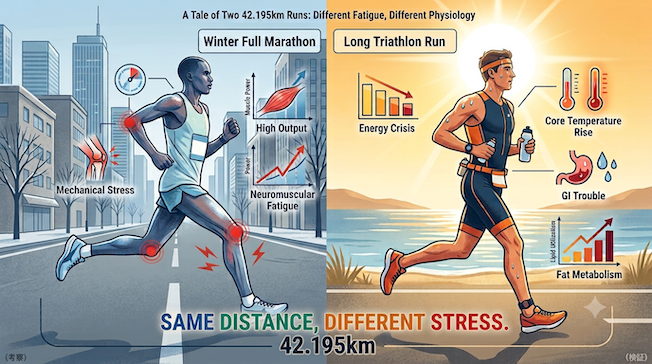
A standalone winter full marathon and the run leg of a long-distance triathlon both cover the exact same distance: 42.195 kilometers.
However, while a winter marathon is a race where you maintain a high cruising speed from start to finish in cool temperatures and endure relentless mechanical impact, a long-distance triathlon run is quite different. You begin the run after completing a 180km bike leg in a state of substantial accumulated fatigue—often, in many races, under much hotter environmental conditions—fighting continuous energy depletion, gastrointestinal stress, and a steadily rising core body temperature (metabolic stress).
It is easy to think, “Since it’s the same marathon distance, can’t I just apply my winter full marathon training directly to the triathlon run?” Yet, gathering information and experiencing middle-distance races firsthand led me to seriously question whether these two can simply be viewed along the same continuum.
Even though the distance is identical, why do your legs feel so different, and why is the nature of the suffering so vastly distinct between a winter marathon and a long-distance triathlon run?
Drawing on widely available data regarding long-distance triathlon runs and my own practical experience, I want to break down and organize how these two running disciplines differ.
1. Why Legs Fail in A Winter Marathon: Mechanical Stress and High Output
In a winter full marathon, you typically run at a high cruising speed in relatively cool temperatures. The most significant load placed on your body under these conditions is mechanical stress (landing impact).
As running speed increases, the mechanical demands placed on the musculoskeletal system generally increase as well. Ground reaction forces generated with each foot strike are repeated tens of thousands of times over 42 kilometers.
- High forward propulsion is required (pushing off the ground efficiently).
- Micro-damage to muscle fibers accumulates easily due to braking forces upon landing.
- Ground contact time is short, forcing muscles to generate high power instantaneously.
The unique sensation that hits after the 30km mark—where your legs feel locked up and won’t move forward an inch—can be partly explained by the accumulation of mechanical stress and neuromuscular fatigue. This reduces the muscle fibers’ capacity to sustain high power output under continuous landing impact. In short, the muscular endurance required in a winter marathon is the ability to maintain high output and withstand accumulating mechanical impact.
2. Characteristics of a Long-Distance Triathlon Run: Complex Stress and Driving Fatigued Muscles
On the other hand, what happens during a long-distance triathlon run after completing a swim and a 180km bike ride?
Most athletes start at a substantially slower pace than they would in a standalone marathon. Because the running speed is generally lower, the mechanical demands associated with each stride may also be lower. However, this does not mean a long-distance triathlon run requires less muscular endurance.
What a long-distance run demands is a different form of muscular endurance than a standalone marathon: the capacity to keep muscles—already heavily fatigued from a 180km bike ride—functioning efficiently over a prolonged duration.
While long-distance racing generally involves prolonged periods at relatively low aerobic intensities, often around or below the first lactate threshold (LT1), transient spikes in load occur due to rolling hills, headwinds, and pace changes, creating a battle against complex, multi-layered stresses:
- Energy Depletion Crisis: Muscle and liver glycogen stores may be substantially reduced by the end of the bike leg.
- Rising Core Temperature: Reduced thermal margin caused by hot environments.
- Central & Neuromuscular Fatigue: Central and neuromuscular fatigue may contribute to a progressive reduction in the ability to sustain output.
- Gastrointestinal Distress: Reduced organ function resulting from prolonged vibration and dehydration.
When I experienced middle-distance races like Nagaragawa and Suwako, I noticed that right after finishing the bike, my legs still felt functional. However, once I started running, unlike the feeling of physically breaking down experienced in a winter marathon, my entire body felt heavy, and I felt a unique inability to push the output higher.
Even in a relatively short middle distance, I strongly realized that rather than isolated muscular fatigue, overall bodily endurance and energy management were the keys. It is easy to imagine how much more critical these demands become in a full long-distance race.
In modern racing, managing thermal stress to preserve electrolyte and hydration balance, alongside fueling strategies to prevent late-race bonking, has taken on critical importance.
3. “Metabolic Strategies” and Training Science
What kind of scientific approaches do world-class athletes take toward these two disciplines? Let me share a few key observations.
- The Core Premise: Why VO₂max and LT2 Still Matter for Long-Distance PerformanceWhen looking toward a long-distance run, it is easy to fall into the trap of thinking, “Because long-distance triathlon is an LT1-dominant event, I only need to train low-intensity endurance.” However, looking at training data and elite performances, high-level athletes possess exceptional VO₂max, LT2 (second lactate threshold), and running economy. A high ceiling in VO₂max and LT2 is precisely what allows an athlete to sustain a higher absolute speed and power output at LT1. Rather than simply logging slow, long miles, the real challenge lies in building both a high physiological ceiling and the ability to sustain output over extended hours.
- Fueling Upgrades: 100–120g/hWhile it was long believed that carbohydrate absorption was limited to 60g–90g per hour, higher intake rates of 100g to 120g per hour are increasingly being explored and adopted at the world-class level, even during the run. To tolerate this volume without gastric distress, targeted “Gut Training” (adapting the digestive tract through daily training) has become an essential strategy.
- Addressing Cardiovascular DriftIn warm conditions, rising core temperatures and dehydration often trigger cardiovascular drift, where heart rate steadily climbs despite a constant pace. To manage this, strategies combining heat acclimation (gradually exposing the body to hot environments), cooling protocols, and targeted water and sodium management are widely utilized to reduce cardiovascular strain.
4. Specific Differences in Training Approaches
Recognizing these physiological differences highlights the need to adjust the emphasis of daily training depending on the target race.
- Training for a Winter Marathon: Developing Speed and DurabilityPreparing for a high-speed winter race centers on building durable, resilient legs capable of sustaining high running speeds and enduring accumulating landing impact.
- Tempo Runs: Improving the ability to sustain a high aerobic output near the lactate threshold (LT2).
- Marathon Pace Runs: Developing the ability to maintain race-specific speed and running economy over prolonged durations.
- Long Runs: Developing the durability needed to tolerate prolonged running and accumulated mechanical stress.
- Hill Training: Elevating raw muscular strength and stimulating the nervous system to generate efficient forward propulsion.
- Training for a Long-Distance Triathlon: Resistance to FatiguePreparing for a long-distance season shifts the focus to movement efficiency under fatigue and metabolic stability.
- Extended Zone 2 (L2) Base Building: Improving the ability to oxidize fat at submaximal intensities while preserving carbohydrate availability for late-stage demands.
- Immediate Brick Sessions (Bike-to-Run): Stimulating the neuromuscular system to transition smoothly from the movement patterns and muscular fatigue associated with prolonged cycling into running.
- Race-Simulation Training with Fueling and Heat: Simulating actual race paces (near LT1) while consuming planned nutrition to simultaneously improve gastrointestinal tolerance and heat tolerance.
5. Testing Theory Through Real-World Action: A Hypothesis for the Next Race
Thus far, I have outlined key strategies and physiological mechanisms. However, while sports science can help us form hypotheses, individual responses must ultimately be tested in real-world conditions.
Though I have gained valuable insights from middle-distance racing, whether these theories truly hold up under the uncharted waters of a full long-distance race remains to be verified.
The contents of this article represent a “hypothesis” I arrived at after studying current data, research, and global trends. How closely does this hypothesis align with my body under the extreme conditions of a full long-distance race? At my next race, the Sado Island International Triathlon, I plan to run the 42.195km while keeping this theory in mind, paying close attention to how my body actually responds over the full 42.195km.
Depending on the outcome, I look forward to sharing a post-race debrief and checking the answers against my real-world experience.
Summary: Annual Timelines Tailored to Discipline Characteristics
While a massive foundation of aerobic capacity and cardiorespiratory fitness, along with peripheral adaptations such as capillary density, remains common to both disciplines, the final focus you apply changes depending on the target race.
For a long-distance season, the goal is to develop a body capable of maintaining efficient movement under prolonged fatigue, managing core temperature and nutrition, and rhythmically driving fatigued muscles.
Then, keeping that broad aerobic foundation intact, you can pivot toward a winter marathon season by introducing higher-intensity workouts (LT2 tempo runs and marathon pace runs) to develop fast, durable legs capable of sustaining high output.
Even at the exact same distance of 42.195km, the factors most likely to limit performance differ drastically between a winter marathon and a long-distance triathlon. Because of this, rather than applying the exact same training program, the key is adjusting the capabilities you hone during the final preparation phase. With structured annual planning, marathons and long-distance triathlons can mutually reinforce one another, lifting your overall athletic performance to new heights.
コメント