
- 1. Introduction: Making the Golden Zone a Sustainable System
- 2. Challenging the 80/20 Rule: “Different Prerequisites Demand Different Optimal Solutions”
- 3. The Three Pillars of Training and Their Concrete Examples
- 4. The Four Ways to Increase Load: Following the Proper Order
- 5. Periodization is Not “Change,” It Is “Preparation”
- 6. The Flat Structure: A Reliable Foundation
- 7. Why You Must Not Rush the X-Session
- 8. Block Periodization and Progressive Progression
- 9. Intensity Management: Maintaining the Golden Zone
- 10. The Staircase of Periodization — The Climax of the Chapter: Sequencing Your Strength
- 11. Bakken’s Experience and the Essence of Chapter 5: Adapt Without Breaking
1. Introduction: Making the Golden Zone a Sustainable System
How should we manage the finite resource of training time? In much of contemporary training theory, the pursuit of performance improvement is dominated by a relentless drive for volume—accumulating massive mileage and escalating the intensity of stimuli to push the body harder. However, the problem Marius Bakken addresses in this final chapter is not one of superficial addition.
The central question is how runners should prioritize training stimuli when time is limited: which elements provide the greatest adaptation, and which can be reduced or removed.
Throughout the preceding chapters, we have explored the concept of the “Golden Zone.” Chapter 5 examines how to maintain and implement this philosophy while navigating the real-world constraints of daily professional life and familial responsibilities, scaling it down into a realistic weekly investment of four to six hours.
For the vast majority of runners, the initial years of training yield a smooth upward curve simply by establishing a consistent running habit. Yet, the moment a certain threshold is surpassed, runners inevitably encounter a wall where accumulating raw distance no longer yields the progress it once did.
This is precisely where practical criteria become necessary: deciding which sessions deserve limited time, and which elements should be cut away.
When structuring training within a tight window of four to six hours per week, if one prioritizes threshold work, eliminates the grey zone between easy running and threshold training, and ensures that easy days remain genuinely easy, high time-efficiency gains become achievable even on a constrained schedule. For most runners, sustaining this level year after year in a durable, repeatable manner is a highly sustainable choice.
The lesson is not simply about doing less training. It is about removing unnecessary training and concentrating resources on the stimuli that generate the greatest adaptation.
The training functions correctly, the body adapts and withstands the load, and a healthy balance with daily life is firmly preserved.
However, some readers may already find themselves dedicating six to eight hours or more per week to training, seeking a superior structure and periodization tuned specifically for competitive focus. Others may notice their recovery accelerating, their physiological response to load improving, and a surplus of physical capacity and desire for deeper training welling up.
Regardless of your current situation, pressing further into the pages ahead holds immense value. A deeper understanding awaits: how to construct training as volume increases, the mechanics of double thresholds, strict intensity management, and the architecture of periodization that functions as cumulative load intensifies.
2. Challenging the 80/20 Rule: “Different Prerequisites Demand Different Optimal Solutions”
The “80/20 rule,” widely cited across the endurance training world, often appears at first glance to be universally applicable—an unshakeable golden law for every runner. Its foundational premise is simple: accumulate a large volume of low-intensity training while adding a small dosage of high-intensity work, thereby suppressing excessive fatigue while securing adaptation.
In Bakken’s framework, however, a fundamental question is raised regarding this dogma:
“Can we apply the exact same distribution to an elite athlete capable of dedicating ten, fifteen, or twenty hours a week to training, and a recreational runner who can only carve out four to six hours from the realities of modern life?”
Bakken’s conclusion is that the answer depends on the athlete’s circumstances and available training time.
It is important to note that Bakken does not argue the 80/20 principle itself is inherently flawed. Rather, the underlying idea highlights a logical truth: when the total volume of training prerequisites differs, the optimal distribution derived from those prerequisites must necessarily change.
While an 80/20 distribution functions well in an elite environment characterized by massive volume, maximizing results within a tight four-to-six-hour window requires different preconditions. The fewer hours you have, the more critical it becomes to determine what to discard and what to retain. Bakken argues that applying the same distribution to a much smaller training volume may not always maximize the available stimulus, as dedicating a vast majority of limited time purely to low-intensity movement risks failing to accumulate the necessary threshold stimulus.
This is why Bakken’s framework advocates shifting time allocation toward the most cost-effective physiological territory—the threshold domain—rather than recklessly chasing intensity. This approach does not mean randomly injecting hard sessions. On the contrary, it is a strategy of continuously targeting the optimal zone capable of extracting structural adaptation within the boundaries of what the body can safely process.
Summarizing Bakken’s framework for runners operating within a four-to-six-hour weekly budget, the time distribution guidelines take the following shape:
- 60% to 65%: Pure, uninterrupted easy running
- 20% to 30%: Threshold training
- 5% to 10%: High-intensity training
This deliberate shift toward a higher proportion of threshold work is intentional. Concentrating your finite time on the domain yielding the highest return on investment forms a core concept of this methodology.
3. The Three Pillars of Training and Their Concrete Examples
To consistently secure performance gains within a restricted time frame, one must delineate the pillars of the training structure. Every single session exists to support three critical pillars:
- Main Quality Session: The structural core of the training week, composed of extended intervals designed to elevate sustained capabilities.
- Support Quality Session: A complementary session built from shorter threshold blocks or interval structures like 45/15s.
- X-Session: A specialized session carefully selected and varied according to individual goals and current adaptation levels.
Every element outside of these three pillars is supplementary; within a constrained schedule, there is little margin to spare on wasteful sessions. The objective is not to inflate the number of workouts, but to imbue each limited session with a clear purpose.
How do these sessions manifest concretely within a four-to-six-hour weekly framework?
- Example of a Main Quality Session: Centered around relatively long threshold bouts, such as four to five repetitions of 10-minute intervals, designed to improve the ability to sustain a high aerobic workload while managing lactate production and clearance.
- Example of a Support Quality Session: Utilizing structures like 45/15s (45 seconds of high-intensity work paired with 15 seconds of incomplete recovery) or consolidated 6-minute intervals, stimulating the cardiovascular and muscular systems from a distinct angle.
- Example of an X-Session: Incorporating hill climbs, running workouts dialed to specific race paces, or targeted stimuli carrying an elevated degree of mechanical stress.
The critical rule here is never to let the X-session usurp the center of gravity. Many runners possess a psychological preference for high-stimulation workouts—the X-session elements. Yet, within this architecture, the X-session is an advanced stimulus meant to sit atop a foundation.
4. The Four Ways to Increase Load: Following the Proper Order
When progressively escalating training load, there exist clear rules and sequences. Ramping up intensity or volume without following a methodical hierarchy is a primary catalyst driving runners into injury and stagnation:
- Cautious Double Thresholds: Introduced sparingly, perhaps utilizing weekends, only after ensuring the body possesses robust structural resilience. This is not an immediate requirement for the standard four-to-six-hour runner.
- Increasing Easy Volume: Raising the foundational floor through an increment of easy running.
- Extending Threshold Intervals: Opting for longer continuous threshold bouts when physiological signals and recovery metrics are positive.
- Introducing Special Sessions: Deploying variations that combine familiar elements in fresh sequences.
Violating this order—rushing high-intensity elements or specialized workouts to the forefront—is a trap that consigns ambitious runners to chronic breakdowns and plateaued fitness.
5. Periodization is Not “Change,” It Is “Preparation”
Before diving into the varied iterations of training structures, it is helpful to examine the essence of periodization. At its structural core, periodization is a mechanism designed to plan training in weekly blocks to preempt chronic overload. Rather than executing the exact same training routine indefinitely or grinding oneself to the edge week after week, periodization means strategically fluctuating the load.
It allows us to view distinct training phases as components of a long-term architecture, each carrying a precise objective. Yet, transitions should not be abrupt. They must remain anchored to foundational principles.
The human body adapts to training through repeated exposure to stress, yet avoiding performance stagnation requires a measured degree of appropriate variation. Crucially, allowing physiological adaptations time to lock into tissue requires periods where load is intentionally pulled back. Without an overarching plan, development can decay into stagnation, or overtraining culminating in injury.
Simultaneously, variation does not demand sweeping overhauls. Every change carries an inherent transition cost, and therefore elevates injury risk. Consequently, variation must be balanced against the primary objective: executing the highest possible volume of quality threshold training supported by adequate easy mileage, without drifting off course.
6. The Flat Structure: A Reliable Foundation
While macro-level training planning depends on the horizon of competitive goals, one of the straightforward paths to begin with is a relatively flat structure—one where training content does not fluctuate wildly from week to week. This is known as a flat training structure.
The advantage of such a uniform structure lies in the minimization of phase transitions. The body attunes to the rhythmic cadence, and because threshold training serves as a constructive stimulus, steady forward momentum is achieved without constantly reshaping the program month after month. Consequently, both the risk of injury and the threat of stagnation can be kept low compared to complex periodized models.
This model is suited for individuals who may not harbor fierce competitive ambitions, yet seek to maintain a high level of general fitness and an injury-free daily existence. It weaves into the demands of a busy lifestyle while supporting continuous progress.
Complement this flat foundation with a single, fixed quality session every 7 to 14 days, and you possess an architectural blueprint that is straightforward to execute, sustainable across time, and reliable in its delivery of progressive fitness. However, if your ambitions demand sport-specific preparation for targeted events, other structural approaches are available.
7. Why You Must Not Rush the X-Session
While the X-session represents a distinctive weapon in Bakken’s framework, readers often encounter two core questions: What does such a session actually look like? And when should it be introduced?
An X-session is not simply synonymous with the fastest possible workout. It is a variable stimulus tailored to current objectives and racing demands—not the core pillar of the structure, but an advanced stimulus built upon a foundation of consistent training.
From this perspective, a training paradox emerges:
- The Conventional Mindset: When the body feels heavy, when form feels flat, or when times stagnate, humans instinctively conclude that there is a lack of stimulation. They react by injecting faster intervals, harsher workouts, and high-intensity variations.
- Bakken’s Perspective: When everything feels leaden and progress stalls, it is rarely a sign of insufficient stimulation. Rather, it is a signal that the body has failed to assimilate the current load—that footing has been lost by over-relying on premature intensity. The solution is not to force intensity higher; it is to return to the principles of the Golden Zone (threshold and easy running) and rebuild from the bedrock up.
When viewed through this lens, the correct timing for introducing an X-session reveals its delicacy.
Bakken suggests a cautious approach regarding the timing of its deployment. First, construct a muscular foundation through months of threshold and easy running discipline. Only when that foundation is stable should you consider appending the developmental stimulus of an X-session. In short, the X-session is not the starting point of growth; it is an instrument used to translate a pre-existing reservoir of capacity into race-specific performance.
The Flat Structure with Progressive X-Sessions
One approach is maintaining a flat training structure throughout a foundational phase while progressively sharpening the X-session as competition draws near. Eventually, actual races assume the mantle of this high-intensity slot.
You accumulate weeks of similarity while building the framework. Main and support quality sessions remain steady. The locus where progression occurs is the X-session, which evolves over time to mirror the physiological demands of your target event.
In its infancy, the X-session manifests as a hill interval, slowly escalating in duration and steepness. As competition draws near, it shifts to speed development on flat tarmac, culminating in distance extension. In the final weeks preceding the race, the session transforms into a race-specific execution.
Under this model, utilizing demanding X-sessions allows you to sculpt the load into a shape resembling race day. If you choose this structural archetype, experience dictates an ideal safety measure: sandwiching the X-session between two consecutive easy days.
The Flat Structure with Periodic Race Paces
A popular variation of this methodology adapts the Norwegian framework for recreational runners. The classic structure here is built upon three threshold sessions, three easy runs, and a slightly elevated stressor deployed every four to six weeks in the form of a test run or a race.
Within this framework, workouts are categorized into a long interval session utilizing approximately 10-minute efforts, another long interval session utilizing roughly 6-minute repetitions, and an interval session built around 3-minute blocks.
Every interval is executed within the sub-threshold domain—maintaining blood lactate values between 2.5 and 3.5 mmol/L, safely below the traditional 4.0 mmol/L threshold marker. Periodic test runs or competitive races serve the controlled role of periodically breaching that ceiling.
This variation is potent for runners prone to injury. The flat structure maintains safety while unlocking deep physiological adaptation because it allows the continuous accumulation of volume at the correct intensity week after week. For many runners, absolute focus on the correct training zones serves as an architect, tuning the musculoskeletal system until it can handle training stress.
8. Block Periodization and Progressive Progression
Regarding more dynamic structures, a discussion within endurance science centers on whether athletes should follow structured, block-periodized models. Both models can yield positive results when applied correctly.
An example of a structured and periodized model runs as follows:
- Two weeks featuring elevated training volume alongside selected double-threshold days.
- One week characterized by lighter training and a reduced total volume.
This model gives the body time to assimilate and structurally anchor the accumulated load, injecting variation into the training block in a manner that preserves motivation and prevents burnout. The objective is to absorb the volume and threshold density your body can tolerate before stepping down into a lighter recovery week featuring fewer sessions to shed residual fatigue.
An alternate strategy involves spending two weeks fixated on threshold work while keeping X-session intensity subdued, subsequently pivoting focus in the third week by reducing total volume and converting a portion of threshold work into two measured, high-intensity X-sessions. Because this path carries vulnerability, it must be approached with caution.
A third path is progressive progression unfolding across a training cycle. In marathon preparation, this translates to a methodical migration from 5K/10K specific work through half-marathon pace down to race-pace execution.
The governing concept is transitioning the training load fluidly from one phase to the next, steering toward an ultimate objective while ensuring the body retains the adaptations already locked into its physiology.
This approach exerts efficacy across a spectrum of race distances. Rather than dividing your calendar into discontinuous epochs, you systematically layer mileage and intensity across a canvas spanning many months, particularly for individuals whose daily lives impose professional burdens but grant windows of concentrated free time during specific calendar seasons.
9. Intensity Management: Maintaining the Golden Zone
The physical length of an interval dictates the pace you can sustain. Shorter intervals permit a velocity higher than true threshold pace for the exact same perceived exertion. For instance, blind adherence to a calculator during 10-minute intervals can drag your pace 7 to 10 seconds per kilometer faster than your actual lactate threshold dictates. As interval durations compress, downward adjustments to speed are required.
Across the training week, maintaining focus on executing the correct intensity—avoiding drift outside the Golden Zone—is what generates uninterrupted athletic growth.
10. The Staircase of Periodization — The Climax of the Chapter: Sequencing Your Strength
Deciding which periodization model to embrace requires assessment of personal lifestyle and biological response:
- Flat Structure: Optimal for those who prefer predictability, whose annual training schedule is restricted, or who break down easily and require a stable load. It is also a framework for mastering true threshold pacing without unnecessary hazard.
- Short-Term Periodization: Best suited for seasoned runners who adapt to variance and seek a dynamic training rhythm.
- Long-Term Periodization: Ideal when life’s external demands fluctuate across the year, or when targeting a specific peak months down the line.
Regardless of the structural archetype selected, consistency triumphs over complexity. A simple plan you can execute to completion is superior to a masterpiece of periodization that proves too difficult to survive.
No matter how sophisticated the periodization model, it is worthless if it sidelines you with an injury. Particularly as you step up your volume toward the four-to-six-hour weekly threshold, the accumulated mechanical toll is notable. When driving off the ground, forces multiplying your body weight crash down through your frame thousands of times per hour, leaving an imprint on muscles, tendons, and joints. Consequently, any experimentation with periodization must be shadowed by vigilance toward the early warning signs of systemic overload.
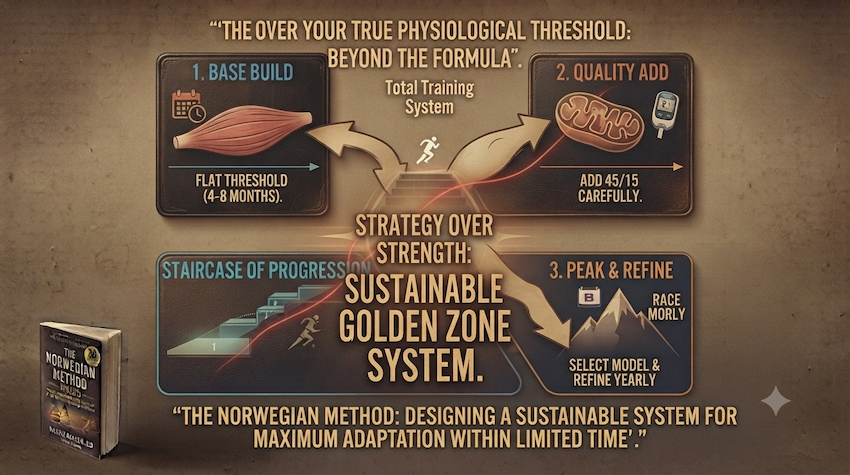
Here, we arrive at the climax of this chapter—the central philosophy coursing through the series: The Staircase of Periodization.
The message delivered here is that to elevate your capacities, the sequence in which you introduce stimuli matters more than the variety of the stimuli themselves.
In other words: do not get the order of building strength wrong.
Countless runners experience a surge in fitness, panic with impatience, tack on high-intensity stimulus, and self-destruct beyond their processing capacity. The biological staircase for ascending toward mastery is defined as follows:
- Flat Threshold: Maintain a flat threshold structure for an extended period before progressing, consisting of threshold training interspersed with easy days. Variations exist, but they are confined within the threshold domain. The objective is to forge the best possible muscular starting point and condition the musculoskeletal system until it becomes capable of handling greater training stress.
- The Addition of 45/15s: Retaining the flat structure as your bedrock, cautiously introduce a single 45/15 X-session. Methodically ratchet up the intensity of these blocks, ideally ensuring each interval runs fractionally faster than its predecessor. Over time, this organically bleeds into work residing beyond the threshold boundary.
- Experimentation: Launch systematic experiments deploying dynamic X-sessions, cautiously testing sport-specific periodization. The point is to compare these against your baseline flat structure to evaluate which paradigm extracts adaptation from your unique physiology.
- Model Selection: Commit to the model that demonstrates compatibility with your body. Prioritize long-term injury-free continuity, perpetually contrasting your flat and periodized iterations.
- Maintenance and Refinement: Refine and sustain your upward trajectory year after year.
Every step is built upon the foundation of the stable muscular platform constructed directly beneath it. Only when your current level feels natural—when your body has completely digested the load—should you plant a foot upon the next step of the staircase.
11. Bakken’s Experience and the Essence of Chapter 5: Adapt Without Breaking
Bakken describes experiencing this problem himself during his competitive career. A period of excessive focus on high-intensity intervals led him to reassess the importance of threshold training and sustainable load management.
The lessons of that experience shaped the philosophy anchoring this chapter:
When your form dips, chasing more intensity is rarely the answer.
When everything feels leaden and sluggish, pulling back—returning to the roots of the Golden Zone (threshold and easy running)—stands as a safe and effective path forward.
Throughout Chapter 5, Bakken reiterates a truth: the futility of chasing novel stimuli within a restricted schedule, and the superiority of precisely executing high-value stimuli, day after quiet day, with consistency.
Viewed across the horizon of a lifetime, the greatest training is never the one that causes the most agony. It is the structure that selects the stimuli your body can digest, stacking them across the years in a seamless architecture that allows you to reach your long-term performance potential.
Note:
This article provides an independent interpretation and discussion of the training concepts presented in Marius Bakken’s The Norwegian Method Applied. It is intended to help readers better understand the ideas behind the Norwegian Method and is not a reproduction of the original text.
Previous Post


コメント