
Prologue: “The Two Horses” as the Ultimate Conceptual Shift
Throughout the first part of Chapter 6, we established that the Norwegian Model is not merely a collection of workouts, but a design philosophy to be applied to the complex reality of the living human being. The strict adherence to frameworks, the essence of distance-specific adaptation, the accumulation of adaptations within the 100-day plan, and intellectual integrity regarding genetic limits all served as the foundation for maximizing trainability.
Yet, the true core of Chapter 6—and one of the most distinctive concepts in Marius Bakken’s endurance framework—is encapsulated in the concept of “The Two Horses” explored in this second part.
For years, mainstream sports science and traditional coaching have treated training as a quantitative and qualitative war of attrition revolving around the question of how much stress to apply and how to recover. The prevailing paradigm poured all resources into pushing up VO2 max. Repeating high-intensity intervals multiple times a week, pushing heart rates to the limit, and enduring sessions saturated with lactate were long believed to be the royal road to speed.
As a medical doctor who treated his own body as a laboratory, Bakken confronted a critical contradiction in this traditional framework. Why do elite runners who execute ferocious VO2 max intervals—yielding world-class maximal oxygen uptake numbers—collapse in the closing stages of a half marathon or marathon? Why does the phenomenon of “the energy system suddenly breaking down in the second half of a race despite brilliant training times” occur incessantly even among the elite?
Traditional coaching brushed these questions aside with superficial explanations such as “glycogen depletion” or “insufficient strength.” Bakken, however, recognized that the problem lay much deeper—in an inherent error within the adaptive structure of human energy systems.
The following sections unpack the intellectual process through which Bakken came to question conventional sports science and arrive at this framework.
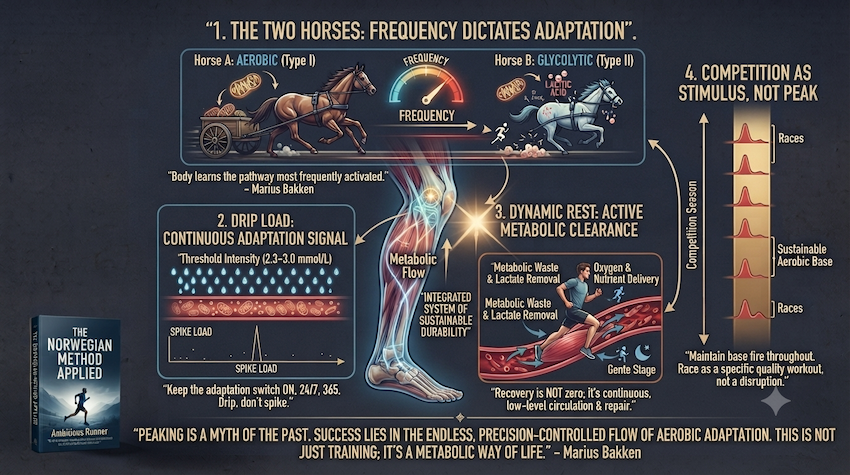
1. The Two Horses: How Repeated Training Shapes Metabolic Preference
The starting point for Bakken’s concept of “The Two Horses” was a profound skepticism toward traditional high-intensity periodization.
Conventional athletics wisdom dictates that as a season approaches, intensity should be stepped up gradually, culminating in high-intensity intervals near the VO2 max or anaerobic zones to build race-specificity. Driven partly by a grit-oriented culture asserting that “only those who endure brutal training can win,” many athletes subject themselves to severe oxygen deprivation two to three times a week.
From a biochemical perspective, however, Bakken recognized a critical flaw in this approach. Repeatedly bombarding the body with high-intensity stimuli forces the primary driver of energy metabolism to shift toward glycolysis—a high-output, carbohydrate-dependent pathway that generates vast amounts of lactate and hydrogen ions as byproducts. When this pathway becomes dominant, the enzymes optimized for it are upregulated within the cells.
This led Bakken to a fundamental question: If the body learns the metabolic patterns we practice daily and adapts accordingly, what happens to the runner who repeatedly taxes their glycolytic system week after week?
He realized that biological systems do not deftly switch gears between aerobic and anaerobic states at will. The body responds not only to the intensity of individual sessions, but also to the frequency and cumulative pattern of the stimuli it repeatedly encounters.
At the cellular level, repeated training stimuli influence the balance of signaling pathways involved in energy metabolism and adaptation. The important point in Bakken’s framework is not the response to a single session, but the cumulative pattern created by repeated exposure. When glycolytic stimuli are repeated at high frequency, the organism prioritizes carbohydrate-dependent adaptations, potentially disrupting the optimal balance with lipid oxidation capacity and endurance efficiency.
In short, the body learns a specific lesson: “This organism is repeatedly exposed to high-demand environments where it must rapidly consume carbohydrates and process lactate. Therefore, rather than expanding capillary networks or optimizing lipid oxidation, the body adapts to prioritize rapid carbohydrate breakdown.”
This is the underlying reason why runners who chase VO2 max display overwhelming speed in training yet experience sudden energy failure during prolonged efforts like half marathons or marathons. Their time and energy have been spent training the glycolytic horse rather than the aerobic horse.
To grasp the essence of endurance training, Bakken employed the metaphor of “Two Horses.” Naturally, actual human metabolism is far more complex, involving countless interwoven pathways. Yet the biological reality remains indifferent to human idealisms. The body is not a democracy; cells respond to the physical history of which metabolic pathway has been operated how many times over the preceding weeks.
Whip the glycolytic horse repeatedly, and the aerobic horse is driven into the corner, eventually forfeiting metabolic dominance. Conversely, if you repeatedly hammer the lactate threshold boundary (2.0 to 3.0 mmol/L)—the zone just before glycolysis becomes dominant—with consistent frequency, the body is repeatedly exposed to a stimulus that favors aerobic metabolism, encouraging adaptations associated with mitochondrial function, oxygen delivery, and oxidative metabolism.
Bakken placed threshold training at the center of his model because he viewed it as a powerful way to repeatedly reinforce the aerobic system.
2. Drip Load: The Philosophy of Maintaining the Aerobic Stimulus
Having concluded via the Two Horses principle that the aerobic system must remain the primary focus, Bakken faced a new hurdle: How to anchor this aerobic adaptation signal within the daily training schedule so that it is not constantly interrupted by prolonged gaps between hard sessions.
Traditional training theory treated workouts as discrete “events.” A typical schedule might feature a long run on Monday, intervals on Tuesday, rest on Wednesday, and a tempo run on Thursday. Coaches felt satisfied after executing a “good stimulus,” and athletes waited for fatigue to clear before the next hard session.
Bakken questioned this premise of intermittent alternation between stimulation and rest. Why do runners hit a plateau in foundational aerobic capacity despite such diligent key workouts?
The answer lay in the fact that human biological systems respond continuously to ongoing patterns. No matter how intense Sunday’s intervals were, spending the subsequent days in complete rest or minimal activity signals to the body that the high-demand environment has ended, causing adaptation signals to wane. Weekly or bi-weekly intense stimuli risk being isolated events rather than sustained drivers of change.
Drawing inspiration from pharmacokinetics in medicine, Bakken approached this like a drug delivery mechanism. Delivering a medication in a single massive bolus risks acute side effects, followed by a rapid spike and subsequent disappearance of the drug from the bloodstream, interrupting therapeutic efficacy. Continuous therapeutic effect requires a “drip.” By continuously delivering minute quantities of active ingredients without interruption, blood concentration can be maintained within a desired therapeutic range.
Bakken applied this to training, giving rise to the philosophy of “Drip Load.”
He concluded that training is not merely a competition over the magnitude of a single stimulus. Rather, ensuring that adaptation signals remain consistent is a priority.
Consequently, he integrated split double-thresholds and clean threshold sessions distributed regularly across the week. Per-session load is kept manageable, strictly controlled so that blood lactate remains within the 2.0 to 3.0 mmol/L range. This managed, controlled metabolic stress is woven into the daily routine.
Without excessively damaging the central nervous system, causing excessive tissue inflammation, or triggering glycolytic runaway, the underlying aerobic stimulus is kept recurrent rather than being allowed to disappear between isolated training sessions. The essence of Drip Load is not about crushing oneself, but about maintaining a consistent, sustainable training stimulus over time.
3. Dynamic Rest: Integrating Recovery into the Process of Adaptation
As Bakken implemented the Drip Load philosophy, a natural concern arose: Would continuous daily loading eventually overwhelm the body with cumulative fatigue?
Conventional training theory naturally concludes with complete rest days to let the body recover, cementing the dogma that rest sits at the polar opposite of training.
Bakken’s approach challenges the idea that recovery must always mean complete inactivity. In his framework, appropriately low-intensity movement can serve as part of the recovery process while maintaining continuity in the training system. He viewed biological systems as a dynamic flow rather than a rigid binary of work and stop.
During complete rest, metabolic waste products or tissue repair byproducts generated by heavy sessions can sometimes linger due to reduced physical activity and slower local circulation. Runners often wake up feeling heavy and sluggish after a complete rest day—a byproduct of sluggish metabolic circulation rather than optimal recovery.
Bakken’s solution was “Dynamic Rest.” Its core philosophy can be summarized as follows:
Recovery is not about resting, but about never stopping adaptation.
We are accustomed to the mindset of stopping when tired. Bakken’s framework suggests that the body can recover more effectively by maintaining light movement that keeps metabolism circulating. Thus, recovery runs were never performed merely because training could not be skipped; they constituted training in the form of recovery.
The day after a grueling double-threshold or between heavy sessions, Bakken incorporated recovery runs at the lower end of Zone 2 with minimal metabolic stress, alongside cross-training to support recovery.
This light exercise encourages circulation through capillary networks, assisting the clearing of metabolic waste products while delivering necessary nutrients to active tissues.
Thus, Drip Load and Dynamic Rest are not separate, isolated menus. They form an uninterrupted circulatory circuit: turning over metabolism while applying load, and keeping the aerobic framework active while facilitating recovery.
For Bakken, a training year is not a collection of fragmented puzzle pieces, but a continuous flow. Navigating this current while controlling intensity and volume is the true essence of Dynamic Rest.
4. Competition Season Strategy: Abandoning the Peak Illusion to Maintain the Base
As the competitive season commences and rigorous races arrive nearly every weekend, most runners and coaches succumb to a panic-driven urgency: “How do we peak and align 100% of our conditioning for a single race day?”
Standard textbooks dictate entering a tapering phase three weeks prior to a race, reducing volume, and shedding fatigue to recover explosive power. Many athletes follow this faithfully, cutting out hard workouts days prior and relying solely on complete rest and light tapers.
Yet, if we examine the reality of world-class elite runners and top athletes who consistently accumulate points throughout the year, do they truly peak only once or twice a year? No; they compete with astonishing frequency throughout the season while maintaining elite-level performance.
How is this possible? Why can they race nearly every weekend without breaking down?
The secret lies in their strategy of preserving the underlying structure of threshold-oriented training rather than abandoning it, rather than chasing a single, isolated peak.
Bakken harbored reservations against the potential drawbacks of traditional tapering. While acknowledging that appropriate tapering can elevate performance, he recognized the risk of severing the continuity of aerobic stimulus frequency. Consequently, runners relying heavily on traditional rapid tapering often experience light legs prior to the race, only to watch their aerobic energy supply engine falter during the race itself.
Bakken’s competition season philosophy viewed training as a continuous process rather than a strict sequence of preparation followed by a single peak.
Even after entering the competition season, Bakken sought to preserve the underlying structure of threshold-oriented training rather than abandoning it entirely. To him, a race was not a special sanctuary that interrupted the training process; it was an extension of high-quality key workouts designed to verify the current attainment level of his aerobic foundation and provide high-level stimuli.
Therefore, even amid a grueling racing calendar, basic training principles continued. Even on the day before a race, complete rest was often avoided in favor of pristine easy runs or brief strides to keep the metabolic engine warm. Because the race itself functioned as a high-intensity stimulus, there was no need to artificially inflate training volume, but the framework of foundational threshold sessions was preserved.
This strategy helps prevent performance volatility across the year while sustaining high competitive standards. Wild fluctuations—running a stellar time one weekend followed by an inability to run due to fatigue—are suppressed, maintaining stable readiness from season-open to season-close.
Rather than letting a peak flare up like a firework and burn to ash, the season itself is maintained as a consistent, sustainable process. This represents a strategic approach for ambitious runners aiming for high-level competition.
Conclusion: Threshold Training as a Way of Life
The philosophy underpinning this book is not merely a technical definition of “threshold.” It is a fundamental training principle: Recovery is not about resting, but about never stopping adaptation.
- The Two Horses teaches us what the body adapts to.
- Drip Load teaches us how to prevent that adaptation from lapsing.
- Dynamic Rest teaches us how to turn recovery into an extension of adaptation.
- Competition Season teaches us how to sustain that adaptation across a full year.
In short, Chapter 6 does not present four disparate theories; it views a single philosophy—maintaining adaptation—from multiple angles.
The body is shaped not by what it does once, but by what it repeats. Training is therefore not a heroic single effort, but an intelligent design that keeps adaptation alive.
Chapter 6 does not teach new workouts; it explores how to guide the body’s physiological development. Once you grasp the “What,” master the “How,” and arrive at the truth of the “Why” (the design philosophy), training ceases to be an agonizing obligation. It transforms into an intellectual endeavor to converse with and guide the adaptation of your own body.
Equipped with the proper philosophy and mindset, we take our next steps toward our ultimate goal: understanding and shaping our physical capabilities with greater precision. Guided by the lessons of Chapter 6, our journey now advances into Part III—the realm of empirical data and scientific evidence.
Note:
This article provides an independent interpretation and discussion of the training concepts presented in Marius Bakken’s The Norwegian Method Applied. It is intended to help readers better understand the ideas behind the Norwegian Method and is not a reproduction of the original text.
Previous Post

コメント