


Author’s Note: This article starts from established physiological facts and builds out potential training applications, personal observations, and hypotheses. Please note that topics such as “High VLamax and individual metabolic responses” or “The exact periodized roles of pace runs versus threshold intervals” do not yet have a single, universally settled standard in sports science. Please read this as a conceptual framework for thinking about your training.
In an era where sports science and exercise physiology information is readily accessible, how should distance runners design their daily training programs? Traditional adages—such as “Build a solid stamina base first with pace runs” or “Push hard with short intervals to build speed”—appear perfectly logical on the surface.
However, when we take a deeper look at how the body generates energy at a cellular level, we begin to realize that exercises done with the best intentions might actually deliver a metabolic stress very different from what was originally intended.
Is the pace run truly an indispensable foundation that every runner must start with?
When and for what explicit purpose does a pace run become necessary?
By examining the frequently misunderstood interplay between the glycolytic system (anaerobic glycolysis) and the aerobic system (oxidative system), and by leveraging the concept of VLamax (maximal lactate accumulation rate)—a metric often invisible through superficial pace numbers alone—we will explore a framework for structuring training for middle- to long-distance runners and endurance athletes.
- 1. Re-establishing the Fundamentals of Energy Systems
- 2. Glycolysis and Aerobic Metabolism: Conflict or Cooperation?
- 3. VLamax and Individual Differences in Metabolic Response
- 4. Pace Runs vs. Threshold Intervals: Not Better or Worse, but Different in Purpose and Timing
- 5. Weekly Schedule Design and Structuring the “Moderate Run”
- 6. Conclusion: When Does a Pace Run Become Necessary?
- References
1. Re-establishing the Fundamentals of Energy Systems
To begin, let us review the foundational science regarding how the human body resynthesizes adenosine triphosphate (ATP) during exercise.
Energy Pathways Are a Spectrum, Not a Relay Race
Older simplified models often presented the three energy systems as a relay race: the ATP-PCr (phosphagen) system fires first, followed by the glycolytic system, which then hands over the baton to the aerobic system.
Modern exercise physiology, however, demonstrates that all three systems operate simultaneously from the very first instant of movement. The difference lies merely in the relative contribution—the “spectrum” or “gradient”—which shifts depending on exercise intensity and duration.
- ATP-PCr System: Generates explosive power output and provides a major source of energy during the first few seconds of high-intensity exercise.
- Glycolytic System: Breaks down glucose or glycogen to rapidly resynthesize ATP, though its duration remains limited.
- Aerobic System: Uses oxygen inside the mitochondria to resynthesize large amounts of ATP. It responds more slowly initially, but provides high long-term sustainability.
Don’t Confuse Maximal Speed with Glycolytic Power
A critical distinction to make here is that maximal top speed over short distances must not be conflated with glycolytic power itself.
Suppose a runner improves their maximum sprint speed or top-end velocity over 100 meters. This adaptation is largely driven by neural recruitment, muscle-tendon stiffness, stretch-shortening cycle (SSC) dynamics, running economy, or phosphagen system capacity. An increase in maximum speed does not automatically imply an increase in glycolytic enzyme activity or maximal lactate production rate (VLamax).
While improving early acceleration or explosive output might make maintaining a submaximal pace feel subjectively easier due to a lower relative intensity, it is not synonymous with increasing the “engine displacement” of the glycolytic system. Separating these two phenomena is a prerequisite for the analysis that follows.
2. Glycolysis and Aerobic Metabolism: Conflict or Cooperation?
In training discourse, the relationship between these systems is often framed as a strict trade-off: “Training the glycolytic system ruins aerobic capacity,” or “Too much aerobic work destroys speed.” From a biochemical standpoint, however, the relationship is far more multidimensional.
Lactate Is a Vital Metabolic Intermediate and Fuel—Not a Waste Product
Lactate was once vilified as a cause of fatigue or a “metabolic waste product.” Contemporary physiology has thoroughly dismantled this view: lactate is an essential metabolic intermediate and a valuable energy fuel.
Lactate produced during high-intensity exercise is transported via the blood and interstitial space to highly oxidative muscle fibers, cardiac tissue, and other organs. There, it is converted back into pyruvate and utilized within the mitochondria for oxidative phosphorylation—a mechanism known as the lactate shuttle.
In short, a clear cooperative relationship exists where the oxidative (aerobic) system receives and recycles the end products generated by the glycolytic system.
Production Rate vs. Systemic Clearance and Utilization
Why, then, can excessive high-intensity training lead to substantial lingering fatigue and make it more difficult to maintain sufficient aerobic training volume and quality?
This occurs not because lactate itself is inherently harmful, but because when production outpaces utilization and disposal, lactate can accumulate in the blood and tissues.
Furthermore, high rates of ATP turnover increase the net release of $\text{H}^+$, and when the rate of $\text{H}^+$ accumulation exceeds the muscle’s capacity to buffer and regulate it, intramuscular pH can fall. When this metabolic strain and neural fatigue become chronic, maintaining the required volume and quality of aerobic training becomes difficult, potentially stalling long-term physiological adaptation across the entire training system.
3. VLamax and Individual Differences in Metabolic Response
Now let us examine VLamax (maximal lactate accumulation rate). VLamax (maximal lactate accumulation rate) is an estimate of the maximum rate at which lactate accumulates following a brief maximal effort and is used as an indicator of maximal glycolytic power.
High VLamax Is a Potent Weapon Depending on the Event
First, it is vital to emphasize that a high VLamax is not an inherently negative trait. In events like the 800m or 1500m, or during explosive surges and sprint finishes in road races, strong glycolytic power can be an important contributor to performance.
Its role shifts depending on the race distance:
- 800m Runners: High glycolytic capacity makes an important contribution to performance.
- 1500m to 5000m Runners: Requires a high-level balance between glycolytic power and aerobic capacity.
- Marathon and Long-Course Triathletes: A lower VLamax may be advantageous in some marathon and long-course endurance contexts, particularly where economical substrate use at submaximal intensities is important.
The issue is never whether a high VLamax is “good” or “bad,” but whether an athlete’s individual metabolic profile aligns with their target event and current training objectives.
Metabolic Individualization (Author’s Hypothesis)
VLamax is an indicator of maximal glycolytic capacity and does not directly measure glycolytic reliance at low exercise intensities. Nevertheless, it is worth considering that athletes with high glycolytic power (high VLamax) may experience noticeably different internal metabolic stress and recovery demands compared to athletes with lower VLamax—even when running at the exact same external pace.
For an athlete with a high glycolytic capacity, even a structured threshold interval session can trigger substantial intracellular perturbation and metabolic stress. Consequently, for such athletes, the adaptation gap that needs to be plugged by continuous pace runs may actually be relatively small.
When aiming to develop aerobic capacity, deciding how to balance VLamax and selecting appropriate workout modalities requires careful evaluation of these individual metabolic responses.
4. Pace Runs vs. Threshold Intervals: Not Better or Worse, but Different in Purpose and Timing
Building on these physiological principles, we arrive at the core question: how should we distinguish between pace runs (continuous runs) and cruise intervals (threshold intervals)?
Challenging the “Pace Run First” Dogma
A prevailing convention in coaching has been to place continuous pace runs (20–30 minutes) as the initial foundation, only transitioning to structured intervals later in the macrocycle.
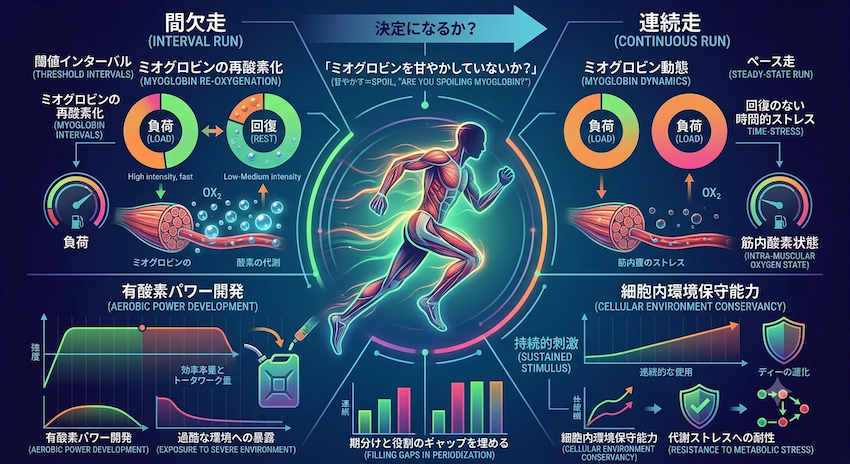
However, this is only one potential methodology. If an athlete with a high VLamax and an undeveloped aerobic base attempts long continuous pace runs too early, they risk losing metabolic equilibrium midway through the session. What was intended to be a controlled aerobic stimulus may instead produce a greater metabolic strain than intended.
Rather than viewing the pace run as an absolute prerequisite for every runner, it is more practical to treat it as one option among many—one whose necessity varies depending on the athlete’s metabolic profile, training phase, and weekly high-intensity tolerance.
The Advantages and Distinct Stimulus of Threshold Intervals
When the primary objective is to build aerobic capacity safely and efficiently, cruise intervals (threshold intervals)—such as 1000m or 2000m repeats with short rest periods (e.g., 60 to 90 seconds)—can offer a practical alternative.
These short pauses do not reset the body’s metabolic state. Rather, they can provide partial recovery from fatigue, making it easier to accumulate a substantial total volume of work at or near threshold intensity.
That said, running continuously at threshold intensity (a pace run) versus running intermittently with short recovery periods (threshold intervals) may create different temporal patterns of physiological stress and may lead to different adaptations. However, direct evidence comparing precisely matched threshold protocols remains limited. The question is therefore not simply which format is superior, but what type of stimulus each format is intended to provide.
5. Weekly Schedule Design and Structuring the “Moderate Run”
Even the most sound workout concept will backfire if it disrupts the balance of the overall weekly training microcycle.
Weekly Load Management and the Moderate Slot
Many runners lack the recovery capacity to absorb three hard, high-intensity sessions per week. For these athletes, a weekly structure consisting of 2 High-Intensity Sessions + 1 Moderate-Intensity Session provides a sustainable framework.
It is precisely within this “1 Moderate Session” slot that a controlled, sub-maximal pace run finds genuine utility.
When executed not to exhaustion, but at a controlled, moderate pace for a fixed duration, a pace run can provide additional aerobic work without necessarily creating the same level of fatigue as a maximal or very high-intensity session.
Preventing “Hidden High-Intensity” Workouts
A major pitfall to guard against is the “hidden high-intensity run”—where a session intended to be moderate unintentionally escalates into a hard workout.
If the target pace is set too aggressively, or if drift in heart rate and Rate of Perceived Exertion (RPE) occurs during the second half, the session crosses the line from moderate to high intensity. This compromises recovery and impairs the quality of subsequent key workouts.
When incorporating a pace run as a moderate session, strict monitoring of heart rate, respiratory stability, and RPE is essential to ensure the intensity remains strictly within its designated boundaries.
6. Conclusion: When Does a Pace Run Become Necessary?
To return to our core question—When is a pace run actually required?—here is a working hypothesis:
- Traditional View: Pace Runs (Base Building) $\rightarrow$ Threshold Intervals / High-Intensity Workouts (Quality Progression)
- Proposed Hypothesis: Threshold Intervals (Safely Accumulating Work Volume & Aerobic Development) $\rightarrow$ Pace Runs (Applied Later to Bridge Specific Gaps)
Under this framework, a continuous pace run is not an absolute prerequisite for threshold intervals; rather, it is a tool to be introduced after threshold intervals have sufficiently elevated aerobic capacity, specifically to address remaining performance gaps.
In practice, a pace run becomes particularly valuable under the following conditions:
- When Threshold Interval Volume Peaks:When an athlete reaches the upper limit of volume achievable through interval repetitions, transitioning the stimulus toward continuous running without rest breaks may help address adaptations that are not fully captured by interval-based training alone.
- When Sufficient Metabolic Margin Is Achieved:Once aerobic development has advanced relative to the athlete’s glycolytic profile, the athlete may have greater physiological headroom to sustain continuous running without generating more metabolic strain than intended.
- When Preparing for Race-Specific Continuous Stress:Continuous running may provide practice in tolerating uninterrupted running demands and may therefore be useful during race-specific preparation.
Training is ultimately not about arguing the absolute correctness of any single workout format. It is a design process: assessing an athlete’s current metabolic profile—the balance between aerobic capacity and glycolytic power—and determining which stimuli to introduce, and in what sequence, to drive continuous adaptation without overwhelming the system.
Moving beyond the reflexive “let’s start with a pace run” mindset and paying close attention to the internal metabolic responses of the body may help inform a more individualized training system.
References
- Brooks GA. Cell-cell and intracellular lactate shuttles. J Physiol. 2009;587(Pt 23):5591-600. PMID: 19805739
- Quittmann OJ. Maximal lactate accumulation rate (ċLamax): Current evidence and future directions for exercise testing and training. Eur J Appl Physiol. 2026. PMID: 41171430
- González-Mohíno F, González-Ravé JM, Juárez D, Fernández FA, Barragán Castellanos R, Newton RU. Effects of Continuous and Interval Training on Running Economy, Maximal Aerobic Speed and Gait Kinematics in Recreational Runners. J Strength Cond Res. 2016;30(4):1059-66. PMID: 26356481

コメント