
As we accumulate training session after session, does our body continue to grow stronger in direct proportion to the amount of training we perform?
When we face our daily training, we inevitably encounter this question at some point. On the one hand, there is a simple expectation that increasing training volume will make us faster and more resilient in proportion to the amount of work we do. On the other hand, we eventually encounter the limits of what the body can absorb, along with the frustrating feeling that fatigue is no longer fully clearing between sessions.
For endurance athletes who take their daily training seriously, and particularly for masters athletes who are trying to maintain or improve performance as they age, the conflict between “if I train more, I should become stronger” and the reality that excessive training can cause fatigue to accumulate and performance to deteriorate is a constant challenge.
When training time is limited, should we pursue more volume, or should we increase the quality of the stimulus and reduce the time required? This question lies at the heart of daily training design.
In sports science, the relationship between exercise duration and training effect has been examined in detail through the concept of the “dose-response” relationship.
Here, HIIT (High-Intensity Interval Training) refers to training that alternates bouts of high-intensity exercise with periods of rest or low-intensity exercise. MICT (Moderate-Intensity Continuous Training), on the other hand, refers to continuous exercise performed at a moderate intensity for a given duration.
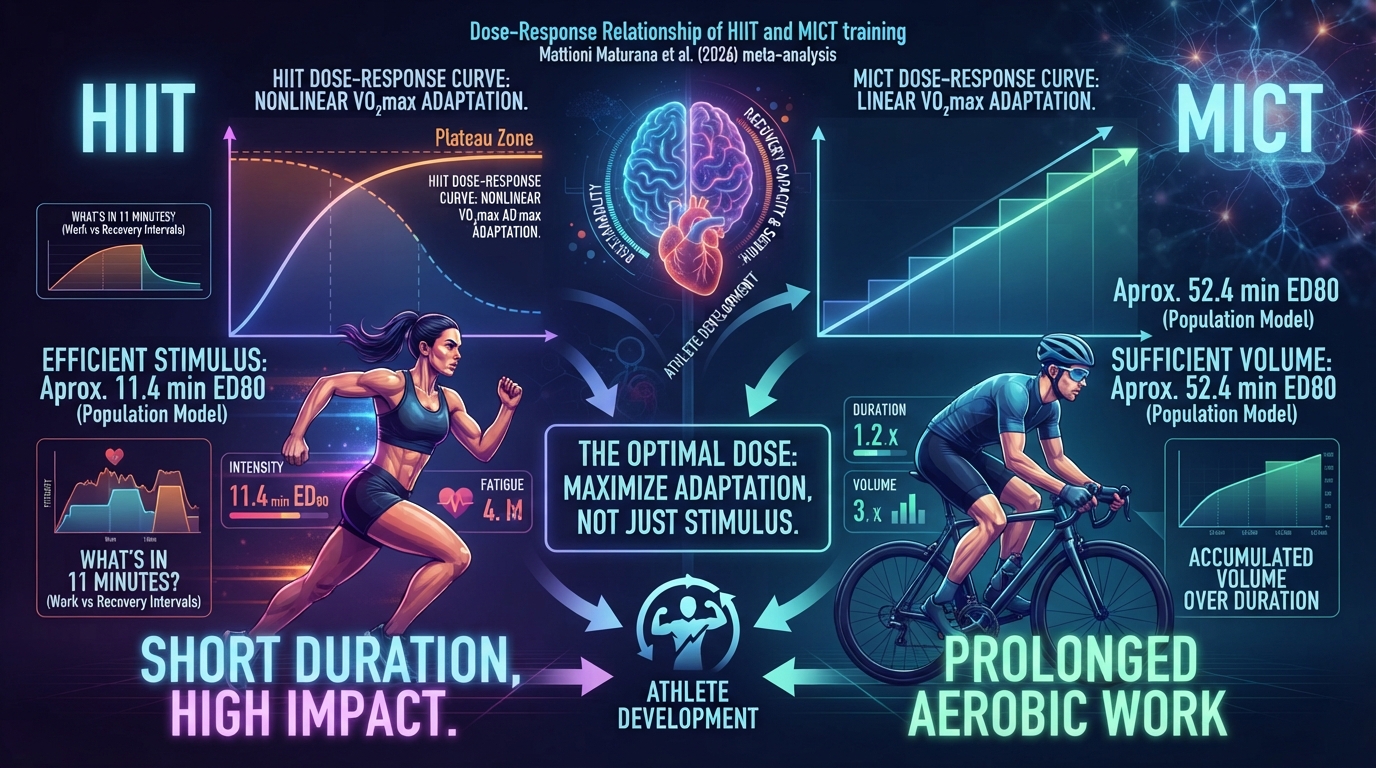
Published in Sports Medicine in September 2026, a new meta-analysis by Mattioni Maturana et al. (2026) examined how adaptations such as VO₂max (maximal oxygen uptake) change as exercise duration increases across these two distinct approaches: HIIT and MICT.
However, interpreting these findings simply as evidence for “efficient, time-saving training” misses the more fundamental point. What emerges from the data is the reality that training effects do not increase in a strictly linear fashion, along with the important distinction between “being efficient” and “being sufficient for an athlete.” This article uses the latest meta-analysis as a scientific starting point to explore the nature of training volume and training effect, and how we should think about daily training design.
- Does Training Make Us Stronger the Longer We Do It?
- Training Has a Relationship Between “Volume” and “Effect”
- This Study Is Not Just About “Which Is Superior, HIIT or MICT”
- The “11 Minutes” of HIIT
- Questioning “11 Minutes”
- What Is Contained Within Those 11 Minutes of HIIT?
- Should Training Be Evaluated Solely by “How Many Minutes Were Done”?
- If HIIT Is Superior, Is MICT Unnecessary?
- Is “Maximum Effect” Truly the Greatest Value for Masters Athletes?
- The Volume That Improves VO₂max by 80% Is Not Necessarily the Volume Needed to Become Stronger in a Race
- Must We Pursue “Maximum Effect” in Every Workout?
- Training Volume Is Not Determined by a Single Workout Alone
- Are “Short Duration With High Efficiency” and “Getting Stronger” the Same Thing?
- Rethinking the Question Itself: “How Long Should HIIT Be?”
- What Is Needed to Grow Stronger Is Not “As Much As Possible,” but “As Much As Necessary”
- References
Does Training Make Us Stronger the Longer We Do It?
In endurance sports, increasing training volume has long been accepted as a natural approach. For example, long-distance runners need to increase their mileage, while triathletes need to accumulate substantial amounts of swimming, cycling, and running. Numbers such as “I swam for two hours today,” “I rode for ten hours this week,” or “I spent this many hours training this month” are highly visible and easy to understand. As a result, we can easily become trapped in the intuitive equation of “training volume = effort = strength.”
This naturally leads us to a simple question: if one hour of training becomes two hours, does the effect also double? Time is finite, and there is always an upper limit to the resources we can devote to training. Yet the body’s adaptation systems do not necessarily respond linearly to the amount of time we invest.
If time were directly proportional to adaptation, the people who could train for the longest periods would always become the strongest. In reality, however, we encounter accumulating fatigue and plateaus in adaptation when training volume becomes excessive. Increasing training time does not simply add positive stimuli; it also increases the stress placed on the body and the cost of recovery.
What we must not overlook is that the body does not evaluate “time on the clock” alone. Even when two training sessions both last 60 minutes, the physiological stimulus can be completely different depending on how intense they were, which muscle groups were involved, how much mechanical and metabolic stress was imposed, and how well recovered the athlete was from the previous session.
More importantly, the amount of training a person can physically complete is not necessarily the same as the amount from which the body can properly adapt. We can extend a workout through willpower and accumulate more distance, but not all of that work is converted into beneficial adaptation. Once training volume exceeds our capacity to absorb it, it may simply increase the debt of fatigue and ultimately prevent further progress. The concept of dose-response provides a scientific framework for understanding this relationship between how much we do and how much the body actually changes.
Training Has a Relationship Between “Volume” and “Effect”
In medicine and pharmacology, increasing the dose of a drug can increase its effect, while beyond a certain point the response may begin to plateau. Exercise training can also be considered in terms of a dose-response relationship, at least for certain adaptations.
The new meta-analysis combined data from 69 randomized controlled trials involving a total of 2,387 participants and modeled the relationship between exercise duration and improvements in VO₂max in HIIT and MICT. Of these participants, 1,199 were assigned to HIIT interventions and 1,188 to MICT interventions.
The most important point revealed by the study is that the response to increasing exercise duration was not simply linear. This nonlinear dose-response relationship was particularly evident for HIIT.
As with drug dose-response relationships, the initial stages of training can produce a relatively large physiological response. When a previously inactive person introduces even a modest amount of high-intensity exercise, the body may respond with substantial adaptation. As the duration of a session is extended, however, the slope of the response gradually becomes less steep, eventually approaching a plateau in the model.
It is important to understand that reaching a plateau does not mean that the effect suddenly becomes zero. Rather, it means that additional exercise produces progressively smaller additional benefits, while the cost of fatigue and stress may continue to increase. Once we recognize this reality, the question of “how much training should I do?” becomes much more demanding.
This Study Is Not Just About “Which Is Superior, HIIT or MICT”
The real value of this meta-analysis is not simply that it decided which of HIIT or MICT is better for improving cardiorespiratory fitness. Its distinctive contribution is that it integrated data from 69 randomized controlled trials involving 2,387 participants and examined how the improvement in VO₂max changes as exercise duration increases.
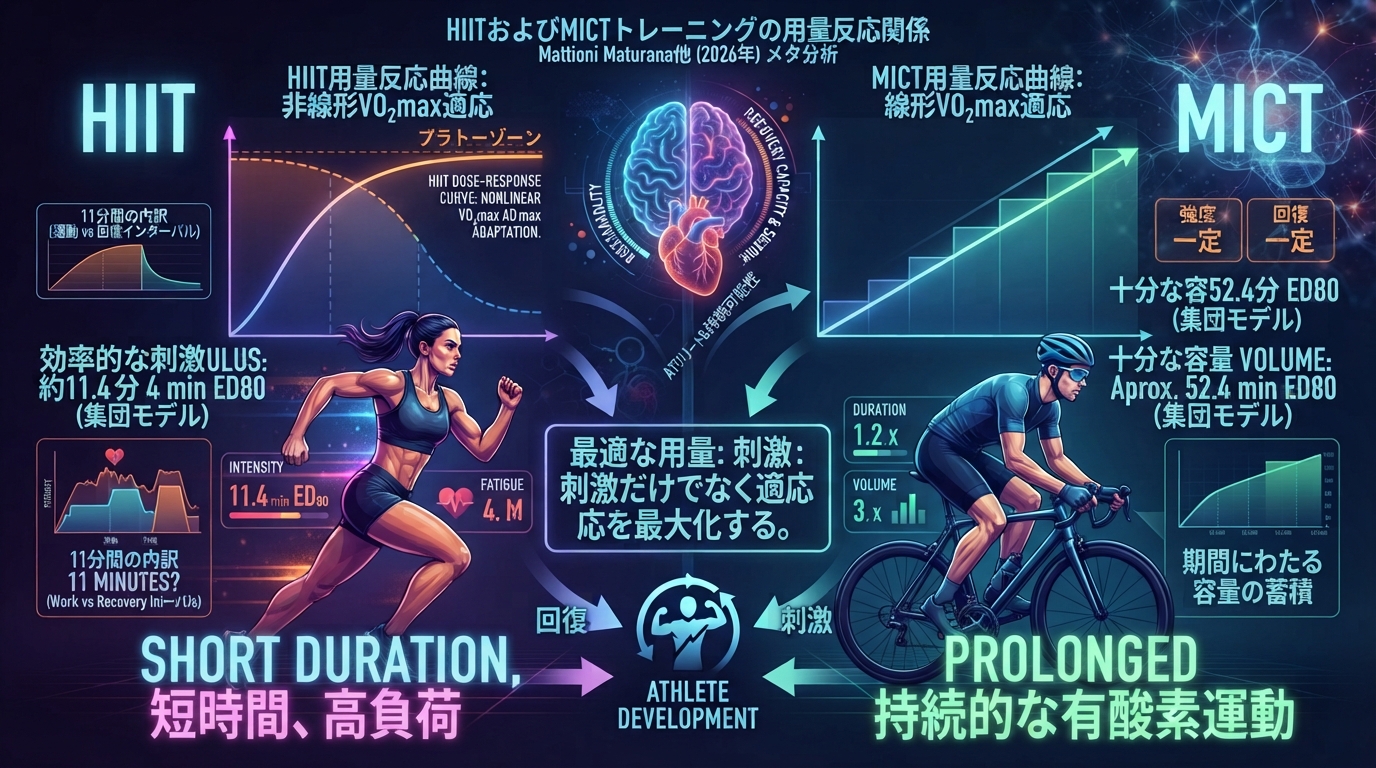
One of the most striking differences was the shape of the dose-response curves themselves. HIIT showed a nonlinear trajectory that moved toward a plateau, whereas MICT demonstrated a relatively linear improvement across the range of exercise doses observed in the included studies.
What does this difference mean? HIIT appears to be capable of producing a substantial adaptive response with a relatively small amount of exercise because of the powerful cardiovascular and metabolic stimulus generated by high-intensity exercise. Once a substantial portion of that response has been achieved, however, extending the duration produces progressively smaller additional gains.
MICT, by contrast, involves a continuous moderate-intensity stimulus. Within the range observed in these studies, increasing exercise duration was more closely associated with an incremental accumulation of aerobic work and therefore showed a more linear relationship with improvement.
However, we should not make the simplistic assumption that “HIIT always reaches a plateau after a certain amount of time, while MICT can continue producing greater benefits forever if we simply train longer.” The observed curves represent statistical models based on the exercise protocols included in the meta-analysis. They do not describe an unlimited physiological response. The important point is to understand the different shapes of the dose-response relationships and then consider what those differences mean for actual training.
The “11 Minutes” of HIIT
So how much exercise is required to obtain a substantial effect? One of the most interesting findings in this study is the estimate known as ED80.
ED80 refers to the exercise dose estimated by the dose-response model to reach 80% of the maximum modeled effect. The “maximum effect” here is an estimate generated by a statistical model based on the observed study data. It does not mean that an individual will personally achieve 100% of some predetermined physiological effect.
Using this model, the estimated ED80 for HIIT was approximately 11.4 minutes per session. For MICT, the corresponding estimate was approximately 52.4 minutes per session.
When the point corresponding to the modeled maximum effect was estimated as ED100, the values were approximately 23.2 minutes per session for HIIT and 63.0 minutes per session for MICT. The estimated ED50 for HIIT, representing 50% of the maximum modeled effect, was approximately 5.8 minutes per session.
| Training Metric | Estimated Exercise Duration |
|---|---|
| HIIT ED50 | Approx. 5.8 min / session |
| HIIT ED80 | Approx. 11.4 min / session |
| HIIT ED100 | Approx. 23.2 min / session |
| MICT ED80 | Approx. 52.4 min / session |
| MICT ED100 | Approx. 63.0 min / session |
The numbers are striking. According to the model, approximately 11 minutes of HIIT per session was associated with reaching 80% of the maximum modeled effect on VO₂max.
At first glance, it is tempting to conclude that “if I want to improve VO₂max, around 10 minutes of HIIT should be enough.” In terms of the efficiency with which HIIT can stimulate cardiorespiratory fitness, the finding certainly illustrates the distinctive power of high-intensity exercise.
However, the 11.4-minute figure should not be interpreted as the “optimal HIIT duration.”
It is not an individualized prescription tailored to a particular athlete. It is an estimate derived from a population-level statistical model based on 69 randomized controlled trials and 2,387 participants.
There is also considerable uncertainty around the estimate. The 95% confidence interval for HIIT ED80 extended from approximately 9.5 to 40.2 minutes per session. That is a very wide interval.
Therefore, the correct interpretation is not that everyone should perform exactly 11.4 minutes of HIIT. Rather, the finding suggests that, across the population and protocols represented in these studies, a relatively short HIIT session can produce a large proportion of the modeled VO₂max response, while the exact dose required can vary considerably.
And there is another important question. What exactly is included in those 11.4 minutes?
The “11.4 minutes” referred to in this study does not simply mean starting a stopwatch and running or cycling continuously for 11.4 minutes.
HIIT protocols differ substantially in their work interval duration, recovery duration, intensity, and work-to-rest ratio. Therefore, simply extracting the number “11.4 minutes” from the paper does not fully describe the physiological stimulus.
Questioning “11 Minutes”
When we see that the estimated HIIT ED80 is approximately 11.4 minutes, it is tempting to turn the number into a prescription: “Then every HIIT session should be 11 minutes.”
That would be an overinterpretation.
The 11.4-minute estimate is not an individualized optimal value. It is derived from a population-level model based on 69 randomized controlled trials and 2,387 participants. Furthermore, the 95% confidence interval of approximately 9.5 to 40.2 minutes shows that there is considerable uncertainty around the point estimate.
The “11.4 minutes” referred to in this study does not mean keeping heart rate elevated continuously for 11.4 minutes from the moment a stopwatch starts.
Nor does it mean that every athlete will obtain exactly the same physiological response from the same duration.
Training experience, fitness level, accumulated fatigue, age, exercise modality, interval structure, and recovery between intervals can all influence the actual stimulus produced by a session.
For an athlete, however, there is an even more important question.
How much fatigue did the session create? How quickly can the athlete recover from it? And can the athlete continue performing high-quality training afterward?
Only when these questions are considered together can we begin to think about an appropriate training dose for an individual.
The 11-minute figure is therefore not a timer telling us when to stop training. It is a useful clue that the relationship between exercise duration and physiological adaptation is not simply proportional.
What Is Contained Within Those 11 Minutes of HIIT?
There is another reason we need to be careful with the phrase “11 minutes of HIIT.”
The HIIT protocols included in the meta-analysis varied considerably. Work-to-rest ratios ranged from approximately 1:9 to 5:1, with a median of around 1:1. In other words, two sessions described as “20 minutes of HIIT” could contain very different amounts of actual high-intensity work depending on how the work and recovery periods were arranged.
The researchers defined HIIT dose as the total duration of the HIIT session, including both high-intensity work periods and recovery periods, while excluding warm-up and cool-down.
This distinction becomes particularly interesting in the sensitivity analysis. When the researchers considered only active high-intensity work time, excluding the recovery periods, the estimated ED80 was approximately 5.2 minutes per session, with a 95% confidence interval of approximately 4.5 to 7.5 minutes. The corresponding estimate for weekly high-intensity work time was approximately 14.7 minutes, with a 95% confidence interval of approximately 12.8 to 19.0 minutes.
The modeled response appeared to plateau at around 10 minutes of high-intensity work per session.
These findings show why it can be misleading to evaluate training simply by asking how many minutes a session lasted. The same total duration can represent very different physiological stimuli depending on how much of that time was spent at high intensity and how much was spent recovering.
At the same time, this does not mean that “five minutes of HIIT is optimal.” The five minutes represents a model-based estimate of active high-intensity work under a particular analysis. It is not a universal prescription.
Should Training Be Evaluated Solely by “How Many Minutes Were Done”?
Using time to manage training is convenient, particularly when planning a schedule. But time alone does not capture the full nature of a training stimulus.
Consider two 60-minute training sessions. One athlete may perform 60 minutes of easy cycling, while another may perform repeated high-intensity intervals. On paper, both sessions lasted exactly one hour. Physiologically, however, they may be completely different.
The cardiovascular and cardiorespiratory load can differ. The metabolic strain placed on the working muscles can differ. The mechanical stress on muscles, tendons, joints, and bones can differ. The fatigue imposed on the central and peripheral nervous systems can also differ.
For an endurance athlete, therefore, training volume needs to be viewed through several dimensions:
- Cardiovascular and cardiorespiratory load
- Muscular metabolic strain and local energy depletion
- Mechanical and physical stress placed on muscles, tendons, joints, and the skeletal system
- Fatigue imposed on the central and peripheral nervous systems
The meta-analysis did not directly measure all of these dimensions. Its primary focus was the relationship between exercise duration and physiological adaptations such as VO₂max. It did not quantify every form of mechanical, muscular, or neural stress that an athlete experiences during training.
This limitation is important when translating the findings into real-world training. A session may provide only a modest additional stimulus to VO₂max while still imposing considerable muscular or mechanical stress. Conversely, a session may provide a strong cardiorespiratory stimulus without creating the same degree of musculoskeletal stress.
This is one reason why training decisions cannot be based on VO₂max data alone.
If HIIT Is Superior, Is MICT Unnecessary?
The answer is no.
The meta-analysis found that HIIT produced greater improvements in VO₂max than MICT. The average within-group improvement was approximately 4.36 mL/kg/min for HIIT compared with approximately 2.59 mL/kg/min for MICT, with a between-group difference of approximately 1.20 mL/kg/min.
But this does not mean that MICT has become unnecessary.
When a broader range of cardiometabolic outcomes is considered, HIIT was not universally superior. HIIT improved measures including BMI, body fat, systolic blood pressure, diastolic blood pressure, triglycerides, and fasting insulin, while MICT improved body fat, systolic blood pressure, diastolic blood pressure, and fasting insulin. There were no significant between-group differences for BMI, body fat, systolic blood pressure, diastolic blood pressure, triglycerides, or fasting insulin.
The strongest difference between the two approaches in this analysis was therefore seen in VO₂max.
MICT also demonstrated a relatively linear improvement in VO₂max across the range of exercise doses observed in the studies. But this should not be interpreted as meaning that MICT can produce unlimited improvement simply by increasing duration indefinitely. The model only describes the range of exercise doses represented in the available studies.
For endurance athletes, the purpose of training is not to maximize VO₂max alone. Aerobic volume, fatigue resistance, muscular endurance, economy, technical skill, and the ability to sustain exercise for prolonged periods are also important.
HIIT and MICT should therefore not be viewed as competing for a single winner. They can play complementary roles within a broader training program.
Is “Maximum Effect” Truly the Greatest Value for Masters Athletes?
This question becomes particularly important for masters athletes.
As we age, simply trying to accumulate the greatest possible amount of intense training can become increasingly difficult to sustain. The central issue is that maximum stimulus and maximum adaptation do not necessarily coincide.
Imagine an athlete performing an extremely demanding HIIT session and obtaining a large acute physiological stimulus. If the result is severe fatigue that remains into the following day, poor sleep, prolonged muscle soreness, or a reduced ability to perform the next high-quality session, the value of that workout within the overall training system may be considerably lower than its isolated physiological effect suggests.
The key question for a masters athlete is therefore not simply, “How much stimulus can I create today?”
It is also, “How often can I successfully absorb and repeat this stimulus?”
That distinction is fundamental.
A workout that produces a slightly smaller stimulus but can be repeated consistently may contribute more to long-term adaptation than a workout that produces a huge stimulus but requires several days of recovery.
This does not mean that masters athletes should avoid intensity. High-intensity training remains valuable. But intensity has to exist within a system that the athlete can actually sustain.
For masters athletes, the ability to repeatedly absorb training may ultimately be more important than the ability to produce the largest possible stimulus in any single session.
The Volume That Improves VO₂max by 80% Is Not Necessarily the Volume Needed to Become Stronger in a Race
This may be the most important distinction in the entire discussion.
The ED80 estimate in this study refers to 80% of the maximum modeled effect on VO₂max. It does not mean 80% of the training required to maximize endurance performance.
These are fundamentally different questions.
An endurance athlete preparing for a triathlon, marathon, cycling event, or other long-duration competition needs much more than a high VO₂max.
Race performance can depend on VO₂max, lactate threshold and sustainable intensity, exercise economy, muscular endurance, fatigue resistance, the ability to maintain power or pace for prolonged periods, metabolic flexibility, fueling, sport-specific technique, pacing ability, and the ability to maintain technique under fatigue.
For example, an Ironman athlete cannot prepare for a 180-km bike leg simply by maximizing VO₂max with short intervals. The athlete needs the ability to remain mechanically and metabolically efficient for several hours.
Likewise, a marathon runner cannot prepare for a marathon exclusively through short HIIT sessions, even if those sessions efficiently improve cardiorespiratory fitness. The ability to maintain running economy and pace under prolonged fatigue is itself a training target.
Therefore, the question “How many minutes of exercise are needed to obtain 80% of the VO₂max response?” is scientifically interesting.
But the question “How much training do I need to become better at my event?” is fundamentally different.
The two should not be confused.
Must We Pursue “Maximum Effect” in Every Workout?
When we approach daily training, it is easy to become focused on producing the largest possible stimulus from every session.
But from a long-term perspective, trying to maximize the effect of every workout can undermine sustainability.
Training has a cost. There is the cost of performing the workout itself, but there is also a second cost: the recovery and adaptation process required afterward.
A session that completely exhausts an athlete may produce a large immediate stimulus, but if the athlete cannot perform quality training for the next several days, the overall training process may suffer.
This is why maximum stimulus and maximum long-term improvement should be considered separately.
What we need is not necessarily the largest stimulus that can be tolerated today, but an appropriate stimulus that leaves enough capacity for tomorrow’s training.
Controlled restraint—grounded in the “eight-tenths rule” of leaving a little in the tank rather than exhausting ourselves completely—can therefore be more useful than constantly chasing the largest possible stimulus.
This is not about avoiding hard training.
It is about understanding that the objective of training is not to win today’s workout.
The objective is to build the athlete who can continue training tomorrow, next week, next month, and next season.
Training Volume Is Not Determined by a Single Workout Alone
When we apply the dose-response concept to an individual’s training plan, we need to expand our perspective from a single session to the entire week, month, and season.
Suppose an athlete performs a very demanding HIIT session and obtains a strong physiological stimulus. If that session compromises the quality of the following day’s training, or causes fatigue that continues into later sessions, the apparent efficiency of that single workout may come at the expense of the overall training load.
In contrast, a session that deliberately stops short of exhaustion may allow the athlete to train well again the following day. Repeated over weeks and months, those slightly smaller individual stimuli can accumulate into a much larger total training effect.
This is why training volume cannot be determined by looking at a single workout in isolation.
Intensity matters.
Duration matters.
Frequency matters.
Density matters.
Mechanical load matters.
Physiological stress matters.
Recovery matters.
And perhaps most importantly, the ability to connect one training session to the next matters.
For endurance athletes, training is inherently cumulative. The goal is not to create the largest possible response from every individual session. The goal is to create a sequence of training stimuli that the body can repeatedly absorb.
That is a very different concept from simply maximizing the dose of each workout.
Are “Short Duration With High Efficiency” and “Getting Stronger” the Same Thing?
Not necessarily.
HIIT is attractive precisely because it can produce a large physiological stimulus in a relatively short amount of time. For people with limited training time, this can be extremely valuable.
If someone can train only a few times per week, a well-designed HIIT session may be an efficient way to stimulate cardiorespiratory fitness.
But endurance athletes often face a different problem.
They may not be short on training time. Instead, they may be trying to determine how to allocate their limited recovery capacity among different types of training.
That changes the optimization problem.
The question becomes not simply, “How quickly can I finish today’s workout?” but rather, “Which training stimulus is most useful today, given everything else I need to do this week?”
A 20-minute HIIT session may be highly efficient for improving VO₂max. But if the athlete’s limiting factor is muscular endurance, prolonged fatigue resistance, running economy, cycling durability, or the ability to maintain race pace for several hours, another type of training may be more valuable.
Efficiency is therefore always relative to the adaptation we are trying to produce.
A training session is efficient only in relation to its purpose.
Rethinking the Question Itself: “How Long Should HIIT Be?”
The question “How long should HIIT be?” sounds simple.
But after examining this meta-analysis, it becomes clear that the question itself may be too simple.
We first need to ask: “How long for what?”
How long to improve VO₂max?
How long to improve race performance?
How long to create a sufficient stimulus without compromising recovery?
How long to fit into a busy schedule?
How long can be repeated consistently?
These questions can have completely different answers.
The study suggests that the VO₂max response to HIIT increases rapidly and then shows diminishing returns. That is valuable information. It tells us that a relatively small amount of high-intensity exercise can produce a substantial cardiorespiratory stimulus, and that additional duration does not necessarily produce a proportional increase in adaptation.
But it does not tell an athlete that every HIIT session should last exactly 11.4 minutes.
Instead, it gives us a useful physiological reference point.
The more important question is what adaptation we are trying to create, how much stimulus that adaptation requires, and how that stimulus fits into the entire training system.
What Is Needed to Grow Stronger Is Not “As Much As Possible,” but “As Much As Necessary”
Perhaps the most useful way to interpret this study is not to ask how little exercise we can get away with.
It is to ask how much exercise is actually necessary for the adaptation we are trying to achieve.
For VO₂max, the study suggests that HIIT can produce a substantial response with a relatively small dose.
For broader endurance performance, however, the answer is inevitably more complicated.
An endurance athlete needs a collection of adaptations rather than a single physiological improvement. Some sessions may be designed to provide a strong cardiorespiratory stimulus. Others may be designed to accumulate aerobic volume. Others may target muscular endurance, economy, fatigue resistance, technical skill, fueling practice, or sport-specific preparation.
The most effective training program is therefore not necessarily the one that produces the largest response from each individual session.
It is the one that creates the right sequence of stimuli, allows sufficient recovery, and can be repeated consistently over time.
This is particularly important for masters athletes.
As training age increases, the ability to continue accumulating high-quality work without exceeding recovery capacity becomes increasingly important. The objective is not to squeeze every possible adaptation out of today’s workout. It is to leave enough capacity to make tomorrow’s workout possible.
And then the next one.
And the one after that.
The new meta-analysis by Mattioni Maturana and colleagues provides a valuable quantitative demonstration of this principle. HIIT and MICT do not produce identical dose-response relationships. HIIT can generate a large VO₂max response with a relatively small exercise dose, while MICT shows a more gradual and approximately linear response across the observed range.
But these findings should not be reduced to the conclusion that “HIIT is better” or that “11 minutes is enough.”
The more important lesson is that training volume is not simply the number of minutes written in a training log. It is the interaction between intensity, duration, frequency, density, mechanical load, physiological stress, recovery, and the athlete’s ability to connect one session to the next.
For an athlete, the most useful training dose is not necessarily the maximum possible dose.
It is the dose that produces the adaptation we need, while leaving enough capacity to continue building.
What is needed to grow stronger is not “as much as possible,” but “as much as necessary.”
References
Mattioni Maturana F, Zadon NHA, Cocks M, Nieß AM, Thijssen DHJ, Dawson EA. Optimising Exercise Prescription: A Meta-Analysis Examining the Dose Response of Exercise Duration on Cardiorespiratory Fitness Following HIIT and MICT. Sports Med. 2026. PMID: 42730846
Buchheit M, Laursen PB. High-intensity interval training, solutions to the programming puzzle: Part I: cardiopulmonary emphasis. Sports Med. 2013;43(5):313–338. PMID: 23539308
コメント