
Day in and day out, you log the miles, push through high-intensity intervals and tempo runs, and steadily build your aerobic base. Yet, every so often, a quiet question surfaces: Is my top-end speed or my movement crispness actually improving?
When deeply immersed in endurance sports, training naturally gravitates toward volume and fatigue resistance. Believing that simply running more miles will automatically make you faster is a cornerstone of the endurance mindset, and establishing that aerobic base is undeniably essential.
However, does simply accumulating endurance training adequately stimulate the actual capacity to move quickly? Even with exceptional endurance, many athletes fail to fully develop the ability to move their bodies at high velocities.
1. Supporting 3:48/km Requires More Than Just 3:48/km Fitness
Suppose you are targeting a sub-20-minute 5,000 meters, which requires maintaining a pace of 3 minutes and 48 seconds per kilometer. Sustaining that pace demands a wide array of aerobic capacities: cardiorespiratory fitness, lactate clearance, lactate threshold, VO₂max, and running economy. These have long been the core focuses of endurance training.
Yet, making a 3:48/km pace feel relatively comfortable requires more than just the capacity to sustain a 3:48/km velocity.
While you are not contesting a 100-meter dash during a 5,000m race, having the reserve capacity to move your body at velocities well above race pace can contribute to overall running quality.
Underpinning that capacity are several distinct elements:
- The function of the foot and ankle complex in absorbing ground forces
- The utilization of elastic energy from the Achilles tendon and other structures
- The rate of force development (RFD)
- Neuromuscular coordination to produce high outputs
- The technical mastery required for high-speed locomotion
These qualities are not automatically maximized simply by training to run for extended durations. In other words, separate from the stimuli that build endurance, the body requires exposure to the act of moving fast itself.
Of course, this does not mean slashing your endurance training to focus purely on sprinting. Whether in a 5,000m race or a triathlon, endurance remains the absolute foundation. Upon that foundation, we layer the speed elements that have been left largely unstimulated.
2. Do You Consider “100m × 10” to Be Speed Training?
When endurance athletes hear the phrase “speed workout,” what kind of session usually comes to mind? For example: 100m × 10 with 30 seconds of rest.
- You run quite fast.
- Your heart rate spikes.
- Your breathing grows heavy.
- Your legs feel completely pumped.
Once all ten repetitions are finished, you might think, “I got my speed session in today.” But is that really true?
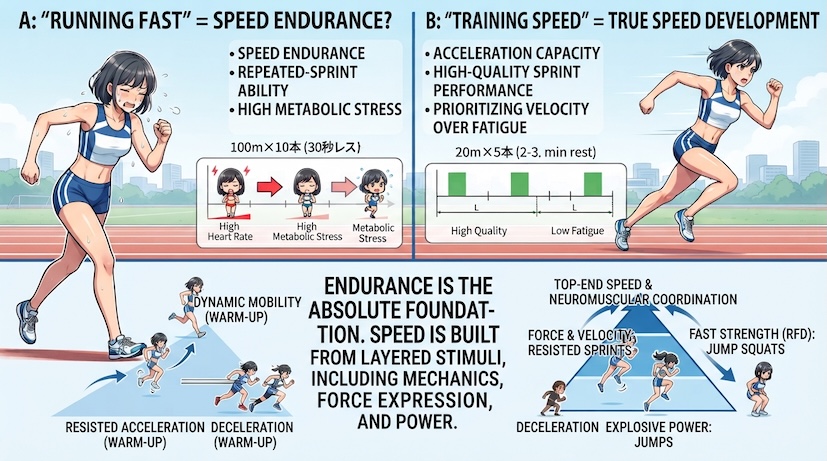
“Running Fast” Is Not the Same as “Training Speed”
This is a critical distinction. Running 100 meters fast is not inherently problematic. The issue arises when viewing a 100-meter distance simply as a “speed training” session without considering the context.
Running a 100-meter rep, resting for only 30 seconds, and going again for ten rounds causes fatigue to accumulate rapidly. By the later repetitions, breathing becomes labored, muscular fatigue sets in, and maintaining the speed of the initial reps becomes increasingly difficult.
Consequently, what this setup demands of the body is less about “eliciting maximum velocity” and more about “the ability to repeatedly produce high-speed movement under accumulating fatigue.”
This is by no means a bad workout. In fact, it serves a very clear purpose: building speed endurance, repeated-sprint ability, and tolerance to high metabolic stress. However, calling it a pure speed-development workout misses the point.
What About 20m × 5 Instead?
Consider an alternative: 20m × 5 with 2 to 3 minutes of rest.
You sprint 20 meters. Then, you rest properly. Once your breathing settles and the fatigue in your legs clears as much as possible, you run again. You rest again. You repeat this for a total of five reps.
“Just five short reps with such a short total distance?” you might wonder.
However, the objective here differs entirely from the 100m × 10 session. The goal is to minimize fatigue as much as possible while producing high acceleration and power on every repetition.
- Rep one is fast.
- Rep two is fast.
- Rep three is fast.
- Reps four and five maintain that high level of speed without significant drop-off.
The metric of success here is not “how much you suffered,” but “how fast and powerfully you were able to move.”
Short-sprint protocols are frequently deployed specifically to target acceleration capacity. Short-sprint training interventions are utilized to enhance short-distance performance in ranges like 0 to 20 meters, with resisted sprinting often employed to improve acceleration profiles.
These Two Sessions Serve Fundamentally Different Objectives
| Session | Primary Nature | Main Objective |
| 100m × 10 (30s rest) | High-Intensity Intervals | Speed endurance, repeated-sprint ability, metabolic stress tolerance |
| 20m × 5 (2–3 min rest) | High-Quality Sprints | Acceleration capacity, high-quality sprint performance |
However, this does not mean that “100m always equals speed endurance” and “20m always equals pure speed.” Running 100 meters with generous recovery allows you to target sprint qualities. Conversely, shortening the rest on 20-meter repeats and stacking a high volume creates a metabolic load characteristic of repeated-sprinting. Distance alone does not define a training category; rather, the interaction of distance, velocity, repetition count, rest duration, velocity decrement, and cumulative fatigue determines the true nature of the session.
This framework aligns with reviews emphasizing that sprint training prescription requires treating distance, intensity, rest, volume, and objective as an integrated set.
“How Fast Was It?” Matters More Than “How Hard Was It?”
Endurance athletes tend to use subjective feelings—such as an elevated heart rate, breathlessness, heavy legs, or completing every single grueling rep—as proof of an effective workout.
When targeting speed qualities, however, that mindset does not always apply. “Suffering” and “speed” are not synonymous.
In fact, finishing a session thinking, “I hardly felt tired at all, but every single rep was fast,” often indicates that the session achieved its exact purpose. Speed-focused training prioritizes preserving the quality of velocity and output over accumulating fatigue.
Put simply:
- 100m × 10 (30s rest)$\rightarrow$ Targets speed endurance, repeated-sprint ability, and metabolic stress tolerance.
- 20m × 5 (2–3 min rest)$\rightarrow$ Targets acceleration capacity and high-quality sprint performance.
Both involve running fast, but they are not the same kind of training. Overlooking this distinction can lead to a misleading assumption: “Because I am running fast, my speed capabilities must be developing.” What endurance athletes need is not merely more training that incorporates fast movement, but distinct stimuli dedicated to “speed itself,” rather than relying solely on endurance-oriented work.
3. Speed Is Built From More Than Just Sprints
Enhancing the capacity to move quickly requires looking beyond a handful of 20-meter sprints. Speed does not exist in a vacuum; it relies on an interconnected chain of attributes, ranging from pre-activity preparation and ground absorption through the foot to force production, acceleration, deceleration, jumping, and the uninhibited release of power.
① Transitioning the Body into High-Speed Action
The session begins with a proper warm-up. Moving beyond a simple jog, dynamic mobility and drills are used to prepare the hips and ankles and gradually increase movement velocity. Fatiguing the body is not the goal here; the objective is simply to prime the system to move fast.
② Waking Up the Feet and Ankles with “Bounce”
Next, attention shifts to the feet and ankles. Low-amplitude plyometric movements like pogo jumps and ankle hops use short ground-contact times to practice absorbing and rapidly returning ground forces.
- Pogo jumps: 10–20 reps × 2 sets
- Ankle hops: 10–20 reps × 2 sets
The legs should not feel blasted or heavy. The aim is to quicken ground contact and cultivate a springy, elastic feel through the lower extremities.
③ Bridging “Force” and “Velocity”
Speed is not simply about moving light things quickly; it requires the capacity to express high force. Consequently, foundational strength work like squats and deadlifts provides a baseline, which is then paired with resisted sprints or unresisted free sprints to bridge that force into high-speed movement.
- Lightly resisted 10–15m acceleration runs × 3–4 sets
- Adequate rest
- Unresisted 15–20m free sprints × 3–4 sets
Using resistance to emphasize force production, followed by unresisted high-velocity movement, can provide a stimulus distinct from standard all-out sprinting.
④ Controlling the Accelerated Body (Deceleration)
Becoming faster requires the corresponding ability to decelerate and control that momentum safely. Rather than jumping straight into violent, abrupt stops, accelerating for 10 to 15 meters and then gradually decelerating over a few strides provides a simple way to practice this control. Running fast and controlling speed go hand in hand.
⑤ Stimulating Explosive Output via Jumps
Jumps offer another accessible avenue for high-velocity coordination. For instance, Countermovement Jumps (CMJs): 3 reps × 2–3 sets can be a simple starting point. Short-contact movements like pogos differ from explosive movements like CMJs in their mechanical and neuromuscular demands, so the two can be used for different purposes.
⑥ Targeting “Fast Strength” (RFD)
In strength training, absolute maximum load is not the only metric of capability; the speed of force development (rate of force development, or RFD) is equally critical. Implementing movements like jump squats with appropriate loads or intentionally explosive concentric execution trains rapid force expression. However, lighter is not always better—load, velocity, and volume must align with the specific training aim.
⑦ Unleashing Power Fully (Ballistics)
Ballistic movements provide the final piece. Medicine ball throws allow you to express power through a movement in which the implement is released rather than deliberately decelerated before the end of the movement (3–5 reps × 2–3 sets). Each repetition should be performed with maximal intent, with enough recovery to preserve output quality. The objective is never to grind out high volumes of fatigue, but to preserve the purity of each explosive output.
Viewed holistically, framing “speed training” as nothing more than running sprints is far too narrow. A complete approach weaves together warm-ups, foot-and-ankle mechanics, force expression, acceleration, deceleration, jumping, rapid strength development, and ballistic power. Crucially, an endurance athlete in their 50s does not need to execute every single element in every single session. Trying to cram everything in is counterproductive.
4. For Masters Athletes, Start Small and Targeted
You do not need to cram every component listed above into a single week. Start by identifying the quality you are currently lacking. For athletes with minimal sprint exposure, starting with a 10-to-15-meter acceleration run rather than diving straight into a 30- or 40-meter all-out sprint is the prudent path.
Sample Speed-Stimulus Session Structure
- Warm-up: Light jog, dynamic mobility, hip and ankle drills
- Feet & Ankles: Pogo jumps (10–20 reps × 2 sets)
- Acceleration: 10–15m × 3–4 reps (2–3 minutes rest between each rep)
- Jumps: CMJ (3 reps × 2 sets)
- Fast Strength: Rapid force-expression exercise (3–5 reps × 2 sets)
This alone provides a completely distinct stimulus from a standard zone-2 or lactate threshold run. As adaptation occurs, resisted sprints, free sprints, deceleration drills, or medicine ball throws can be gradually introduced as needed. Stopping a session while feeling fully capable of doing more is often the right cue; speed training prioritizes the preservation of repetition quality far above the accumulation of fatigue.
5. Think in Terms of “Placement,” Not “Addition”
For athletes already carrying high monthly running volume and layering in zone-2, threshold, and VO₂max work, simply adding sprints, jumps, and heavy strength sessions on top of the existing schedule only inflates total fatigue, burying the speed stimulus underneath layers of exhaustion.
This makes placement far more important than addition.
Attempting high-velocity sprints at the tail end of an exhausting long run fails to serve the intended purpose; those efforts are better performed in a relatively fresh state. Introducing a new stimulus requires re-evaluating how different sessions fit together. Rather than blindly adding volume through an additive mindset, the goal is to strategically balance endurance, strength, speed, and recovery.
This idea of applying small, high-quality doses of stimulus without substantially increasing fatigue also has parallels with the “drip load” concept developed and promoted by Norwegian coach Marius Bakken. Rather than applying large training loads all at once, the body is exposed to small, consistent, repeatable stimuli. Speed training can be approached in a similar way: instead of turning every speed session into a fatiguing workout, short, high-quality speed stimuli can be woven into the broader training plan.
6. Summary
Endurance athletes naturally tend to gauge a workout’s worth by how far they ran or how deeply they suffered. Yet, sessions designed to build high-velocity movement capabilities do not measure success in fatigue. Often, finishing a session with the thought, “I barely felt tired at all, but my movement was unmistakably fast,” aligns much closer to the target.
Running ten 100-meter repetitions until breathless and executing a handful of crisp 20-meter accelerations both involve running fast, but they emphasize different qualities.
By maintaining endurance training to build fatigue resistance while also incorporating fresh, high-quality speed stimuli, athletes can build a reserve of speed that endurance training alone may not fully develop.
At age 50 and beyond, the goal does not have to be limited to simply running longer. You can run long. You can move powerfully. And you can move fast. Treating endurance and speed as distinct physical capacities may reveal qualities that still have room to develop, even in well-trained masters athletes.
参考文献
- Aldrich EK, Sullivan K, Wingo JE, et al. The Effect of Resisted Sprint Training on Acceleration: A Systematic Review and Meta-Analysis. Int J Exerc Sci. 2024;17(6):986-1002. PMID: 39253367. PubMed
- Myrvang S, van den Tillaar R. The Longitudinal Effects of Resisted and Assisted Sprint Training on Sprint Kinematics, Acceleration, and Maximum Velocity: A Systematic Review and Meta-analysis. Sports Med Open. 2024;10(1):110. PMID: 39392558. PubMed
- Ramírez-Campillo R, Gentil P, Negra Y, Grgic J, Girard O. Effects of Plyometric Jump Training on Repeated Sprint Ability in Athletes: A Systematic Review and Meta-Analysis. Sports Med. 2021;51(10):2165-2179. PMID: 33909274. PubMed
コメント