
During the base training phase, the question of how hard to push is a constant presence. How many bpm on the heart rate monitor? What percentage of FTP on the power meter? What kind of pace on the run?
As a standard metric in endurance sports, LT1 (the first lactate threshold) is frequently used. Certainly, LT1 is an important benchmark when considering base training intensity.
However, energy supply in the body is not determined solely by lactate dynamics. Even at the same “comfortably sustainable” exercise intensity, the underlying adaptive processes differ depending on the relative contributions of fat and carbohydrate oxidation.
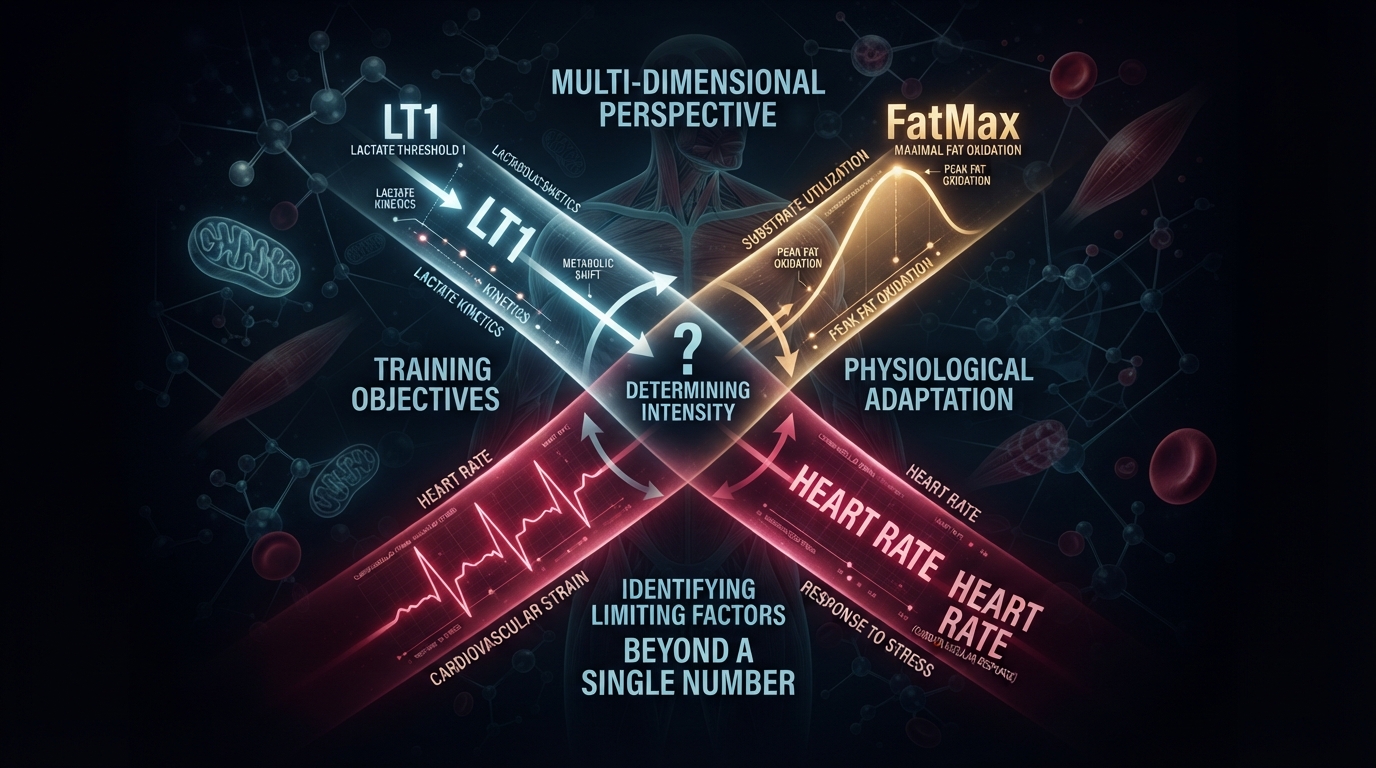
This is where FatMax (the exercise intensity that elicits the maximal fat oxidation rate) becomes a crucial perspective. LT1, FatMax, and actual heart rate do not always align at the exact same intensity.
When discrepancies arise among these metrics, what should we use as our guiding principle to determine base training intensity?
This article explores base training intensity not simply as a rigid numeric target, but through the lens of our training objectives—specifically, what physiological capacities we want to develop.
- 1. Base Training Intensity Cannot Be Defined by a Single Number
- 2. LT1 as an Indicator of Metabolic Shifts with Intensity
- 3. FatMax: Examining the Peak of Fat Oxidation
- 4. The Significance of Discrepancies Between LT1 and FatMax
- 5. Interpreting High Heart Rate Alongside Low Lactate
- 6. Identifying the Limiting Factor Rather Than Chasing the Lowest Number
- 7. Deciding Intensity Based on Desired Adaptations, Not Comfort
- 8. Conclusion: Heart Rate as a Tool for Dialogue, Not an Absolute Answer
- References
1. Base Training Intensity Cannot Be Defined by a Single Number
When people talk about base training, it is often simplified into a single metric, such as “Zone 2,” “below LT1,” or “a certain percentage of maximum heart rate.” However, multiple physiological changes occur simultaneously within the body.
As exercise intensity rises, the proportion of energy derived from carbohydrates gradually increases, while fat continues to serve as an essential energy source. Furthermore, increases in exercise intensity trigger changes in blood lactate concentration, accompanied by synchronized shifts in respiration and heart rate.
In other words, simply drawing a line and saying “this heart rate equals base training” fails to control intensity meaningfully unless we understand what those numbers actually represent. Therefore, our starting points should be two distinct axes: LT1 and FatMax.
2. LT1 as an Indicator of Metabolic Shifts with Intensity
LT1 is generally treated as the point where blood lactate concentration begins to rise clearly above baseline levels during a progressive exercise test. However, lactate is not merely a “fatigue byproduct.” Lactate is continuously produced and cleared during exercise, and blood lactate concentration reflects the balance between these two processes.
Consequently, LT1 is better understood not as the exact point where lactate “starts appearing,” but rather as the point where a clear shift occurs in lactate metabolic dynamics in response to increasing intensity.
In endurance base training, low-to-moderate intensities around or below LT1 are commonly used. This zone makes it easier to accumulate adequate training volume while avoiding excessive metabolic stress, facilitating the development of continuous aerobic capacity.
One important caveat, however, is that knowing your LT1 does not automatically provide a complete picture of your fat oxidation capacity. This is where FatMax comes into play.
3. FatMax: Examining the Peak of Fat Oxidation
FatMax refers to the exercise intensity at which the rate of fat oxidation during exercise reaches its peak.
If exercise intensity is too low, absolute fat oxidation remains modest because total energy expenditure is small. Conversely, as intensity becomes higher, carbohydrates increasingly become the dominant energy source. Between these extremes lies the point of maximal fat oxidation—FatMax.
Crucially, FatMax should not be viewed simply as the “ideal heart rate for burning fat.” FatMax is merely an indicator derived under specific testing conditions, and its results fluctuate depending on nutritional status, exercise duration, fatigue levels, and testing protocols.
Therefore, it is inappropriate to conclude simplistically that “training at this exact heart rate will optimize fat adaptation.” Nonetheless, FatMax offers valuable insights into energy substrate partitioning from an angle distinct from LT1.
4. The Significance of Discrepancies Between LT1 and FatMax
Suppose an athlete’s test results reveal that FatMax occurs at an intensity noticeably lower than LT1.
In this scenario, rather than debating which number is “correct,” we need to understand what each metric is actually measuring. Being able to exercise comfortably at a given intensity does not mean you must always perform your base training at that specific intensity.
If your current primary objective is to emphasize lipid utilization during prolonged exercise, incorporating sufficient volume at lower intensities, including intensities around FatMax, may be one reasonable approach. On the other hand, dismissing a low FatMax value as an absolute indicator of poor fat-burning capacity would be premature. These metrics are simply mirrors reflecting current physiological characteristics.
5. Interpreting High Heart Rate Alongside Low Lactate
Another fascinating scenario frequently observed in the field is when blood lactate concentration remains relatively low during exercise, yet heart rate climbs higher than anticipated.
In such cases, jumping to the conclusion that “lactate is low, so we should push the intensity higher” is dangerous. Heart rate is influenced by a multitude of variables beyond muscular metabolic state, including autonomic responses, core temperature increases, dehydration, accumulated fatigue, sleep quality, and ambient temperature.
Consequently, observing a high heart rate does not justify a hasty assumption that the heart is the primary bottleneck.
However, if a significant divergence exists between muscular metabolic status (low lactate) and cardiovascular response (high heart rate), we must interpret the data cautiously while accounting for external and systemic stressors. At the very least, we cannot assume that “low lactate equals license to ignore a high heart rate.” By combining heart rate, blood lactate, ratings of perceived exertion (RPE), power, and pace, we can gain a multi-dimensional understanding of where our physiological stress lies.
6. Identifying the Limiting Factor Rather Than Chasing the Lowest Number
At this point, a natural question arises: “Should we simply default to the lower of the LT1 and FatMax thresholds to play it safe?”
However, rigid, mechanical application should be avoided here as well. The key when determining training intensity is not blindly adopting the most conservative number, but rather identifying what the current limiting factor (bottleneck) is relative to your specific objectives.
For example, if your current objective is to emphasize lipid utilization during prolonged exercise, ensuring sufficient volume at lower intensities may be one reasonable approach. Conversely, if your goal is to improve lactate handling or sustained aerobic capacity, incorporating work around the LT1 boundary may be appropriate. Furthermore, elements outside of metabolism—such as running economy, pedaling efficiency, muscular strength, and local muscular endurance—may also act as limiting factors.
In short, even when using the umbrella term “Zone 2,” the underlying purpose of your training changes fundamentally depending on what physiological adaptation you are targeting.
7. Deciding Intensity Based on Desired Adaptations, Not Comfort
During a base training block, athletes naturally feel the temptation to run faster or push slightly higher power numbers—especially when lower intensities still feel comfortable.
Yet, the true essence of base training is not simply about “staying as easy as possible.” Its real value lies in systematically remodeling the body’s physiological systems to sustain prolonged exertion.
To achieve this, adopting a multi-dimensional perspective that integrates several key data points is indispensable:
- Where does LT1 lie?
- What intensity corresponds to FatMax?
- How is heart rate responding in real time?
- How do power output and pace behave?
- What is the subjective rating of perceived exertion (RPE)?
- How does your body respond during prolonged exercise?
Heart rate during base training is not a ceiling to test against—it is a management metric designed to ensure your training intensity aligns with your current developmental objectives.
8. Conclusion: Heart Rate as a Tool for Dialogue, Not an Absolute Answer
In structuring base training, LT1 serves as a useful compass. However, relying on LT1 as a standalone metric cannot reveal the entire story of the body.
Examining FatMax sheds light on another dimension of exercise intensity and substrate utilization. Pairing these with heart rate and other field data allows us to continuously monitor how the body is adapting during actual training sessions.
The goal is not to use these numbers to chase an absolute definition of “right.” Rather, it is to examine the discrepancies between them and interpret what they reveal about your current physiological state.
- If LT1 and FatMax sit close together, that is simply one characteristic of your profile.
- If they diverge widely, that gap provides valuable clues for targeted improvement.
- If heart rate is disproportionately high, examine cardiovascular strain alongside fatigue accumulation and environmental factors.
Ultimately, guiding your training with the question, “What do I need to develop right now?” is the most important mindset to maintain.
Base training is neither a period of passive recovery nor an exercise in enduring needlessly low heart rates. It is a strategic window to identify and develop the physiological capacities needed to sustain performance over long distances until the very end.
Rather than being bound by a single heart rate figure, design your training intensity by integrating lactate kinetics, lipid metabolism, cardiovascular responses, and overarching training purpose into a coherent dialogue with your body.
References
- Goodwin, M. L., et al. (2007). Blood lactate measurements and analysis during exercise: a guide for clinicians. Journal of Diabetes Science and Technology, 1(4), 558–569. PMID: 19885119
- Amaro-Gahete, F. J., et al. (2019). Assessment of maximal fat oxidation during exercise: A systematic review. Scandinavian Journal of Medicine & Science in Sports, 29(7), 910–921. PMID: 30929281
- Coyle, E. F., & González-Alonso, J. (2001). Cardiovascular drift during prolonged exercise: new perspectives. Exercise and Sport Sciences Reviews, 29(2), 88–92. PMID: 11337829

コメント