
For many years, individuals dedicated to training and health management have been guided by the notion that “the body can only use about 25g to 30g of protein in a single meal,” and that “anything consumed beyond that goes to waste.” Protein powder packaging and fitness-oriented nutrition advice have often reinforced the idea that keeping protein intake within this range per meal is optimal.
However, recent sports nutrition research—particularly detailed experimental work examining myofibrillar muscle protein synthesis (MPS)—has challenged the idea that MPS simply reaches a hard ceiling at around 25g.
But if there is no such ceiling, does consuming a massive amount such as 100g of protein in a single meal build significantly more muscle? The answer is far less straightforward.
Using recent research as a guide, this article examines the relationships among protein digestion and absorption, the amount of protein required to stimulate MPS in a single meal, and the amount of protein that may be useful for long-term muscle hypertrophy. We will also consider what these findings actually mean for master’s athletes who continue to train as they age.
- 1. Where Did the “25g Per Meal” Figure Come From?
- 2. Requirements Shift With Age
- 3. What Happens When You Ingest 100g of Protein? Trommelen and Colleagues’ Bold Test
- 4. Does 100g Yield Four Times the Benefit of 25g?
- 5. What Does the 100g Study Actually Prove? And What Does It Not Prove?
- 6. Acute MPS Is Not the Same as Long-Term Muscle Hypertrophy
- 7. Is the Traditional “25–40g Range” Outdated?
- 8. Protein Strategies for Master’s Athletes
- Summary: The “25g Wall” Is Gone, But 100g Is Not the New Rule
- References
1. Where Did the “25g Per Meal” Figure Come From?
The idea that “protein exceeding a certain amount in a single meal is not absorbed” or “does not contribute to muscle building” has been widely repeated in fitness and nutrition discussions.
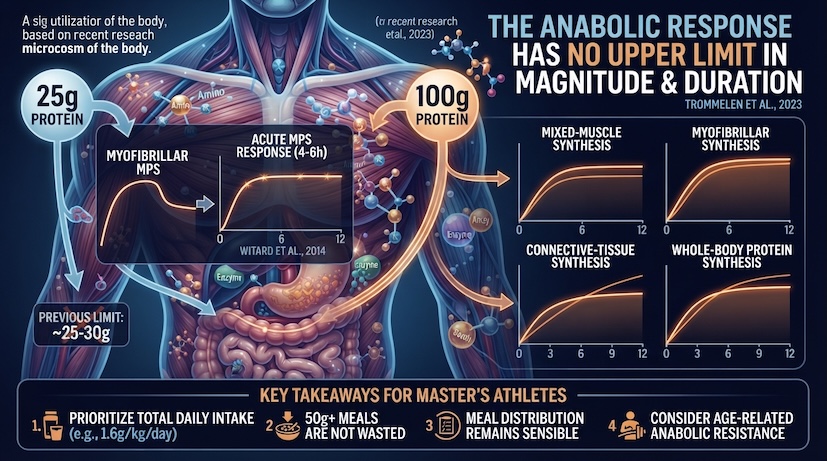
An important study in the development of the practical 20–30g-per-meal guideline was conducted by Witard and colleagues in 2014 (PMID: 24257722). In this study, resistance-trained young men consumed 0, 10, 20, or 40g of whey protein after resistance exercise. Myofibrillar MPS was measured over the following four hours.
MPS increased substantially after 20g of whey protein, while increasing the dose to 40g did not produce a statistically significant additional increase in MPS during the measurement period. However, this should not be interpreted as proof that 20g—or 25g—is a universal physiological ceiling. The study involved young, resistance-trained men weighing approximately 80kg, used whey protein, and measured the response over only four hours.
In other words, this study provided important evidence for the idea that relatively modest protein doses can strongly stimulate MPS, but it did not demonstrate that protein consumed beyond 20–25g is simply “wasted.”
This distinction is essential.
Once protein enters the digestive tract, it is broken down into amino acids and peptides, absorbed into the circulation, and distributed throughout the body. These amino acids can contribute to muscle protein synthesis, the synthesis and maintenance of other tissues and proteins, and other metabolic processes.
Therefore, we need to separate two different questions:
- Is protein above 25–30g absorbed and used by the body?
- How much can a single meal stimulate muscle protein synthesis?
These are not the same question.
A plateau in the measured MPS response does not mean that the additional protein was not absorbed. Likewise, protein that does not directly increase muscle protein synthesis at that particular moment is not necessarily biologically useless.
This distinction becomes especially important when interpreting newer studies involving much larger protein doses.
2. Requirements Shift With Age
Another reason why a fixed “25g per meal” rule cannot be applied universally is that the response to dietary protein varies with age and other individual characteristics.
A particularly relevant study is the work of Moore and colleagues (Moore et al., 2015 / PMID: 25056502), which examined the protein dose required to maximally stimulate myofibrillar MPS in healthy young and older men.
The researchers found that older men required a greater relative protein intake to maximize the MPS response. Their breakpoint analysis estimated a plateau at approximately 0.24g/kg of body mass in younger men and approximately 0.40g/kg in older men. When expressed relative to lean body mass, the difference was even greater.
This provides an important lesson for master’s athletes.
The amount of protein required to produce a strong MPS response is not necessarily identical across all individuals. Aging can reduce the sensitivity of skeletal muscle to the anabolic effects of dietary amino acids, a phenomenon commonly referred to as anabolic resistance.
However, this study does not justify a rigid rule such as “older adults must always consume 40g or more per meal.” The more defensible conclusion is that older adults should not assume that a small protein dose that works well in a young population will necessarily provide the same maximal stimulus.
Again, the important point is not to replace one rigid number with another.
3. What Happens When You Ingest 100g of Protein? Trommelen and Colleagues’ Bold Test
This brings us to the study that has challenged the traditional interpretation most directly.
Trommelen and colleagues deliberately used a very large protein dose to investigate whether the post-exercise anabolic response really reaches a hard upper limit (Trommelen et al., 2023 / PMID: 38118410).
Following resistance exercise, participants consumed either 0g, 25g, or 100g of milk protein. The researchers then used a comprehensive quadruple isotope tracer approach to follow protein digestion, amino acid availability, and protein synthesis over a 12-hour period.
The results were striking.
The 100g group showed a greater and more prolonged anabolic response than the 25g group. The researchers observed higher rates of mixed-muscle, myofibrillar, connective-tissue, and whole-body protein synthesis after the 100g dose. The response was not limited to the early postprandial period; the difference became particularly apparent during the later portion of the 12-hour observation period.
The study also provided important information about digestion and absorption. Over the 12-hour period, considerably more dietary-protein-derived amino acids appeared in the circulation after 100g than after 25g. The release of amino acids from the 100g dose had not plateaued by the end of the 12-hour observation period, indicating that a very large protein dose takes considerably longer to digest and process.
This is an important challenge to the simplistic idea that “once you consume 25g, everything beyond that is irrelevant.”
The body did not simply stop responding at 25g.
4. Does 100g Yield Four Times the Benefit of 25g?
This is where interpretation becomes critical.
The fact that 100g produced a greater MPS response than 25g does not mean that eating 100g in one sitting builds four times as much muscle as eating 25g.
The fourfold increase in protein intake did not produce a fourfold increase in MPS. The response therefore cannot be described as a simple linear relationship between grams of protein consumed and the amount of muscle protein synthesized.
However, we should also be careful about describing the exact shape of the dose-response curve.
The Trommelen study compared three conditions—0g, 25g, and 100g. It did not test every intermediate dose such as 30g, 40g, 50g, 60g, and 80g. Therefore, the study cannot tell us exactly where the practical optimum lies or precisely how much additional benefit is obtained with each additional gram.
What it does show is something more fundamental:
The physiological response does not simply stop at 25g.
That is a very different claim from saying that “more is always better.”
5. What Does the 100g Study Actually Prove? And What Does It Not Prove?
This is perhaps the most important section of the entire discussion.
The 100g study demonstrates that a single large protein dose can produce a greater and more prolonged anabolic response than 25g under the experimental conditions used.
But several important questions remain unanswered.
First, evidence from single-meal studies using very large protein doses is still extremely limited. The 100g experiment is unusual precisely because earlier dose-response studies generally examined much smaller amounts over much shorter observation periods.
Second, the study compared 100g consumed as a single bolus with 25g consumed as a single bolus. It did not compare 100g consumed at once with 100g distributed across several meals.
For example, it did not determine whether:
- 100g in one meal
- 50g + 50g
- 25g + 25g + 25g + 25g
- 40g + 30g + 30g
would produce the same or different cumulative anabolic responses over 12 or 24 hours.
This is a crucial limitation.
The study therefore does not establish that consuming 100g at once is superior to spreading the same total amount throughout the day. In fact, the prolonged response observed after the 100g dose raises a new research question rather than settling the old one:
Is a large protein bolus actually better than distributing the same amount across several meals?
We simply do not have sufficient direct evidence to answer that question yet.
Third, the study measured an acute physiological response. It did not follow participants for months to determine whether consuming 100g of protein in a single meal produces greater long-term muscle hypertrophy than consuming the same daily amount in smaller portions.
This distinction is essential.
6. Acute MPS Is Not the Same as Long-Term Muscle Hypertrophy
One of the biggest mistakes in sports nutrition is to equate a higher acute MPS response with greater long-term muscle growth.
MPS tells us how rapidly muscle proteins are being synthesized over a particular measurement period. It is an important physiological marker, but an acute difference in MPS does not automatically translate into a proportional difference in muscle mass months or years later.
Long-term changes in muscle mass depend on many interacting factors, including:
- Consistent, high-quality resistance training
- Total daily protein intake
- Total energy intake and energy balance
- Adequate carbohydrate availability
- Sleep and recovery
- Age and physical activity
- The long-term balance between muscle protein synthesis and breakdown
Therefore, the finding that “100g produced a greater 12-hour anabolic response than 25g” cannot be translated directly into the claim that “people who eat 100g in one meal will build more muscle over the long term.”
The acute response is real.
The long-term outcome remains a separate research question.
7. Is the Traditional “25–40g Range” Outdated?
At this point, it is reasonable to ask whether the traditional recommendation of roughly 25–40g per meal has been disproven.
Again, the answer is no—but neither is it appropriate to regard 25g as a hard physiological ceiling.
The 100g study challenges the idea that protein above 25g is entirely meaningless. At the same time, it does not demonstrate that 100g in one meal is superior to distributing the same daily protein across multiple meals.
This distinction is important when interpreting the views of researchers such as Stuart Phillips and the broader protein literature.
The practical recommendation to prioritize total daily protein intake and to distribute protein across meals when practical remains reasonable. What has changed is how strictly we should interpret the numbers.
A recommendation such as 25–40g per meal should be regarded as a practical strategy, not as a biological cutoff beyond which protein suddenly becomes useless.
In other words:
The 25g ceiling has become difficult to defend as a hard physiological limit. But that does not make 100g the new optimal target.
This is perhaps the most useful way to reconcile the newer evidence with the older practical recommendations.
8. Protein Strategies for Master’s Athletes
For master’s athletes—particularly those in their 40s, 50s, and 60s who combine running, cycling, or triathlon with resistance training—the question is not simply how to maximize MPS after one meal.
The larger goal is to provide enough protein, energy, and carbohydrate to support training, recovery, and the maintenance of muscle mass over many years.
When endurance training is involved, pursuing protein at the expense of total energy or carbohydrate intake can be counterproductive. Protein needs to be considered as part of the entire nutritional system.
Meal frequency also does not need to be treated as an absolute rule. Some athletes naturally eat three or four times per day, while others prefer a narrower eating window. Research into time-restricted feeding has explored such patterns, although these studies do not establish that two meals are superior for muscle growth. (Tinsley et al., 2017 / PMID: 27550719; Moro et al., 2016 / PMID: 27737674.)
The practical question is therefore:
Can you consistently obtain an appropriate total protein intake within a meal pattern that works for your training and lifestyle?
① Prioritize Total Daily Protein Intake
Rather than becoming overly concerned about a precise upper limit for each individual meal, the first priority should be ensuring an adequate total daily protein intake.
For resistance-trained individuals and athletes seeking to maximize or preserve muscle mass, reviews of the literature have commonly placed approximately 1.6g/kg/day around the point at which additional protein provides diminishing benefits for many people under typical conditions. However, this should be treated as a practical benchmark rather than a universal requirement or an absolute physiological ceiling.
Actual needs can vary according to training volume, age, energy balance, body composition, and the specific demands of the sport.
The broader principle is simple:
First make sure you are getting enough protein over the entire day.
② If You Eat Two Meals, 50g Is Not “Wasted”
This point is particularly relevant for athletes who naturally eat only two substantial meals per day.
For example, a 64kg athlete targeting 1.6g/kg/day would aim for approximately 102g of protein per day.
With two meals, that could mean roughly:
- ~51g + ~51g
Under the old “30g maximum” interpretation, this might create unnecessary anxiety: “If I eat 51g at once, does the extra 21g simply go to waste?”
The answer is no.
There is no physiological basis for assuming that the protein above 30g suddenly stops being absorbed or becomes completely useless. The Trommelen study provides particularly clear experimental evidence that a large protein dose can continue to supply amino acids to the circulation and support protein synthesis well beyond the early post-meal period.
This does not prove that 50g twice per day is the optimal distribution for maximizing long-term hypertrophy.
It does mean that an athlete should not avoid eating enough protein simply because a meal exceeds an arbitrary 30g threshold.
If two meals fit your lifestyle and allow you to consistently meet your daily protein target, there is no reason to regard the protein consumed in those meals as “wasted.”
③ Spreading Protein Across Meals Still Makes Sense
At the same time, it would be premature to swing to the opposite extreme and conclude that meal distribution no longer matters.
We currently lack strong direct evidence showing that a single massive protein bolus produces better long-term muscle outcomes than distributing the same total daily amount across several meals.
For that reason, spreading protein across multiple meals remains a sensible practical strategy when it is convenient.
Examples might include:
- 30g + 30g + 40g
- 35g + 35g + 30g
- 40g + 30g + 30g
But if lifestyle constraints make two meals more realistic:
- 50g + 50g
- 50g + 52g
are not something to fear.
The key is not to worship the number of meals. It is to build a dietary pattern that provides adequate protein, sufficient energy, and enough carbohydrate to support training—and that can actually be maintained for years.
④ Do Not Forget Age-Related Anabolic Resistance
As we age, skeletal muscle can become less responsive to smaller protein doses, a phenomenon often described as anabolic resistance. The work of Moore and colleagues suggests that older men require a greater relative protein intake than younger men to maximize the postprandial MPS response.
For master’s athletes, this provides another reason not to rely on extremely small protein servings.
However, it still does not justify rigid rules such as “older adults must always consume at least 40g” or “50g is mandatory.”
The appropriate amount depends on body size, protein quality, physical activity, the composition of the meal, and the individual’s overall dietary pattern.
The sensible takeaway is simply this:
As we age, both total daily protein intake and a sufficiently substantial protein stimulus at individual meals deserve attention.
Summary: The “25g Wall” Is Gone, But 100g Is Not the New Rule
The idea that protein intake reaches a hard ceiling at around 25g per meal was influenced by earlier dose-response studies showing that relatively modest protein doses could strongly stimulate MPS. Witard et al., for example, found that 20g of whey protein produced a substantial MPS response in young resistance-trained men, while 40g did not produce a statistically significant additional response during their four-hour measurement period.
But this should never have been interpreted as evidence that protein above 25g is simply “wasted.”
The 2023 study by Trommelen and colleagues provided a much broader look at post-exercise protein handling. A 100g dose produced a greater and more prolonged anabolic response than 25g, with dietary-protein-derived amino acids continuing to appear in the circulation over the 12-hour observation period.
This challenges the idea of a strict 25g physiological ceiling.
But it does not establish that 100g in a single meal is the optimal amount.
The study did not compare a 100g bolus with 100g distributed across several meals, nor did it determine whether the acute difference in MPS translates into greater muscle hypertrophy over months or years.
So the most defensible interpretation of the current evidence is:
- Prioritize your total daily protein intake.
- Distribute protein across meals when practical.
- Do not treat 25–30g as a hard physiological ceiling.
- Do not assume that 100g in one meal is a superior long-term strategy.
- Do not worry that protein above 30g is automatically “wasted.”
For a master’s athlete, this means that a two-meal pattern providing roughly 50g of protein per meal can be perfectly reasonable if it fits the individual’s lifestyle and allows adequate total daily intake.
At the same time, there is still a rational case for spreading protein across several meals when doing so is convenient.
The important questions are therefore not:
“What is the maximum amount of protein my body can use in one meal?”
or
“Should I eat 100g at once?”
Instead, ask:
- Am I consistently meeting my total daily protein needs?
- Am I providing a sufficiently substantial protein stimulus at my meals?
- Am I consuming enough total energy and carbohydrate to support my training?
- Does my eating pattern fit my lifestyle?
- Can I maintain this approach over the long term?
The 25g wall is no longer a useful way to think about protein.
But neither is 100g a new golden number.
The more nuanced lesson from modern protein research is that the body’s handling of dietary protein is considerably more flexible than the old “25g maximum” story suggested.
For master’s athletes, the ultimate priority remains unchanged: train consistently, recover adequately, eat enough to support the work, and build a nutritional strategy that can be sustained for years.
That is where the science ultimately meets real life.
References
- Trommelen, J., van Lieshout, G. A. A., Nyakayiru, J., Holwerda, A. M., Smeets, J. S. J., Hendriks, F. K., van Kranenburg, J. M. X., Zorenc, A. H., Senden, J. M., Gijsen, A. P., Kuipers, H., & van Loon, L. J. C. (2023). The anabolic response to protein ingestion during recovery from exercise has no upper limit in magnitude and duration in vivo in humans. Cell Reports Medicine, 4(12), 101324.
- DOI: 10.1016/j.xcrm.2023.101324
- PMID: 38118410
- Witard, O. C., Jackman, S. R., Breen, L., Smith, K., Selby, A., & Tipton, K. D. (2014). Myofibrillar muscle protein synthesis rates subsequent to a meal in response to increasing doses of whey protein at rest and after resistance exercise. The American Journal of Clinical Nutrition, 99(1), 86–95.
- DOI: 10.3945/ajcn.112.055517
- PMID: 24257722
- Moore, D. R., Churchward-Venne, T. A., Witard, O. C., Breen, L., Burd, N. A., Tipton, K. D., & Phillips, S. M. (2015). Protein ingestion to stimulate myofibrillar protein synthesis requires greater relative protein intakes in older than younger men. The Journals of Gerontology: Series A, 70(1), 57–62.
- DOI: 10.1093/gerona/glu103
- PMID: 25056502
- Tinsley, G. M., Forsse, J. S., Butler, N. K., Paoli, A., Bane, A. A., La Bounty, P. M., Morgan, G. B., & Grandjean, P. W. (2017). Time-restricted feeding in young men performing resistance training: a randomized controlled trial. European Journal of Sport Science, 17(2), 200–207.
- DOI: 10.1080/17461391.2016.1223173
- PMID: 27550719
- Moro, t., Tinsley, G., Bianco, A., Marcolin, G., Pacelli, Q. F., Battaglia, G., Palma, A., Gentil, P., Neri, M., & Paoli, A. (2016). Effects of eight weeks of time-restricted feeding on basal metabolism, hormones, body composition, and resistance training performance in resistance-trained males. Journal of Translational Medicine, 14, 290.
- DOI: 10.1186/s12967-016-1044-0
- PMID: 27737674
- Schoenfeld, B. J., & Aragon, A. A. (2018). How much protein can the body use in a single meal for muscle-building? Implications for daily protein distribution. Journal of the International Society of Sports Nutrition, 15, 10.
- DOI: 10.1186/s12970-018-0215-1
- PMID: 29497353
コメント