
- Introduction: What Does the Body Need When Life Is at Risk?
- Chapter 1: Why Does Modern Society Demonize Carbohydrates?
- Chapter 2: The Human Body Is Built to Utilize Carbohydrates
- Chapter 3: In an Emergency, What Matters Is Energy
- Chapter 4: Fat Is Also a Vital Energy Source
- Chapter 5: High Carbohydrate Intake Is Different From the Ability to Utilize Carbohydrates
- Chapter 6: What Carbohydrates Mean to an Athlete
- Conclusion: Mastering Carbohydrates Rather Than Demonizing Them
- References
Introduction: What Does the Body Need When Life Is at Risk?
What if you suddenly found yourself in a life-threatening situation?
Imagine being bedridden for days with a severe illness and high fever, unable even to get out of bed. Or imagine becoming stranded in a snow-covered mountain wilderness, with little food available and the need to survive in extreme cold.
In such circumstances, what does your body need?
Beetroot? A healthy vegetable salad? Or a diet that severely restricts carbohydrates?
Of course, these foods and dietary approaches may have nutritional value. But when the body needs energy to sustain life, what it requires is not a healthy image or the latest dietary trend. It needs water, electrolytes, and energy to support essential physiological functions.
For example, when you lose your appetite and cannot consume enough food or fluids because of an illness such as the common cold, you may receive intravenous fluids at a medical facility. The type of IV solution depends on the patient’s condition and the purpose of treatment. Some solutions contain glucose, which can be delivered directly into the bloodstream as an energy source. In clinical practice, glucose is used when appropriate, alongside fluids and electrolytes, to support the body’s needs.
Of course, not every IV infusion is intended to provide nutrition. Nevertheless, the fact that glucose is used in medical settings to support essential bodily functions raises an interesting point: carbohydrates are an important energy source for the human body.
The human body has several mechanisms for supplying the energy it needs, using ATP, phosphocreatine, muscle glycogen, and blood glucose, among other resources. Carbohydrates are one of the important fuels that support this energy supply.
Yet in modern society, carbohydrates and sugar are often portrayed as enemies of good health. Excessive sugar consumption is certainly a problem. In particular, regularly consuming large amounts of sugar-sweetened beverages and highly processed foods can pose health risks. But does that mean carbohydrates themselves should be treated as something harmful? I think that is a different matter altogether.
The health risks associated with excessive sugar consumption and the idea that carbohydrates themselves are harmful are not the same thing. Over the course of human evolution, our bodies developed the ability to use carbohydrates as a source of energy. Carbohydrates play an important role in physical activity, brain function, and the maintenance of life itself.
In this article, I would like to explore what carbohydrates mean to the human body, how they are used alongside fat as an energy source, and why they matter to people seeking to improve their physical performance.
Chapter 1: Why Does Modern Society Demonize Carbohydrates?
Carbohydrates and Sugar Are Not the Same
In today’s society, terms like “low-carb” and “carb-free” are ubiquitous. As the relationship between carbohydrate intake and health issues such as obesity and diabetes has become widely recognized, reducing carbohydrates is often perceived as a prerequisite for a healthy lifestyle.
First, however, we must clarify that carbohydrates and sugar are not synonymous. Carbohydrates are commonly classified into digestible carbohydrates and dietary fiber. Digestible carbohydrates include sugars and starches, while dietary fiber consists of carbohydrates that are not digested by human enzymes, although some types can be fermented by gut bacteria. The starch found in staple foods we eat daily—rice, bread, noodles, and potatoes—is also a carbohydrate. In short, cutting back on table sugar and avoiding carbohydrates altogether are two entirely different things.
What the WHO Recommends Limiting Is “Free Sugars”
The World Health Organization (WHO) recommends reducing the intake of free sugars to less than 10% of total energy intake in both adults and children, noting that a further reduction to below 5% could provide additional health benefits (WHO, 2015).
The crucial point here is that the WHO’s target is not carbohydrates as a whole, but specifically “Free Sugars.” Free sugars include monosaccharides and disaccharides added to foods and beverages by the manufacturer, cook, or consumer, plus sugars naturally present in honey, syrups, fruit juices, and fruit juice concentrates.
Conversely, starches and dietary fibers found in whole grains, tubers, and legumes, as well as intrinsic sugars naturally incorporated within the cellular structure of intact fruits and vegetables, are distinct from free sugars. Interpreting the WHO guidelines to mean “all carbohydrates should be minimized as much as possible” is inaccurate. What warrants caution from a health perspective is specifically the excessive intake of free sugars.
What Is the Purpose of the UK’s “Sugar Tax”?
An illuminating example when considering societal attitudes toward sugar and carbohydrates is the “Soft Drinks Industry Levy,” introduced in the United Kingdom in 2018 and commonly referred to in the media as the “sugar tax.”
However, this policy does not tax sugar across the board. It specifically targets sugar-sweetened soft drinks, applying a standard levy to drinks containing 5g to less than 8g of total sugar per 100ml, and a higher levy to those containing 8g or more per 100ml. Its objective is to protect public health—particularly by addressing childhood obesity—encouraging manufacturers and importers to reformulate products with less sugar and helping consumers choose lower-sugar beverages. According to UK government reports, between 2015 and 2020, the sales-weighted average sugar content of soft drinks subject to the levy fell by 46% (Office for Health Improvement and Disparities, 2022).
Much like tobacco taxes, this levy is a policy tool designed to nudge consumer behavior and corporate product formulation toward better health outcomes. Yet tobacco and carbohydrates are fundamentally different. Tobacco is not an essential nutrient or a required energy substrate, whereas carbohydrates are physiological energy sources utilized by the human body.
Policies aimed at curbing excessive added sugars in soft drinks must be separated from an ideology that vilifies carbohydrates themselves. The real issue is not the existence of carbohydrates, but consuming them without regard to the amount or context the body actually requires.
Chapter 2: The Human Body Is Built to Utilize Carbohydrates
Glycogen: The Body’s Energy Reservoir
The human body does not merely digest carbohydrates as food; it possesses a sophisticated mechanism to store glucose in the form of glycogen so it can be mobilized whenever needed. Glycogen is stored primarily in two locations: the liver and skeletal muscles.
- Liver Glycogen: Plays a vital role in maintaining blood glucose homeostasis, releasing glucose into the bloodstream as needed to prevent blood sugar levels from dropping.
- Muscle Glycogen: Serves as a dedicated fuel source for the specific muscle in which it is stored. During exercise, it is broken down and used to resynthesize ATP via glycolysis and subsequent metabolic pathways.
While storage capacity varies depending on individual body size, diet, and training status, a general benchmark for an adult is approximately 80g of glycogen in the liver, although the amount can vary considerably (roughly 0–160g), and 300–700g across total skeletal muscle mass (Murray & Rosenbloom, 2018). Our bodies are inherently engineered to store carbohydrates as readily accessible energy.
The Brain Also Relies on Glucose as a Primary Fuel
The importance of carbohydrates extends well beyond skeletal muscle. Under normal conditions, the human brain relies on glucose as its primary energy source.
Of course, during prolonged fasting or severe carbohydrate restriction, the brain increases its utilization of ketone bodies produced by the liver, meaning it is not exclusively dependent on glucose under all circumstances. Nevertheless, for individuals following a standard diet, glucose remains the principal fuel sustaining brain function. Furthermore, certain cells—such as red blood cells, which lack mitochondria—require glucose obligately for energy production. Clearly, the human body houses multiple integrated systems built around carbohydrate utilization.
Chapter 3: In an Emergency, What Matters Is Energy
To move, the human body requires ATP (adenosine triphosphate). When muscle fibers contract, ATP is the direct currency of energy expended. However, because intracellular stores of ATP are minuscule, sustaining movement requires continuous ATP resynthesis. To accomplish this, the human body relies on three primary energy systems.
These three energy systems do not operate in isolation or switch on and off sequentially. All three contribute simultaneously to ATP resynthesis, but their relative contributions change depending on exercise intensity and duration.
1. The ATP-PCr System: Generating Instantaneous Peak Power
The fastest pathway for resynthesizing ATP is the ATP-PCr (phosphagen) system, which uses phosphocreatine (PCr) stored within muscle cells to regenerate ATP from ADP. However, because PCr stores are severely limited, the ATP-PCr system can dominate only during very brief, explosive efforts, typically lasting several seconds. Its contribution does not suddenly stop, but its relative importance declines as other energy systems contribute more substantially.
2. The Glycolytic System: Rapidly Supplying ATP
Next is glycolysis, which breaks down blood glucose or muscle glycogen to resynthesize ATP. Because this pathway does not directly require oxygen, it can deliver ATP at a relatively rapid rate. Short sprints and intense interval efforts rely heavily on the glycolytic system, while middle-distance events involve substantial contributions from both glycolytic and oxidative metabolism.
3. The Oxidative (Aerobic) System: Sustaining Prolonged Activity
Supporting sustained endurance is the oxidative energy system, which oxidizes carbohydrates and fatty acids inside the mitochondria to generate large quantities of ATP. This mechanism underpins continuous activities such as walking, jogging, cycling, and distance running. Both carbohydrates and fats serve as substrates for oxidative metabolism.
Fats and Carbohydrates Define “Efficiency” Differently
Here, it is crucial to distinguish what “efficiency” means when comparing fats and carbohydrates as fuels.
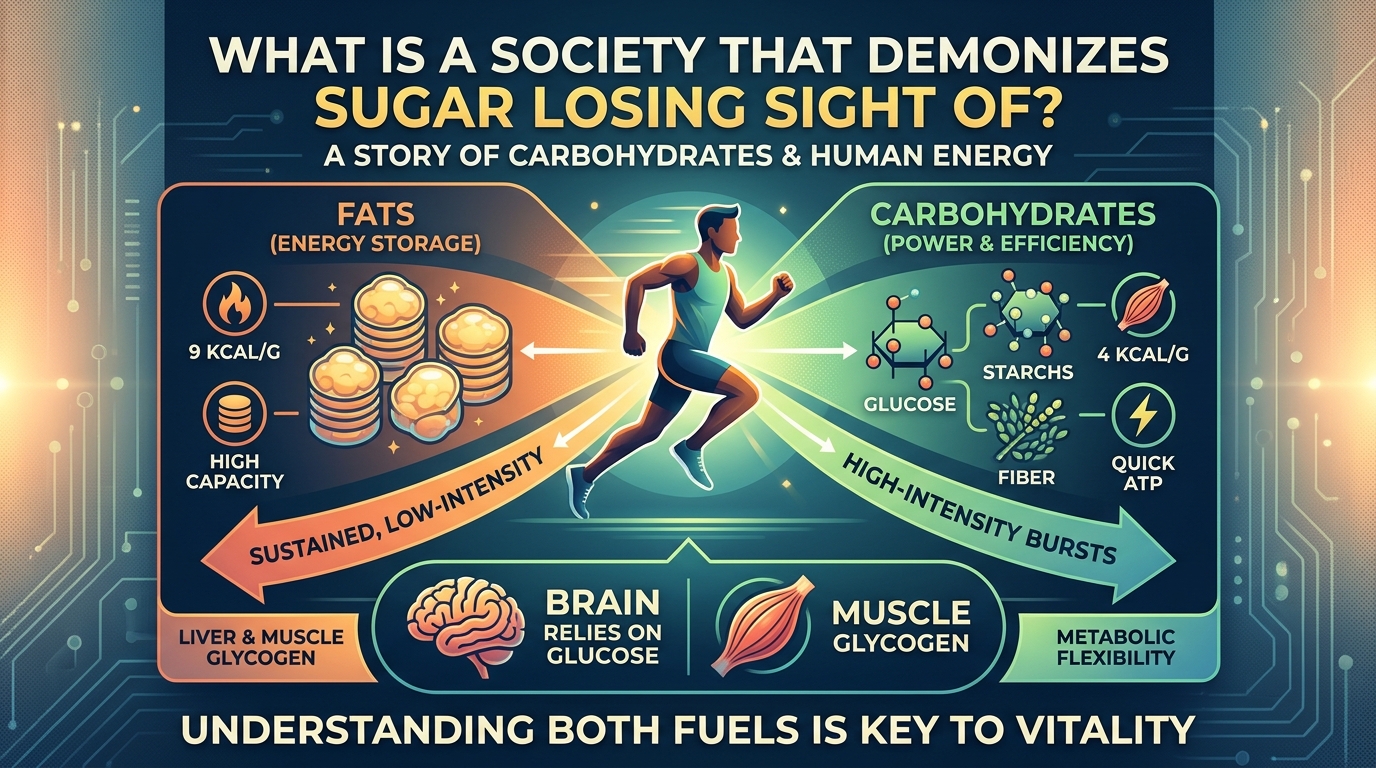
In terms of energy density, fat provides approximately 9 kcal per gram, more than double the roughly 4 kcal per gram provided by carbohydrates. Consequently, fat is vastly superior in terms of energy storage capacity per unit of body weight.
However, when viewed through the lens of energy delivery during exercise, their characteristics diverge sharply. Fat oxidation generally supports ATP resynthesis at a lower maximal rate than carbohydrate metabolism, making it less suited to meeting the rapid energy demands of high-intensity movement. Moreover, oxidizing fatty acids requires significantly more oxygen to produce a given amount of ATP than oxidizing carbohydrates. In contrast, carbohydrates not only generate ATP rapidly via oxygen-independent glycolysis, but also resynthesize ATP with less oxygen consumption during aerobic metabolism.
In other words, carbohydrates yield more ATP per liter of oxygen consumed than fat, giving them a distinct advantage during high-intensity exercise where oxygen delivery becomes a limiting factor. The human body dynamically balances these two complementary fuels: fat for massive, long-term energy storage, and carbohydrates for high-rate, oxygen-efficient energy delivery.
Chapter 4: Fat Is Also a Vital Energy Source
The Body Can Produce Energy Even When Carbohydrates Are Scarce
Having emphasized the importance of carbohydrates, it is equally important to recognize that fat is a vital energy source. At rest and during low-intensity movement, fatty acid oxidation contributes substantially to energy expenditure. Even when dietary carbohydrate intake is reduced, the human body adapts by upregulating fat oxidation.
Furthermore, through a process called gluconeogenesis, the liver can synthesize new glucose from non-carbohydrate precursors such as lactate, glycerol, and certain amino acids. When low carbohydrate availability persists, the liver produces ketone bodies, which the brain and peripheral tissues can utilize as an alternative fuel.
Thus, the human body possesses robust mechanisms to cope with low-carbohydrate conditions; movement does not simply grind to a halt without dietary carbs. However, being able to function without carbohydrates is quite different from optimizing athletic performance. The body’s capacity to burn fat does not render carbohydrates obsolete. Fat and carbohydrates are not mutually exclusive rivals; they are cooperative fuels deployed according to physiological demand.
Chapter 5: High Carbohydrate Intake Is Different From the Ability to Utilize Carbohydrates
Physical Activity Alters the Meaning of Carbohydrates
An essential distinction often lost in nutrition debates is the difference between merely ingesting carbohydrates and possessing a body capable of utilizing them effectively. Someone with a sedentary lifestyle and someone engaging in hours of daily endurance training have vastly different energetic requirements.
For instance, if an office worker with minimal daily physical activity consistently consumes large amounts of carbohydrate-rich foods and sugary beverages, total caloric intake can easily exceed expenditure. When energy intake chronically exceeds energy expenditure, the body stores the excess energy, primarily as body fat. Although increased carbohydrate availability promotes carbohydrate oxidation and can suppress fat oxidation, long-term changes in body fat are determined by overall energy balance, not carbohydrate intake alone. Sustained energy surplus and increased adiposity can contribute to metabolic disturbances such as obesity and insulin resistance.
Conversely, for an individual subjecting their body to high daily training loads and depleting muscle glycogen stores, carbohydrate intake can serve an important purpose beyond simply providing calories. It helps replenish glycogen stores and supports the energy demands of training.
The key is not to blanketly vilify carbohydrates, but to consider the type and quantity of carbohydrates consumed in balance with one’s physical activity level and energy expenditure. Building a body capable of utilizing carbohydrates when needed—and fueling appropriately for daily activity and training—is central to sound health management.
Chapter 6: What Carbohydrates Mean to an Athlete
VT1, VT2, and Fuel Utilization Ratios
In endurance sports, the relative contribution of carbohydrates and fats shifts dynamically with exercise intensity. Fundamentally, both substrates are oxidized simultaneously from rest all the way to maximal exertion.
These thresholds are markers of changes in ventilatory response, not precise metabolic boundaries at which the body switches from fat to carbohydrate. The relative contribution of each fuel changes continuously with exercise intensity, duration, training status, and nutritional availability.
- Below the First Ventilatory Threshold (VT1): During low-to-moderate intensity exercise, fatty acid oxidation accounts for a relatively high proportion of total energy expenditure.
- Above the Second Ventilatory Threshold (VT2): As intensity rises into high-intensity domains, reliance on muscle glycogen and blood glucose oxidation increases sharply to sustain the required rate of ATP production per unit of time.
Do Low-Carbohydrate, High-Fat Diets Benefit Endurance Performance?
Does maximizing the body’s ability to burn fat automatically translate into superior endurance performance? Research offers compelling insights.
Burke and colleagues conducted a dietary and training intervention on elite race walkers following a low-carbohydrate, high-fat (LCHF) diet (Burke et al., 2017). While the LCHF group markedly increased their rates of fat oxidation during exercise, their oxygen consumption increased at race-pace intensities—meaning their exercise economy (oxygen cost to maintain a given speed) worsened—and their 10 km race performance failed to improve.
These findings are consistent with the physiological advantage of carbohydrates, which provide more ATP per liter of oxygen consumed than fat. This advantage can become particularly important in high-intensity endurance events where oxygen delivery is a limiting factor.
Periodizing Carbohydrate Availability Around Training Goals
Modern sports nutrition emphasizes adjusting carbohydrate availability to align with specific training objectives. Strategically training with reduced glycogen stores—a practice known as “Train Low”—has been studied for its potential to amplify certain cellular adaptations, such as mitochondrial biogenesis and the upregulation of fat-oxidizing enzymes (Mata et al., 2019).
However, because low glycogen availability compromises absolute training intensity and session quality, performing all workouts in a carbohydrate-depleted state is unlikely to maximize high-intensity performance. During key high-intensity workouts and race-pace sessions, ensuring ample carbohydrate availability remains vital to maintaining training quality.
Meanwhile, the precise mechanisms by which carbohydrate ingestion during exercise enhances performance remain an active area of scientific inquiry. A 2026 review by Noakes and colleagues challenges aspects of this conventional paradigm, proposing a model that places greater emphasis on preventing exercise-induced hypoglycemia and maintaining central nervous system function, rather than attributing fatigue primarily to muscle glycogen depletion (Noakes et al., 2026). However, this represents the authors’ interpretation of the evidence, and the relative contributions of muscle glycogen depletion, blood glucose availability, and central mechanisms to exercise fatigue remain subjects of scientific discussion. In any case, the practical takeaway for athletes remains clear: rather than blindly slashing carbohydrates, the goal is to strategically deploy carbohydrates in alignment with targeted physiological adaptations and exercise intensities.
Conclusion: Mastering Carbohydrates Rather Than Demonizing Them
In modern society, we are easily drawn to simplistic narratives suggesting that vilifying a single nutrient is the secret to health. Decades ago, dietary fat was cast as the enemy; today, carbohydrates occupy that role. Yet human physiology does not operate on such reductive moral binaries.
Our bodies are equipped with multiple, complementary energy systems: the ATP-PCr system, glycolysis, aerobic carbohydrate oxidation, and fatty acid oxidation. Carbohydrates play a particularly important role in sustaining high-intensity exercise and repeated efforts requiring high power output, while fats serve as a major energy reservoir and contribute substantially to energy production at rest and during prolonged, low-intensity activity.
Within the context of sedentary modern lifestyles, moderating the excessive intake of free sugars is undeniably prudent. However, a vast gulf separates that sensible precaution from treating carbohydrates themselves as toxic enemies of the human body.
Rather than fixating exclusively on restricting carbohydrates, cultivating metabolic flexibility—the capacity to efficiently utilize both carbohydrates and fats according to physiological demand—lies at the true heart of health and physical capability.
Health is not achieved solely by eliminating carbohydrates. Building a body capable of utilizing carbohydrates, and deploying the right fuel when the moment demands it, is an equally vital expression of human health and physical potential.
References
1. Mata F, et al. Carbohydrate Availability and Physical Performance: Physiological Overview and Practical Recommendations. Nutrients. 2019;11(5):1084. PMID: 31100798
2. World Health Organization (WHO). Guideline: Sugars intake for adults and children. 2015. WHO publication
3. Noakes TD, Prins PJ, Buga A, D’Agostino DP, Volek JS, Koutnik AP. Carbohydrate Ingestion on Exercise Metabolism and Physical Performance. Endocrine Reviews. 2026;47(2):191–243. PMID: 41562187
4. Burke LM, Ross ML, Garvican-Lewis LA, et al. Low carbohydrate, high fat diet impairs exercise economy and negates the performance benefit from intensified training in elite race walkers. The Journal of Physiology. 2017;595(9):2785–2807. PMID: 28012184
5. Murray B, Rosenbloom C. Fundamentals of glycogen metabolism for coaches and athletes. Nutrition Reviews. 2018;76(4):243–259. PMID: 29444266
6. Office for Health Improvement and Disparities (UK). Sugar reduction programme: industry progress 2015 to 2020. 2022. UK Government report
コメント