
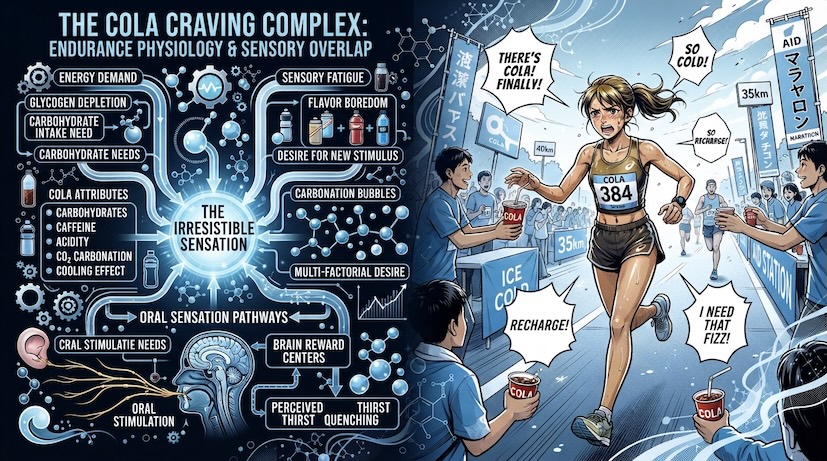
Why cola? Let’s start by delving into that sensation through my own experience.
When running a long race, there are times when a sudden, intense craving for cola arises in the second half. At least, that is how it is for me. Moreover, it is not merely the thought of, “It would be nice to have some cola if it’s there.” In the later stages of a race, my mind can become entirely consumed by cola.
Is there cola at the next aid station? What about the one after that? How many more kilometers do I have to run until I reach cola? How much farther is it to an aid station with cola? I find myself thinking about little else.
The water and sports drinks I have consumed for hours no longer matter. Gels? I am done with them. I don’t even want to look at any more fuel. Yet, I still want to drink something. And in my case, that “something” is cola.
Ideally, I want it ice-cold. Not lukewarm cola, but cold cola. I want to drink it soon. I wish I could reach the next aid station faster. Thinking about such things while running sometimes makes “the next cola” feel more important than the race itself.
And then, I finally reach an aid station with cola. Finding cola feels completely different from simply finding something to drink.
“There’s cola!”
It truly feels just like that.
It is not a matter of casually sipping a single cup. I want to drink as fast as possible. One cup is often not enough. I end up going back for a second, and sometimes a third.
Normally, I wouldn’t think of drinking that much cola during a race. However, after hours of continuous exercise and physical exhaustion, for some reason, cola is the one thing I desperately want.
What is even more mysterious is that the sensation lingers even after crossing the finish line. The race is over. I no longer have to run. Yet, a little while later, I still want cola.
What on earth is this sensation?
Is it a desire for carbohydrates? Caffeine? Water? Or are we seeking a combination of coldness, sweetness, acidity, and carbonation? Or perhaps all of these factors overlapping?
Of course, this is merely a matter of my personal experience. It is not to say that “everyone fiercely craves cola when running a long race.” But for me, it is a remarkably distinct phenomenon.
Precisely for that reason, I wanted to explore this question: “Why cola?”
- “I Need Carbohydrates” Doesn’t Explain It All
- “A Desire for Caffeine” Is Also a Candidate
- The Explanation That “You Just Need Water” Also Misses the Mark
- After Consuming the Same Sustenance for Hours, Does a “Different Stimulus” Become Desirable?
- Do Carbonation Bubbles Hold Any Significance?
- Be Cautious With the Idea That “Carbonation Energizes the Brain”
- So, Ultimately, What Part of Cola Is Being Desired?
- Why Does the Desire for Cola Persist Even After the Finish Line?
- It Is Not a Matter of “The Body Needing Carbonation”
- The Most Convincing Answer So Far
- Even So, I Still Want Cola
- References
“I Need Carbohydrates” Doesn’t Explain It All
Long-Duration Exercise Increases the Demand for Carbohydrates
First, let us consider carbohydrates.
Long-duration exercise depletes glycogen stored in the muscles and liver. To sustain physical activity, obtaining energy externally through food and drink is just as crucial as the energy stored within the body.
Particularly in endurance sports, consuming carbohydrates during exercise helps maintain blood glucose levels while utilizing exogenous carbohydrates as an energy source. Therefore, feeling a desire to “take in some carbohydrates” in the latter half of a race is not particularly strange.
The problem lies beyond that point.
Why, among all carbohydrates, is it specifically cola?
This is the central question here.
Sports drinks also contain carbohydrates. Gels allow for even more efficient carbohydrate intake. Yet, after running for hours, the desire is not for “gels,” but for “cola.”
Here, there appears to be something that simple energy replenishment alone cannot fully explain.
Research Suggests Cola Has Been Used to Boost Performance in the Latter Half of Races
Cola is not merely a beverage one happens to crave during a race.
A 2002 study by Cox et al. examined a condition where participants consumed Coca-Cola during the latter half of a time trial following two hours of moderate-intensity cycling. In the Coca-Cola condition, time trial performance improved, and the study indicated that caffeine played a role in this effect. The researchers concluded that replacing a sports drink with Coca-Cola during the latter stages of exercise could enhance endurance performance, with the effect primarily attributed to the relatively small amount of caffeine consumed.
However, a crucial point to note here is that “it has not been proven that the craving for cola is caused by caffeine.”
What this study investigated was athletic performance when consuming cola. It did not investigate the craving itself—the intense desire to drink cola in the latter half of a long-distance race.
In other words,
the possibility that cola helps improve performance
and
the intense craving for cola in the latter half of a long race
may be related, but they are not necessarily the exact same phenomenon.
“A Desire for Caffeine” Is Also a Candidate
When considering cola, caffeine is another element alongside carbohydrates that cannot be ignored.
Caffeine acts on adenosine receptors, known to affect arousal levels, subjective fatigue, and perceived exertion during exercise.
The effects of caffeine on endurance exercise have long been researched, and in the aforementioned study by Cox et al., caffeine was linked to performance improvements in the cola condition.
Furthermore, a 2021 study by Fowles et al. examined high-intensity interval performance in 13 competitive cyclists using caffeinated cola and other beverages.
In this study, 13 competitive cyclists completed 45 minutes of constant-load cycling followed by four maximal 1-minute intervals. Both caffeinated cola conditions improved mean power, minimum power, and total work compared with the decaffeinated control, while adding carbohydrates to the caffeinated cola did not produce additional improvements in these measures.
So, caffeine is clearly one factor worth considering when we think about the effects of cola.
Yet, even so, it cannot entirely account for my personal cola craving.
This is because caffeine can also be obtained from coffee, energy drinks, or supplements.
And yet, I still want cola.
In other words, while caffeine may be “one piece of material explaining the cola craving,” it is unlikely to be the definitive answer.
The Explanation That “You Just Need Water” Also Misses the Mark
Long races can involve substantial fluid loss through sweating. Naturally, water is also lost. In hot environments, this impact is even greater.
Therefore, feeling strong thirst in the latter half of a long race is completely natural.
So, is it simply because “I am thirsty, therefore I want cola”?
This, too, may be partly relevant.
However, viewed purely from the perspective of hydration, cola is not necessarily the most rational beverage. When considering fluid and electrolyte replacement during a race, sports drinks are generally formulated with fluid and electrolyte replacement in mind.
And yet, cola is what I want.
In short, the explanation that “cola is desired because water is needed” remains insufficient.
To begin with, the sensation of “being thirsty” and the desire of “wanting cola” are not identical.
Drinking water alleviates the sensation of thirst to a certain extent. Even so, the desire for cola remains.
This distinction is precisely what seems important.
After Consuming the Same Sustenance for Hours, Does a “Different Stimulus” Become Desirable?
Growing Tired of Gels and Sports Drinks
Let us shift perspectives slightly.
In long-duration races, the issue is not just about nutrients; “flavor” also becomes a problem.
Gels that went down easily in the early stages suddenly become repulsive in the latter half. Drinking the same sports drink for hours makes the same sweet flavors can become difficult to tolerate.
This is likely something anyone with experience in long-duration endurance sports can relate to to some degree.
Of course, there is no direct scientific proof stating that “consuming the same flavor for hours creates a desire for cola.”
This consideration stems strictly from my own personal experience.
Physically, the body requires carbohydrates. But the mouth no longer accepts the same kind of sweet nutrition.
That is when a completely different stimulus enters the picture.
Cola has sweetness. But that is not all. It has acidity. A unique aroma. Carbonation. And it is cold.
After hours of taking in similar foods and drinks, all of these sensations arrive at once.
That creates an experience entirely different from simply “adding more carbohydrates.”
Beyond “What Is Ingested” to “How It Is Experienced”
Sports nutrition tends to focus heavily on numerical figures: “how many grams of carbohydrates were ingested,” “how many milligrams of caffeine,” “how many milliliters of water.”
Of course, those are important.
However, a human actually running a race is not consuming mere numbers.
Sweet.
Cold.
Sour.
Fizzy.
These sensory experiences are felt simultaneously.
After hours of repeating similar forms of nutrition, such “shifts in sensation” itself can become attractive.
That being said, this cannot be stated conclusively either.
There are no studies directly proving the phenomenon that “boredom with flavors creates a craving for cola.”
Even so, looking back at my own experience, this factor is difficult to ignore.
Do Carbonation Bubbles Hold Any Significance?
Coldness and Carbonation Alter the Drinking Experience
One of the defining characteristics of cola is its carbonation.
Carbonation is more than just carbon dioxide; it provides a unique tactile stimulation to the mouth and throat.
An interesting study exists regarding this sensation.
In 2016, Peyrot des Gachons et al. investigated how beverage temperature and carbonation affect the perception of “drinking sensation” and “thirst quenching” in thirsty adults.
The results showed that oral cooling and carbonation altered how participants perceived drinking and thirst quenching. In other words, the sensory stimulation produced in the mouth and throat can influence how drinking and thirst relief are perceived, independently of the actual amount of fluid consumed.
This is an intriguing point when considering our current theme.
Having run for hours, the mouth is dry.
Into that environment enters cold cola.
Sweet. Sour. Fizzy.
The moment that happens, one feels, “This is it.”
Perhaps there is a sensory satisfaction here distinct from mere hydration.
However, this study did not target athletes during a race.
Nor did it prove that “carbonation causes the desire for cola.”
What is known is that oral sensations resulting from coldness and carbonation can affect thirst and perceived drinking experiences.
Beyond that point remains speculation.
A University of Tsukuba Study on Carbonated Water After Exercise
When considering the relationship between carbonation and exercise, a 2024 study by Kajiki et al. from the University of Tsukuba is also of interest.
In this study, 12 healthy, regularly exercising young adults performed 60 minutes of cycling in a hot environment (35°C), followed by the ingestion of either 4℃ carbonated water or non-carbonated water.
As a result, the condition in which carbonated water was ingested showed temporary changes in blood pressure and cerebral blood flow indices post-exercise, along with enhanced oral refreshment and reduced sleepiness.
It would be premature to conclude from this that “carbonated water has a fatigue recovery effect.”
The conditions investigated in this study involved post-exercise responses in a hot environment. They differ from the conditions of endurance athletes in the latter half of a race, such as a long-distance triathlon or marathon.
Nevertheless, this study features one interesting aspect.
The physiological and subjective responses to drinking carbonated water may involve mechanisms that cannot be fully explained by water alone.
Particularly, the differences observed in sensations like “oral refreshment” and “sleepiness” serve as a useful reference point when pondering the craving for cola.
However, one cannot conclude from this that “therefore, cola is desired in the latter half of a long-distance race.”
The research does not go that far.
Be Cautious With the Idea That “Carbonation Energizes the Brain”
Further interesting research was published in 2026.
Takahashi et al. conducted a randomized crossover trial in which 15 young adults consumed either carbonated water or plain water during 3 hours of e-sports play.
In the carbonated water condition, increases in subjective fatigue were suppressed, and declines in executive function were also mitigated. Furthermore, no major differences were observed between conditions regarding blood glucose or salivary cortisol levels.
This is quite a fascinating study.
However, a clear line must be drawn here as well.
The participants were not endurance athletes. Nor were they participating in cycling or running races. They were playing e-sports for 3 hours.
Consequently, these results cannot be directly interpreted to mean that “carbonated water reduces brain fatigue in endurance races.”
While this study serves as material to consider how sensory stimulation from carbonation might affect cognitive fatigue and related factors, it does not directly explain the “cola craving in the latter half of a race.”
Oral Stimulation Alone Can Impact Exercise Performance
Here, another vital study comes into play.
The carbohydrate mouth-rinse study conducted by Carter et al. in 2004.
In this study, endurance cyclists rinsed their mouths with a carbohydrate solution without swallowing the carbohydrate solution.
In other words, they investigated whether “sensing” carbohydrates in the mouth, prior to digestion and absorption for energy use, could affect exercise performance.
The research showed that carbohydrate mouth rinsing improved 1-hour bicycle time-trial performance.
This offers a very fascinating suggestion for our theme.
When humans consume food or drink, its significance does not begin only “after nutrients are absorbed into the body.”
From the moment it enters the mouth, tastes, temperatures, and stimuli are perceived, and those signals can influence the brain and our perception of the experience.
Therefore, the feelings of “delicious” and “coming back to life” experienced when drinking cola in the latter half of a race may not simply be the result of carbohydrates entering the bloodstream.
However, a major caveat exists here.
Carter et al.’s study examined oral stimulation by carbohydrates. The same effect has not been proven for carbonation.
“Carbohydrate mouth rinsing showed an effect”
↓
“Carbonation also stimulates the mouth”
↓
“Therefore, the carbonation in cola is stimulating the brain”
cannot be connected in a straight line.
This should be taken merely as a clue that “the sensory stimulation felt inside the mouth itself holds meaning.”
So, Ultimately, What Part of Cola Is Being Desired?
Reflecting on all this brings us back to the initial question.
What on earth is it that I crave in the latter half of a race?
Is it carbohydrates? If so, gels should suffice.
Is it caffeine? If so, coffee or caffeine supplements should suffice.
Is it water? If so, water or sports drinks should suffice.
Is it coldness? If so, cold water should suffice.
Is it carbonation? If so, carbonated water should suffice.
Yet, what I crave is “cola.”
This is where it gets interesting.
Probably, trying to explain it through a single component is impossible.
Cola contains carbohydrates. Depending on the product, it contains caffeine. It contains water. It can be chilled. It has sweetness. It has acidity. It has a unique aroma. It has carbonation.
In other words, multiple stimuli are bundled into a single beverage.
When the body is exhausted from a long race, the mouth is parched, repetitive nutrition has worn down the palate, and mental fatigue has set in, all of those elements enter at once.
Viewed that way, it becomes a bit easier to understand why a single beverage called “cola” may become uniquely appealing as a single beverage.
Still, even here, one cannot conclusively state, “Therefore, this is the cause.”
Rather, it feels more natural to think that multiple factors overlap.
Why Does the Desire for Cola Persist Even After the Finish Line?
Here, there is one more question that lingers for me.
What happens after the race is over?
The finish line has been crossed. Running has stopped. There is no longer any need to expend energy.
Yet, a little while later, a desire for cola arises.
This might be slightly different from the cola craving during the race.
During a race, physiological reasons like carbohydrates, caffeine, and hydration can be hypothesized to some extent. But once the race has ended, such explanations become harder to apply.
Perhaps it is related to the sense of liberation brought by the completion of long-duration exercise.
Drinking a cold beverage itself might serve as a demarcation line signaling “the race is over.”
The intense stimulation of strong flavors and carbonation might act as a trigger to transition from an extended athletic state back to daily life.
Alternatively, the constant thought of “I want cola” during the race might have simply amplified the desire itself.
However, regarding this point, I currently lack a definitive answer.
Even the research examined this time yielded no data directly explaining the phenomenon of “craving cola after the finish line of a long-distance race.”
It is probably better not to forcefully fill that blank with science.
It Is Not a Matter of “The Body Needing Carbonation”
From everything discussed so far, one thing is relatively clear.
It is not that the body requires carbonation.
While carbon dioxide is an important substance in human metabolism, it is different from a nutritional craving like “carbonation is lacking, so I want a carbonated drink.”
That is fundamentally different from craving water, carbohydrates, or sodium.
Therefore, the expression “the body is craving carbonation” is not accurate.
If carbonation is involved, what is being sought is not carbon dioxide itself, but rather the oral and throat stimulation, coldness, refreshment, and overall sensory experience produced by carbonation.
And as a result of that sensation combining with carbohydrates, caffeine, and water, “cola” as a single beverage may become a special existence.
The Most Convincing Answer So Far
So, “Why do I want to drink cola in the latter half of a long race?”
At present, the answer that makes the most sense to me is that a single reason cannot explain it.
Long-duration exercise increases the demand for carbohydrates.
Caffeine possesses actions related to arousal and athletic performance.
Water is also necessary.
Repeating the same nutrition might create a desire for different flavors and stimuli.
To that environment, stimuli such as coldness, acidity, sweetness, aroma, and carbonation are introduced all at once.
Furthermore, the sensory stimulation felt within the mouth itself may influence satisfaction and perception.
Rather than existing independently, these elements overlap within the unique circumstances of a race’s latter half.
Looked at in that light, my desire to “drink cola” does not seem all that strange.
However, what is important here is not to mix what has been directly proven by research with what is being inferred from personal experience.
There are studies suggesting cola’s potential to aid performance in the latter half of a race.
There are studies showing that carbonation and cooling affect thirst and perceived drinking sensations.
There are studies where post-exercise carbonated water influenced oral refreshment and sleepiness.
Studies have also emerged showing that carbonated water affects fatigue and executive function during prolonged cognitive tasks.
And studies have indicated that oral stimulation alone can impact athletic performance.
Yet, connecting all of these to conclude,
“Therefore, this is why cola is craved in the latter half of a long-distance race”
goes too far.
At least within the scope checked this time, no research directly answers it to that extent.
Even So, I Still Want Cola
Ultimately, in my case, it probably comes down to this.
Running for hours leaves the body with little reserve. Water and sports drinks have been consumed. Gels have been eaten. Yet, there is still more running to be done.
It is under those conditions that cola is found at an aid station.
At that moment, the thought is:
“There’s cola!”
And cold cola is consumed.
Sweet.
Sour.
Fizzy.
Cold.
For that brief moment, something slightly different is felt.
Whether that comes from carbohydrates, caffeine, water, carbonation, changes in taste perception, or the tired body and brain responding to several different sensory and physiological needs at once, with cola becoming the thing that feels most appealing—
is still not entirely clear.
Yet, at least the single phrase “because carbohydrates are lacking” cannot explain the sensation.
Nor is it a matter of “carbonation being physically required.”
It is likely far more complex.
Within the unique context of a long-duration race, the body’s energy state, thirst, fatigue, taste perception, caffeine, coldness, carbonation, and the sensation of “drinking this will make things a bit easier” all overlap.
Viewed that way, why that cup of cola is so intensely alluring becomes a little easier to understand.
Even if not fully understood.
And that is fine.
The purpose this time was not to forcefully determine a single “correct answer” for the cola craving.
It was to examine why I search for cola in the latter half of a race, reflecting on it against what happens inside the body.
In that process, it became apparent that it is not just carbohydrates, not just caffeine, not just water, and not just carbonation.
That is as far as I can say for now.
And in the next race, I will probably still be running while searching for cola.
Why does that one drink become so irresistible? Writing this article has given me a slightly clearer sense of why.
References
- Cox GR, Desbrow B, Montgomery PG, et al. Effect of different protocols of caffeine intake on metabolism and endurance performance. Journal of Applied Physiology. 2002;93(3):990-999.
PubMed - Fowles JR, O’Brien MW, Comeau KG, Thurston B, Petrie H. Flattened cola improves high-intensity interval performance in competitive cyclists. European Journal of Applied Physiology. 2021;121(10):2859-2867.
PubMed - Peyrot des Gachons C, Avrillier J, Gleason M, et al. Oral Cooling and Carbonation Increase the Perception of Drinking and Thirst Quenching in Thirsty Adults. PLoS One. 2016;11(9):e0162261.
PubMed - Kajiki M, Katagiri A, Matsutake R, et al. Ingesting carbonated water post-exercise in the heat transiently ameliorates hypotension and enhances mood state. Experimental Physiology. 2024;109(10):1683-1697.
PubMed - Takahashi S, Kosugi W, Mizuno S, Matsui T. Sparkling water consumption mitigates cognitive fatigue during prolonged esports play. Computers in Human Behavior Reports. 2026;21:100943.
ScienceDirect - Carter JM, Jeukendrup AE, Jones DA. The effect of carbohydrate mouth rinse on 1-h cycle time trial performance. Medicine & Science in Sports & Exercise. 2004;36(12):2107-2111.
PubMed
コメント