
- 1. Introduction: Is a Caloric Surplus Necessary to Build Muscle?
- 2. What Is Body Recomposition?
- 3. Why Can Muscle Gain and Fat Loss Occur Simultaneously?
- 4. Can Everyone Achieve Body Recomposition?
- 5. Practical Conditions for Achieving Body Recomposition
- 6. What Does the 2026 Research and Review Evidence Show?
- 7. Implications for Masters Athletes and Adults Over 40
- 8. Conclusion: Do We Need to Separate Bulking and Cutting?
- References
1. Introduction: Is a Caloric Surplus Necessary to Build Muscle?
In the fields of physique development and weight management, a single “rule” has been widely accepted for decades: to build muscle, one must consume more energy than one expends (a caloric surplus), and to lose body fat, one must consume less energy than one expends (a caloric deficit).
Based on this model, gaining muscle and losing body fat appear to be physiologically opposing processes. Consequently, traditional physique transformation has relied on a two-phase strategy that completely separates these goals: a “bulking” phase, in which food intake is increased to gain muscle alongside body weight, followed by a “cutting” phase, in which calories are restricted to shed excess body fat.
However, when focusing solely on whole-body energy balance, it seems difficult to simultaneously establish an energy surplus to build muscle and an energy deficit to lose body fat. For this reason, separating phases for muscle gain and fat loss became the standard approach in conventional physique training.
Yet, is building muscle while losing body fat truly biologically impossible?
To state the conclusion upfront: when appropriate training stimuli are combined with precise nutritional management, achieving both simultaneously is entirely possible. In recent exercise physiology and sports nutrition intervention studies and reviews, this phenomenon is defined as Body Recomposition, and its underlying mechanisms and practical conditions are increasingly being systematized.
2. What Is Body Recomposition?
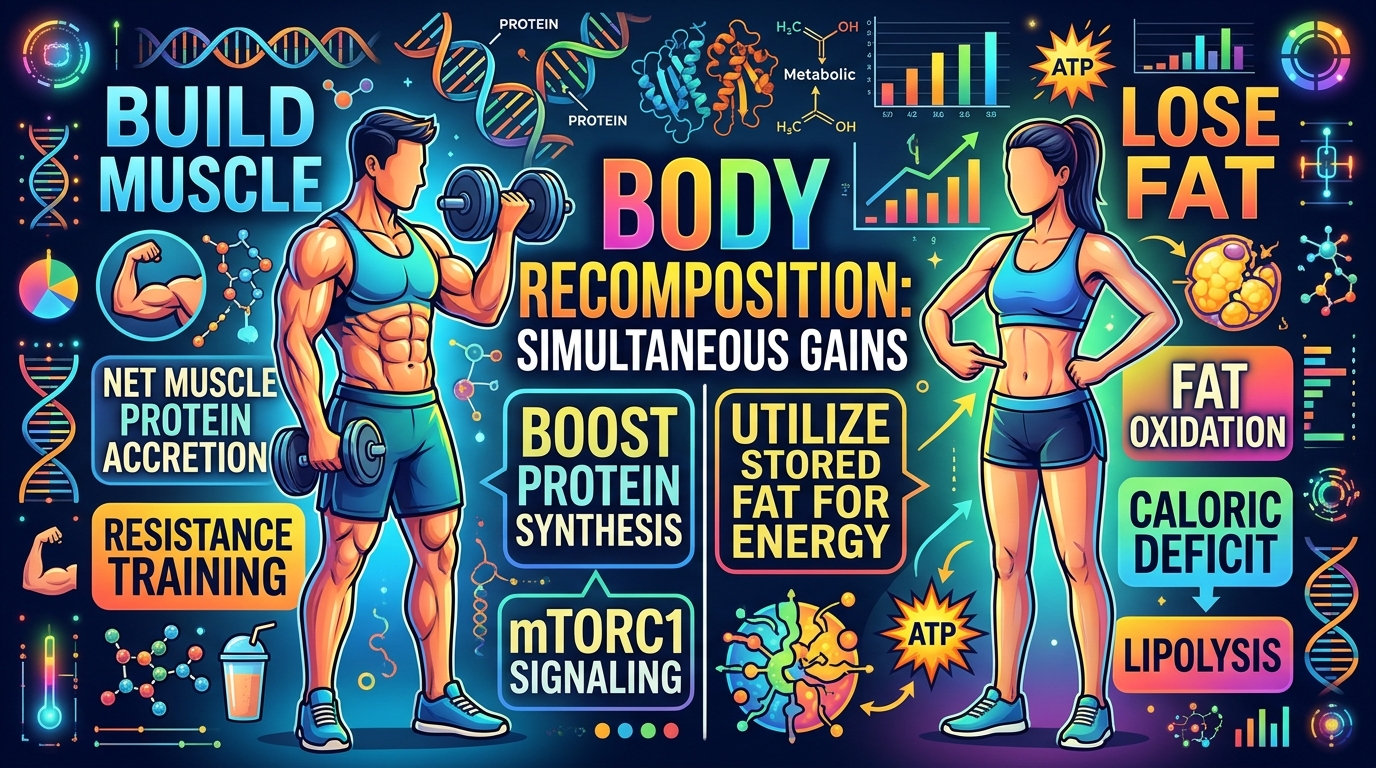
Body recomposition refers to improving overall body tissue composition by simultaneously increasing muscle mass and decreasing fat mass within the same intervention period.
The most critical point in understanding this concept is that changes in body weight do not necessarily align with changes in body composition. For example, if an individual loses 2 kg of body fat while simultaneously gaining 2 kg of fat-free mass (or skeletal muscle), the number on the scale shows a net change of zero. Looking at body weight alone, progress appears stagnant; however, a clear structural recomposition is occurring inside the body.
To advance our scientific discussion accurately, let us clearly distinguish the metrics that constitute the body:
- Body Weight / Body Mass: The total weight of the entire body, including fat, muscle, bone, organs, and water.
- Fat Mass (FM): The total amount of lipids centered around adipose tissue stored in the body, including subcutaneous and visceral fat.
- Fat-Free Mass (FFM): All body weight remaining after subtracting fat mass. This includes skeletal muscle, bone, organs, blood, and body water.
- Skeletal Muscle Mass (SMM): The weight of the muscles attached to bones for bodily movement (skeletal muscle) alone.
- Body Composition: The distribution of body mass among its major components, particularly fat mass and fat-free mass. Fat-free mass includes skeletal muscle, bone, organs, blood, and body water, while skeletal muscle mass represents one component of fat-free mass.
There is an important methodological caveat to keep in mind here. Common body composition assessment tools, such as dual-energy X-ray absorptiometry (DXA) and bioelectrical impedance analysis (BIA), typically calculate “fat mass (FM)” and “fat-free mass (FFM).” Therefore, even when a study reports an “increase in fat-free mass (FFM),” not all of that gain represents pure contractile skeletal muscle protein. Increases in muscle glycogen stores resulting from resistance training and dietary changes, along with the intracellular water retained alongside that glycogen, are also measured as increases in FFM. Thus, when interpreting research data, we must avoid equating FFM entirely with skeletal muscle mass and must account for tissue water and glycogen dynamics.
3. Why Can Muscle Gain and Fat Loss Occur Simultaneously?
The question—”Why would new muscle tissue be synthesized when caloric intake is lower than caloric expenditure (an energy deficit)?”—is entirely natural. To understand this phenomenon, we must clearly separate two distinct metrics: whole-body energy balance and tissue-specific metabolic and substrate balance.
Net Muscle Protein Balance and Accretion
What determines the net accretion of muscle protein over time is the balance between Muscle Protein Synthesis (MPS) and Muscle Protein Breakdown (MPB) within skeletal muscle tissue. When cumulative MPS exceeds cumulative MPB over an extended period, muscle protein is progressively accrued, contributing to skeletal muscle hypertrophy.
Performing resistance training applies mechanical tension to the muscle, stimulating MPS via intracellular signaling pathways such as the mTORC1 pathway. Meanwhile, exercise also alters MPB. By consuming sufficient dietary protein and consistently tipping this balance between synthesis and breakdown toward the positive side, muscle protein accumulation progresses.
Distinguishing Building Materials from Energy Sources
What must not be confused here is the difference between the raw materials needed to build muscle and the energy sources required to synthesize and maintain muscle.
The direct building blocks for synthesizing new muscle protein are amino acids obtained from dietary protein, particularly the essential amino acids. Among them, leucine plays an important signaling role in stimulating muscle protein synthesis. Muscle is not built directly from calories. As long as sufficient dietary protein is supplied and anabolic signals from resistance training are present, muscle cells will take up amino acids to synthesize muscle protein, though this response can be modulated by energy status and recovery capacity.
On the other hand, the chemical reactions required to synthesize muscle protein (peptide bond formation), the training sessions themselves, and the maintenance of basal metabolism all demand substantial energy (ATP). When dietary energy intake falls below energy expenditure (a whole-body energy deficit), where does the missing energy come from?
It comes from the mobilization of energy stored in adipose tissue.
When an energy deficit occurs—accompanied by exercise-induced catecholamine secretion and hormonal shifts like reduced insulin levels—triglycerides stored within adipocytes undergo lipolysis, breaking down into free fatty acids (FFAs) and glycerol, which are released into the bloodstream. These circulating FFAs are transported to tissues such as skeletal muscle, where they are oxidized within mitochondria to generate ATP.
In an energy deficit, stored body fat can be mobilized and oxidized to contribute to the energy required for daily metabolism and tissue maintenance. At the same time, dietary amino acids and resistance-training stimuli can support muscle protein synthesis. Although these processes are not completely independent, this helps explain how fat mass can decrease while muscle protein is maintained or, under favorable conditions, increased.
Limits of the Energy Deficit
However, the ability to mobilize energy from body fat does not mean unlimited muscle hypertrophy is possible regardless of how severely calories are cut. When the energy deficit becomes too large, the anabolic response to resistance training and protein intake may be attenuated. Changes in cellular energy-sensing pathways, including AMPK-related signaling, may contribute to this response, alongside alterations in hormonal regulation, substrate availability, and recovery capacity.
A meta-analysis and meta-regression by Murphy & Koehler (2022) demonstrated that as the magnitude of the energy deficit increases, gains in fat-free mass from resistance training are progressively blunted. Their meta-regression estimated that an energy deficit of approximately 500 kcal per day was sufficient to eliminate average resistance-training-induced gains in lean mass in the populations studied. This should not be interpreted as a universal threshold, as individual responses vary according to factors such as training status, body composition, and age.
4. Can Everyone Achieve Body Recomposition?
While body recomposition is physiologically possible, it does not occur to the same magnitude in everyone. The difficulty of achieving it and the extent of observable change vary considerably depending on an individual’s training experience and baseline body fat percentage.
- Resistance Training Beginners: Individuals without prior training experience tend to show robust adaptations during the initial stages of resistance training, exhibiting relatively large increases in muscle protein synthesis responses and muscular strength. Consequently, pronounced gains in lean mass alongside reductions in fat mass are frequently observed even under energy restriction.
- Individuals Returning After a Long Break: Those with past training experience who resume training after a prolonged hiatus due to injury or lifestyle factors also demonstrate heightened responsiveness similar to beginners. This phenomenon—the ability to rapidly regain previously acquired muscle and training adaptations—is known as Muscle Memory. Mechanisms such as the retention of myonuclei and epigenetic modifications are actively researched as potential contributors, though the full picture has yet to be elucidated.
- Individuals with Higher Baseline Body Fat: People starting with higher fat mass possess a relatively large reserve of stored energy, which may provide greater flexibility for mobilizing energy from adipose tissue during an energy-restricted intervention. When combined with limited resistance-training experience, this can create favorable conditions for simultaneous fat loss and muscle gain.
- Highly Experienced Trainees: Individuals who have engaged in structured resistance training consistently over many years have less room for hypertrophic adaptation compared to beginners. Consequently, incremental muscle gains in response to training stimuli are smaller, making it challenging to build additional muscle in an energy-deficient environment.
- Individuals Who Are Already Muscular and Lean: For individuals who are already highly muscular and lean, the relatively small reserve of stored body fat and limited potential for further hypertrophy make simultaneous muscle gain and fat loss more difficult, particularly during an energy deficit.
Even for experienced trainees, body recomposition is not entirely impossible. As we will see in the studies discussed below, simultaneous increases in fat-free mass and decreases in fat mass have been reported in trained individuals. However, compared to beginners or those with higher body fat, the magnitude of muscle gain is far smaller and demands highly precise training and nutritional management—a realistic limitation that must be kept in mind.
5. Practical Conditions for Achieving Body Recomposition
To intentionally induce body recomposition, training, nutrition, and recovery must all be aligned with high precision.
Resistance Training
When aiming to build muscle while reducing caloric intake, resistance training is the critical trigger that provides the stimulus for muscle synthesis. Although some forms of aerobic exercise can stimulate modest muscle adaptations, progressive resistance training provides a more direct and reliable stimulus for skeletal muscle hypertrophy. Therefore, it should be a central component of a body recomposition program when muscle gain is a primary goal. For hypertrophy, training does not strictly need to be confined to a narrow percentage of one-repetition maximum (1RM). Both relatively heavy loads and lighter loads can stimulate muscle hypertrophy provided sets are performed with sufficient effort. However, heavier loads become increasingly important when prioritizing maximal strength gains. Moreover, applying the principle of progressive overload—gradually increasing training demands through changes in load, repetitions, volume, or other relevant variables—is an important strategy for sustaining long-term adaptations.
Protein Intake
Under energy restriction, protein is the most critical macronutrient. In sports nutrition, an intake of approximately 1.6–2.4 g per kilogram of body weight per day is often suggested as a practical range, particularly for individuals undertaking resistance training during energy restriction. The appropriate target depends on training status, body composition, and the magnitude of the energy deficit. Distributing total daily protein intake across multiple meals is a rational approach.
Energy Intake
When pursuing body recomposition, avoiding severe caloric deficits and instead establishing a modest energy deficit close to maintenance calories is the most rational strategy. The exact size of the deficit should be adjusted based on body fat percentage, training history, muscle mass, and recovery status. Notably, for beginners, returning trainees, or individuals with higher body fat, a pronounced caloric deficit is not always necessary; simply combining resistance training with a high-protein diet near maintenance calories (energy balance) can lead to fat loss and muscle gain.
Carbohydrates
Excessively restricting carbohydrates can deplete muscle glycogen stores, making it difficult to sustain high training intensities and volumes. As a result, one may fail to secure the mechanical stimulus necessary for muscle hypertrophy. After prioritizing adequate protein intake and maintaining sufficient dietary fat to support essential fatty acid requirements and normal physiological function, allocating an appropriate proportion of the remaining energy intake to carbohydrates can help sustain training performance. Carbohydrate periodization—consuming more carbohydrates on demanding training days and somewhat less on rest or low-intensity days—can be used as a practical strategy to align carbohydrate availability with training demands. However, its superiority over a consistent daily intake for improving body recomposition has not been established.
Sleep and Recovery
Resistance training provides the mechanical stimulus that initiates muscle protein synthesis, while the ongoing balance of synthesis and breakdown continues afterward; establishing a recovery environment that includes adequate nutrition and sleep supports long-term muscle maintenance and growth. For example, in a 14-day randomized crossover study involving 10 overweight adults (Nedeltcheva et al.), reducing nightly sleep opportunity from 8.5 hours to 5.5 hours decreased fat loss from 1.4 kg to 0.6 kg and increased fat-free mass loss from 1.5 kg to 2.4 kg. These findings suggest that insufficient sleep can adversely affect body composition changes during energy restriction. Although individual sleep needs vary, maintaining approximately 7–9 hours of sleep per night is a reasonable general target for adults.
6. What Does the 2026 Research and Review Evidence Show?
Scientific knowledge regarding body recomposition was recently synthesized in a comprehensive review published in November 2026.
Overview of the 2026 Review
- Title: Body recomposition in adults: mechanisms, modulators, and practical algorithms for simultaneous skeletal muscle mass gain and fat mass loss
- Authors: Siavash Naddafha, Brad J. Schoenfeld, Jose Antonio, Jeffrey R. Stout
- Journal: Journal of the International Society of Sports Nutrition
- Volume & Article Number: Vol. 23, Issue 1, Article 2743880 (Published online: November 10, 2026)
- DOI:
10.1080/15502783.2026.2743880
This paper is a narrative review integrating randomized controlled trials (RCTs), meta-analyses, and mechanistic studies, in which the authors operationally define body recomposition as the simultaneous increase in fat-free mass and decrease in fat mass within the same intervention period.
Naddafha et al. (2026) synthesize the available evidence and propose practical recommendations for body recomposition, while emphasizing that the magnitude of the response depends on individual characteristics and intervention conditions:
- Feasibility and Conditions: Combining progressive resistance training, sufficient protein intake (generally 1.6–2.4 g/kg/day), and appropriate energy management makes body recomposition achievable in adults.
- Population Differences: Effects are most pronounced in untrained individuals and those with higher body fat, whereas changes are smaller in trained individuals and lean athletes, though still attainable. Recomposition is also achievable in older adults with appropriate interventions.
- Practical Algorithms: Practitioners should avoid aggressive energy deficits, adjust intake near maintenance calories, allocate carbohydrates appropriately to support training-day performance, and monitor body composition and strength progression—not scale weight alone—to make ongoing adjustments.
Specific Intervention Studies Observing Simultaneous Changes
Examining representative RCTs and related studies forming the evidence base of this field illustrates concrete protocols and outcomes:
- Longland et al. (2016) (American Journal of Clinical Nutrition, DOI:
10.3945/ajcn.115.119339):- Subjects & Duration: 40 overweight young men over a 4-week intervention.
- Protocol: Participants underwent a severe energy deficit (~40% below maintenance) combined with 6 days per week of high-intensity resistance training and HIIT, randomized into a high-protein group (2.4 g/kg/day) or a control protein group (1.2 g/kg/day).
- Measurements & Results: Assessed via a 4-compartment model, the control group showed a +0.1 kg change in lean body mass (LBM) and a −3.5 kg change in fat mass (FM), whereas the high-protein group gained +1.2 kg of LBM while losing −4.8 kg of FM. However, because this study involved young men over a short duration performing high-frequency training 6 days per week, its exact magnitude of results cannot be directly generalized to average trainees.
- Josse et al. (2011) (Journal of Nutrition, DOI:
10.3945/jn.111.141028):- Subjects & Duration: 90 overweight and obese premenopausal women over a 16-week intervention.
- Protocol: Participants followed a dietary deficit alongside an exercise program (aerobic exercise plus twice-weekly resistance training), divided into groups varying in protein and dairy intake.
- Results: All groups lost body weight and fat mass. The high-protein, high-dairy group experienced greater fat loss during the second half of the intervention and gained lean tissue, whereas the adequate-protein, low-dairy group lost lean tissue. These findings indicate that the combination of higher protein and dairy intake with exercise can favorably influence body composition during weight loss.
- Antonio et al. (2015) (Journal of the International Society of Sports Nutrition, DOI:
10.1186/s12970-015-0100-0):- Subjects & Duration: 48 resistance-trained men and women over an 8-week intervention.
- Protocol & Results: Comparing a normal-high protein group (~2.3 g/kg/day) with a super-high protein group (~3.4 g/kg/day), the super-high protein group lost −1.7 kg of fat mass (compared to −0.3 kg in the normal-high group) and reduced body fat percentage by −2.4% (vs. −0.7%), while total energy intake increased in the super-high protein group. Note that this study was not conducted under energy restriction and therefore does not directly demonstrate recomposition under an energy deficit.
- Murphy & Koehler (2022) Meta-Analysis:
- This meta-analysis and meta-regression found that increasing energy deficits progressively impaired resistance-training-induced gains in lean mass, with an estimated deficit of approximately 500 kcal/day eliminating average lean-mass gains. However, strength gains were not significantly impaired by the energy deficit.
7. Implications for Masters Athletes and Adults Over 40
For adults in their 40s, 50s, 60s, and beyond, the concept of body recomposition carries profound health implications that extend far beyond aesthetics.
With aging, the risk of sarcopenia increases. Sarcopenia is characterized primarily by reduced muscle strength, accompanied by low muscle quantity or quality, and may progress to impaired physical performance. Aging is also associated with changes in body composition, including an increased tendency toward fat accumulation and a decline in skeletal muscle mass. Furthermore, aging is often associated with anabolic resistance, a reduced muscle protein synthesis response to dietary protein intake and exercise compared with younger adults. However, its magnitude varies among individuals and is influenced by physical activity, nutritional status, and health conditions.
When middle-aged and older adults engage in conventional calorie-restricted dieting aimed solely at lowering scale weight without resistance training or adequate protein, they risk losing valuable skeletal muscle alongside body fat. Particularly in midlife and beyond, preserving muscle mass and strength is vital; rather than using weight loss alone as the yardstick of success, attention must be directed toward changes in body composition and physical function.
Therefore, for the masters demographic, adopting a body recomposition mindset—maintaining or increasing skeletal muscle mass while reducing excess body fat without drastic drops in body weight—is exceptionally rational.
Clinical trials in middle-aged and older populations support the efficacy of this approach:
- Verreijen et al. (2017) (Nutrition Journal, DOI:
10.1186/s12937-017-0229-6):- A 10-week weight-loss intervention in 100 overweight and obese adults aged 55–80. Within-group analysis showed that the group combining high protein intake with resistance training increased fat-free mass by an average of 0.6 kg. However, this change was not significantly greater than the changes observed in the other groups in between-group comparisons. FFM was assessed using air-displacement plethysmography rather than a direct measurement of skeletal muscle mass.
- Verreijen et al. (2015) (American Journal of Clinical Nutrition, DOI:
10.3945/ajcn.114.090290):- A 13-week energy-restricted intervention with thrice-weekly resistance training in 80 obese older adults (mean age ~63 years). The intervention group showed a +0.4 kg change in appendicular muscle mass, compared with a −0.5 kg change in the control group. The between-group difference was statistically significant, indicating that the whey protein-, leucine-, and vitamin D-enriched supplement helped preserve appendicular muscle mass during weight loss, while both groups significantly reduced fat mass.
These studies suggest that even in older adults, combining resistance training with adequate high-quality protein intake can help preserve muscle-related tissue during energy restriction. Under certain conditions, increases in fat-free mass or appendicular muscle mass may also be observed, although the magnitude and statistical significance of these changes vary across studies.
8. Conclusion: Do We Need to Separate Bulking and Cutting?
As we have seen, the traditional dichotomy claiming that “a caloric surplus is mandatory to build muscle and a caloric deficit is mandatory to lose fat” captures only part of human physiology. While an energy surplus can be advantageous for maximizing the rate of muscle hypertrophy, it is not an absolute prerequisite for muscle growth.
Whole-body energy balance and net muscle protein balance within skeletal muscle are governed by distinct mechanisms. By delivering mechanical signals to muscle via resistance training, supplying adequate dietary amino acids, and moderating the magnitude of an energy deficit, the body can utilize stored body fat to help meet energy demands while supporting muscle protein synthesis. Under favorable conditions, these processes allow fat mass to decrease while fat-free mass is maintained or increased.
Of course, body recomposition is not the single optimal strategy for everyone. However, for general trainees seeking health and performance improvements, and for masters adults aiming to improve body composition, maintain physical function, and prevent age-related muscle loss, it is not strictly necessary to adopt a traditional two-phase cycle of bulking up with excess body fat only to diet it off later.
To build muscle, you do not necessarily need to gain weight.
By understanding the body’s adaptive capacity and metabolic flexibility—and precisely integrating training, nutrition, and recovery—we can proactively reshape our body composition regardless of age or conventional dogma.
References
1. Naddafha S, Schoenfeld BJ, Antonio J, Stout JR. Body recomposition in adults: mechanisms, modulators, and practical algorithms for simultaneous skeletal muscle mass gain and fat mass loss. J Int Soc Sports Nutr. 2026;23(1):2743880.
PubMed PMID: 43007655
2. Longland TM, Oikawa SY, Mitchell CJ, Devries MC, Phillips SM. Higher compared with lower dietary protein during an energy deficit combined with intense exercise promotes greater lean mass gain and fat mass loss: a randomized trial. Am J Clin Nutr. 2016;103(3):738-746.
PubMed PMID: 26817506
3. Josse AR, Atkinson SA, Tarnopolsky MA, Phillips SM. Increased consumption of dairy foods and protein during diet- and exercise-induced weight loss promotes fat mass loss and lean mass gain in overweight and obese premenopausal women. J Nutr. 2011;141(9):1626-1634.
PubMed PMID: 21775530
4. Antonio J, Ellerbroek A, Silver T, et al. A high protein diet (3.4 g/kg/d) combined with a heavy resistance training program improves body composition in healthy trained men and women – a follow-up investigation. J Int Soc Sports Nutr. 2015;12:39.
PubMed PMID: 26500462
5. Murphy C, Koehler K. Energy deficiency impairs resistance training gains in lean mass but not strength: A meta-analysis and meta-regression. Scand J Med Sci Sports. 2022;32(1):125-137.
PubMed PMID: 34623696
6. Nedeltcheva AV, Kilkus JM, Imperial J, Schoeller DA, Penev PD. Insufficient sleep undermines dietary efforts to reduce adiposity. Ann Intern Med. 2010;153(7):435-441.
PubMed PMID: 20921542
7. Verreijen AM, Verlaan S, Engberink MF, Swinkels S, de Vogel-van den Bosch J, Weijs PJM. A high whey protein-, leucine-, and vitamin D-enriched supplement preserves muscle mass during intentional weight loss in obese older adults: a double-blind randomized controlled trial. Am J Clin Nutr. 2015;101(2):279-286.
PubMed PMID: 25646324
8. Verreijen AM, Engberink MF, Memelink RG, van der Plas SE, Visser M, Weijs PJM. Effect of a high protein diet and/or resistance exercise on the preservation of fat free mass during weight loss in overweight and obese older adults: a randomized controlled trial. Nutr J. 2017;16(1):10.
PubMed PMID: 28166780
コメント