
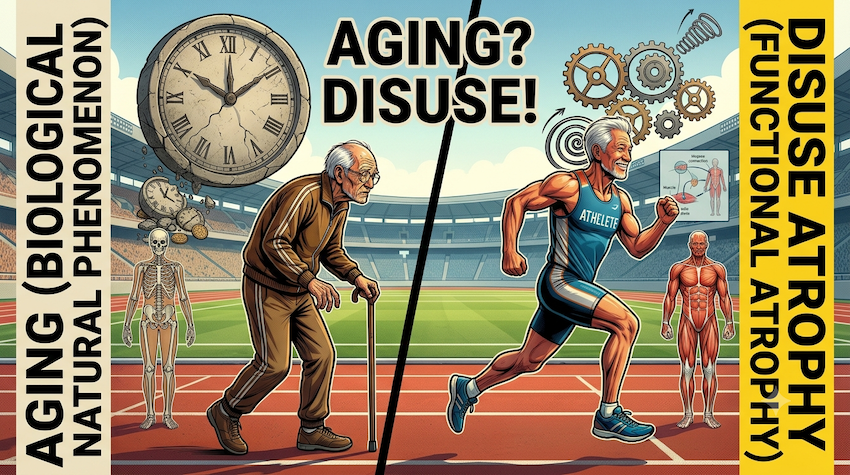
In the midst of grueling daily training, we often catch ourselves reaching for a convenient excuse: “I’m just getting older.” “If I push this hard, I’ll get injured.” “At my age, recovery takes forever.”
Of course, biological aging is real. Muscle mass, hormonal environment, connective tissue properties, and recovery capacity do change with age. But aging and inactivity are not the same thing.
In reality, much of what we dismiss as “aging” is actually simple “degeneration”—the plain truth that we’ve just stopped doing what we used to do. The human body adapts specifically to the demands placed upon it: when a capacity is no longer challenged, that capacity gradually declines.
Today, let’s question the passive, mild exercise advice constantly pushed on older adults. Let’s dive deep into what it truly takes to remain a capable, high-performing athlete—and the exact, no-nonsense approaches needed to get there.
📌 KEY TAKEAWAYS (Read this if you’re in a hurry!)
- Much of what many people blame on “aging” is actually degeneration caused by decades of reduced stimulus. The human body is unforgiving; stop using a complex movement pattern for decades, and your nervous system will gradually lose the efficiency and coordination required for that movement.
- A casual daily walk will NEVER preserve athletic capacity. While walking offers great general health benefits, it provides very little stimulus for maintaining maximal power, speed, and explosive capacity.
- Older muscles and nerves suffer from a brutal “forgetting curve.” Stop a movement pattern for just three months, and regaining it will take a mountain of blood, sweat, and tears.
- Reject the environments that normalize decline. Stop letting your surroundings excuse your performance drop. To delay physical decay, you must put yourself in tough environments and force high-velocity stimulus into your nervous system.
If you’re serious about defending your raw athletic potential as a Homo sapiens—and sick of sugar-coated fitness fluff—read on for concrete drills, hard-earned lessons (including how I blew out my Achilles), and gritty training hacks.
- 1. The Crucial Difference Between Aging and Degeneration
- 2. Is Walking Really “Enough Exercise”?
- 3. The Cold “Forgetting Curve” I Witnessed at the Pool
- 4. Reject Closed Thinking: Force Yourself Into High-Standard Environments
- 5. Concrete Drills for a Capable, Multi-Sport Body
- 6. Execution Rules for Masters Athletes
- 7. Final Thoughts: Moving Your Body as Intended
1. The Crucial Difference Between Aging and Degeneration
Let’s clear up the definitions first. “Aging” and “degeneration” sound similar, but they are entirely different concepts.
- Aging: The inevitable, biological decline where cellular regeneration and metabolic rates gradually slow down over time.
- Degeneration: The regression of physical function caused by a lack of stimulus, disuse, and neglect.
Most people say, “I can’t move because I’m old” (Aging). But the cold reality is: “I can’t move because I haven’t moved like this in decades” (Degeneration).
The Classic “Dad Faceplant” at Sports Day
Nothing illustrates this degeneration better than the classic sight of a dad falling flat on his face during a school sports day.
Eager to impress his kids, he lines up and sprints out with everything he’s got. In his mind, he’s still in his prime, flying like the wind. But tragically, his legs can’t keep up with the mental image. He trips over thin air and crashes into the dirt.
It’s a familiar scene, but it’s a tragedy born from a massive disconnect between neural drive and physical capability.
His brain sent a powerful electrical signal: “SPRINT!” But his muscles, tendons, and neuromuscular coordination hadn’t received a high-output sprinting signal in twenty years. His physical system simply couldn’t handle the force or get his feet out fast enough to catch his leaning torso.
That isn’t aging. That is functional degeneration from neglecting max-effort output.
You Didn’t Lose the Ability. You Just Stopped Doing It.
When you ask older adults to do a short sprint, their instant reaction is almost always: “No way, I can’t do that.”
But look back. As kids and young adults, every single one of us could sprint without a second thought. The reason you feel you can’t do it now isn’t your age—it’s because you haven’t done it in 30 years.
Of course, I’m not telling someone who hasn’t run in decades to lace up and hit a 100% max-effort sprint tomorrow. Do that, and you’ll snap an Achilles tendon or tear a hamstring in seconds.
It’s all about the process. You start with light jogs, slowly and methodically building up speed. You let your joints and connective tissues adapt to higher forces. If you build up meticulously with extreme caution against injury, older athletes can sprint again. Denying your own potential from day one is what accelerates your body’s decay.
The Only Way to Stop Getting Tired Is to Do Things That Tire You Out
Choosing “not to do it because it’s exhausting” is the fastest trap to ending your athletic lifespan. The human body adapts specifically to the stress imposed upon it. If you want a body that doesn’t fatigue easily, the only path is to intentionally subject it to hard, fatigue-inducing work.
Stop playing it safe and backing off intensity. Embrace the deep, satisfying fatigue of hard training and elevate your baseline. The higher your “normal” baseline is, the easier previously exhausting efforts will feel.
What Kids Do Daily That Adults Never Do
Take a second to reflect. When was the last time you:
- Jumped rope?
- Hung from a bar, or did a pull-up/turnover?
- Made a sharp, sudden cut or direction change (like playing dodgeball or tag)?
- Kicked, caught, or threw a ball with maximum force?
- Vaulted over an obstacle?
- Ran a 50-meter all-out sprint?
Think back. When was the last time? Can you do them right now? Most adults can’t—and even if they managed, they’d be crushed by crippling muscle soreness the next morning.
Elementary school kids do these every single day at recess. But as adults, especially as we age, these multidirectional, explosive movements vanish entirely from our lives. Even dedicated endurance athletes tend to lose these non-linear, high-power movements because they focus solely on repetitive, straight-line work. (Guilty as charged here, too!).
2. Is Walking Really “Enough Exercise”?
Seeing a 70-year-old taking a brisk morning walk around the neighborhood is great. For general health, mental clarity, and basic longevity, walking has immense value.
But through the lens of an athlete, we have to ask: “Is walking really a sport that prevents athletic decline?”
Even more critically, from the perspective of stopping physical degeneration: “Is walking enough to preserve your athletic capacity?”
Think back to physical education class at school. Did the coach ever say, “Alright team, today we’re going to walk around the block for an hour”? Never. Walking is just a baseline daily life activity. It doesn’t cross the threshold into “training” or “athletics” required to build or preserve peak function.
Walking is obviously better than sitting on the couch. But settling for a slow one-hour walk as your primary stimulus is a massive missed opportunity for an athlete aiming for real performance.
Why a Few 50m Sprints Beat a Slow 1-Hour Jog
What declines fastest with age isn’t your aerobic endurance (the ability to go long and slow)—it’s your agility, speed, and explosive power.
Instead of jogging mindlessly for an hour, hitting a few sharp 50m acceleration runs is infinitely more effective at fighting off functional decay. (If I recall correctly, multi-sport personality So Takei expressed a very similar sentiment on X/Twitter).
To understand why, look at muscle fiber recruitment and neural systems:
- Slow-Twitch (Type I): Fatigue-resistant fibers used for light, prolonged endurance (walking, light jogging).
- Fast-Twitch (Type II): Powerful, explosive fibers used for max-effort sprints, jumps, and heavy loads. They fatigue quickly.
Aging disproportionately affects fast-twitch muscle fibers and the neural systems responsible for explosive power. They atrophy rapidly if unused. A slow one-hour walk offers very little stimulus to these high-threshold motor units. Relying solely on walking will never preserve the quick reflexes, explosive power, or rapid foot placement needed to catch yourself if you stumble.
That’s why you must systematically reintroduce short, controlled sprints. Warm up thoroughly, then run 50 meters at 70% to 80% effort for a few reps. That small stimulus instantly wakes up dormant fast-twitch fibers and neural pathways. Time-wise and stimulus-wise, a few high-quality accelerations are far superior for overall athletic preservation.
3. The Cold “Forgetting Curve” I Witnessed at the Pool
We all know Ebbinghaus’s Forgetting Curve for memory. But human muscle and neuromuscular coordination suffer from an identical forgetting curve—and for older adults, the rate of decay is brutally fast.
This isn’t theory. It’s a cold reality I witnessed firsthand over ten years of swimming in a masters program.
In our masters squad, there were several swimmers in their 70s who had trained diligently for years. They possessed gorgeous, highly refined stroke mechanics that put younger swimmers to shame. But occasionally, one of them would have to take three months off due to an injury, illness, or family matter.
When they returned after those twelve weeks, the transformation was heartbreaking.
Their posture was broken, their gait was unsteady, and their former athleticism seemed completely erased. In the water, it was even worse. In just three months, they sank like beginners. They couldn’t hold a streamlined body position. Their refined motor patterns had clearly deteriorated. None of them ever made it back to their former lane.
Once an older body forgets how to hold tension and coordinate complex movement in the water, recovering it is an uphill battle. I saw this happen to athlete after athlete over a decade.
A younger athlete often regains lost performance faster, while a masters athlete usually requires a more patient rebuilding process. With lower baseline muscle mass and slower neural transmission, recovering lost function requires significantly more time and consistency.
Frequency and Intensity Management Are Everything
The takeaway from this harsh reality is simple: As a masters athlete, you can never afford long gaps of total inactivity (Consistency of Frequency). And at the same time, you cannot just cruise on comfortable, easy efforts—you must apply targeted, meaningful stress (Intensity Management).
The young guy’s approach of “smashing yourself on the weekend and doing nothing all week” is a recipe for injury and minimal gain. Instead, anchor high-frequency, well-managed, satisfying efforts into your daily routine to constantly push up the ceiling of your physical capacity.
4. Reject Closed Thinking: Force Yourself Into High-Standard Environments
Stopping physical decay isn’t just about training—it’s about your mental environment.
Two years ago, I joined a local triathlon team. Before that, I was a pure lone wolf. I thought joining a team was out of the question and preferred training strictly on my own.
Why did I change my mind and join? Because I grew thoroughly tired of environments that normalize decline and foster a culture of excuses. Settling for the status quo and comforting each other by blaming age is a trap. I knew that if I stayed in that kind of environment, my mind and body would degenerate right along with them. I craved an environment filled with drive, accountability, and relentless self-improvement.
My current team is packed with young athletes—some are young enough to be my kids.
As you get older, people around you naturally start treating you with soft gloves. They make excuses for you: “Oh, don’t push too hard at your age,” or they overlook your dropping pace. But if you want to grow as an athlete, you must reject that comfortable trap.
Choose harsh truths over sweet lies. Look reality dead in the eye. If you don’t keep driving yourself, delaying physical decline becomes increasingly difficult.
As we age, our sensory and physical systems become dull unless actively provoked. That’s why surrounding yourself with young, hungry athletes—soaking in their raw speed and relentless energy—is vital.
We live in an incredible era. You don’t even have to physically attend every local meetup to benefit. You can connect remotely, share training data, and draw insights from high-level teammates anywhere. Personally, even though I’m a member of my team, I’ve actually never attended an in-person group workout or social gathering. I leverage the network and metrics purely to raise my own standard.
Using age as a shield to retreat into a shell is a tragic waste. Fight the urge to become conservative and closed-off. Reject the cozy status quo, and deliberately place yourself in environments that force you to reach higher. That is the true secret to breaking plateaus and keeping a body that actually moves.
5. Concrete Drills for a Capable, Multi-Sport Body
So, for endurance athletes balancing swimming, cycling, and running, what specific drills should we weave into our training?
For maximal strength, heavy resistance training (barbells or machines) is scientifically proven to maintain and build muscle mass well into old age. But as athletes, we don’t just need static strength—we need dynamic, three-dimensional movement capability.
Here are the exact drills I personally practice and rely on to keep my athleticism sharp:
① Skips and Boundings (Plyometric Power)
If full sprinting feels too risky right now, learning to hit the ground and harness elastic recoil (plyometrics) directly upgrades your running stride, cadence, and pedaling efficiency on the bike.
- How to do it: Find a gentle uphill slope, or soft grass/dirt in a park. Perform 2 to 3 reps of relaxed, exaggerated skipping over 20–30 meters. Transition into “bounding”—driving your arms and springing high and long with each stride.
- The Benefit: This conditions your joints to absorb impact and builds elastic stiffness in your tendons (like a spring). Adding these after a warm-up or run builds the explosive spring needed for sprinting.
- ⚠️ WARNING: Do NOT rush this. Plyometrics carry extreme loads. I personally rushed it once and flared up my Achilles tendon (painful lesson learned!). Scale your distance and volume with extreme caution.
② Bodyweight Quickness & Agility (Neuromuscular Speed)
To preserve rapid footwork and quick neural drive, incorporate ladder drills or rapid multi-directional steps.
- How to do it: I personally do Carioca steps and lateral shuffle jumps. And here’s a funny confession: despite recommending ladder drills, I don’t actually own an agility ladder! (LOL). Instead, I use the concrete drainage gutters along the side of the road as my ladder lines to execute fast step patterns.
③ Hill Sprint Intervals (High Stimulus, Low Impact)
If flat-ground sprinting feels too harsh on your joints, short hill sprints are the ultimate secret weapon. Running uphill forces you to work against gravity, naturally capping your top speed. This dramatically reduces joint impact while delivering an intense, top-tier neural and metabolic stimulus.
- How to do it: Find a gentle grade (3% to 5% incline). Sprint up with 70%–80% effort for 70 to 80 meters. Walk down slowly for full recovery.
- The Benefit: I keep hill sprints in my routine year-round. Flat max-effort sprints carry high impact risks, but hill sprints give you explosive glute/hamstring engagement with maximum safety.
6. Execution Rules for Masters Athletes
To execute these drills without tearing yourself apart, masters athletes must follow strict management rules. Relying on “pure grit and willpower” like you did in your 20s will end in a hospital visit.
Treat Warm-Ups as the Main Event
In your youth, you could lace up your shoes and start blasting work immediately. But physiologically, older athletes take significantly longer to raise muscle temperature, lubricate joints with synovial fluid, and prepare stiffened tendons.
I run high-intensity or quickness work 3 to 4 days a week, and on those days, my warm-up is taken very seriously. I do thorough dynamic stretching, light jogging until a light sweat breaks out, and progressively ramp up speed before touching any explosive movement.
Non-Negotiable Recovery: Sleep and Nutrition
Doing hard work is only half the equation; your body must be able to process and adapt to the stress.
Deep sleep is where growth hormone surges to repair micro-tears in muscle tissue and restore fried nervous systems. Hard training without elite sleep is just active self-destruction. Pair this with immediate, high-quality protein intake after hard sessions to give your body the raw building blocks it needs to repair at its naturally slower rate.
7. Final Thoughts: Moving Your Body as Intended
“I’m too old for this…” “Fast movements are too dangerous now…”
It’s time to purge these cultural excuses and cozy justifications from our mindset. The master swimmers I watched lose their stroke in three short months were a wake-up call: that could easily be any of us tomorrow. We don’t decay simply because time passes; we decay because we stop. Most of it isn’t “aging”—it’s degeneration.
Going slow and long is a fantastic foundation. But as athletes, we must never surrender the ability to strike the ground with power, slice through water with precision, and drive horsepower into the pedals.
To move your own body freely, explosively, and effortlessly—as a true Homo sapiens—is the ultimate thrill. Elevate your baseline. Refuse to settle for comfortable excuses. Demand more from yourself.
It is never too late to fight back against degeneration. Embrace smart intensity, reclaim your speed, and watch your true athletic potential wake back up!


コメント