
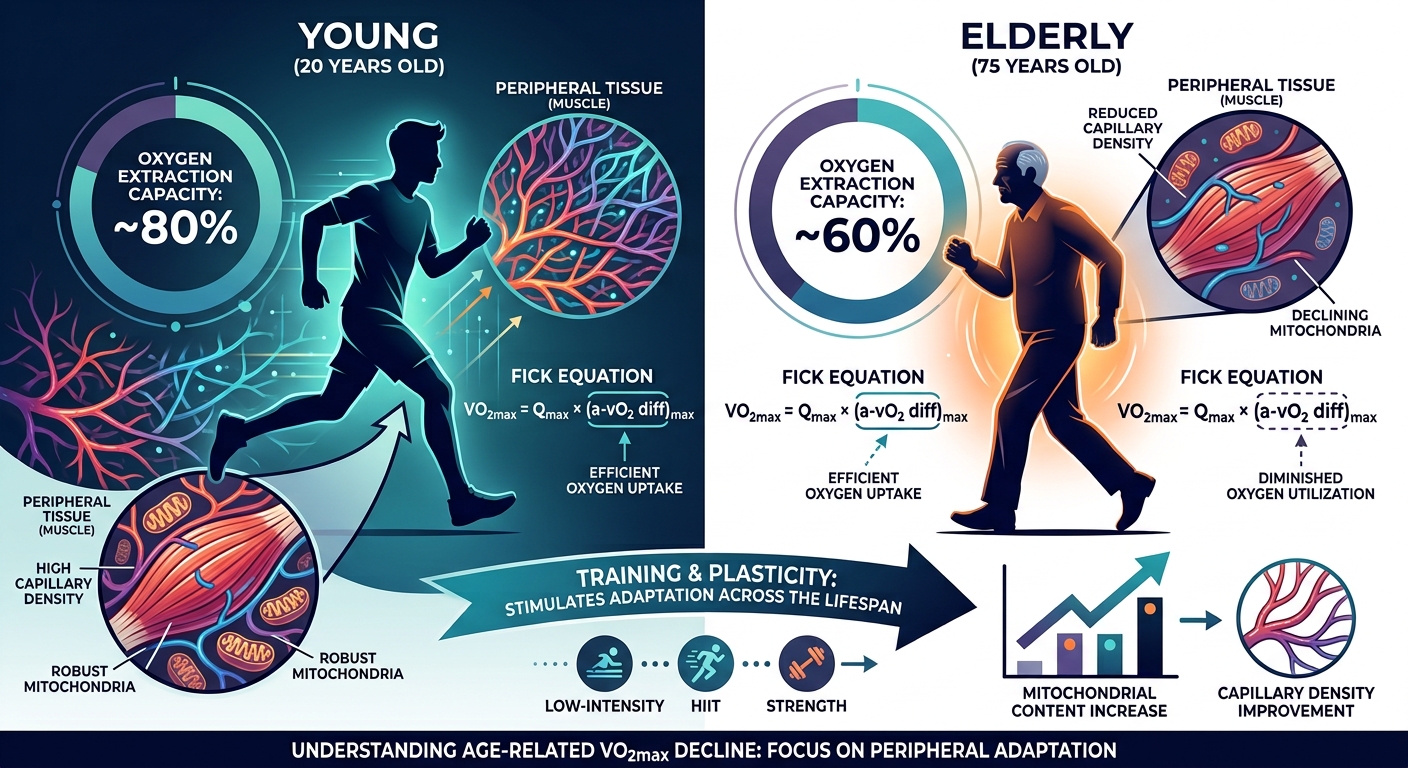
“I feel like my stamina isn’t what it used to be.” This is a reality that virtually every long-term endurance athlete eventually confronts. Despite maintaining the same training regimen, times begin to plateau, or the ability to push through high-intensity efforts diminishes. Behind these subtle shifts are age-related physiological changes affecting both the cardiovascular system and skeletal muscle.
However, where exactly in the body is this decline taking place? Is it primarily driven by a weakening of the heart’s pumping capacity, or by a reduced ability of peripheral tissues to extract oxygen from the blood? Drawing on the latest exercise physiology data and predictive modeling, this article delves into the mechanisms behind age-related reductions in VO2max (maximal oxygen uptake) and explores the physiological plasticity that training can help preserve.
- 1. What Is the Fick Principle That Governs VO2max?
- 2. Experimental Data Revealing the “Central vs. Peripheral” Discrepancy (Fuller et al.)
- 3. Mathematical Modeling: An Extracted Fraction Drop from 80% to 60% (Capelli Model)
- 4. What Factors Drive the Decline in Peripheral Capacity?
- 5. Training-Induced Plasticity: Do Adaptations Still Occur with Age?
- 6. Training Strategies for Masters Athletes
- 7. Summary: Understanding the Science to Optimize Longevity
- References
1. What Is the Fick Principle That Governs VO2max?
A useful starting point for understanding aging and aerobic performance is the Fick Principle:
VO2max = Qmax x (a-vO2 difference)max
Here, Qmax (maximal cardiac output) represents the maximum volume of blood the heart can pump per minute – a central cardiovascular factor. Meanwhile, (a-vO2 difference)max (maximal systemic arteriovenous oxygen difference) reflects how effectively peripheral tissues extract oxygen from the circulating blood – a peripheral factor. Thus, an individual’s maximum oxygen uptake per minute (VO2max) is determined by the product of central delivery (cardiac pumping performance) and peripheral extraction (tissue oxygen extraction capacity).
Crucially, the “peripheral side” in the Fick equation does not simply refer to muscle tissue in isolation. It encompasses a cascade of physiological processes, including oxygen transport from capillaries to muscle fibers, regional blood flow distribution, and mitochondrial oxygen utilization. While reductions in maximal heart rate and maximal cardiac output are important contributors to age-related declines in aerobic capacity, recent experimental and modeling studies indicate that limitations in peripheral oxygen extraction also play a substantial role.
2. Experimental Data Revealing the “Central vs. Peripheral” Discrepancy (Fuller et al.)
To examine how central and peripheral factors differ across age groups in a laboratory setting, Fuller et al. (2021) conducted detailed measurements of hemodynamic responses and oxygen dynamics in young (n=43) and older (n=28) adults during maximal exercise.
| Measurement | Young Group (n=43) | Older Group (n=28) | Observed Trend |
|---|---|---|---|
| Peak VO2 (mL/kg/min) | 34.4 | 18.8 | Significant decline |
| Maximal Cardiac Output, Qmax (L/min) | 22.7 | 22.1 | No significant difference |
| Maximal Heart Rate, HRmax (bpm) | 162 | 129 | Significantly lower |
| Maximal Stroke Volume, SVmax (mL) | 142 | 173 | Higher in older group |
| Maximal Arteriovenous O2 Difference, a-vO2 difference (mL/100 mL) | 15.8 | 9.01 | Significant decline |
The findings reveal a compelling physiological picture. Although the older cohort exhibited a significantly lower maximum heart rate (HRmax), their maximal stroke volume (SVmax) was higher. In this cohort, the higher stroke volume largely offset the age-related reduction in maximal heart rate, resulting in similar maximal cardiac output between the two groups (22.7 L/min vs. 22.1 L/min).
Despite this preserved central output, peak VO2 dropped sharply from 34.4 to 18.8 mL/kg/min. The most prominent peripheral difference was the marked reduction in maximal arteriovenous oxygen difference (a-vO2 difference), which fell from 15.8 mL/100 mL in young subjects to 9.01 mL/100 mL in older subjects. This indicates that age-related declines in VO2max cannot be explained by cardiac pumping function alone and are accompanied by a substantial reduction in peripheral oxygen extraction.
To be precise, systemic a-vO2 difference measures the oxygen concentration difference between arterial and mixed venous blood, reflecting systemic peripheral extraction rather than muscle tissue exclusively. Nevertheless, these empirical data reinforce that viewing age-related VO2max reduction solely as a central “cardiac issue” is scientifically incomplete.
3. Mathematical Modeling: An Extracted Fraction Drop from 80% to 60% (Capelli Model)
How significantly does peripheral oxygen extraction capacity decline across the human lifespan? Capelli et al. (2026) constructed a comprehensive mathematical model based on extensive literature data to analyze age-related trajectories in maximal oxygen extraction fraction (O2ext,max).
Note:
The values derived from this model represent theoretical estimations calculated from broad population datasets, rather than direct invasive tissue measurements in individual subjects.
According to this mathematical model, the estimated maximal oxygen extraction fraction (O2ext,max) in young adults (around age 20) is approximately 0.80 (80%). This means that during maximal effort, peripheral tissues extract about 80% of the oxygen delivered through systemic circulation. By ages 75-80, however, this model estimates that the extraction fraction decreases to approximately 0.60 (60%).
This does not imply that every 75-year-old individual is rigidly limited to extracting exactly 60% of delivered oxygen. Individual variation is substantial, and long-term training status markedly influences physiological function. Rather, the model illustrates a generalized age-related trend in maximal oxygen extraction and suggests that the age-related increase in peripheral resistance to oxygen utilization may contribute substantially to the decline in aerobic capacity.
This raises an essential follow-up question: What specific physiological mechanisms drive this peripheral decline?
4. What Factors Drive the Decline in Peripheral Capacity?
The age-related reduction in peripheral oxygen extraction is likely influenced by several interrelated physiological changes rather than a single isolated mechanism:
- Capillary Rarefaction (Reduced Capillary Density):Aging is associated with structural changes in skeletal muscle microvasculature. Because capillaries serve as the exchange site for oxygen diffusion into muscle tissue, capillary rarefaction involves more than just a reduction in vessel count. These changes may increase diffusion distances and alter the local distribution of blood flow, potentially reducing the efficiency of oxygen delivery and exchange within active muscle.
- Mitochondrial Content Reduction and Functional Decline:Mitochondria serve as the primary organelle for cellular oxidative metabolism, converting oxygen into ATP. Aging is frequently accompanied by decreases in mitochondrial volume density, reduced oxidative enzyme activity, and altered mitochondrial quality control. Age-related alterations in mitochondrial content and oxidative function may therefore contribute to reduced muscle oxidative capacity and, ultimately, to limitations in whole-body aerobic performance.
- Altered Microvascular Blood Flow Regulation:During exercise, blood flow is dynamically matched to active muscle fibers through precise local vasodilation and vasoconstriction. Aging can blunt these microvascular control mechanisms. As a result, the matching between local blood flow and the metabolic demands of active muscle fibers may become less efficient.
Taken together, these age-related changes can be viewed as an interconnected network:
Capillary Network Architecture -> Microvascular Flow and Diffusion -> Intracellular Mitochondrial Density -> Oxidative ATP Production
Changes across these levels may reduce the efficiency of peripheral oxygen extraction and thereby contribute to the decline in overall VO2max.
5. Training-Induced Plasticity: Do Adaptations Still Occur with Age?
This brings us to a fundamental question: Is this age-related peripheral decline an inevitable, unalterable fate?
The scientific evidence indicates that this decline is not simply an irreversible loss of adaptive capacity. Aging does not eliminate the human body’s capacity to adapt to endurance training. While older adults may not exhibit identical physiological baselines to younger individuals, age-related functional decline and training-induced adaptations coexist.
Insights from Faricier et al. (2025)
Faricier et al. (2025) conducted a 12-week endurance training intervention consisting of 3 sessions per week, 45 minutes per session, at approximately 70% of VO2max, in a cohort of 14 adults comprising young participants (n=7, mean age 26 years, SD 7 years) and older participants (n=7, mean age 68 years, SD 7 years).
Across the entire 14-subject cohort, 12 weeks of training elicited an average 20% increase in VO2max, a 15% increase in Qmax, a 14% increase in SVmax, a 144% increase in citrate synthase (CS) enzyme activity, a 22% increase in capillary density, and a 4% increase in a-vO2 difference.
Because these metrics reflect the combined cohort rather than older subjects exclusively, they should not be interpreted as a blanket guarantee that every 68-year-old will achieve a 20% VO2max gain in 12 weeks. Nevertheless, the study demonstrates that exercise training stimulates substantial central (cardiac output, stroke volume) and peripheral (mitochondrial enzyme activity, capillary growth) adaptations, even in cohorts that include older adults.
Conclusions from the Mølmen et al. (2025) Systematic Review
These findings are further supported by Mølmen et al. (2025) in a comprehensive systematic review and meta-regression analyzing mitochondrial adaptations across 353 studies (5,973 subjects) and capillary adaptations across 131 studies.
The meta-analysis demonstrated that training-induced increases in mitochondrial content were largely comparable across Traditional Endurance Training (ET: approximately 23%), High-Intensity Interval Training (HIIT: approximately 27%), and Sprint Interval Training (SIT: approximately 27%), with no statistically significant differences between modalities.
Crucially, the statistical analysis revealed no negative moderating effects of age, sex, menopausal status, health status, or muscle mass on mitochondrial adaptation to exercise training. Overall, it provides strong evidence that aging does not eliminate the capacity of skeletal muscle to undergo exercise-induced mitochondrial adaptations, while broader evidence indicates that the ability to adapt to exercise training is maintained throughout life.
6. Training Strategies for Masters Athletes
To offset age-related peripheral declines and maximize remaining physiological plasticity, masters athletes benefit from a multifaceted training structure rather than relying on a single training intensity.
- Low-to-Moderate Intensity, Long-Duration Base Training (e.g., Zone 2):Sustained aerobic exercise provides prolonged muscular and metabolic stimuli that contribute to adaptations in capillarization, local perfusion, and oxidative capacity.
- High-Intensity Interval Training (HIIT / VO2max Intervals):High-intensity bouts impose substantial metabolic and cardiovascular stress and can stimulate adaptations in both mitochondrial oxidative capacity and central cardiovascular function.
Combining continuous low-to-moderate aerobic volume with targeted high-intensity intervals addresses both peripheral microvascular/mitochondrial adaptations and central cardiovascular delivery.
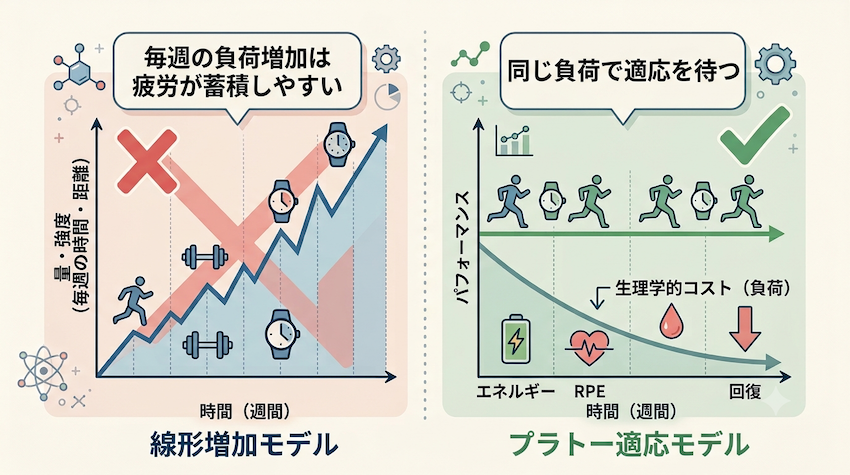
However, recovery management is paramount. Older athletes require individualized monitoring of training load, fatigue, and recovery kinetics. Blindly increasing volume or intensity without adequate recovery can increase the risk of excessive fatigue, impaired performance, and injury. When structured with appropriate intensity distribution and sufficient recovery, endurance training can continue to stimulate oxidative and microvascular adaptations in aging skeletal muscle.
7. Summary: Understanding the Science to Optimize Longevity
Age-related decline in VO2max is an established physiological reality. However, attributing this decline solely to a weakening heart oversimplifies human exercise physiology.
Key insights from current scientific literature:
- Impairments in peripheral oxygen extraction ((a-vO2 difference)max) play a significant role alongside central cardiac factors (Qmax) in age-related VO2max decline.
- Experimental findings (Fuller et al.) show that while maximal cardiac output was preserved in the older group despite lower maximal heart rate, partly because of higher stroke volume, marked reductions in a-vO2 difference were associated with the lower peak VO2.
- Modeling studies (Capelli et al.) estimate a trajectory where maximal oxygen extraction capacity drops from approximately 80% at age 20 to approximately 60% at ages 75-80.
- Age-related changes in capillarization, microvascular blood flow regulation, and mitochondrial function may contribute to limitations in peripheral oxygen extraction.
- Extensive meta-analytic evidence (Mølmen et al.) demonstrates that mitochondrial training plasticity is preserved across the lifespan.
- Physiological decline and training adaptability coexist; aging alters baseline parameters, but skeletal muscle continues to respond to structured exercise stimuli.
Race performance is governed by multiple physiological factors beyond VO2max alone, including movement economy (running economy/cycling efficiency), fractional utilization of VO2max at lactate threshold, and metabolic durability.
By understanding these physiological realities, masters athletes can better target trainable physiological capacities and continue to adapt to endurance training across the aging process.
References
Mølmen KS, Almquist NW, Skattebo Ø. (2025). Effects of Exercise Training on Mitochondrial and Capillary Growth in Human Skeletal Muscle: A Systematic Review and Meta-Regression. PMID: 39390310
Fuller KN, et al. (2021). The effect of age on mechanisms of exercise tolerance: Reduced arteriovenous oxygen difference causes lower oxygen consumption in older people. PMID: 33838218
Capelli C, Ferretti G, di Prampero PE, Tam E. (2026). Cardiovascular and peripheral factors affecting the decay of maximal oxygen uptake across the spectrum of age in humans. PMID: 41160092
Faricier R, Paterson DH, Murias JM. (2025). Physiological Determinants of V̇O₂max Increase with Endurance Training in a Group Including Older and Young Adults. PMID: 40173327
コメント