
Is muscle decline simply a consequence of getting older, or does reduced physical activity account for much of it?
This question is difficult to answer because aging and inactivity usually occur together. As people grow older, they tend to walk less, spend more time sitting, and engage in less vigorous physical activity. As a result, molecular differences between young and older muscle may reflect both biological aging and differences in habitual activity.
A 2026 study published in Nature Aging took a different approach. The researchers compared young adults with several groups of older adults, including older people whose habitual activity levels were similar to those of the young participants. They then examined skeletal muscle at the molecular level, allowing the researchers to better distinguish age-related changes from those associated with lower physical activity.
The results provide an interesting perspective on a question that matters far beyond molecular biology: Is simply staying active enough to preserve aging muscle, or does the body need a different kind of stimulus?
- Four Groups and the Experimental Design
- Mitochondrial Energy Metabolism Was a Major Feature of Muscle Aging
- Moving Every Day Is Not the Same as Training
- Exercise Also Produced an Acute Molecular Response
- Some Age-Related Changes Remained Despite Training
- What This Study Means in Practical Terms
- My Perspective on the Study
- Reference
Four Groups and the Experimental Design
The researchers studied four groups with different combinations of age, habitual activity, physical function, and training history:
- Young adults in their twenties
- Older adults whose daily step counts and higher-intensity activity were comparable to those of the young group (Normally Active)
- Older adults who had maintained structured exercise training, typically around three one-hour sessions per week (Trained)
- Older adults classified as physically impaired (Impaired)
The participants underwent skeletal muscle biopsies before and after a one-hour cycling session. The researchers then examined more than 24,000 transcripts, 135 metabolites, and 1,383 lipid species in the muscle samples.
The inclusion of older adults whose habitual activity levels were comparable to those of the young participants was particularly important. It made it possible to examine molecular differences that remained even when a major difference between younger and older people—habitual physical activity—had been reduced.
Mitochondrial Energy Metabolism Was a Major Feature of Muscle Aging
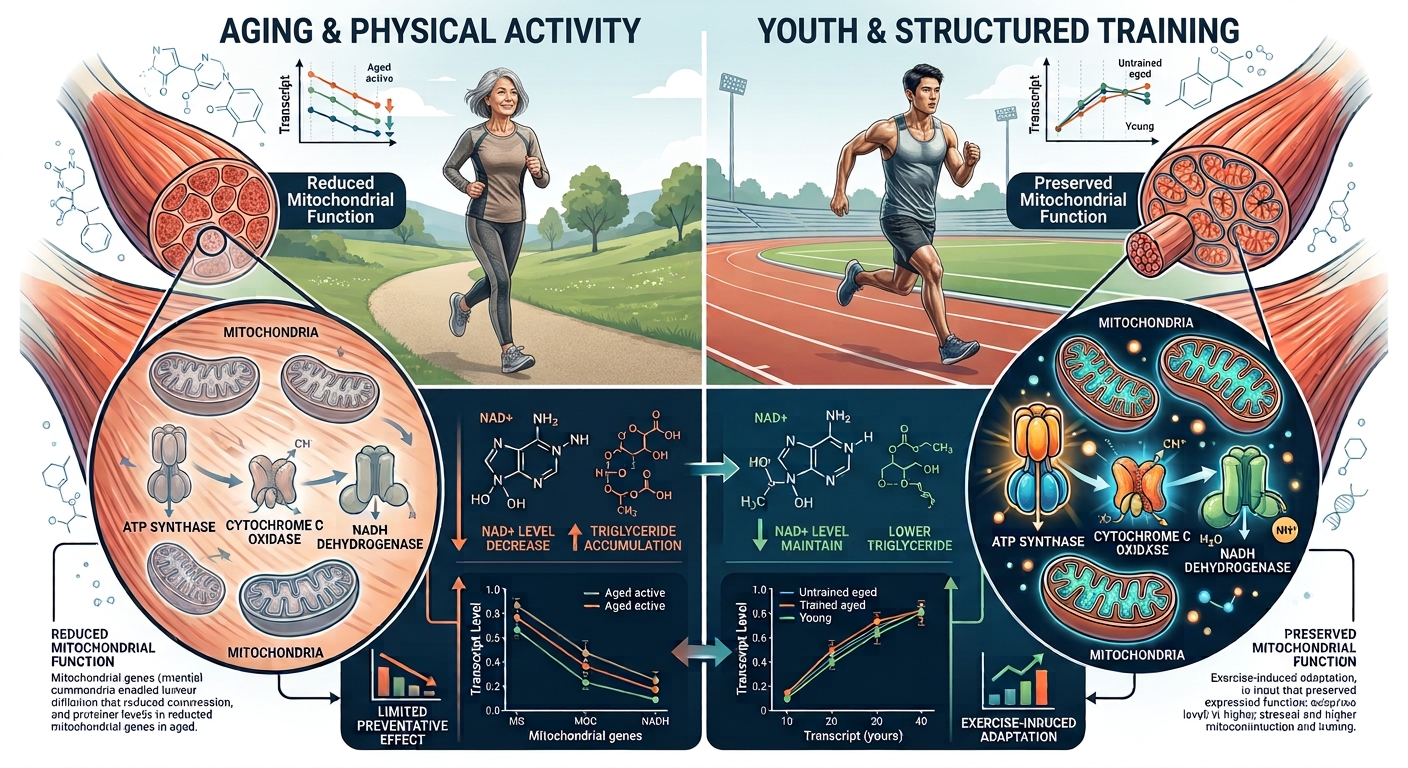
When young adults were compared with Normally Active older adults, 1,106 genes showed lower expression in the older group.
A striking feature of these changes involved genes associated with mitochondrial energy metabolism. Several of the affected genes encode components of the molecular machinery responsible for producing ATP, including proteins involved in:
- ATP synthase
- Cytochrome c oxidase
- NADH dehydrogenase
These findings suggest that reduced expression of genes involved in mitochondrial energy production is an important molecular feature of aging skeletal muscle.
The older muscle also showed alterations in NAD+ metabolism together with greater accumulation of triglyceride species. The combination of these findings is consistent with alterations in energy metabolism in aging muscle.
Importantly, these molecular findings do not mean that mitochondrial function simply “switches off” with age. Rather, they indicate that the molecular systems supporting energy metabolism become altered as skeletal muscle ages.
Moving Every Day Is Not the Same as Training
One of the most interesting findings of the study was the difference between maintaining a high level of everyday activity and participating in structured exercise training.
The Normally Active older adults accumulated daily step counts and higher-intensity activity comparable to those of the young participants. They were therefore not simply sedentary older adults. Nevertheless, their muscles still showed age-related changes in genes involved in mitochondrial energy metabolism.
This is an important distinction. Being physically active throughout the day is undoubtedly valuable for health. However, the amount of movement accumulated during daily life does not necessarily describe the type of stimulus that skeletal muscle receives from structured exercise.
The Trained group showed a different molecular profile.
Among the age-related changes in gene expression observed in the older groups, 57.1% of the decreases and 55.9% of the increases were not observed in the trained participants. In other words, long-term structured training was associated with the preservation of a substantial portion of the gene-expression profile that differed between young and older muscle.
Several mitochondrial genes illustrate this pattern particularly well. NDUFS1 and COX5A, for example, were reduced in the Normally Active and Impaired groups but remained at levels closer to those observed in young adults in the Trained group.
The significance of this finding is not that walking or daily movement is unimportant. Rather, it suggests that movement volume and training stimulus are not interchangeable measures of what the muscle experiences.
Daily walking, household activities, and other low-intensity movements expose the body to repeated physical activity. Structured training, by contrast, deliberately manipulates variables such as intensity, duration, frequency, and workload. Those differences in the stimulus can be reflected in the molecular response of skeletal muscle.
At the same time, this study does not establish an exact exercise threshold required to prevent age-related muscle decline. Nor does it mean that older adults need to perform extreme exercise. Because the long-term training groups were compared rather than randomly assigned to training interventions, the findings do not establish that a particular training program directly caused the molecular differences.
The broader lesson is therefore more nuanced: Staying active is important, but staying active and training are not necessarily the same physiological stimulus.
Exercise Also Produced an Acute Molecular Response
The study also examined how the participants’ muscles responded to the one-hour cycling session.
After exercise, genes associated with immune and stress-related responses—including IL6, IL1B, and TNF-related pathways—showed increased expression across the groups.
The response was most pronounced in the Trained older adults and more closely resembled the pattern observed in the young participants. The Normally Active group showed a less pronounced response, while the response was more blunted in the Impaired group.
This finding is important because an acute response to exercise should not automatically be interpreted as evidence of harmful inflammation. Exercise temporarily disturbs the physiological state of the muscle. Such disturbances can activate signaling pathways involved in remodeling and adaptation. The molecular response observed immediately after exercise therefore represents part of the body’s response to the exercise stimulus, rather than simply indicating tissue damage.
However, the present study does not by itself establish that every component of the acute inflammatory response is necessary for adaptation, nor does it demonstrate that suppressing inflammation with medication will necessarily impair the long-term benefits of exercise.
Some Age-Related Changes Remained Despite Training
Structured training was associated with substantial preservation of age-related molecular features, but it did not eliminate every difference between young and older muscle.
Some changes remained in older adults regardless of their training status, including alterations involving pathways related to synaptic transmission and WNT signaling. These pathways are involved in processes such as communication between cells, tissue maintenance, and cellular signaling.
This is an important limitation of the findings. Exercise appears to modify many aspects of the molecular phenotype associated with aging, but it does not make older muscle molecularly identical to young muscle.
In other words, aging and physical inactivity should not be treated as two completely interchangeable explanations for muscle decline. Some molecular changes appear to be associated with differences in habitual activity and training status, whereas others persist despite long-term training.
What This Study Means in Practical Terms
The most useful way to interpret this research is not to ask whether walking or exercise is “better.” The more relevant question is: What kind of stimulus is the muscle receiving?
A person may accumulate thousands of steps every day and still lack the type of repeated workload that produces certain training adaptations. Conversely, structured exercise does not replace the importance of remaining physically active throughout the day. The two behaviors serve different purposes and should not be regarded as competing alternatives.
This distinction also helps explain why simply counting steps cannot capture every aspect of physical fitness. Step counts tell us something important about how much a person moves. They do not tell us everything about the intensity, duration, frequency, or physiological challenge associated with that movement.
For masters athletes and physically active older adults in particular, this is an important distinction to keep in mind. As we age, maintaining the habit of moving every day remains fundamental. But if the goal is to preserve the capacity of muscle to respond to physical stress, there is also a reason to provide the body with regular, appropriately dosed training stimuli.
That does not mean training harder at all costs. It means giving the body a stimulus strong enough to require adaptation while still allowing sufficient recovery.
My Perspective on the Study
What I found most interesting in this study was not simply that trained older adults looked more like young adults at the molecular level. It was the contrast between two ideas that are often treated as almost identical: being active and being trained.
Walking more is important. Reducing sedentary time is important. Maintaining movement throughout the day is important. But this study suggests that these forms of activity should not automatically be assumed to provide the same biological signal as structured exercise.
For me, this connects directly with a distinction between biological aging and deconditioning. Some changes accompany biological aging and cannot simply be eliminated through exercise. But some of the functional decline that we associate with getting older is also influenced by how much physical stimulus the body continues to receive.
This study provides molecular evidence that some aspects of biological aging can be distinguished from changes associated with physical inactivity, at least to some extent, in skeletal muscle. That is perhaps the most encouraging aspect of the research.
We cannot choose whether we grow older. But we can influence whether our muscles continue to receive a meaningful training stimulus. And the important point is not simply to move more. It is to continue giving the body a reason to adapt.
Reference
JJanssens, G. E., Trętowicz, M. M., Grevendonk, L., et al. Delayed molecular aging, preservation of energy metabolism and enhanced exercise response in exercise-trained human muscle. Nature Aging 6, 1482–1500 (2026). PMID: 42399371
コメント