
Growing up in Japan, my memories of summer nights were simple. We would open the windows to catch whatever breeze existed and run an electric fan in the bedroom. Having an air conditioner in every bedroom was not standard practice at the time.
Sleepwear consisted of a short-sleeved shirt and shorts, covered only by a thin cotton towel-blanket. When the night felt particularly warm, we simply turned the fan up a notch.
It is tempting to look back at those years with nostalgia, but times have changed significantly. Today, daytime temperatures regularly climb well past 35°C (95°F), and heat remains trapped inside modern, insulated homes long after sunset. Expecting a fan and open windows to handle contemporary summer heat is no longer realistic in many parts of the world.
For masters athletes in their 40s, 50s, and 60s, this shift in climate presents a real challenge. We cannot always train, recover, or sleep the exact same way we did in our 20s or 30s. As we age, recovering from a tough session requires a more deliberate approach. However, slower recovery is not an inevitable fate we must passively accept. It simply means we need to become more intentional about the environmental factors that support our body’s repair processes.
Optimizing your sleep environment during hot summer months is not a luxury or a matter of pampering yourself. It is a fundamental part of your overall training and conditioning strategy.
- The Physiology of Heat and Sleep Disturbance
- Moving Beyond the Search for a “Perfect” Temperature
- Managing Ambient Air vs. Your Microclimate
- Is Sleeping With the Air Conditioner On Bad for You?
- Practical Guidelines for Air Conditioner Use
- Baseline Temperatures and Troubleshooting
- Reframing Sleep as Part of Your Training Program
- References
- YouTube Video for This Article
The Physiology of Heat and Sleep Disturbance
To understand why summer nights can feel so draining, it helps to look at how the body manages temperature during rest.
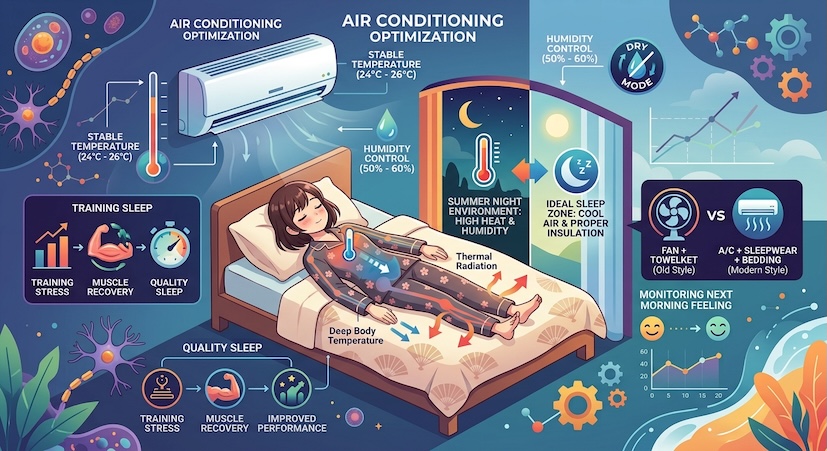
Under normal conditions, your core body temperature naturally drops as you prepare to sleep. To facilitate this internal cooling, blood vessels in the skin and extremities dilate, releasing heat into the surrounding environment. A comfortably cool bedroom can support this natural decline in core body temperature that occurs as we prepare for rest.
When your bedroom is hot or humid, this thermal exchange is disrupted. If the surrounding air is close to skin temperature, or if high humidity prevents sweat from evaporating, heat stays trapped inside the body.
Physiologically, this heat strain keeps your body in a state of heightened thermal defense. Instead of transitioning into deep, uninterrupted sleep cycles, you are more likely to experience delayed sleep onset, lighter sleep, and frequent nighttime awakenings. For an athlete, fragmented sleep reduces the valuable window during which physical repair and neural recovery take place.
Moving Beyond the Search for a “Perfect” Temperature
A common question among athletes looking to optimize their sleep is straightforward: “What exact temperature should I set my air conditioner to?”
It is easy to find sources online claiming that a specific number—such as 25°C (77°F)—is the ideal setting for human sleep. However, scientific evidence does not support the idea of a single, universal bedroom temperature that works for everyone.
Your personal thermal comfort depends on an interconnected set of variables:
- Ambient Room Temperature: The temperature of the air surrounding you.
- Relative Humidity: The amount of moisture in the air, which directly dictates how effectively sweat evaporates.
- Air Velocity: The movement of air from fans or AC vents across your skin.
- Microclimate: The specific micro-environment of heat and moisture trapped between your skin, clothing, and bedding.
- Individual Physiology: Personal differences in metabolic rate, body composition, age, and acclimation to heat.
Setting an air conditioner to a specific number on the remote will not guarantee optimal recovery if the air is too humid, if cold air is blowing directly onto your skin, or if your mattress traps heat. Rather than searching for a magical number, the goal should be preventing heat-induced sleep disruptions using every tool at your disposal.
Managing Ambient Air vs. Your Microclimate
One helpful framework is to distinguish between room climate and your microclimate.
- Room Climate: The ambient temperature and humidity in the bedroom.
- Microclimate: The temperature and humidity inside your bed, created by your sleepwear and sheets.
A room that feels comfortably cool to breathe in helps lower overall thermal strain. However, if your skin is directly exposed to moving cold air, your skin temperature may drop too low, causing localized discomfort or making it harder to maintain a comfortable sleep environment.
To balance this, many people find success by keeping the room air relatively cool while using lightweight long clothing (such as thin pajama pants and a long-sleeved shirt) along with a breathable top sheet or light duvet. This combination allows you to inhale cool air and radiate heat from your head, while maintaining a stable, comfortable microclimate around your limbs and torso.
This approach is not a rigid rule, but rather an illustration of how room air and bedding work together. If you tend to run warm, lighter sleepwear with a slightly higher thermostat setting may feel far more comfortable.
Is Sleeping With the Air Conditioner On Bad for You?
Some people worry that sleeping with the air conditioner running all night is unhealthy, fearing it might cause fatigue, joint stiffness, or respiratory dryness.
In practice, the problem is usually not air conditioning itself, but how it is used. The discomfort people experience typically stems from specific factors:
- Direct Drafts: Cold air blowing continuously onto exposed skin.
- Extreme Cold: Setting the thermostat far lower than necessary.
- Unstable Conditions: Using shut-off timers that cause the room to heat up rapidly at midnight, forcing the body to repeatedly adjust to severe temperature swings.
When used thoughtfully—maintaining a moderate temperature, avoiding direct airflow, and controlling humidity—an air conditioner simply stabilizes the thermal environment, allowing your body to rest without constantly fighting nighttime heat.
Practical Guidelines for Air Conditioner Use
Uncertainty around air conditioner use often leads to two extremes: either blasting cold air directly onto the bed or turning the unit off via a timer after two hours. Neither extreme is ideal for night-long recovery.
- Continuous Operation: Running the air conditioner through the night at a moderate, stable setting is generally preferable to using a shut-off timer. When a timer turns the AC off, room temperature and humidity spike rapidly, often waking you up during crucial sleep cycles.
- Managing Humidity: High humidity is often a greater culprit in sleep disruption than ambient temperature alone. Keeping relative humidity around 50% to 60% allows natural evaporative cooling to work effectively, making a room feel comfortable without needing to over-chill the air.
- Direct Airflow: Ensure that cool air from the unit or a ceiling fan is directed away from your body. Indirect circulation cools the space without creating cold drafts that disturb rest.
Baseline Temperatures and Troubleshooting
While individual preferences vary, having a baseline range can help you start experimenting with your setup. Use 24–26°C (75.2–78.8°F) as a flexible practical starting point, adjusting according to room layout, humidity, and personal comfort.
| Actual Room Temperature | Practical Interpretation |
| 28°C / 82.4°F or higher | Heat accumulation is likely. High risk of sleep fragmentation, especially if humidity is elevated. |
| 26–27°C / 78.8–80.6°F | Mildly warm. Can feel comfortable if humidity is controlled and light clothing is worn. |
| 24–26°C / 75.2–78.8°F | A practical starting range for many adults. Easy to fine-tune using light sheets and breathable sleepwear. |
| 22–24°C / 71.6–75.2°F | Cooler range. Requires sufficient bedding and sleepwear to prevent chilling during early morning hours. |
| Below 22°C / 71.6°F | May feel too cold for some people; bedding and sleepwear choices become increasingly important. |
Note: These ranges are practical starting points, not universal rules. Individual comfort depends on humidity, airflow, bedding, sleepwear, room characteristics, and personal metabolic differences.
To evaluate whether your setup is working, pay attention to how you feel when you wake up. Your physical sensations in the morning offer direct feedback on your nighttime thermal environment.
| Morning / Night Symptom | Possible Cause | What to Try |
| Waking up feeling hot/sweaty | Ambient temperature or humidity is too high. | Lower thermostat by 0.5–1°C or activate dehumidifier mode. |
| Damp sheets or heavy sweating | Poor air evaporation due to elevated humidity. | Lower room humidity (aim for 50–60%) or switch to lighter bedding. |
| Waking up feeling chilled | Room temperature is too low or cold air is blowing on you. | Raise thermostat setting or adjust AC louvers away from the bed. |
| Stiff extremities or feeling chilly | Insufficient microclimate insulation around limbs. | Wear thin long-sleeved sleepwear or use a light blanket over lower body. |
| Restless sleep despite cool room | Drafts, excess humidity, or mismatched bedding layer. | Check fan placement, monitor room humidity, or adjust sleepwear material. |
Reframing Sleep as Part of Your Training Program
When you push your body through challenging workouts in mid-summer heat, your thermoregulatory system works overtime during the day. Continuing that thermal strain into the night deprives your body of the tranquil window it needs to rebuild.
Setting up your bedroom for optimal summer sleep should be viewed with the same intentionality as planning your weekly training volume, nutrition, or hydration. You do not need to settle for broken sleep simply because it is summer, nor do you need to follow rigid rules about exact thermostat numbers.
Experiment systematically with your room temperature, humidity control, and bedding until you find the combination that allows you to sleep soundly through the night. Rested mornings are the foundation of consistent, sustainable performance as a masters athlete.
References
- A systematic review of ambient heat and sleep in a warming climatehttps://pubmed.ncbi.nlm.nih.gov/38598988/
- Effects of thermal environment on sleep and circadian rhythmhttps://pubmed.ncbi.nlm.nih.gov/22738673/
- Sleep environments and sleep physiology: A reviewhttps://pubmed.ncbi.nlm.nih.gov/30509635/
- How Temperature Influences Sleephttps://pubmed.ncbi.nlm.nih.gov/36293048/

コメント