
📌 Key Takeaways
- Metaphors vs. Biology: Many popular explanations of tapering—such as a “two-week mitochondrial lifespan” or a direct switch to “race-mode mitochondria”—blend established exercise physiology with oversimplified metaphors. Human skeletal muscle does not operate like a simple on/off switch.
- The Core Goal of Tapering: The primary goal of tapering is not to rigidly protect every single molecular adaptation by training hard until race day. Rather, it is to allow accumulated fatigue to dissipate while preserving the physiological adaptations and neuromuscular readiness needed for performance.
- A Balanced Practical Approach: Maintaining baseline low-intensity aerobic work while inserting brief, race-specific or appropriately sharp stimuli helps sustain metabolic efficiency and neuromuscular readiness without accumulating unnecessary fatigue. The precise dose, however, varies by individual and event.
If you want to deepen your understanding of the physiological background and learn to interpret your body’s feedback more effectively, please read on.
- Introduction: Why Do We Taper Before a Race?
- Section 1: The Molecular Basis of Tapering—Mitochondria and Capillaries
- Section 2: The “Race-Mode Mitochondria” Metaphor
- Section 3: Mitochondrial Turnover and the Half-Life Misconception
- Section 4: Glycolytic and Oxidative Balance (VLamax in Context)
- Section 5: Practical Application—Structuring the Pre-Race Taper
- Section 6: Distinguishing Hypothesis from Established Fact
- Section 7: Conclusion
- References
Introduction: Why Do We Taper Before a Race?
As a race approaches, endurance athletes inevitably face a familiar dilemma: “How much should I cut back my training volume, and what intensity should I maintain to avoid losing fitness?”
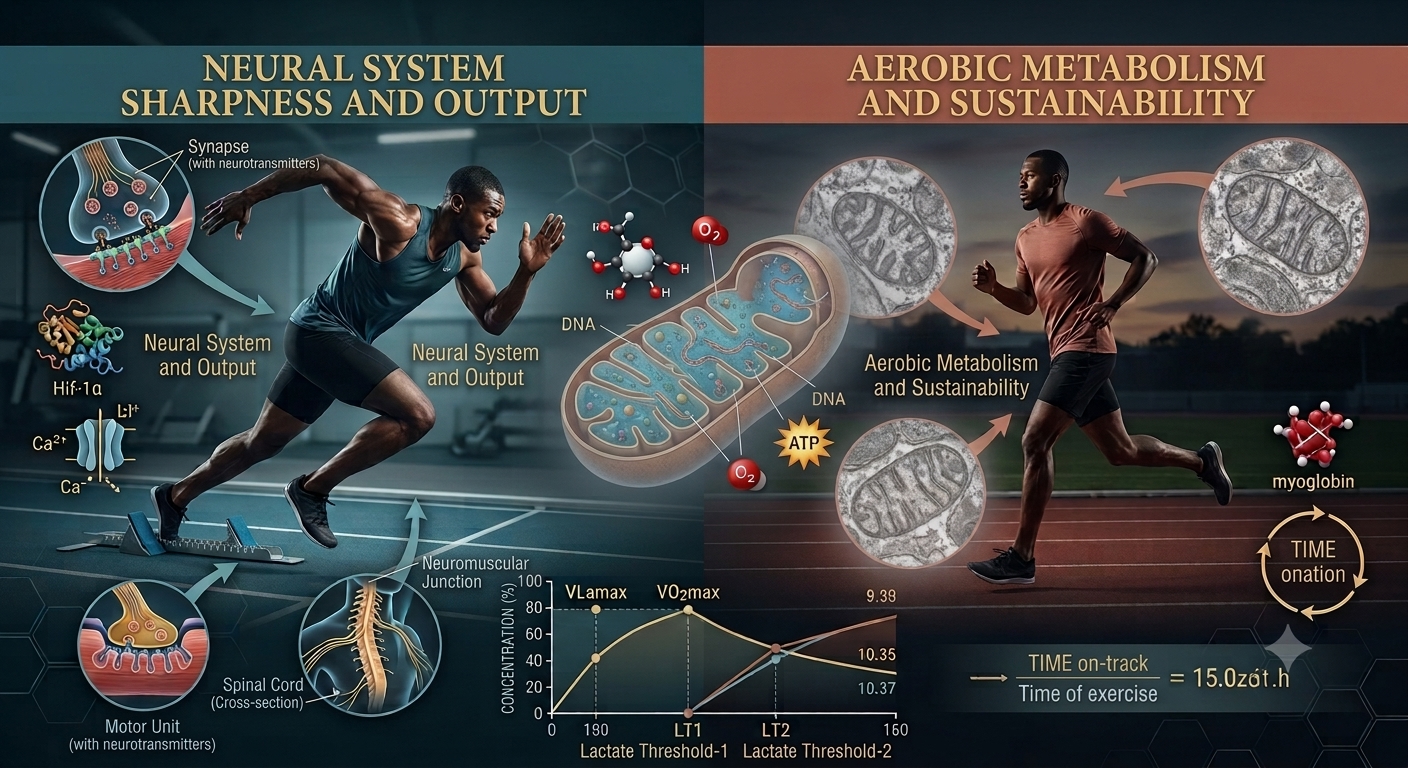
During strenuous exercise, transient changes in oxygen availability and substantial metabolic stress occur within active muscle tissue. In response to these physiological stressors, complex signaling pathways involving proteins like HIF-1α (hypoxia-inducible factor-1 alpha) and PGC-1α contribute to the regulation of gene expression and downstream aerobic adaptations. Even during high-intensity interval training at sea level, such as intervals performed near vVO2max, HIF-1α activation is considered one of several potential molecular mechanisms involved in exercise-induced adaptation.
When these molecular concepts are popularized in endurance coaching, compelling narratives often emerge: “High-intensity intervals activate HIF-1α, converting your mitochondria into race mode. But because these adaptations decay rapidly, you must keep inserting hard sessions right up until race day.”
It is an undeniably appealing story. But does exercise physiology actually support such a precise, deterministic mechanism? Translating molecular observations directly into a rigid tapering formula requires caution. Training adaptations are governed by multiple overlapping, redundant systems rather than a single molecular switch.
Section 1: The Molecular Basis of Tapering—Mitochondria and Capillaries
Endurance performance depends heavily on the oxidative capacity of skeletal muscle, which is supported by several interacting features, including:
- Mitochondrial Density & Enzyme Activity: The cellular machinery responsible for aerobic ATP production through oxidative phosphorylation.
- Capillary Density: The microvascular network delivering oxygen and substrates to working muscle fibers while facilitating metabolic byproduct removal.
When training volume is reduced during race week, athletes often worry that these hard-earned structures will rapidly degrade. To evaluate whether this fear is justified, we must examine the actual rate of protein turnover in human skeletal muscle.
Section 2: The “Race-Mode Mitochondria” Metaphor
The idea of switching muscle cells into “race mode” is a helpful mental model for conceptualizing acute readiness. However, actual mitochondrial adaptation in skeletal muscle does not involve replacing one discrete type of “specification” with another, as if switching between two factory assembly lines.
Skeletal muscle mitochondria exist as a dynamic, interconnected reticulum. Adaptation occurs through ongoing structural and functional remodeling—expanding the mitochondrial network and altering the abundance and activity of metabolic proteins and enzymes.
Signaling pathways involving HIF-1α and PGC-1α are thought to contribute to the regulation of mitochondrial biogenesis and respiratory function. However, viewing high-intensity taper sessions as a way to “selectively turn on race-mode mitochondria” falls into the realm of useful metaphorical simplification rather than strict biological reality.
Section 3: Mitochondrial Turnover and the Half-Life Misconception
A common justification for late high-intensity sessions is the statement that “mitochondria have a half-life of roughly two weeks, so fitness decays immediately if you stop pushing.”
This statement misinterprets how cellular turnover works. In exercise physiology, a half-life does not mean that half of your mitochondria physically vanish after 14 days of reduced training.
Instead, skeletal muscle mitochondria undergo continuous synthesis, degradation, and remodeling. The constituent proteins and enzymes making up the mitochondrial network have varying half-lives, ranging from several days to a few weeks depending on the specific subunit and individual training status.
Because turnover is an ongoing, gradual process, there is little reason to assume that a short, well-structured taper will mechanically erase the structural adaptations built through months of training.
What athletes may experience as “losing sharpness” during an overly passive taper is unlikely to be explained simply by a rapid collapse in mitochondrial content. Other factors, including subtle changes in neuromuscular responsiveness or motor skill familiarity, are far more likely to account for this sensation as training stress drops.
Reducing overall training stress allows accumulated fatigue to dissipate and facilitates the restoration of muscle glycogen and other aspects of physiological readiness. The central challenge of tapering is thus not fighting immediate mitochondrial destruction, but allowing accumulated fatigue to clear while preserving neuromuscular responsiveness.
Section 4: Glycolytic and Oxidative Balance (VLamax in Context)
Another popular framework used to plan pre-race training involves discussing glycolytic capacity, often using concepts such as VLamax (maximal glycolytic rate), alongside aerobic thresholds such as LT1 and LT2.
In long-distance endurance events, a relatively high VLamax is often considered potentially disadvantageous because greater glycolytic flux at a given submaximal workload may increase carbohydrate use and lactate production. These effects are commonly discussed as one possible factor influencing endurance performance, rather than as a simple causal pathway from VLamax to lower LT1 or LT2.
Recent metabolic profiling has highlighted associations between VLamax and endurance performance metrics. However, the exact strength, direction, and causal mechanics of these relationships remain active areas of ongoing scientific debate.
It is sometimes claimed that glycolytic capacity can be maintained with very infrequent high-intensity stimuli, whereas aerobic adaptations require much more frequent endurance-oriented stimulation. Exercise physiology does not support such rigid, universal rules:
- The frequency and volume of high-intensity work required to maintain glycolytic or neuromuscular capacity vary significantly based on individual muscle fiber composition, training history, and event demands.
- Aerobic adaptations depend on regular, repeated endurance stimuli over time, but the exact maintenance frequency depends on the athlete’s baseline status and overall workload.
Incorporating low-intensity Z2 work or structured baseline methods (such as my “Drip Load” approach) helps sustain aerobic conditioning and provide regular low-cost endurance stimulus without adding unnecessary systemic fatigue.
Section 5: Practical Application—Structuring the Pre-Race Taper
How should an athlete structure their pre-race weeks based on these physiological realities?
Modern tapering research generally supports an approach that involves:
- Reducing Overall Volume Substantially: Reducing total training volume while adjusting the magnitude and duration according to the event and athlete.
- Maintaining Intensity: Keeping selected sessions at or near race-specific intensity to preserve familiarity with race-specific movement and maintain readiness.
- Preserving Frequency: Maintaining training frequency where appropriate, rather than eliminating training altogether.
Rather than removing all fast movement, inserting brief, race-specific or moderately sharp stimuli may help preserve neuromuscular responsiveness and familiarity with race-specific movement.
However, claiming that the exact physiological reason for this success is “selectively prompting HIF-1α while suppressing glycolytic enzyme expression” overinterprets current science. The human body does not provide such neat, isolated control, where one specific interval session selectively drives mitochondrial adaptation while completely bypassing other metabolic pathways.
Changes in VLamax and overall race readiness are influenced by a complex matrix of factors:
- Muscle fiber composition and recruitment patterns
- Chronic training volume and intensity distribution over preceding months
- Nutritional status and carbohydrate availability
- Neuromuscular recruitment strategies under fatigue
Section 6: Distinguishing Hypothesis from Established Fact
In sports science and coaching, empirical observations almost always precede precise molecular explanations. Coaches and athletes often discover training methods that work exceptionally well in practice long before researchers uncover the underlying cell-signaling pathways.
Many methods developed through coaching practice have accumulated strong empirical support over time, even when the initial molecular explanations given for them were incomplete or partially incorrect.
Scientific rigor requires maintaining a clear boundary between correlation and direct causation. Believing that optimizing a single metric (such as selectively activating HIF-1α or manipulating a single enzyme) will guarantee race performance oversimplifies human biology. Real-world performance emerges from the interaction of multiple physiological systems rather than from any single signaling pathway.
Section 7: Conclusion
Practicing established modern training methodologies—such as periodizing phases clearly, raising intensity gradually, and cutting volume toward race day—will generally help put the pieces of the body’s metabolic puzzle into place, regardless of whether one knows every micro-mechanism.
Many of the concepts discussed in this article are grounded in established exercise physiology, while other elements remain working hypotheses or simplified interpretations of complex biological processes. For example, research supports important roles for HIF-1α-related signaling in skeletal muscle adaptation, the dynamic nature of mitochondrial turnover, and the performance benefits of appropriately structured volume reduction during tapering. At the same time, the precise relationship between VLamax, its underlying physiological determinants, and endurance performance remains an active area of research.
By maintaining baseline aerobic work while incorporating targeted, race-specific stimuli, athletes can aim to arrive at the start line with reduced fatigue, well-restored energy stores, and good neuromuscular readiness.
References
・Quittmann OJ. Maximal lactate accumulation rate (La_max): Current evidence and future directions for exercise testing and training. Eur J Appl Physiol. 2026;126(1):1-36. PMID: 41171430
・Li J, Li Y, Atakan MM, et al. The Molecular Adaptive Responses of Skeletal Muscle to High-Intensity Exercise/Training and Hypoxia. Antioxidants (Basel). 2020;9(8):656. PMID: 32722013
・Hood DA, Tryon LD, Vainshtein A, et al. Exercise and the Regulation of Mitochondrial Turnover. Prog Mol Biol Transl Sci. 2015;135:99-127. PMID: 26477912
・Wang Z, Wang YT, Gao W, Zhong Y. Effects of Tapering on Performance in Endurance Athletes: A Systematic Review and Meta-Analysis. PLoS One. 2023;18(5):e0282838. PMID: 37163550

コメント