
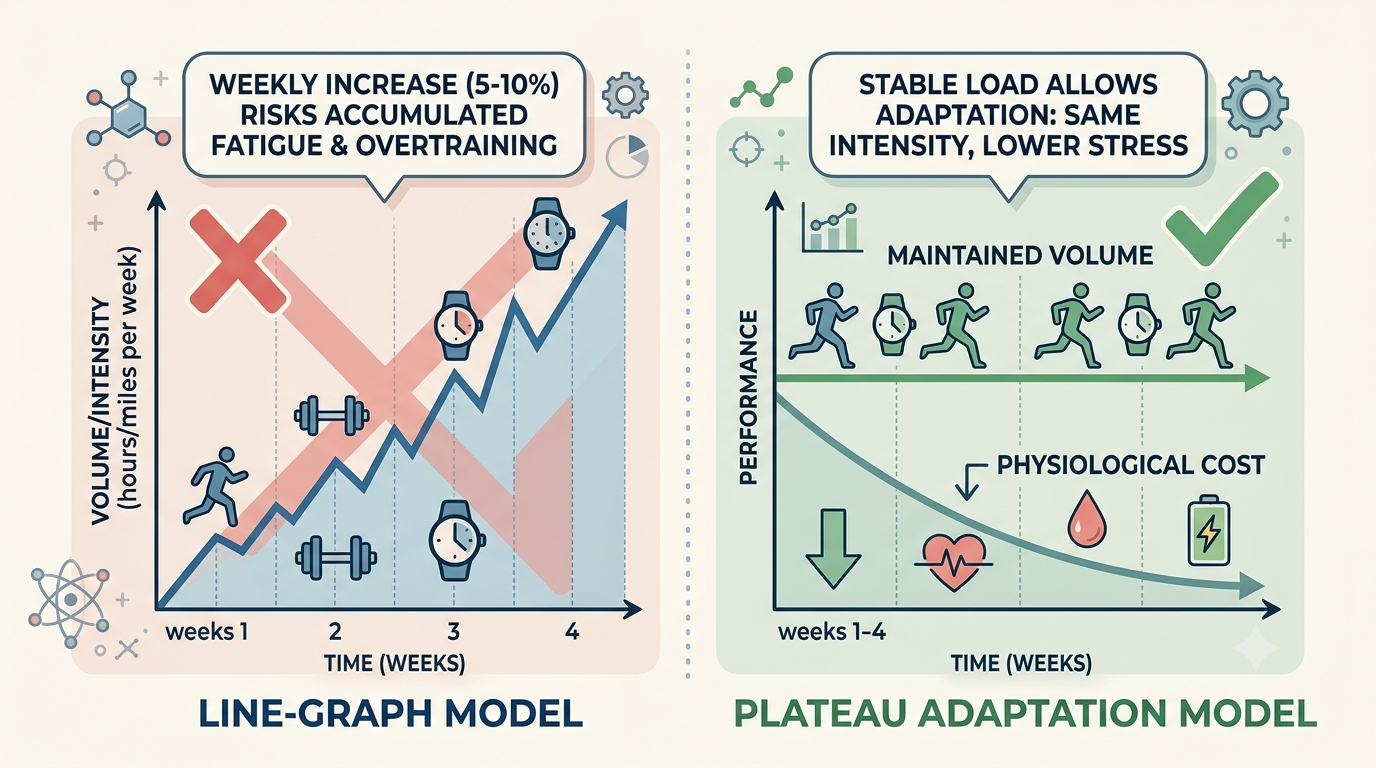
When engaging in consistent endurance training, it is easy to assume that building greater performance requires a weekly increase in volume or intensity. Indeed, progressive overload—the principle of progressively adjusting training demands to provide a sufficient stimulus for continued adaptation—is widely recognized as a foundational principle of exercise science.
However, a critical premise requires closer examination.
While training induces performance gains, it simultaneously generates fatigue. Crucially, fitness adaptations and fatigue recovery do not proceed at identical rates.
The presence of residual fatigue does not imply a lack of adaptation. Conversely, continuously increasing weekly workload does not guarantee a proportional rise in physiological capacity.
What actually occurs when, instead of forcing a weekly escalation in load, we maintain a consistent training stimulus over an extended period?
Starting from the classic Fitness-Fatigue framework, this article examines the relationship between training load and performance responses, exploring the structural value of maintaining workload stability and its practical applications.
- 1. Training Enhances Capacity While Simultaneously Generating Fatigue
- 2. Does Increasing Weekly Load Accelerate Adaptation?
- 3. What Happens When the Same Workload Is Repeated?
- 4. “Maintaining Workload” Is Distinct From “Mindless Stagnation”
- 5. The Concept of “Consistency” in Endurance Programming
- 6. Practical Application: Evaluating Adaptation via the “1+4 Jog”
- 7. The Objective of Training Is to Accumulate Adaptations, Not Fatigue
- References
1. Training Enhances Capacity While Simultaneously Generating Fatigue
The primary objective of athletic training is to apply a physical stimulus that elicits specific physiological responses.
In endurance sports, these adaptations manifest over time as structural and metabolic shifts: enhanced mitochondrial density and function, expanded capillary networks, refined oxidative energy pathways, and optimized cardiovascular responses. In strength training, adaptations include improvements in neuromuscular function and, depending on the training program, increases in muscle size and strength.
Importantly, these physiological adaptations are not fully realized during the exercise session itself. Exercise initiates physiological signaling processes, while many of the resulting adaptations develop during the recovery period that follows.
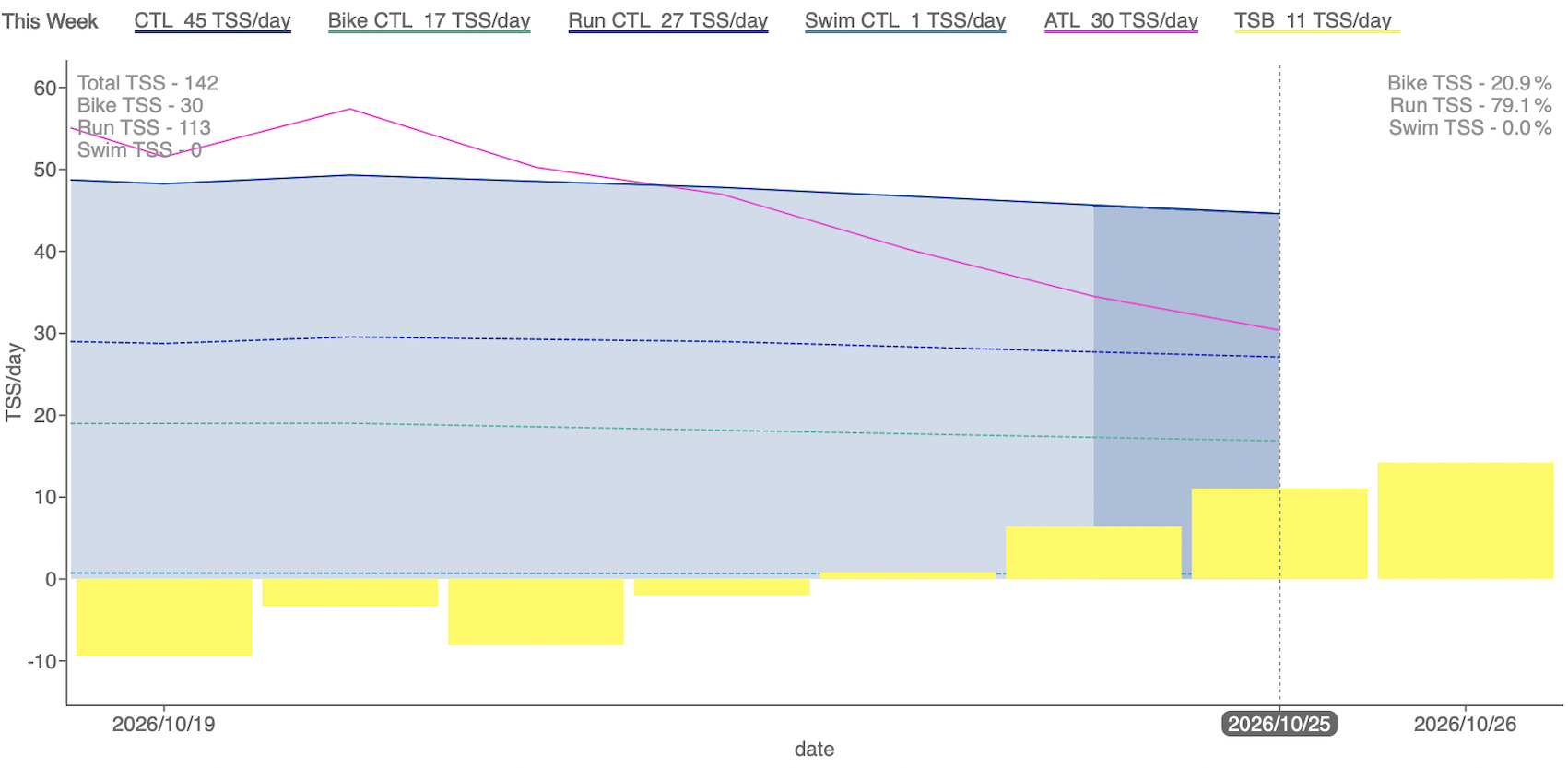
To conceptualize this dynamic, the Fitness-Fatigue model introduced by Banister and Calvert (1980) offers a foundational framework.
The model represents the effects of training through two conceptual components:
- Fitness: A modeled positive response associated with improved performance capacity.
- Fatigue: A modeled negative response that temporarily suppresses performance.
These components are mathematical representations of training responses, not two completely independent physiological processes that can be directly measured in isolation. The model estimates how their combined effects influence performance over time.
Following a demanding session, fatigue often has a greater immediate effect on observable performance than the positive training response. However, the balance varies with the session, the athlete, and the performance measure being considered. As fatigue dissipates over the following hours or days, underlying performance gains, if achieved, may become more apparent.
Therefore, a temporary post-workout drop in performance does not signify an ineffective training session. This distinction highlights an essential perspective in program design:
Building long-term capacity and endlessly accumulating fatigue are fundamentally different outcomes.
The phrase “fatigue accumulates faster than fitness” is a useful heuristic for illustrating how training-related fatigue can temporarily outpace the expression of performance gains. It should not be interpreted as a universal biological law or as a precise description of how fatigue and fitness accumulate after every session. Real-world responses vary significantly depending on exercise modality, load, training history, and recovery status.
2. Does Increasing Weekly Load Accelerate Adaptation?
The principle of progressive overload suggests that once the body adapts to a current stressor, the stimulus must be incrementally adjusted.
While this principle is logically sound, progressive overload does not dictate that workload must rise every single week.
Consider a conventional progression where weekly training volume climbs linearly—from 10 hours to 11, 12, and 13 hours—followed by a deload week.
While such structured cycles can be effective, a structural flaw arises when load increases are dictated strictly by a calendar schedule rather than by genuine physiological adaptation or recovery status.
Increasing volume or intensity too aggressively relative to an athlete’s recovery capacity can lead to excessive residual fatigue and impair subsequent training quality. Conversely, repeating a manageable workload can provide a useful period for consolidating training, maintaining consistency, and evaluating changes in the body’s response. Whether it continues to produce further adaptation depends on the adequacy of the stimulus, recovery, and the athlete’s training status.
In this context, the widely cited “10% rule” for weekly running-volume progression warrants scrutiny. A systematic review by Damsted et al. (2018) found very limited evidence linking changes in training load to running-related injuries and insufficient evidence to establish the 10% rule as a universal preventive guideline.
This suggests that an arbitrary percentage cap should not be treated as a guarantee of injury prevention. Adjustments must instead be informed by current volume, intensity, individual recovery capacity, and athletic background.
The classic “3 weeks up, 1 week down” periodization scheme also warrants critical evaluation. While it functions well for some, it is not a universally optimal cycle.
The issue lies not in the recovery week itself, but in the practice of blindly escalating stress to the point of deliberate exhaustion, relying on a scheduled deload to rescue the athlete from unsustainable fatigue.
3. What Happens When the Same Workload Is Repeated?
What occurs physiologically when an athlete holds weekly workload constant for several consecutive weeks rather than forcing an increase?
When an appropriate stimulus is applied and adequate recovery is provided, the body learns to process that specific workload with superior physiological efficiency.
For example, when riding at a fixed power output on a bicycle, ongoing adaptation may manifest as a lower heart rate and a reduced Rate of Perceived Exertion (RPE) for that same wattage. Alternatively, the athlete may sustain a higher power output at the exact same heart rate.
These changes may reflect improved exercise efficiency or a reduced internal response to the same external workload. However, heart rate and RPE alone cannot identify the specific physiological mechanisms responsible for the change.
Shifts in Heart Rate and Perceived Exertion at Fixed Output
Imagine executing a structured workout at a constant 150 watts over several weeks.
As the same workout is repeated under comparable conditions, heart rate and RPE at 150 watts may decline if the athlete adapts to the workload. However, these responses can remain stable or increase because of fatigue and other influencing factors.
When consistently observed under comparable conditions, this shift suggests that the internal response to the same external workload has decreased.
However, heart rate is sensitive to confounding variables such as ambient temperature, hydration, sleep quality, psychological stress, and acute fatigue. A lower heart rate in a single workout does not prove structural adaptation. Observations must be repeated under consistent conditions across multiple sessions to identify a true trend.
Metabolic Adaptations
Endurance training can increase mitochondrial content and oxidative capacity, while also changing the relative physiological intensity of a given workload. These adaptations may alter the relative contributions of fat and carbohydrate oxidation, although the direction and magnitude of the change depend on exercise intensity, training status, and other factors.
Furthermore, maximizing fat oxidation is not advantageous across all performance domains; high-intensity efforts remain fundamentally dependent on carbohydrate metabolism.
The key takeaway is that tracking internal responses to a fixed external workload across repeated sessions allows coaches and athletes to gather useful evidence of adaptation. These measures should be interpreted alongside performance, recovery, and relevant environmental conditions rather than treated as definitive proof on their own.
4. “Maintaining Workload” Is Distinct From “Mindless Stagnation”
Holding training load constant should not be misinterpreted as a strategy of permanent stagnation.
As the body adapts to a given training stimulus, the additional benefits from repeatedly applying the same stimulus may diminish over time. The extent of this effect depends on the athlete’s training status and the characteristics of the workload. When a workout no longer provides a sufficient stimulus to drive further development, adjustments to volume, intensity, duration, or exercise selection become necessary.
Maintaining workload is a deliberate phase, not a permanent state. It is helpful to categorize load management into three operational phases:
- The Consolidation Phase (Holding Load Constant): Repeating a structured menu to observe how the body processes the stress. Establishing high training repeatability creates a clean baseline to evaluate changes in internal physiological responses.
- The Progression Phase (Adjusting Load): Adjusting the training stimulus when the athlete’s goals, performance trends, and recovery status justify a change. Lower RPE at a standardized workload, improved output at a comparable heart rate, and better recovery may support this decision, but no single marker should determine progression on its own.
- The Recovery Phase (Reducing Load): When the same workload is accompanied by persistent fatigue, declining performance, or ongoing sleep disturbances, training stress should be reassessed. Depending on the pattern and severity of these signs, reducing the workload may be more appropriate than maintaining it unchanged.
It is critical to distinguish between maintaining load to consolidate adaptation and reducing load to manage fatigue. The former is a strategy to allow time for adaptation; the latter is a corrective measure to protect the athlete. Both are necessary decisions for long-term athletic development.
5. The Concept of “Consistency” in Endurance Programming
Elite endurance programs frequently maintain a consistent weekly structure over extended periods, prioritizing execution quality over continuous volume increases.
This is often structured by establishing a high volume of low-intensity aerobic training punctuated by carefully controlled high-intensity sessions.
Research by Seiler and Kjerland (2006) examined training-intensity distribution in 11 well-trained junior cross-country skiers and documented a pattern in which most training was performed at low intensity, alongside a smaller proportion of high-intensity work. This study illustrates how training intensity can be distributed across a program, but it does not establish that maintaining a constant weekly workload is superior to progressive loading.
The broader practical point is that training intensity, session structure, and total workload are distinct variables. A consistent training structure can be useful, but it must be evaluated in the context of the athlete’s goals, training phase, and recovery.
The goal is not to mimic the exact volume of elite athletes, but to consider their underlying philosophy: maintaining structural consistency while balancing adaptation against fatigue.
Repeating the same workout structure is not mindless repetition. When clear evaluation metrics are established, repeating a workload transforms into a precise method for tracking physiological evolution.
6. Practical Application: Evaluating Adaptation via the “1+4 Jog”
This framework directly informs the practical execution of my own foundational running session, the “1+4 Jog.”
This workout alternates a 100-meter segment at target 5000m race pace with a 400-meter easy recovery jog. Rather than forcing weekly increases in pace or total distance, the workout is maintained as a stable reference session.
The same workout structure is repeated across multiple weeks while tracking relevant variables, including overall RPE, post-session fatigue, next-day recovery, and heart rate under comparable conditions. Heart rate can provide useful context, but its delayed response limits its value for evaluating the intensity of a 100-meter effort in isolation. Acute neuromuscular and tendinous stress from the faster 100m segments must also be factored in.
The core principle is to avoid increasing workload solely because a predetermined number of weeks has elapsed. Instead, decisions should consider trends in performance, internal responses, recovery, and the athlete’s training objectives. These observations can help inform whether the current workload should be maintained, increased, or reduced.
7. The Objective of Training Is to Accumulate Adaptations, Not Fatigue
Training requires applying stress to the body, but stress itself is not the ultimate objective.
Holding workload constant can help manage training stress and make changes in the body’s response easier to evaluate. Whether this approach is appropriate depends on the athlete’s current workload, recovery, and training goals. At other times, increasing or reducing the workload may be the more appropriate choice.
The Fitness-Fatigue model offers a valuable conceptual framework to understand these dynamics. However, as noted in recent critical reviews (e.g., Imbach et al., 2022), it remains a simplified mathematical representation; it cannot predict every individual biological variable, nor can complex human adaptation be reduced to a single equation.
Consequently, training programs must remain dynamic—guided not by rigid schedules, but by real-time performance, physiological markers, and recovery status.
Progressive overload does not demand an endless weekly climb in volume or intensity.
Learning to process an external workload with lower physiological strain is a meaningful indicator of athletic progression.
A workout is not superior simply because it generates greater exhaustion. The essence of athletic development lies in applying a precise stimulus, allowing the body to adapt and recover, and progressing when the overall evidence suggests that a change in workload is appropriate.
Our focus should not be the accumulation of fatigue for its own sake, but the systematic accumulation of physiological adaptations made possible through intelligent fatigue management.
References
- Banister EW, Calvert TW. Planning for future performance: implications for long term training. Can J Appl Sport Sci. 1980;5(3):170–176. PubMed PMID: 6778623
- Morton RH, Fitz-Clarke JR, Banister EW. Modeling human performance in running. J Appl Physiol. 1990;69(3):1171–1177. PubMed PMID: 2246166
- Damsted C, Glad S, Nielsen RO, Sørensen H, Malisoux L. Is there evidence for an association between changes in training load and running-related injuries? A systematic review. Int J Sports Phys Ther. 2018;13(6):931–942. PubMed Central
- Seiler S, Kjerland GØ. Quantifying training intensity distribution in elite endurance athletes: is there evidence for an “optimal” distribution? Scand J Med Sci Sports. 2006;16(1):49–56. DOI: 10.1111/j.1600-0838.2004.00418.x

コメント