
I am currently 56 years old and continue to engage in endurance sports. Up until now, I have consciously consumed a certain amount of protein in my daily diet and nutritional routine.
Looking back at my specific dietary habits, they generally consisted of the following routine:
- Breakfast: Approximately 10g of protein equivalent from protein powder.
- Lunch: A relatively generous amount of protein.
- Post-workout: EAA (Essential Amino Acids) and other supplements.
- Dinner: Protein from regular meals.
I previously believed that I was securing an adequate amount of protein because I ate a solid lunch and incorporated EAA after workouts. However, while reading research papers on aging and muscle protein metabolism, I realized the necessity of paying attention not only to the total daily intake, but also to the per-meal intake and the distribution across meals.
Although I do not actually measure or aggregate my total daily intake, I cannot definitively state that my past total intake was absolutely insufficient. However, consuming only about 10g of protein at breakfast may have been somewhat insufficient to maximally stimulate myofibrillar protein synthesis (MPS) per meal, given the physiological characteristics of aging. Of course, this does not mean that 10g at breakfast causes zero MPS, nor does it mean my past diet was meaningless. It is important to have the perspective of how muscular responses change depending on dietary content and intake volume.
Furthermore, while EAA taken after workouts is an effective means to directly supply essential amino acids, it cannot be simply equated in grams with regular food or complete protein. Without verifying the leucine content and amino acid formulation of the EAA product, one must carefully judge how well it translates into equivalent protein intake.
The feeling of “believing one is eating enough” and “whether muscles are properly receiving the stimuli necessary for actual metabolism and synthesis” do not always align. Based on scientific evidence, this article explores per-meal protein intake, total daily intake, the role of leucine, and its relationship with exercise, using the age-related muscular physiological shift known as “anabolic resistance” as our clue.
- What is Anabolic Resistance?
- Required Protein Amounts Differ Between Younger and Older Individuals
- How Much Protein is Needed Per Meal?
- How Much Total Daily Protein Intake is Needed?
- Leucine Triggers: Quality Matters Alongside Quantity
- How Exercise Affects Anabolic Resistance
- Perspectives on Post-Workout EAA Intake
- How to Reflect This in Actual Dietary Habits
- Conclusion
- References
What is Anabolic Resistance?
Within skeletal muscle, muscle protein synthesis (MPS) and breakdown occur continuously, and maintaining a healthy state requires balancing synthesis and breakdown from a long-term perspective.
However, with advancing age, a phenomenon where the responsiveness of MPS to anabolic stimuli—such as dietary protein ingestion and exercise—diminishes is observed. This reduction in responsiveness is termed “anabolic resistance”.
Crucially, aging does not mean that muscles completely lose their fundamental capability to synthesize protein. Rather than muscles simply “becoming unresponsive” to external stimuli, it is more accurate to view it as requiring larger nutritional and physical stimuli to elicit a synthetic response comparable to that of younger individuals. Given the right conditions, aging muscles retain the capacity to exhibit robust protein synthesis responses.
Required Protein Amounts Differ Between Younger and Older Individuals
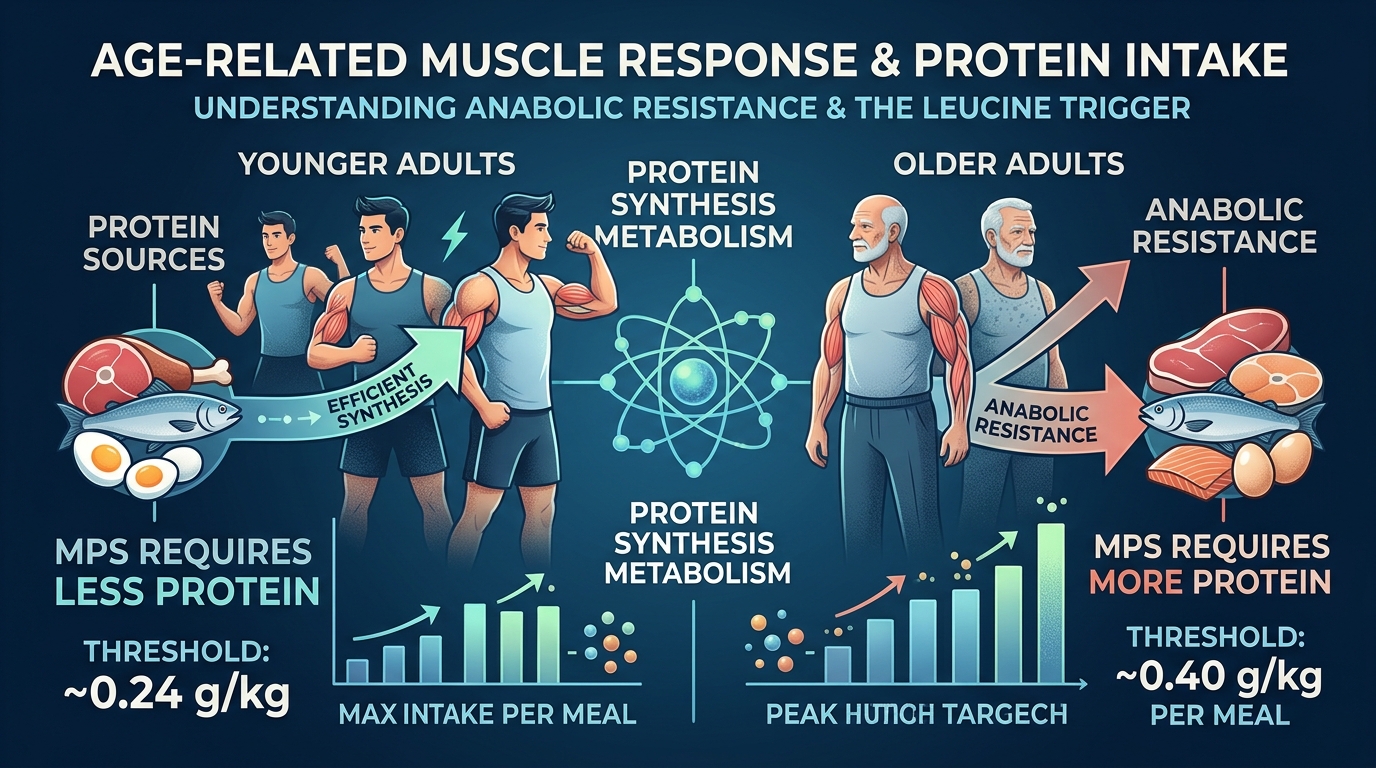
An important study quantifying this age-related shift in responsiveness is the research paper by Moore et al.. This study retrospectively analyzed data measuring myofibrillar protein synthesis (MPS) following a single bolus ingestion of 0–40g of high-quality animal protein in healthy older men (average ~71 years) and younger men (average ~22 years).
The results showed no significant difference in basal MPS rates between the two groups. However, the dose-response analysis indicated a rightward shift in the estimated protein intake required to maximize MPS in the older group. Although the difference in the body-weight-based breakpoint did not reach conventional statistical significance (p = .055), a significant difference was observed when protein intake was expressed relative to lean body mass (p < .01).
Key Estimates from Moore et al.’s Study
- Estimated breakpoint for maximizing MPS in younger men: Approximately 0.24 g/kg of body weight .
- Estimated breakpoint for maximizing MPS in older men: Approximately 0.40 g/kg of body weight (The group comparison relative to body weight was p = .055, which did not reach conventional statistical significance. Conversely, when expressed relative to lean body mass, significant differences were observed, with 0.60 g/kg for older men and 0.25 g/kg for younger men).
- Estimated peak MPS values: Approximately 0.056 %/h for older men and 0.058 %/h for younger men, showing virtually no difference in the maximum values themselves.
This study is based on acute MPS measurements from men averaging roughly 71 and 22 years of age, and these exact numerical values have not been proven to directly apply to an individual like myself at age 56. Additionally, because it evaluated acute synthetic responses following a single bolus ingestion, it does not prove that long-term continuous intake directly increases actual muscle mass or strength.
How Much Protein is Needed Per Meal?
Based on the aforementioned research findings and related reviews, we can deduce guidelines for how much protein to target per meal or protein serving. However, since requirements vary by age and physique, treating any single number as an absolute rule should be avoided.
The table below organizes the research-based estimates and practical guidelines:
| Target / Category | Estimated Protein Intake Per Meal | Equivalent for 64kg Body Weight | Basis / Positioning |
| Younger Men | Approx. 0.24 g/kg | Approx. 15 g | Estimated value from Moore et al.’s acute MPS study |
| Older Men | Approx. 0.40 g/kg | Approx. 26 g | Estimated value from Moore et al.’s acute MPS study |
| Practical Guidelines for Older Adults | Approx. 25–30 g | Approx. 25–30 g | Practical benchmarks from reviews such as PROT-AGE |
Regarding the question of “from what age one should consume more protein,” recommendations such as PROT-AGE primarily target individuals over 65. Age 65 is not a sudden physiological cutoff line, and physical changes associated with aging involve substantial individual variation. Therefore, reviewing one’s dietary habits and physical activity levels starting from one’s 50s to be conscious of nutrient distribution holds substantial value.
How Much Total Daily Protein Intake is Needed?
In addition to per-meal intake, securing total daily intake is equally important. On this matter, the evidence-based position paper by the PROT-AGE Study Group is widely recognized. Furthermore, domestically in Japan, official standards are established by the Ministry of Health, Labour and Welfare’s Dietary Reference Intakes for Japanese (2025 Edition).
Accounting for these, the table below organizes Japanese dietary reference values alongside PROT-AGE recommendations:
| Category / Target | Recommended Dietary Allowance (RDA) / Intake Recommendation | Positioning / Application Criteria |
| Dietary Reference Intakes for Japanese (2025 Edition) | Men 18–64 yrs: 65 g/day, Men 65+ yrs: 60 g/day, Women 18–64 yrs: 50 g/day, Women 65+ yrs: 50 g/day | Official national intake standards established by the MHLW |
| International Adult Standard Example | 0.8 g/kg/day | International general adult comparison benchmark / traditional recommendation |
| Healthy Older Adults (65+ yrs) | 1.0–1.2 g/kg/day | Core recommendation by PROT-AGE |
| Active Older Adults | 1.2 g/kg/day or more | Recommendations for older adults with exercise habits |
| Older Adults with Acute/Chronic Illness | 1.2–1.5 g/kg/day | Cases requiring adjustments based on pathology or recovery phases |
| Severe Illness / Marked Malnutrition | May require around 2.0 g/kg/day depending on individual status | Cases requiring indispensable individualized medical and nutritional management |
Note: The figure of 0.8 g/kg/day cited here is an example of international adult standards and is not the official recommendation figure of Japan’s 2025 edition. Moreover, these recommendations aim at health maintenance and recovery and do not represent absolute requirements universally applicable to every individual. In particular, individuals with severe kidney disease (eGFR below 30 mL/min/1.73 m²) who are not receiving dialysis may need to restrict protein intake. Their intake should be adjusted under appropriate medical and nutritional supervision.
For reference, based on my own body weight (64kg), let’s convert total daily amounts using several coefficients:
- At 0.8 g/kg: Approx. 51.2 g
- At 1.0 g/kg: 64.0 g
- At 1.2 g/kg: Approx. 76.8 g
- At 1.4 g/kg: Approx. 89.6 g
- At 1.5 g/kg: 96.0 g
Furthermore, the International Society of Sports Nutrition (ISSN) position stand on single-stage ultramarathon training and racing cites approximately 1.6 g/kg/day as a protein intake level for maintaining lean mass and supporting recovery. Its discussion also describes a broader range of approximately 1.6–2.1 g/kg/day for athletes undertaking chronic endurance training, with higher intakes potentially warranted during particularly demanding training periods. Because these recommendations address the specific demands of endurance training, they should be considered separately from recommendations for the general older population.
Leucine Triggers: Quality Matters Alongside Quantity
Beyond the “quantity” of protein, its “quality”—specifically its amino acid composition—dictates the efficiency of muscle protein synthesis. Leucine, one of the essential amino acids, plays a vital role in triggering muscle protein synthesis via intracellular signaling pathways such as mTORC1.
For details on leucine and past discussions, please refer to the related article below:
What requires attention here is that “consuming large amounts of leucine alone does not synthesize muscle by itself.” Actual muscle protein synthesis requires not only leucine as a “signal (trigger),” but also other essential amino acids serving as “materials (building blocks).”
PROT-AGE and other insights suggest that older adult diets should secure high-quality protein (approx. 25–30g of total protein) containing roughly 2.5–2.8g of leucine per serving. Whey protein and similar options feature relatively high leucine content and offer the advantage of efficient amino acid delivery. Therefore, instead of relying solely on isolated leucine amounts, a perspective that combines total protein and essential amino acid balance is required.
How Exercise Affects Anabolic Resistance
Beyond nutrition, physical activity and muscle contraction status profoundly influence muscular metabolic responses. Exercise stimuli, such as resistance training, powerfully stimulate muscle protein synthesis on their own.
In a study involving 10 healthy older adults (mean age approximately 72 years), Breen et al. (2013) reduced participants’ daily step counts by approximately 76%, to an average of about 1,413 steps per day, over 14 days. This intervention resulted in an approximate 3.9% reduction in leg lean mass and a roughly 26% decline in postprandial MPS responses. This study is important data showing that a reduction in routine physical activity affects muscle protein metabolism, though it does not imply that slightly reduced steps in ordinary life will yield identical outcomes.
Furthermore, a systematic review by Shad et al. (2016) examining studies combining exercise with amino acid/protein intake demonstrated that pairing appropriate exercise stimuli with nutrition tends to narrow the gap in MPS responses seen between younger and older individuals. In other words, exercise and protein intake act synergistically, functioning as dual wheels supporting muscle maintenance and adaptation.
However, exercising does not mean age-related anabolic resistance can be completely eradicated. The degree of response improvement depends on various conditions, such as the volume and intensity of exercise performed, as well as the amounts of protein and leucine ingested. Aerobic exercise is also indispensable for cardiovascular health and endurance improvements, but it possesses distinct stimulus characteristics compared to resistance training. Even for endurance athletes, the significance of intentionally incorporating strength training lies right here.
Perspectives on Post-Workout EAA Intake
I personally consume EAA post-workout, and the physiological positioning of this habit also warrants organization.
EAA is useful as a means to directly supply essential amino acids. However, as mentioned earlier, EAA gram weights cannot be compared on the exact same baseline as regular dietary protein. They must be evaluated after confirming the leucine content and amino acid formulation of the specific product.
Regarding post-workout protein intake amounts, response dynamics may also differ between younger and older adults. While Churchward-Venne et al.’s review discusses that amounts around 40g could serve as an effective stimulus in the context of post-resistance exercise MPS for older adults, this is primarily based on a context targeting post-resistance exercise MPS in older populations. It does not mean that 40g is uniformly necessary after every endurance training session.
A recent systematic review and meta-analysis on protein and amino acid intake at breakfast (Ikeda et al., 2026, covering 7 RCTs and 305 participants) evaluated that while no significant improvements in muscle mass or strength were confirmed from protein/amino acid intake at breakfast, the certainty of evidence included in the studies was low or very low. Consequently, we should not hastily jump to the conclusion that “consuming protein at breakfast is meaningless.” Adding protein to breakfast versus maintaining total daily intake while redesigning inter-meal distribution should be approached as distinct strategies.
How to Reflect This in Actual Dietary Habits
Based on these scientific insights, let us consider how to translate them into daily dietary habits. For example, using my body weight (64kg) as a baseline, if we distribute daily protein while keeping recommended per-meal benchmarks in mind, a single model allocation looks like this:
| Meal Timing | Target Protein Intake Example |
| Breakfast | 25–30 g |
| Lunch | 25–30 g |
| Dinner | 25–30 g |
| Daily Total | 75–90 g |
This is merely one balanced example, and it does not mean everyone must rigidly divide three meals evenly. For instance, individuals whose breakfast tends to lack protein can utilize protein powder, eggs, or dairy products to effectively supplement a solid amount in a single sitting.
Adding protein to breakfast does not automatically guarantee long-term muscle mass gains on its own. It only gains meaning when combined with total daily intake, overall nutritional balance across meals, and daily training habits.
Conclusion
Age-related physiological shifts in muscle are not simply a matter of “muscles weakening and losing their ability to synthesize protein.” Muscles fundamentally maintain a robust capacity to respond to appropriate nutritional and exercise stimuli.
However, the thresholds and quantities of stimuli required to elicit those responses may change with age. Precisely because of this, as we age, rather than obsessing solely over “total daily protein,” it becomes vital to comprehensively review the following elements:
- Adequate per-meal intake (targeting around 0.4 g/kg or 25–30g as a benchmark)
- Reliable supply of essential amino acids including leucine
- Appropriate distribution across meals
- Continued appropriate exercise and loading on muscles
For me personally, this served as a wonderful catalyst to review my previous dietary habit of “thinking I was eating enough,” allowing me to redesign my morning protein intake and overall meal distribution. To continue endurance training long-term and enhance performance, I want to carefully review my daily nutrition and training strategies from the dual perspectives of improving endurance and maintaining/recovering my physical body.
References
- Moore DR, et al. (2015). Protein Ingestion to Stimulate Myofibrillar Protein Synthesis Requires Greater Relative Protein Intakes in Healthy Older Versus Younger Men. The Journals of Gerontology: Series A, 70(1), 57–62. PMID: 25056502
- Bauer J, et al. (2013). Evidence-Based Recommendations for Optimal Dietary Protein Intake in Older People: A Position Paper From the PROT-AGE Study Group. Journal of the American Medical Directors Association, 14(8), 542–559. PMID: 23867520
- Tiller NB, et al. (2019). International Society of Sports Nutrition Position Stand: nutritional considerations for single-stage ultra-marathon training and racing. Journal of the International Society of Sports Nutrition, 16(1), 50. PMID: 31699159
- Shad BJ, Thompson JL, Breen L. (2016). Does the muscle protein synthetic response to exercise and amino acid-based nutrition diminish with advancing age? A systematic review. American Journal of Physiology-Endocrinology and Metabolism, 311(5), E803–E817. PMID: 27555299
- Breen L, et al. (2013). Two weeks of reduced activity decreases leg lean mass and induces “anabolic resistance” of myofibrillar protein synthesis in healthy elderly. The Journal of Clinical Endocrinology & Metabolism, 98(6), 2604–2612. PMID: 23589526
- Churchward-Venne TA, et al. (2016). What is the Optimal Amount of Protein to Support Post-Exercise Skeletal Muscle Reconditioning in the Older Adult? Sports Medicine, 46(9), 1205–1212. PMID: 26894275
- Ikeda T, et al. (2026). Protein or Amino Acid Intake at Breakfast for Muscle Mass Gain in Older Adults: A Systematic Review and Meta-Analysis. Food Science & Nutrition, 14(7), e72171. PMID: 42502805

コメント