
“Exercise is good for your body.”
Everybody knows this. But if asked why it is good, how many people can give a precise answer?
Many might reply, “To burn calories, lose fat, or build up stamina.” That is because muscle was long viewed merely as a locomotor organ serving only to support the skeleton and enable movement.
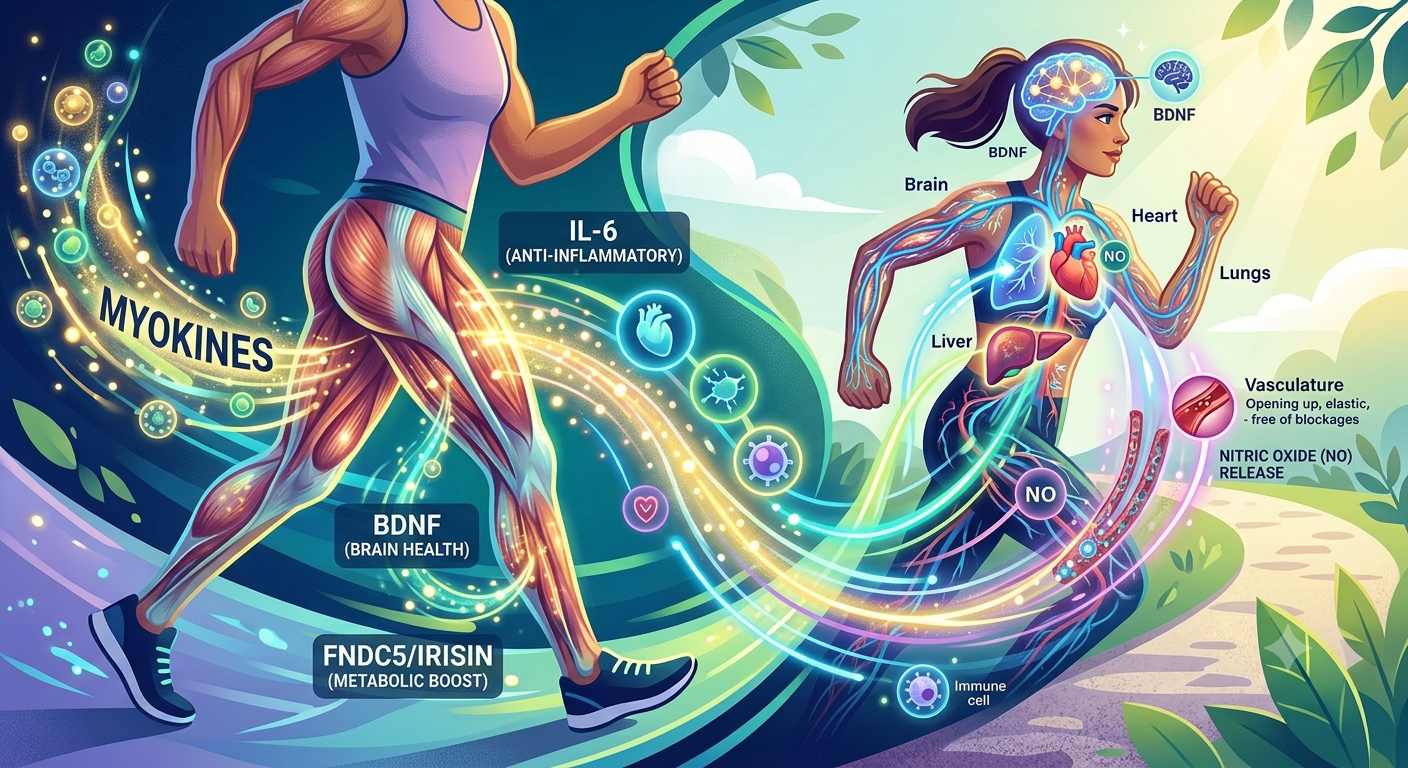
However, medical research has revealed another remarkable function of skeletal muscle: it is not merely an organ of movement but also an active signaling organ.
- Chapter 1: When Muscles Move, They Send Messages to the Whole Body
- Chapter 2: “Myokines” and the Orchestration of Exercise Signals
- Chapter 3: Just 10 Minutes of Movement Shifts Your Blood Environment
- Chapter 4: Does Walking Alone Still Make a Difference?
- Chapter 5: What Should Middle-Aged and Older Adults Do?
- Chapter 6: My Perspective as a 56-Year-Old Practitioner
- Summary
- References
Chapter 1: When Muscles Move, They Send Messages to the Whole Body
When we move our bodies and contract our muscles, more is happening beneath the surface than mere energy consumption. Contracting skeletal muscle releases myokines and other signaling molecules. At the same time, exercise alters blood flow and creates mechanical stimuli within blood vessels, triggering additional physiological responses.
Muscles contract
↓
Release of myokines and other signaling molecules, alongside exercise-induced blood flow and vascular changes
↓
Circulation throughout the body, reaching key organs (brain, blood vessels, adipose tissue, liver, etc.)
↓
Target organs adapt to their environment and begin optimizing bodily functions
To be clear, exercise is not a pharmaceutical drug in the literal sense.
Yet, exercise is often described as “medicine” because a single stimulus—moving the body—can influence multiple physiological systems, including glucose regulation, vascular function, inflammation, and brain health.
This framework is built upon the landmark paradigm introduced by Professor Bente Pedersen and colleagues, who defined skeletal muscle as an endocrine organ.
Exercising is not about purchasing medication from the outside; it is an act of stimulating a complex network of physiological responses within your own body, helping regulate multiple systems without the need for an external drug.
Chapter 2: “Myokines” and the Orchestration of Exercise Signals
Among the diverse signals emitted by contracting muscles, researchers worldwide are paying particular attention to a group of substances known as “Myokines.”
Myokines are signaling molecules, primarily proteins and peptides, produced and released by skeletal muscle cells. They can act locally on muscle tissue itself or communicate with distant organs through the bloodstream. The term combines myo, meaning muscle, with cytokine, reflecting its role as a signaling molecule.
It may come as a surprise to learn that such molecules are produced within your muscles, with their production and release modulated by physical activity.
Crucially, the health benefits of exercise do not stem from myokines working in isolation. Rather, myokines, metabolic intermediates (such as lactate), and hemodynamic shifts act as a synchronized team to deliver these messages throughout the body.
Specifically, exercise initiates a cascade of vital physiological responses:
- Modulating Immune and Metabolic Responses (Myokines such as IL-6)
During exercise, contracting muscles release IL-6, a myokine that plays an important role in metabolic and immune regulation. In the context of acute exercise, IL-6 can stimulate the production of anti-inflammatory mediators such as IL-1ra and IL-10, while helping regulate inflammatory responses. - Reinforcing Vascular Function (Increased Blood Flow & NO)
As blood flow increases during exercise, mechanical shear stress stimulates endothelial cells lining the blood vessels. This activates endothelial nitric oxide synthase (eNOS), promoting the production of nitric oxide (NO), which helps relax blood vessels and improve vascular function. - Supporting Brain Function (Metabolic Signals & BDNF Regulation)
Exercise produces metabolic signals, including lactate, that may contribute to signaling pathways involved in brain function and BDNF regulation. Muscle-derived factors such as cathepsin B and irisin have also been investigated for their potential roles in muscle-brain communication, although the precise mechanisms in humans are not yet fully understood. - Flipping the Metabolic Switch (Direct Contraction Effects)
Muscle contractions stimulate the translocation of GLUT4 glucose transporters to the cell membrane through pathways that are partly independent of insulin. This increases glucose uptake by skeletal muscle and contributes to blood glucose regulation.
The moment muscles contract, these signal pathways shift dynamically, launching an active stream of physiological communication throughout the system.
Chapter 3: Just 10 Minutes of Movement Shifts Your Blood Environment
You might assume that unless you engage in hours of strenuous training, these benefits remain out of reach. However, the body’s physiological response occurs far more rapidly than most realize.
A particularly compelling line of research illustrates this rapid shift.
In a 2025 study published online in the International Journal of Cancer (2026 print edition), researchers asked 30 overweight or obese adults aged 50–78 to perform a maximal incremental cycling test lasting approximately 10–12 minutes.
Blood samples collected immediately after exercise were used to prepare serum, which was then applied to cultured colorectal cancer cells (LoVo cells) in the laboratory. The researchers found that, following exposure to post-exercise serum, irradiated LoVo cells showed faster DNA damage repair. The serum also altered gene-expression patterns, including changes in pathways associated with reduced cell proliferation.
To prevent any misunderstanding, this in vitro laboratory observation does not prove that short bouts of exercise halt cancer progression within the human body.
However, the fascinating takeaway is that a 10–12 minute bout of maximal cycling exercise can rapidly alter the circulating molecular environment. The resulting changes in exercise-conditioned serum were sufficient to influence DNA repair and gene-expression patterns in cultured colon cancer cells.
Even a brief bout of intense exercise can trigger measurable changes in the body’s circulating molecular environment.
Chapter 4: Does Walking Alone Still Make a Difference?
Does this mean you must hit the gym for intense workouts to reap any rewards? Not at all.
Even routine physical activities like walking yield substantial physiological benefits.
The major muscle groups of the body—such as the quadriceps, glutes, and calves—are concentrated in the lower body. Everyday movements like walking, standing, or climbing stairs repeatedly engage these massive muscle beds, promoting glucose uptake and boosting local and systemic circulation.
Naturally, as exercise intensity, duration, and mode vary, the resulting physiological responses change accordingly. The magnitude and pattern of these responses depend on several factors, including exercise intensity, duration, mode, muscle mass recruited, and training status. Not all signaling molecules respond in the same way.
Physical activity offers a spectrum of physiological benefits, with the nature and magnitude of those benefits varying according to the type, duration, and intensity of movement.
Chapter 5: What Should Middle-Aged and Older Adults Do?
How should one translate this science into daily action? There is no need to jump straight into exhausting routines. It is best to progress step by step at your own pace.
【The 5-Step Action Plan to Activate Your Body】
- Level 1: Avoid Prolonged Sitting
If you spend long hours sitting, make a habit of interrupting prolonged sitting with brief periods of standing or walking. Even light movement can help stimulate muscle activity and improve glucose regulation. - Level 2: Increase Daily Walking Time
Walk briskly during errands, commutes, or casual strolls. Take slightly longer strides or choose longer routes to naturally accumulate movement. - Level 3: Put Your Muscles to Work (Bodyweight Resistance Twice a Week)
Incorporate simple exercises like squats, stair climbing, or calf raises. Using your own body weight to apply mechanical resistance to your muscles is key—no gym membership required. - Level 4: Add Activities That Leave You Slightly Breathless
Adding activities such as brisk walking or uphill walking provides a greater cardiovascular stimulus and can promote further physiological adaptations. - Level 5: Transition into Sustained Sports (Running, Cycling, Swimming, etc.)
Activities such as running, cycling, and swimming allow you to engage large muscle groups and develop cardiovascular fitness while stimulating a wide range of exercise-related signaling responses.
You do not need to aim for Level 5 right away. The most sustainable shortcut is simply to stay mindful of Levels 1 and 2, steadily increasing the frequency with which your muscles are put to work.
Chapter 6: My Perspective as a 56-Year-Old Practitioner
I turned 56 this year.
People often view muscle as a form of “savings”—something to accumulate in youth and preserve against age-related decline for as long as possible. That is certainly an important aspect.
However, I believe another perspective is equally vital: Muscle is an asset, but it is also an organ that must be actively worked.
At 56, what I fear most is not a minor decrease in muscle mass itself. What I fear most is stopping the active use of my muscles.
Without regular physical activity, muscles lose many of the contraction-induced signaling responses that contribute to communication with other organs. They become a wasted asset.
This is why I do not view my daily running and cycling sessions merely as routines for “building stamina” or “managing body weight.” I view them as vital habits to regularly activate my muscle tissue, continuously signaling to my entire systemic network that we remain active.
Yet, for anyone in their 50s and beyond, there is one rule that overrides all others:
Never push through severe fatigue or injury just to chase exercise volume.
Exercise provides a remarkable stimulus, but it is also a form of stress that demands proper recovery. If you force yourself through pain and end up injuring a knee or lower back—sidelining yourself for months—you reduce the opportunities for your muscles to send these beneficial contraction-induced signals.
When fatigue accumulates, listen to your body and rest. Engage in a continuous dialogue with your physical frame, preventing injury so you can keep your muscles active over the long haul.
“Sustaining movement without breaking down” is far more valuable than “pushing to absolute exhaustion.” This, to me, is the single most crucial philosophy of self-care for the master’s athlete and aging body.
Summary
Exercise is not a grueling chore designed solely to burn off calories.
Walking. Standing. Climbing stairs. Squatting.
Muscle contractions trigger a variety of physiological signals. Some act locally within muscle tissue, while others travel through the bloodstream to influence distant organs. Together, these responses help the body adapt to physical activity and maintain physiological balance.
Leaving your muscles as passive “savings” without using them is a missed opportunity.
If you have been sitting for a long period today, stand up right now and stretch.
With that single, simple movement, your muscles will once again begin broadcasting powerful messages of health throughout your body.
References
- Pedersen BK, Febbraio MA. Muscles, exercise and obesity: skeletal muscle as a secretory organ. Nat Rev Endocrinol. 2012;8(8):457-465. PMID: 22473333.
- Severinsen MCK, Pedersen BK. Muscle-Organ Crosstalk: The Emerging Roles of Myokines. Endocr Rev. 2020;41(4):594-609. PMID: 32393961.
- Pedersen BK. Physical activity and muscle-brain crosstalk. Nat Rev Endocrinol. 2019;15(7):383-392. PMID: 30837717.
- Orange ST, et al. Exercise serum promotes DNA damage repair and remodels gene expression in colon cancer cells. Int J Cancer. 2026;158(10):2641-2649. PMID: 41387212.
コメント